 Land Reforms in India
Land Tenure Systems in Pre-Independence India
Before 1947, India had various types of land tenure systems imposed by the British colonial administration. The three major systems were:
Zamindari System (Permanent Settlement)
Introduced in Bengal by Lord Cornwallis in 1793.
Land revenue was collected through intermediaries called Zamindars.
Farmers had no ownership rights and were often exploited.
Ryotwari System
Practiced in parts of South India.
Farmers (ryots) paid revenue directly to the state but had insecure land rights.
Mahalwari System
Implemented in parts of North and Central India.
Revenue was collected from entire villages (mahals), often managed collectively.
These systems created inequality in land distribution, absentee landlordism, and peasant exploitation.
 Land Reforms in India
Need for Land Reforms
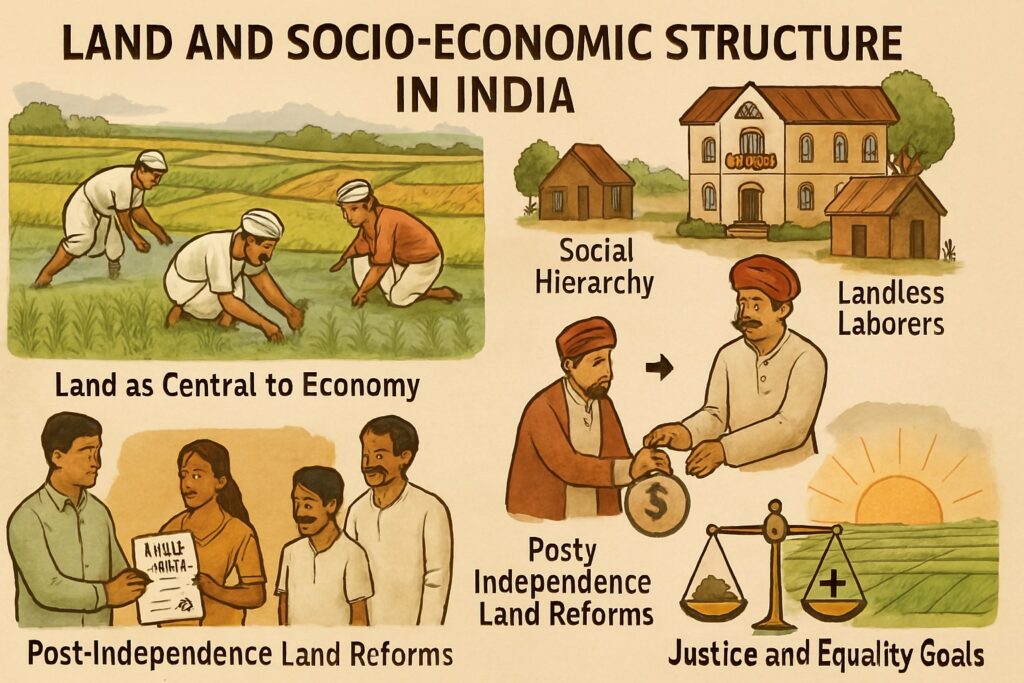
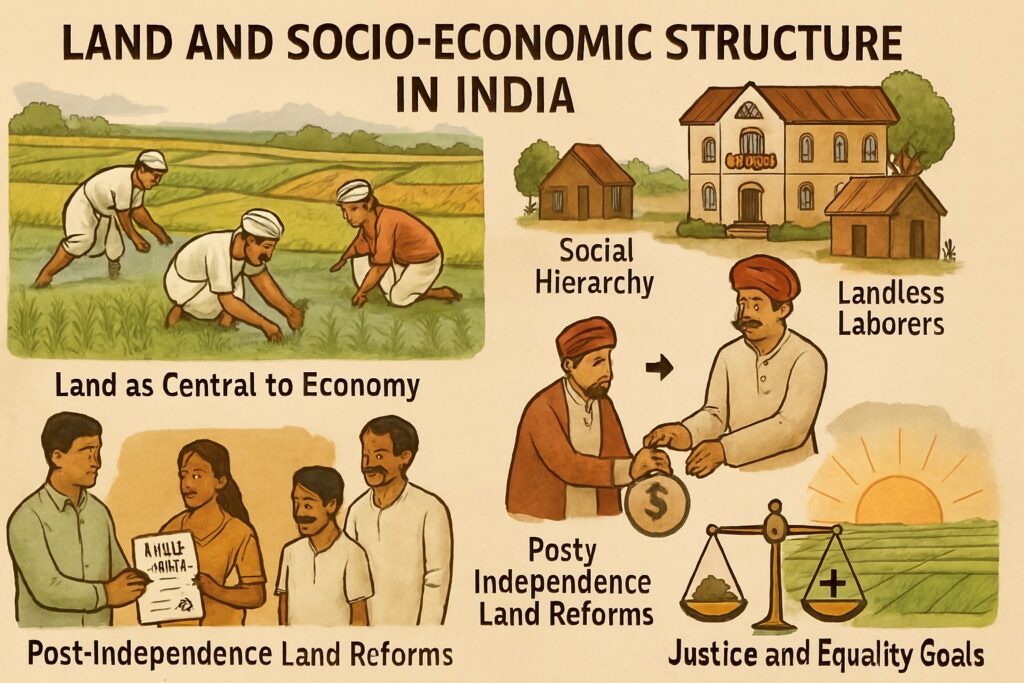
After independence, land reforms were seen as essential to:
Eliminate intermediaries.
Redistribute land to reduce inequality.
Improve agricultural productivity.
Provide security and dignity to cultivators.
Promote social justice in rural areas.
Major Components of Land Reforms in India
Abolition of Intermediaries
Laws were passed to remove Zamindars and other intermediaries.
Ownership rights were transferred to actual cultivators.
Benefited millions of tenants, though implementation varied across states.
Tenancy Reforms
Regulation of rent to prevent exploitation.
Security of tenure for tenants.
Provision for ownership rights to tenants (land-to-the-tiller principle).
Ceiling on Land Holdings
Imposed upper limits on how much land an individual could own.
Surplus land was to be redistributed among landless and marginal farmers.
Effectiveness was limited due to loopholes and poor enforcement.
Consolidation of Land Holdings
Aimed at merging fragmented land plots to improve efficiency.
Implementation was successful in states like Punjab, Haryana, and parts of Uttar Pradesh.
Land Records and Computerisation
Accurate land records are essential for reforms.
The government has taken initiatives to digitise and update land records to ensure transparency and reduce disputes.
Achievements of Land Reforms
Millions of tenants became landowners.
Intermediary landlordism was largely eliminated.
Social inequality reduced in some areas.
Consolidation of land helped increase productivity in certain states.
Challenges and Limitations
Inefficient implementation due to lack of political will.
Strong resistance from powerful land-owning classes.
Manipulation of land records and evasion of ceiling laws.
Lack of updated and accurate land data.
Land reforms largely bypassed in tribal and backward regions.
Recent Initiatives and the Way Forward
Digital India Land Records Modernization Programme (DILRMP) aims to digitize land records and improve transparency.
Emphasis on land leasing reforms to allow flexible land use and investment.
Focus on women’s land rights to ensure gender equity in ownership.
Promotion of land pooling models for urban development.
Conclusion
Land tenure and land reforms have played a crucial role in transforming rural India. While the abolition of intermediaries and tenancy reforms brought some success, the full potential of land reforms remains unrealized due to uneven implementation. Moving forward, comprehensive reforms backed by political commitment, technological support, and community participation are essential to ensure equitable access to land, boost agricultural productivity, and promote rural development in India.
Read: Geography Notes