Mackinder’s Heartland Theory
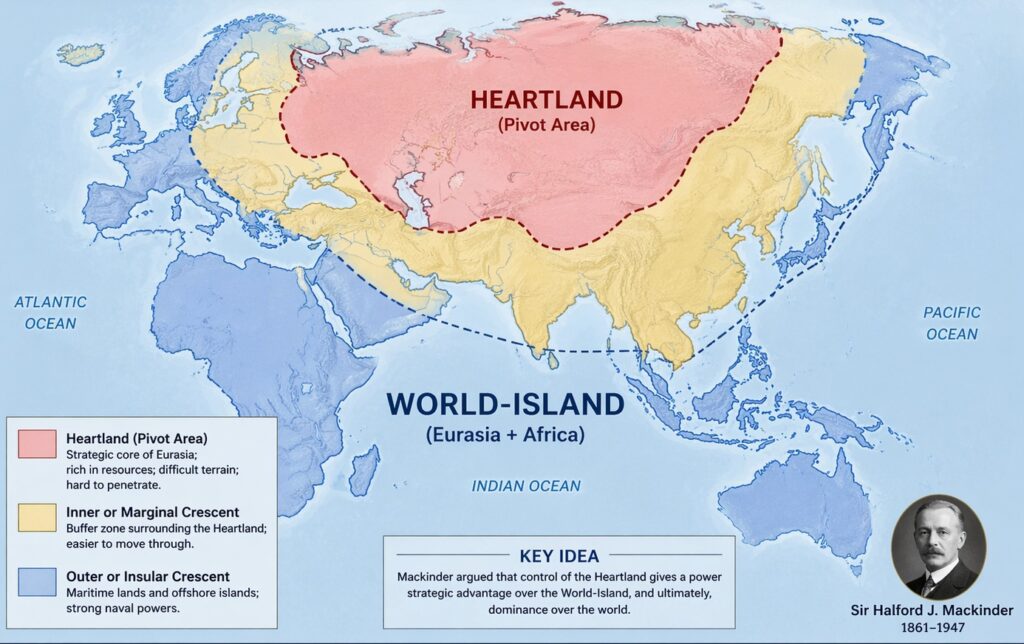
The Heartland theory was proposed by British geographer Halford Mackinder in his famous paper 'The Geographical Pivot of History' in 1904. He observed that global politics is a struggle between land power (controlling landmass) and sea power (controlling sea) and ultimate victory would belong to the continental power.
At its core, the theory argues that control of Eurasia’s “Heartland” is the key to global dominance.
"Who rules East Europe commands the Heartland!
Who rules Heartland commands the world island!
Who rules the world island commands the world!"
He divided the world into: Continuous Land Mass and Isolated Islands. According to the theory, the State Commanding the Heartland would Rule the World.
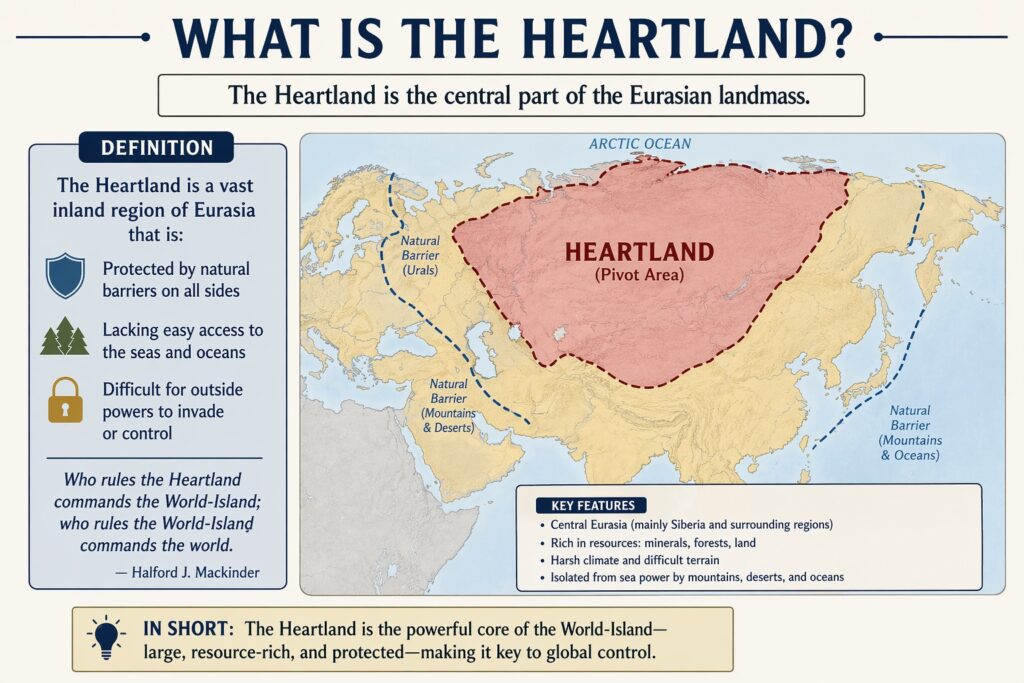 What is Heartland
Why the Heartland was so important?
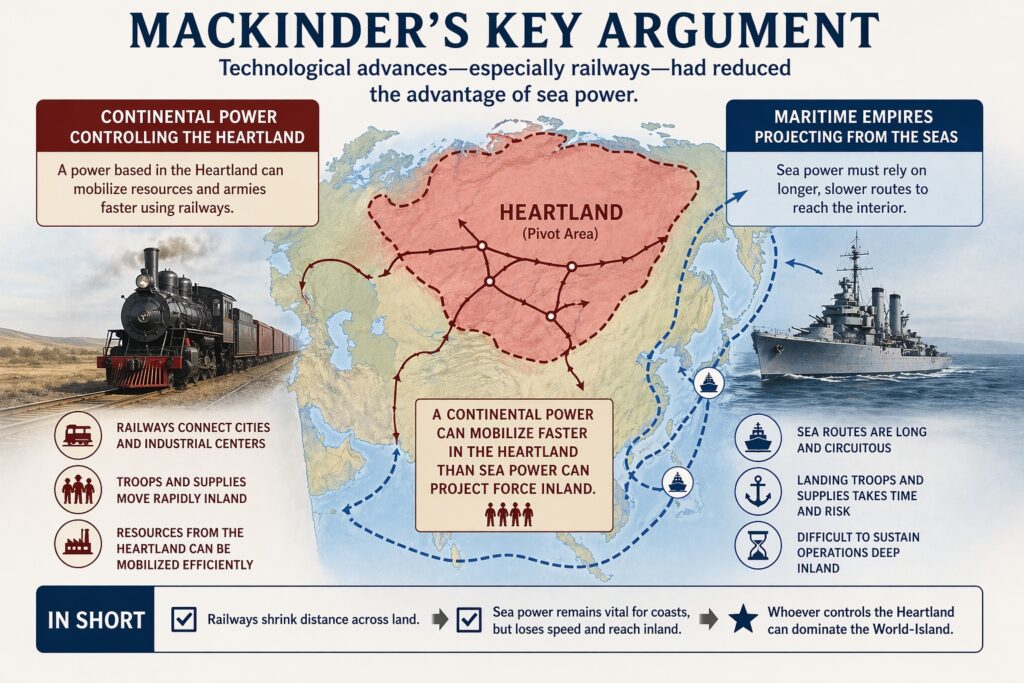
Mackinder argued that technological advances, especially railways, had reduced the advantage of sea power. A continental power controlling the Heartland could mobilize resources and armies faster than maritime empires could project force inland. It cannot be accessed easily by sea routes due to natural barriers. It contains vast natural resources.
- The World-Island: Europe, Asia, and Africa — the largest, most resource-rich landmass.
- The Heartland: Central Eurasia, stretching from the Volga to the Yangtze, from the Arctic to the Himalayas.
- Offshore Islands: Britain, Japan.
- Outlying Islands: The Americas and Australia.
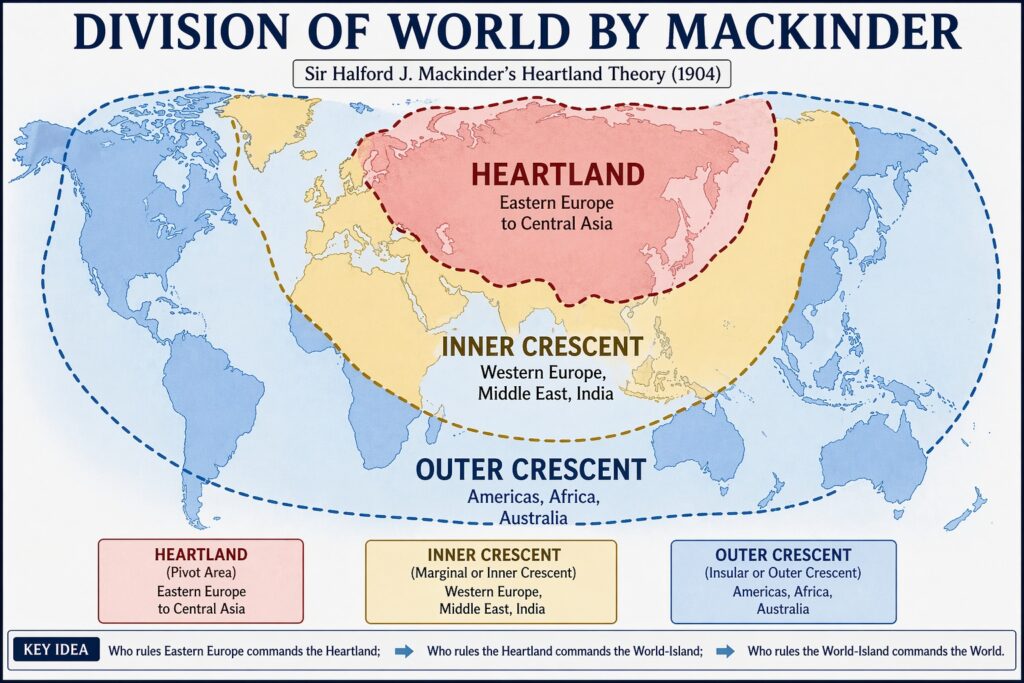
Division of World by Mackinder
- Heartland: Eastern Europe to Central Asia.
- Inner Crescent: Western Europe, Middle East, India.
- Outer Crescent: Americas, Africa, Australia.
Applications of Heartland Theory
- Military Strategy: Cold War containment policies.
- Economic Development: Infrastructure and resource control.
- Geopolitical Analysis: Global power structure understanding.
- Energy Security: Oil and gas importance.
Criticism of the Theory
- Oversimplification: Ignores cultural and economic factors.
- Historical Bias: Based on early 20th century world.
- Ignoring Rimland: Coastal regions also important.
- Inaccurate Predictions: Soviet dominance did not fully occur.
- Technology Factor: Modern weapons reduce geography importance.
Rimland Theory
The Rimland Theory was proposed by Nicholas Spykman and focuses on coastal regions as key to global power.
Who controls the Rimland, rules Eurasia!
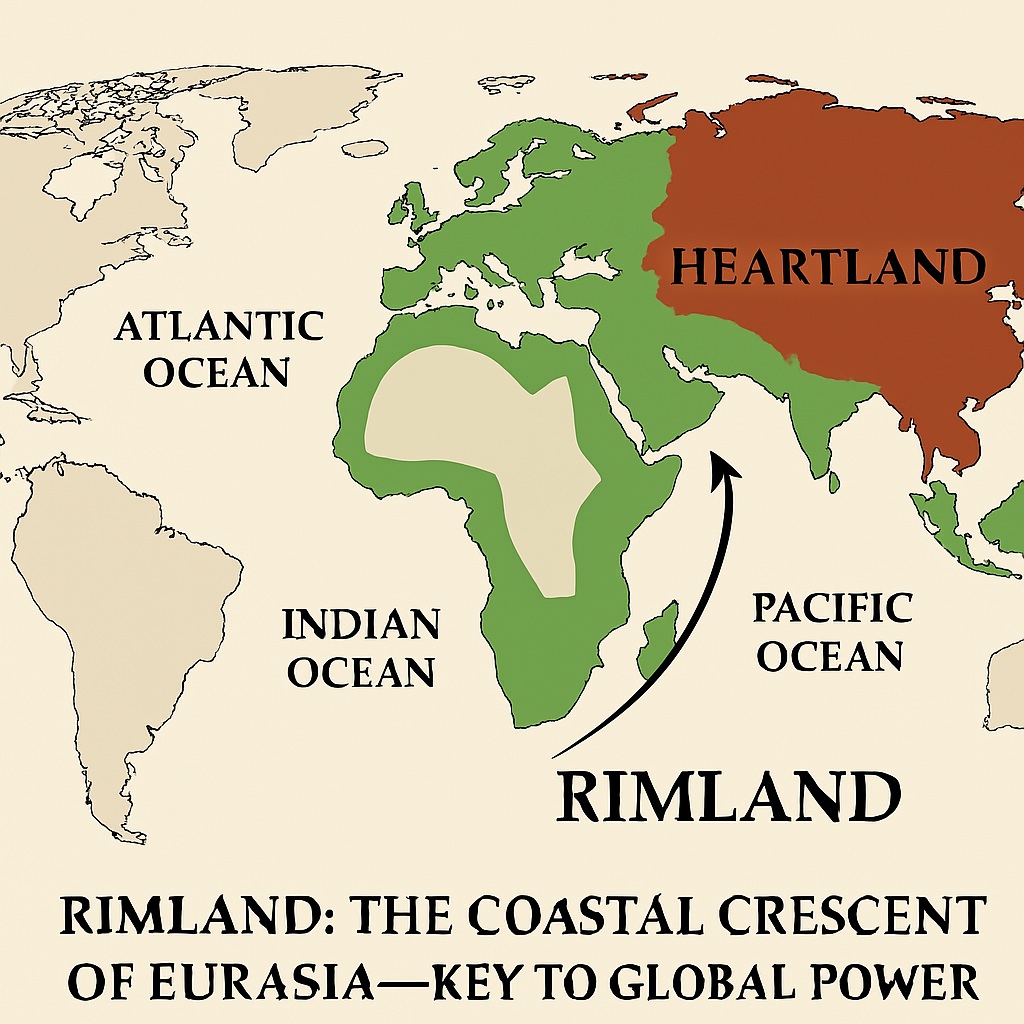
Differences Between Heartland and Rimland Theories
| Aspect | Heartland Theory | Rimland Theory |
|---|---|---|
| Focus | Interior Eurasia | Coastal regions |
| Theorist | Halford Mackinder | Nicholas Spykman |
| Strategy | Land power dominance | Sea power dominance |
Conclusion
Both theories are important in understanding global geopolitics, though modern technology and globalization have changed their relevance.
Read: Geography Notes