Five Year Plans in India are a series of social and economic development plans implemented by the Government of India. Formulated for five-year periods, they aimed to achieve specific objectives related to the growth of the Indian economy. In this blog, we discuss the history, objectives, achievements, and criticisms of the Five Year Plans in India.
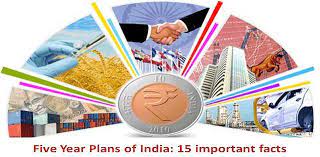
History of Five Year Plans in India
- Inception: The First Five Year Plan was launched in 1951 under the leadership of Jawaharlal Nehru, marking the beginning of planned economic development in independent India.
- Twelve Plans: Since then, India implemented twelve Five Year Plans, with the last being the Twelfth Five Year Plan, which ended in 2017.
- Plan Holiday: Between 1966 and 1969, a "plan holiday" was declared due to war and drought, during which annual plans were implemented instead.
- End of the Era: Following the replacement of the Planning Commission by NITI Aayog in 2015, the traditional Five Year Plan system was eventually discontinued after the Twelfth Plan.
Objectives of Five Year Plans in India
The Five Year Plans were designed to achieve specific objectives related to economic growth, social development, and poverty alleviation. The objectives of each plan varied based on the prevailing economic conditions and the priorities of the government at the time. Some of the key objectives included:
- Increasing agricultural production to ensure food security.
- Developing infrastructure across rural and urban India.
- Promoting industrialization to build a self-reliant economy.
- Reducing poverty and generating gainful employment.
Achievements of Five Year Plans in India
- Infrastructure Boost: The plans helped improve the country's infrastructure, from power and irrigation to transport and communication networks.
- Agricultural & Industrial Growth: They significantly increased agricultural production and promoted industrialization across sectors.
- Social Progress: The plans led to marked improvements in social indicators, including literacy rates, life expectancy, and access to basic healthcare.
Criticisms of Five Year Plans in India
- Quantitative Bias: The plans' focus on quantitative targets often led to a neglect of quality concerns in implementation.
- Inequality & Poverty: They have been criticized for their failure to adequately address issues related to income inequality and poverty.
- Implementation Gaps: Weak execution, bureaucratic delays, and inefficient resource allocation limited the intended outcomes of several plans.
The Twelve Five Year Plans at a Glance
| Plan | Period | Key Priorities & Focus Areas |
|---|---|---|
| First FYP | 1951–1956 | Agriculture and land reform, community development, power & irrigation, transport & communication, basic industries, education & healthcare. |
| Second FYP | 1956–1961 | Rapid industrialization, promotion of public sector enterprises, agricultural growth, community development, expansion of transport & communication. |
| Third FYP | 1961–1966 | Expansion of heavy industries, import substitution, agricultural modernization, rural infrastructure, family planning & population control. |
| Fourth FYP | 1969–1974 | Growth with stability, employment generation, agricultural growth, modernization of industries, poverty alleviation. |
| Fifth FYP | 1974–1979 | Removal of poverty and unemployment, modernization of industries, agricultural growth, expansion of social services, rural electrification. |
| Sixth FYP | 1980–1985 | Rural development, increase in food production, stabilization of prices, employment generation, infrastructure development. |
| Seventh FYP | 1985–1990 | Increasing productivity, modernization of industries, infrastructure development, employment generation, growth of exports. |
| Eighth FYP | 1992–1997 | Human resource development, increasing productivity, poverty alleviation, infrastructure development, agriculture & rural industries. |
| Ninth FYP | 1997–2002 | Growth with social justice, poverty alleviation, infrastructure development, employment generation, agricultural development. |
| Tenth FYP | 2002–2007 | Accelerated economic growth, employment generation, infrastructure development, agricultural development, regional development. |
| Eleventh FYP | 2007–2012 | Inclusive growth, infrastructure development, skill development & employment, environmental sustainability, rural development. |
| Twelfth FYP | 2012–2017 | Faster, sustainable and more inclusive growth, infrastructure development, governance reforms, skill development, environmental sustainability. |
Concluding Remarks
The Five Year Plans in India have played a critical role in India's economic and social development, achieving significant successes in infrastructure, agricultural production, and industrialization. However, they also faced criticisms, particularly regarding quality concerns, income inequality, and poverty alleviation. While the era of centralized Five Year Plans has concluded, they have left a lasting impact on the country's development trajectory.