Precipitation describes all forms of water falling from the atmosphere to the Earth's surface, including rain, snow, sleet, and hail. It plays a critical role in the global water cycle, sustaining life and shaping regional climates.
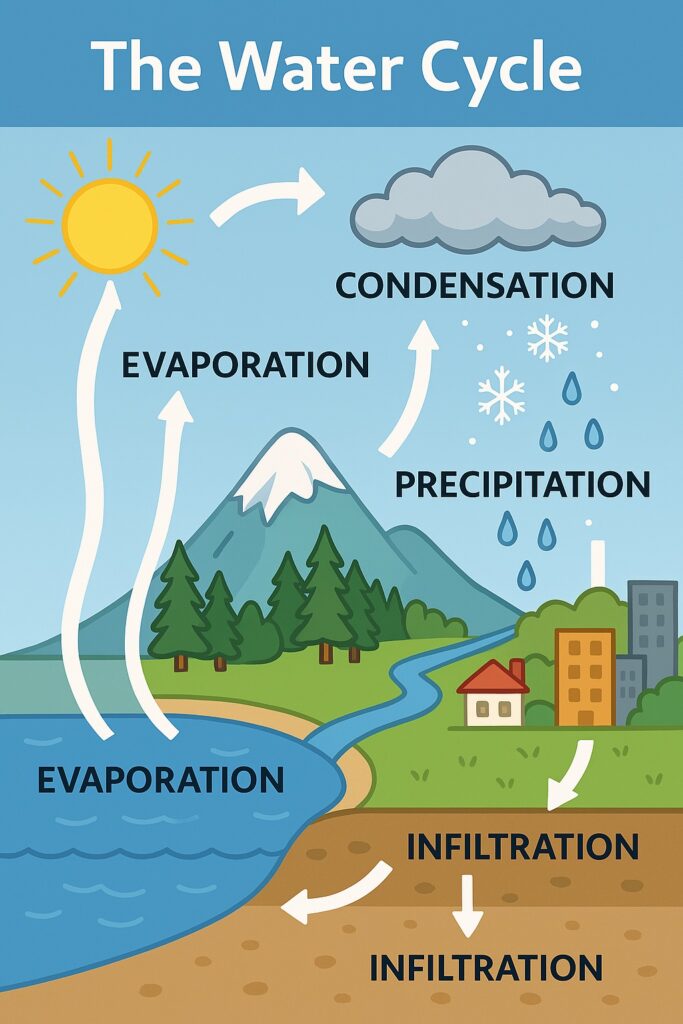
Types of Precipitation
- Rain: Water droplets combining to form larger droplets falling from clouds.
- Snow: Ice crystals falling from clouds, common in cold climates.
- Sleet: Raindrops freezing in the atmosphere before reaching the ground into small ice balls.
- Hail: Precipitation frozen into solid balls of ice within thunderstorm clouds.
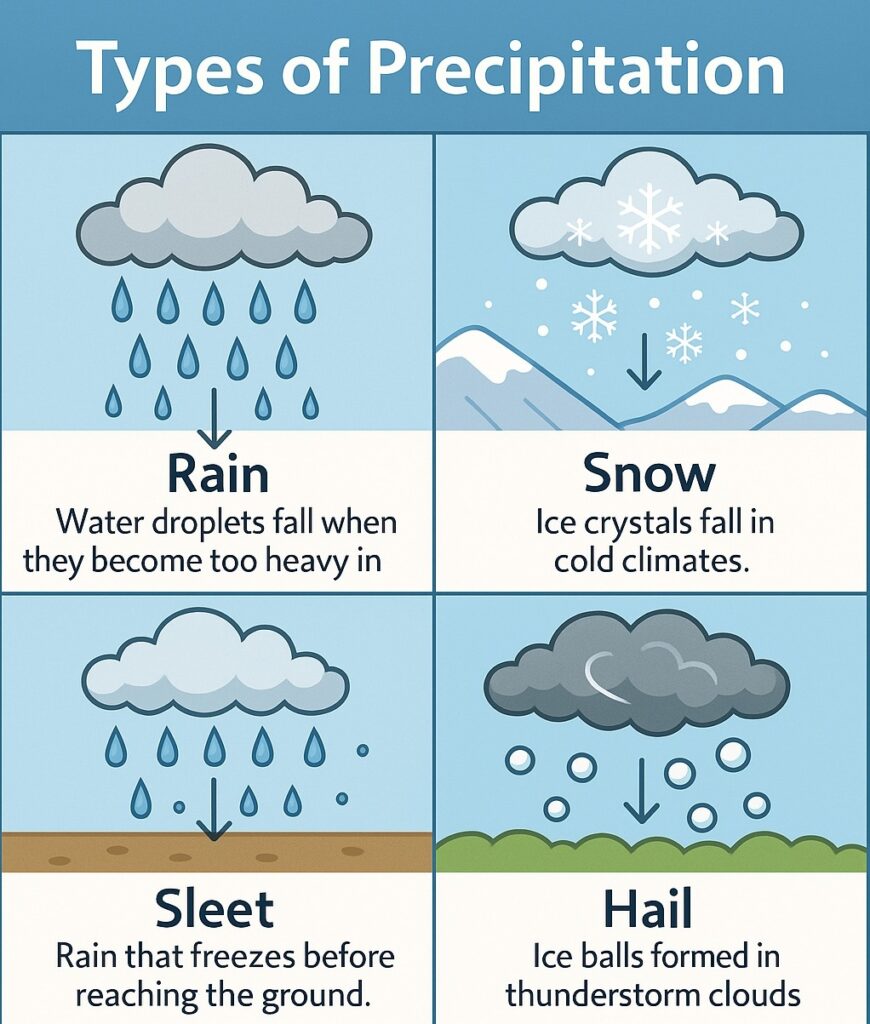
The Role of Precipitation in the Water Cycle
Precipitation forms the core mechanism returning atmospheric moisture to the Earth's surface. Mathematically, the net hydrological balance over land areas can be expressed as:
$$P = E + R + \Delta S$$where \(P\) is precipitation, \(E\) is evapotranspiration, \(R\) is runoff, and \(\Delta S\) is change in water storage. Heavy precipitation can induce severe flooding, whereas deficits cause prolonged drought conditions.
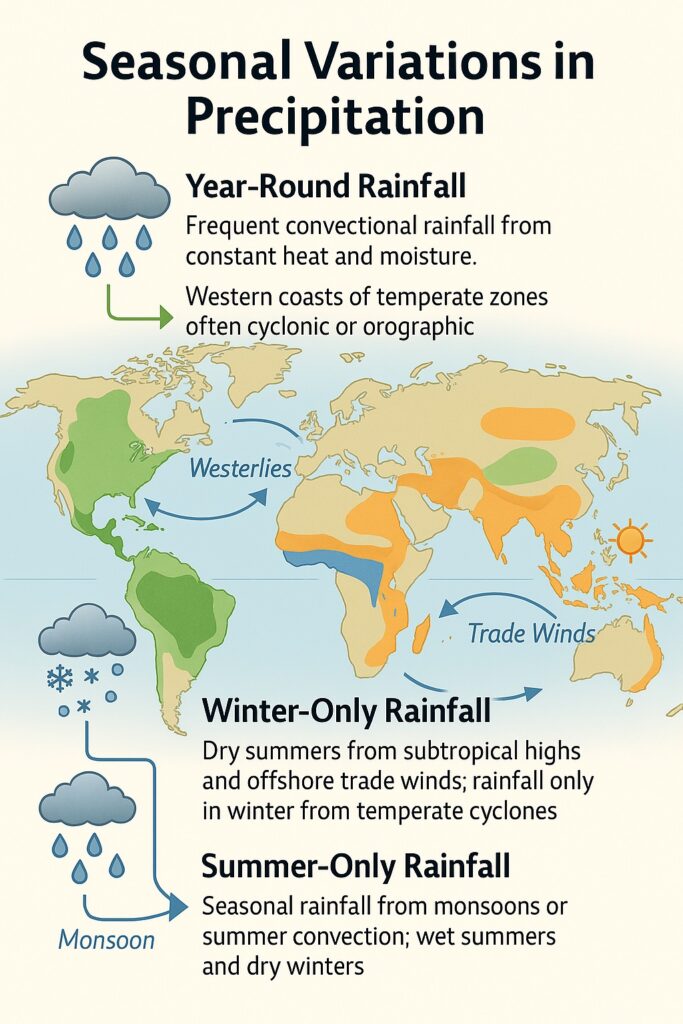
Seasonal Variations in Precipitation
- Year-Round Rainfall: Equatorial regions experience frequent convectional rainfall due to intense heating. Western temperate coasts receive rain from westerlies.
- Winter-Only Rainfall: Characteristic of Mediterranean-type climates and India's Coromandel Coast.
- Summer-Only Rainfall: Prevalent across South and Southeast Asia driven by seasonal monsoon shifts.
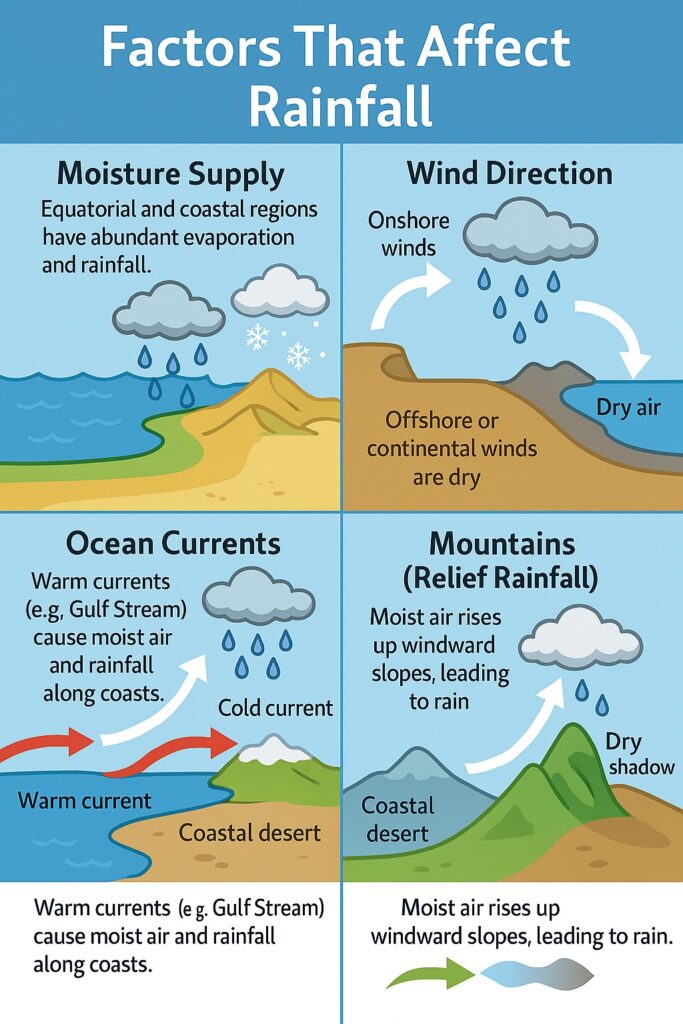
Factors That Affect Rainfall
- Moisture Supply: Higher evaporation rates over warm waters yield greater precipitation.
- Wind Direction: Sea-to-land winds carry moisture, while land-based winds are dry.
- Ocean Currents: Warm currents enhance precipitation, whereas cold currents suppress it.
- Topography (Mountains): Forced orographic uplift produces heavy windward rain and dry leeward rain shadows.
Distribution of Rainfall in the World
Global rainfall distribution is dictated by atmospheric circulation cells, latitude, and topography:
- Precipitation is highest near the equator and decreases toward the poles.
- Coastal regions receive more rainfall than continental interiors.
- Wettest zones include the Amazon Rainforest, Central Africa, and Southeast Asia.
- Driest regions include the Sahara, Atacama, and Australian deserts due to subtropical high-pressure dominance.
Distribution of Rainfall in India
India's rainfall is heavily dictated by the southwest monsoon season (June to September).

- High Rainfall Zones: Western coast (Maharashtra, Goa, Kerala) and northeastern states (Assam, Meghalaya) receive heavy monsoon downpours.
- Arid/Semi-Arid Zones: Northwestern India (Rajasthan, parts of Gujarat) experiences low annual rainfall.
- Variability: States like Tamil Nadu experience erratic rainfall patterns, remaining prone to both floods and droughts.
Conclusion
Precipitation is vital for sustaining life and driving the global water cycle. Understanding its varied types and geographical distribution is essential for hazard preparedness, agricultural planning, and water resource management.