Rainfall is a vital component of the Earth's water cycle, providing water for plants, animals, and human consumption. Rainfall occurs in various forms, ranging from light drizzle to heavy downpours. In this article, we will discuss the different types of rainfall — convectional, orographic, and cyclonic — and their unique characteristics and causes.
1. Convectional Rainfall
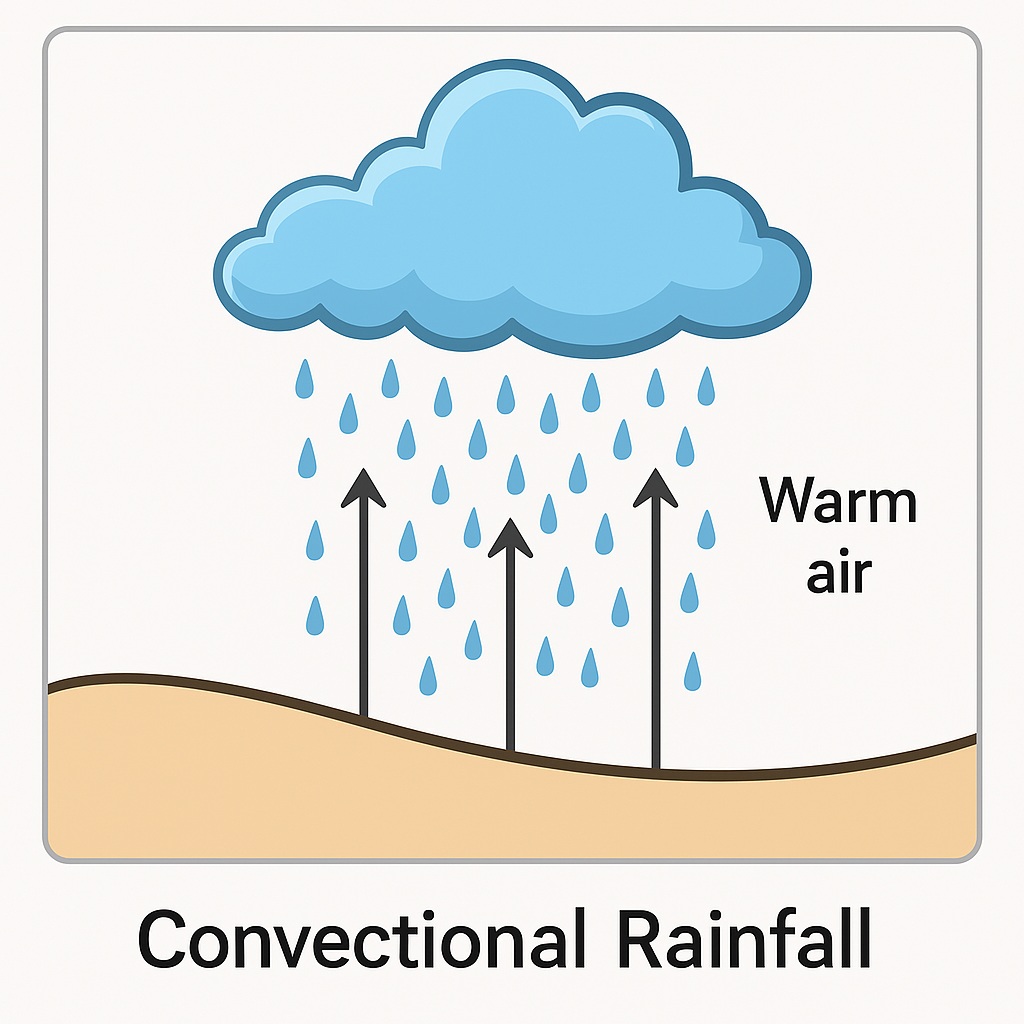
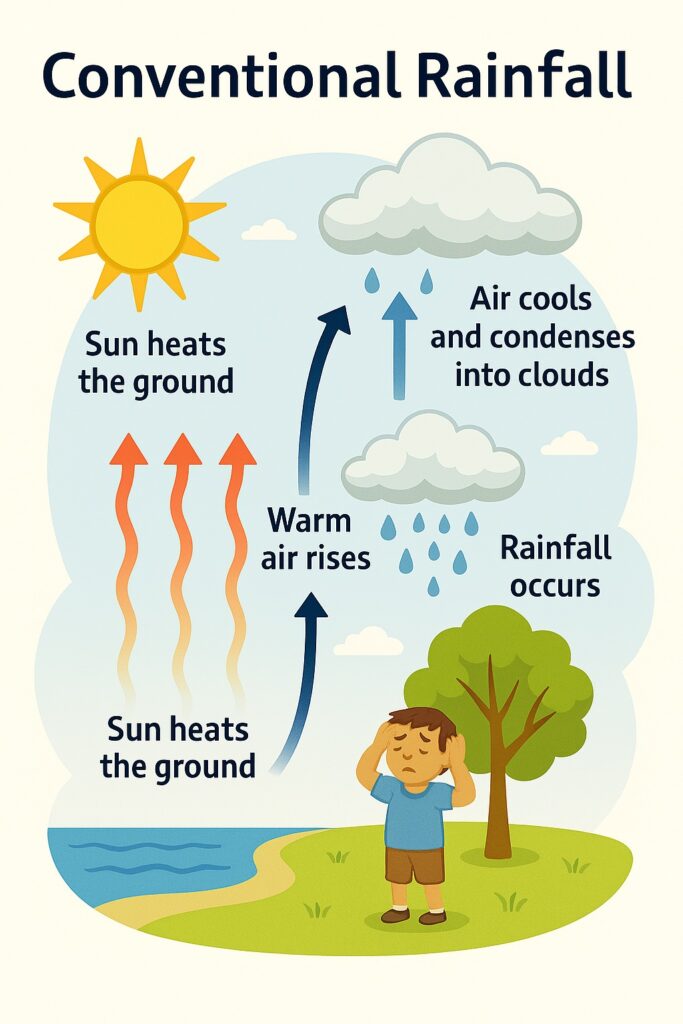
Convectional rainfall occurs when the Sun heats the ground, causing the air above it to rise and cool, leading to the formation of clouds and rainfall. This type follows a simple vertical process:
- Surface Heating: The Sun heats the Earth's surface, especially in the afternoon. This warms the air near the ground.
- Rising of Warm Air: The heated air becomes lighter (less dense) and starts to rise in a process called convection.
- Cooling and Condensation: As the air rises, it cools at higher altitudes. The water vapor condenses to form cumulonimbus clouds.
- Rainfall: Once condensation continues and cloud droplets grow larger, they fall as rain due to gravity — often as heavy, short-duration showers.
- Timing: Most common in the afternoon and evening when surface heating is at its peak.
- Duration: Typically short-lived but intense — heavy showers with thunder and lightning.
- Cloud type: Cumulonimbus (towering vertical clouds).
- Regions: Common in Equatorial and tropical regions — Amazon Basin, Congo Basin, Southeast Asia, and interior parts of continents during summer.
- Associated weather: Thunderstorms, lightning, and sometimes hail.
2. Orographic (Relief) Rainfall
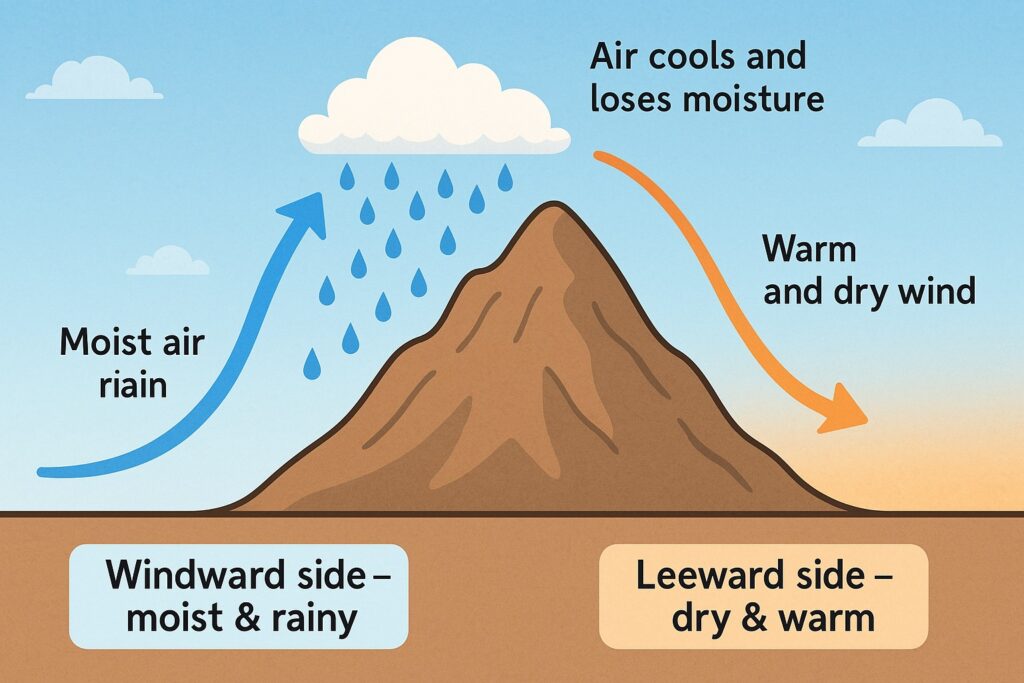
Orographic rainfall occurs when moist air is forced up over mountains or other topographic features, causing it to cool and condense, resulting in rainfall on the windward side of the mountain. The process unfolds as follows:
- Moist air approaches: Wind carries moisture-laden air towards a mountain range.
- Orographic lifting: The air is forced to rise along the windward slope of the mountain.
- Cooling & condensation: As the air rises, it cools adiabatically and the water vapor condenses — forming clouds and producing rain on the windward side.
- Rain shadow: After crossing the mountain, the descending air on the leeward side warms and dries — creating a rain shadow zone with very little rain.
- Windward side: Receives heavy rainfall — the "wet" side of the mountain.
- Leeward side: Experiences rain shadow — dry, warm conditions (Foehn/Chinook winds).
- Duration: Can be prolonged as long as moist air continues to flow against the barrier.
- Examples: Western Ghats (windward side gets heavy monsoon rain; leeward Deccan plateau is dry); Himalayas (Southern slopes wet, Tibetan plateau dry); Andes (Amazon-side wet, Atacama-side dry).
3. Cyclonic (Frontal) Rainfall
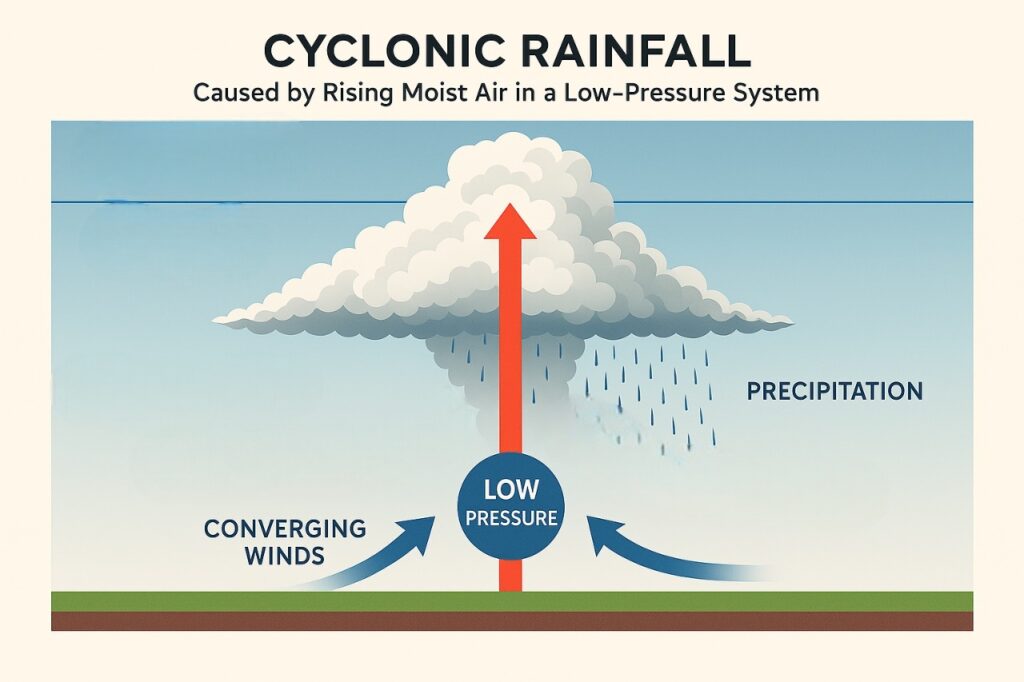
Cyclonic rainfall occurs in areas of low pressure, where converging winds cause moist air to rise and cool, leading to the formation of clouds and rainfall. It can also occur when a warm air mass meets a cold air mass (frontal rainfall), forcing the warm air to rise over the cold air.
- Low pressure formation: A cyclone (low-pressure system) develops where air converges from surrounding high-pressure areas.
- Air rises: Converging air is forced upward at the centre of the low-pressure system.
- Cooling & condensation: Rising air cools, water vapor condenses, and clouds form.
- Rainfall: Clouds release moisture as rain — can be widespread and prolonged, sometimes causing heavy rainfall and flooding.
- Frontal rainfall: When warm and cold air masses meet — warm front (gentle, prolonged rain) and cold front (intense, short-duration rain).
- Duration: Can be long-lasting and widespread — covering large areas for hours or days.
- Cloud type: Nimbostratus (warm front), cumulonimbus (cold front).
- Regions: Temperate regions — Western Europe, eastern North America; also tropical cyclones in coastal tropical areas (Bay of Bengal, South China Sea, Caribbean).
- Associated weather: Can cause flooding, storm surges, and strong winds in tropical cyclones.
Types of Rainfall: Comparative Overview
| Parameter | Convectional | Orographic | Cyclonic / Frontal |
|---|---|---|---|
| Cause | Surface heating → vertical air rise | Mountain barrier → forced ascent | Low pressure / air mass convergence |
| Driving Force | Solar heating (temperature difference) | Topography (relief barrier) | Pressure gradient (cyclonic circulation) |
| Cloud Type | Cumulonimbus | Nimbostratus / Cumulonimbus | Nimbostratus (warm front), Cumulonimbus (cold front) |
| Duration | Short & intense | Prolonged (as long as wind blows) | Widespread & prolonged |
| Region | Equatorial & tropical interiors | Mountainous coastal areas | Temperate & tropical cyclone zones |
| Example | Afternoon thunderstorms in Congo Basin | Western Ghats (windward); Andes | Winter rain in NW Europe; Bay of Bengal cyclones |
| Special Feature | Often accompanied by thunder & lightning | Rain shadow on leeward side | Warm front vs. cold front distinction |
Conclusion
Rainfall is classified into three major types based on the mechanism that causes air to rise and cool. Convectional rainfall is driven by surface heating and is common in equatorial regions. Orographic rainfall is caused by mountain barriers forcing moist air upward, creating wet windward slopes and dry leeward rain shadows. Cyclonic rainfall results from low-pressure systems and converging air masses, producing widespread and often prolonged precipitation. Understanding these types is essential for weather forecasting, agricultural planning, flood management, and climate studies.