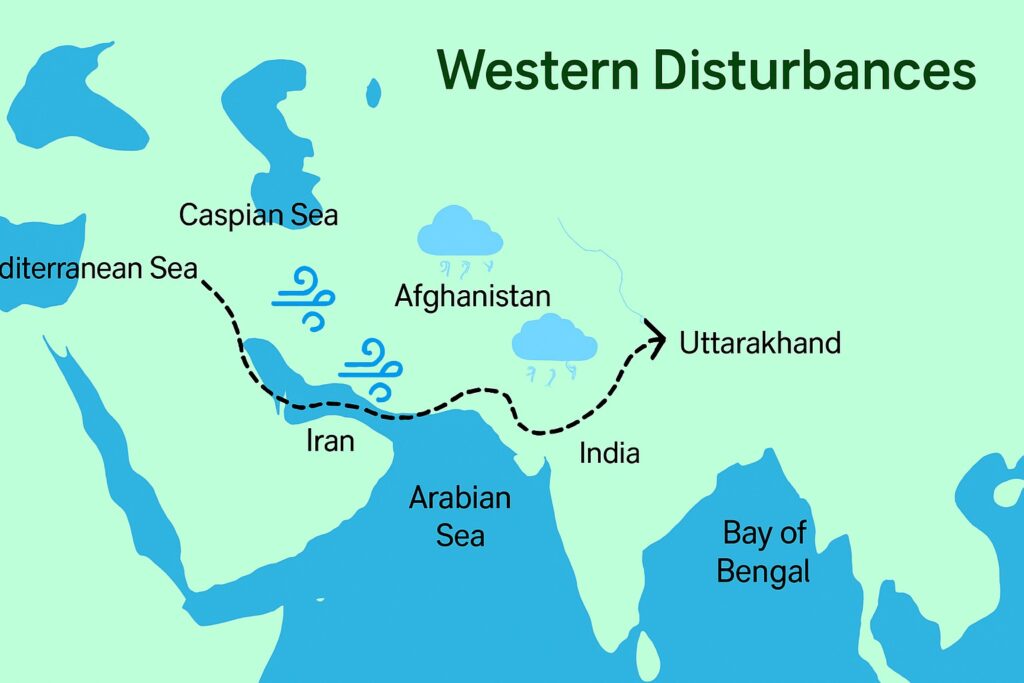
A Western Disturbance is an extratropical storm system that originates in the Mediterranean region and travels eastwards, driven by the subtropical westerly jet stream (SWJ). It brings moisture-laden winds that cause precipitation (rain or snow) in northern India, especially in the Western Himalayas. The Western Disturbance affects the Indian subcontinent, particularly during the winter months. It is characterized by the movement of low-pressure systems from the Mediterranean region, across Iran and Afghanistan, and into India.
What is the Western Disturbance?
The Western Disturbance is a term used to describe a low-pressure system that forms over the Mediterranean Sea or Caspian Sea and moves across Iran and Afghanistan before entering India. This system is caused by the interaction between cold air from the Arctic and warm air from the Mediterranean. As the system moves across the Indian subcontinent, it brings with it additional moisture from the Arabian Sea, which can result in rain, snow, and strong winds in various parts of the country.
Mechanism of Western Disturbance
- A low-pressure system forms over the Mediterranean Sea.
- The Subtropical Westerly Jet Stream (SWJ) transports this system towards Iran, Afghanistan, Pakistan, and eventually India.
- When it reaches northwestern India, it interacts with the Himalayan terrain and existing cold air masses.
- This interaction leads to the formation of clouds, precipitation, and sometimes hailstorms.
Origin of Western Disturbance
Stage 1: Mixing of cold and warm air masses — A western disturbance begins with the mixing of cold air masses from the polar regions with warm air masses from the Mediterranean region.
Stage 2: Formation of a low-pressure system — The mixing of these air masses leads to the formation of a low-pressure system. The air in the low-pressure system rises and cools, causing water vapor in the air to condense into clouds.
Stage 3: Movement towards Indian subcontinent — The low-pressure system then moves eastwards towards the Indian subcontinent, pushed by prevailing westerly winds.
Stage 4: Interaction with local weather patterns — As the western disturbance moves towards the Indian subcontinent, it interacts with local weather patterns and topography, such as the Himalayas, which can cause it to intensify or weaken.
Stage 5: Precipitation and weather effects — When the western disturbance reaches the Indian subcontinent, it brings precipitation in the form of rain or snow, depending on the temperature and humidity levels. It can also cause thunderstorms, winds, and temperature fluctuations.
Impact of Western Disturbance on Indian Subcontinent
It can have a significant impact on the Indian subcontinent, particularly during the winter months. In the northern states of Jammu and Kashmir, Himachal Pradesh, and Uttarakhand, it can cause heavy snowfall, which can lead to road closures, power outages, and disruption of daily life. In other parts of the country, it can cause heavy rainfall, which can lead to flooding and landslides.
It can also have a significant impact on agriculture. While the rainfall brought by the system is essential for the growth of crops, excessive rainfall or snowfall can damage crops and disrupt the harvest season. The strong winds accompanying the system can also cause damage to crops and infrastructure, such as power lines and buildings.
Measures to Mitigate the Effects
- Weather forecasting: Helps people prepare for the impact. Enables farmers to protect crops and authorities to prepare for road closures and power outages.
- Infrastructure development: Building strong roads, power lines, and buildings that can withstand strong winds and heavy snowfall.
- Crop diversification: Growing different crops that can withstand heavy rainfall or snowfall reduces dependence on a single crop.
- Disaster management: Plans that include deploying rescue teams and providing emergency relief to affected areas.
Frequently Asked Questions
Summary
- The Western Disturbance is a low-pressure system that forms over the Mediterranean and moves across Iran and Afghanistan before entering India.
- It brings moisture from the Arabian Sea, resulting in rain, snow, and strong winds in various parts of the Indian subcontinent.
- It has a significant impact during the winter months, causing heavy snowfall and rainfall that can lead to road closures, power outages, and crop damage.
- Mitigation measures include weather forecasting, infrastructure development, crop diversification, and disaster management.
- It is also beneficial for wheat cultivation in northwestern India due to winter rainfall.
Key Takeaway
The Western Disturbance is a meteorological phenomenon that can have a significant impact on the Indian subcontinent, particularly during the winter months. While it is an essential source of rainfall for agriculture (especially wheat), excessive rainfall or snowfall can cause damage to crops and infrastructure. By taking measures such as weather forecasting, infrastructure development, crop diversification, and disaster management, its adverse impact can be mitigated. Preparedness by both authorities and individuals is essential for the safety and well-being of people and the country’s infrastructure.