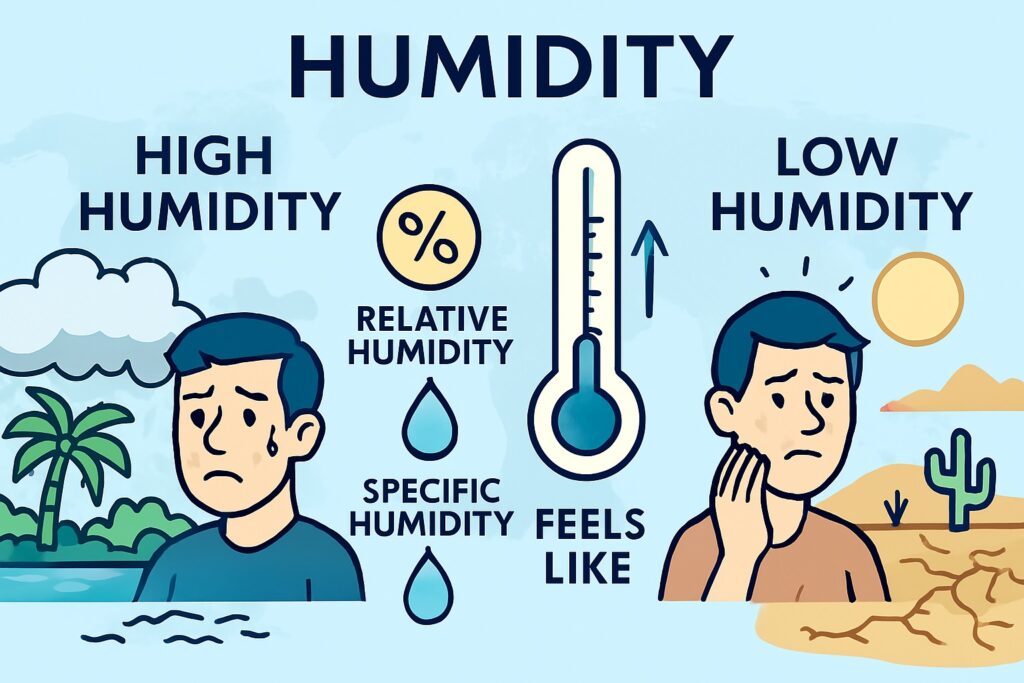
Humidity represents the amount of water vapor present in the air. Absolute humidity, relative humidity, and specific humidity are primary measures of atmospheric moisture, differing in how they are quantified, expressed, and applied across meteorological and industrial fields.
What is Absolute Humidity?
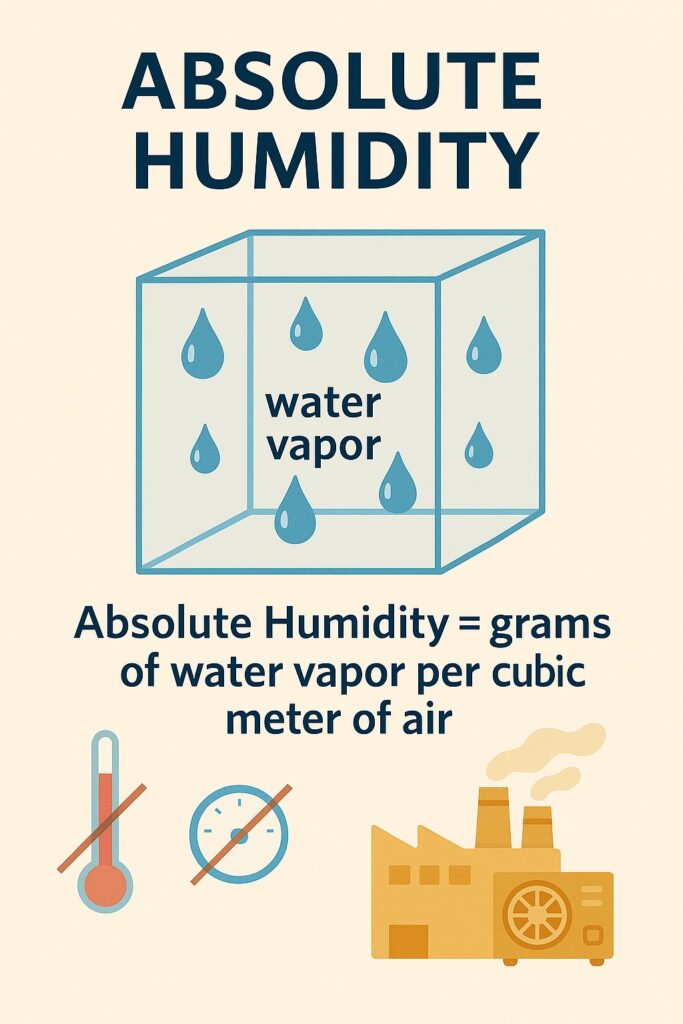
Absolute humidity refers to the actual mass of water vapor present in a given volume of air, expressed in grams per cubic meter ($g/m^3$). Mathematically, it can be expressed as:
$$AH = \frac{m_v}{V_{air}}$$where $m_v$ is the mass of water vapor and $V_{air}$ is the volume of air. It measures the absolute water content independent of temperature or pressure, making it useful in industrial applications and HVAC design.
What is Relative Humidity?
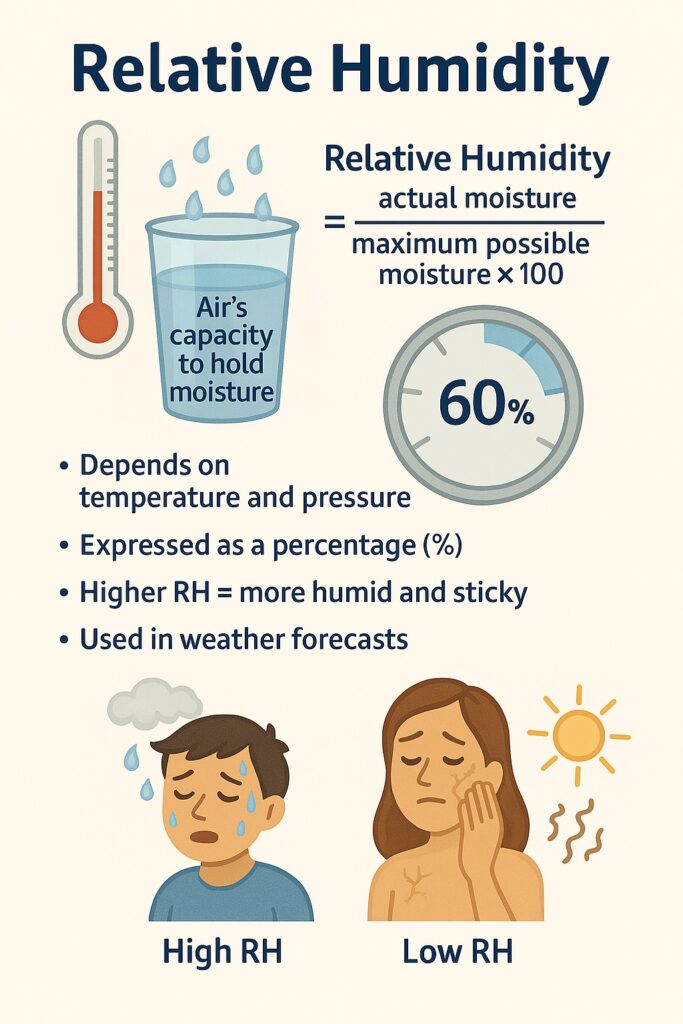
Relative humidity ($\text{RH}$) is the ratio of the actual water vapor content to the maximum amount of water vapor the air can hold at a specific temperature and pressure, expressed as a percentage:
$$\text{RH} = \left( \frac{w}{w_s} \right) \times 100\%$$where $w$ is the mixing ratio and $w_s$ is the saturation mixing ratio. It is widely used in weather forecasting as an indicator of human comfort.
Comparison Table: Absolute vs. Relative Humidity
| Parameter | Absolute Humidity | Relative Humidity |
|---|---|---|
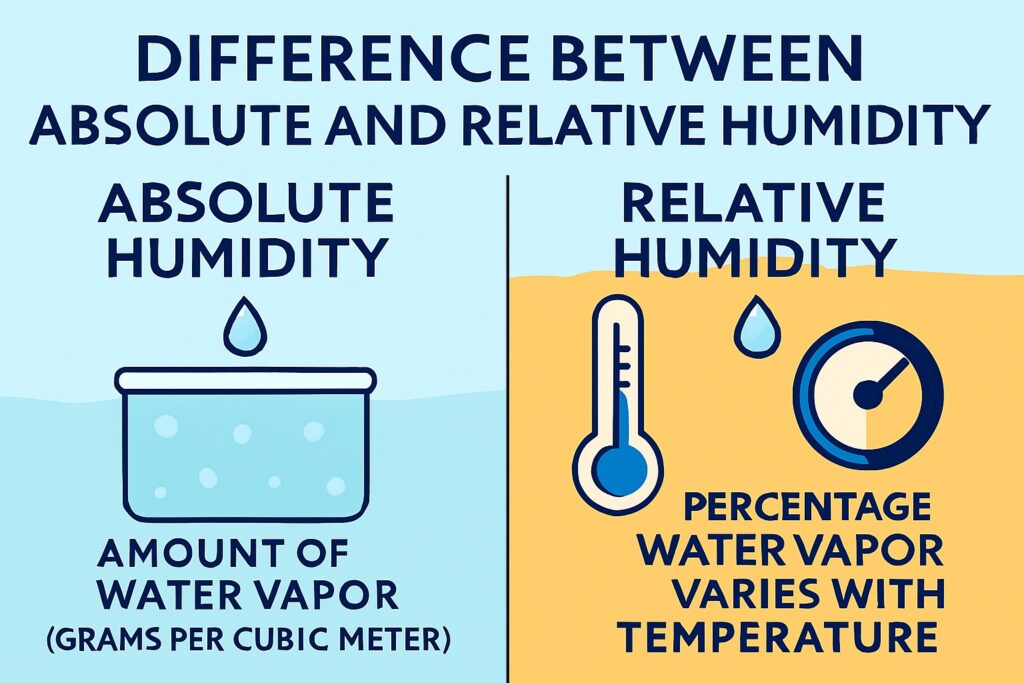
| Definition | Actual amount of moisture in the air, expressed in grams of water vapor per cubic meter ($g/m^3$) | Ratio of actual water vapor to the maximum capacity at a given temperature and pressure, expressed as a percentage (%) |
| Units | Grams per cubic meter ($g/m^3$) | Percentage (%) |
| Temperature Dependency | Independent of temperature and pressure | Decreases as temperature increases (if moisture constant) |
| Primary Application | Industrial applications and material moisture assessment | Weather forecasting and human comfort indexing |
| Human Comfort Impact | Not directly related to perceived comfort | High values feel muggy; low values cause dry skin and irritation |
What is Specific Humidity?
Specific humidity ($q$) is the mass of water vapor present in a unit mass of moist air (including both dry air and water vapor), expressed in grams of water vapor per kilogram of air ($g/kg$).
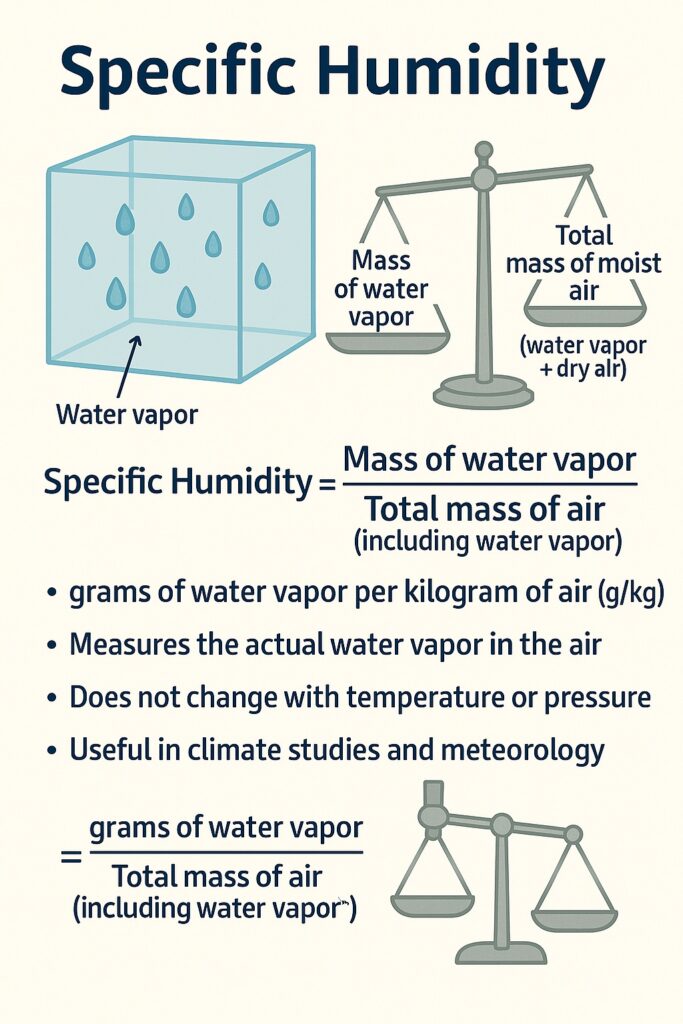
where $m_v$ is the mass of water vapor and $m_d$ is the mass of dry air.
- Quantifies actual water vapor content independent of temperature.
- Remains constant as air parcels rise or sink unless moisture is added or removed.
- Serves as a reliable metric when comparing moisture across different altitudes and regions.
Conclusion
Understanding absolute, relative, and specific humidity provides essential insight into atmospheric science, meteorological forecasting, and industrial climate control.