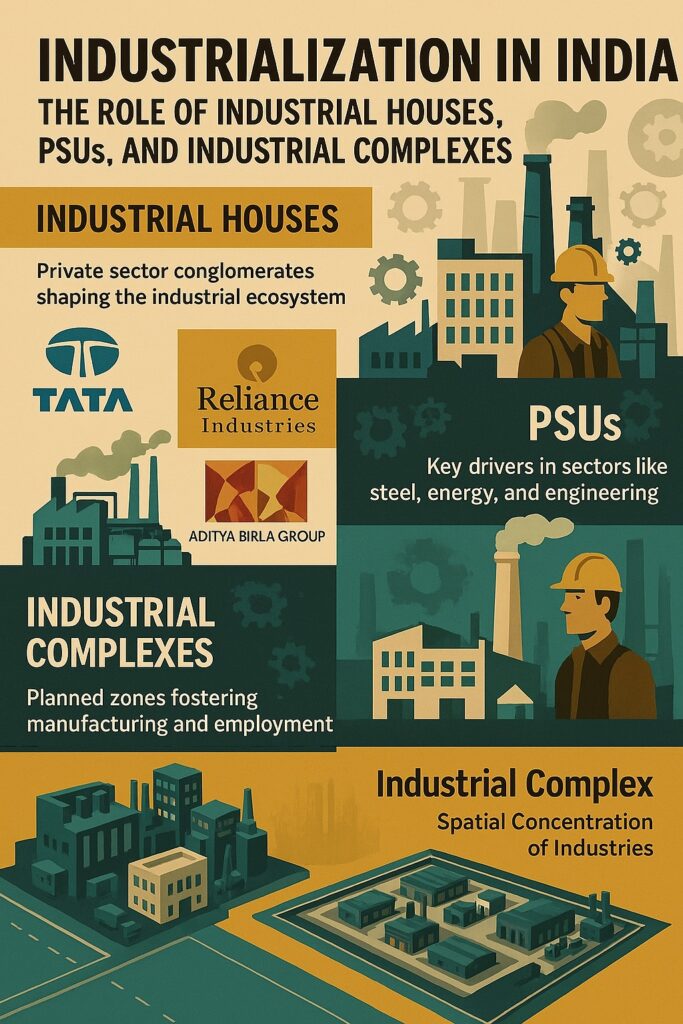
Industrialization is a key driver of economic growth. In India, both industrial houses and public sector undertakings (PSUs) shape the country's industrial landscape, frequently organized spatially into industrial complexes.

1. Industrial Houses
Industrial houses are large private or family-owned business conglomerates controlling multiple companies across diverse economic sectors. They played a vital role in India's post-independence industrialization during the mixed economy phase.
Key Features:
- Owned and operated by private entrepreneurs or corporate families.
- Diversified business portfolios spanning textiles, steel, automobiles, and chemicals.
- Extensive integration across finance, media, and infrastructure.
- Strong national and global market presence.
Notable Examples:
- Tata Group: Steel, automobiles, IT, and telecommunications.
- Birla Group: Cement, textiles, education, and financial services.
- Reliance Industries: Petrochemicals, retail, telecom, and energy.
2. Industrial Complexes
An industrial complex refers to a spatially concentrated cluster where multiple industries operate in close proximity, sharing common infrastructure such as power grids, transport networks, and water supplies.
Key Features:
- Strategically located near raw material sources or logistics hubs.
- Accommodates ancillary industries and supporting service sectors.
- Fosters economies of scale and regional economic development.
- Drives urbanization and the growth of dedicated industrial towns.
Notable Examples:
- Jamshedpur: Centered around Tata Steel.
- Bhilai: Major steel plant complex supported by heavy engineering industries.
- Chennai Industrial Belt: Hub for automobiles, electronics, and IT.
3. Public Sector Undertakings (PSUs)
PSUs are government-owned corporations established to build core industries critical for national security, infrastructure, and balanced regional development. Following independence, PSUs formed the bedrock of India's planned industrial economy.
Key Features:
- Fully or majority-owned by central or state governments.
- Dedicated to supplying essential goods/services, generating employment, and promoting socio-economic equity.
- Operate extensively in core sectors: steel, coal, power generation, heavy machinery, and petroleum.
Categorization of PSUs:
- Maharatna: Large-scale PSUs with substantial global operations (e.g., ONGC, SAIL).
- Navratna: Medium-sized, high-performing enterprises (e.g., BEL, GAIL).
- Miniratna: Smaller but consistently profitable enterprises (e.g., BSNL, HAL).
Geographical Implications
- Locational Determinants: Raw material availability, labor supply, market accessibility, infrastructure, and policy incentives govern siting decisions.
- Urbanization: Industrial hubs frequently evolve into bustling industrial cities.
- Environmental Impact: Unmitigated industrial clustering risks severe pollution, deforestation, and land degradation.
- Regional Disparities: Industrial momentum remains heavily concentrated in states like Maharashtra, Gujarat, and Tamil Nadu, causing uneven regional growth.
Conclusion
Industrial houses and public sector undertakings together form the backbone of India's industrial sector. While private industrial houses drive innovation and capital efficiency, PSUs fulfill vital strategic and welfare mandates. Their spatial clustering into industrial complexes profoundly shapes the economic geography of India.