The economic transformation of India since the 1990s has been significantly shaped by the twin forces of liberalisation and the entry of multinational corporations (MNCs). These developments have played a crucial role in the reorganisation of industrial activities, employment patterns, and urbanisation across the country.
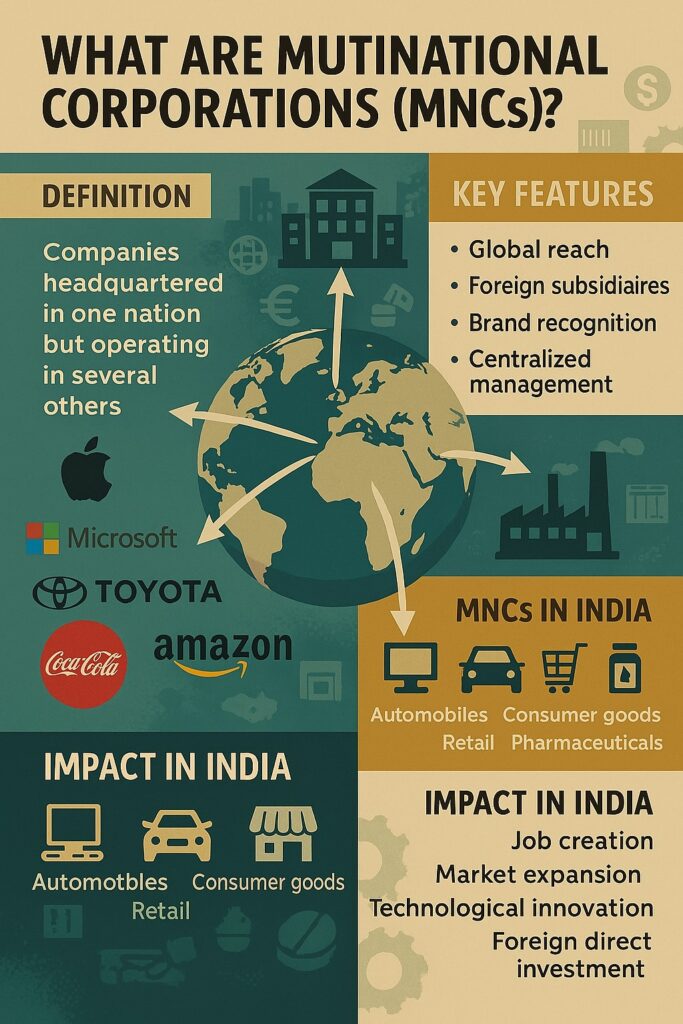
1. What are Multinational Corporations (MNCs)?
Multinational Corporations (MNCs) are companies that have business operations in more than one country. They are usually headquartered in one nation but own or control production and services in multiple countries. In the Indian context, MNCs have become key players in sectors like information technology, automobiles, consumer goods, retail, and pharmaceuticals.
Examples in India:
- Google, Microsoft, Amazon — IT and e-commerce
- Toyota, Hyundai, Honda — Automobile industry
- Nestlé, Unilever, PepsiCo — Food and beverages
- Samsung, LG, Apple — Electronics and mobile phones
2. What is Liberalisation?
Liberalisation in India began in 1991 as part of a series of economic reforms to overcome a major financial crisis. The government adopted a policy shift from a tightly controlled economy to a more open and market-driven one.
Major Steps Taken:
- Ended industrial licensing for most industries (deregulation)
- Reduced import tariffs and quotas (trade liberalisation)
- Encouraged Foreign Direct Investment (FDI)
- Allowed private sector participation in many sectors previously reserved for the state
- Reduced the role of public sector undertakings (PSUs) through disinvestment
- Reformed the banking and financial sector to integrate with global markets
3. Impact of Liberalisation on Indian Economy
The liberalisation policy led to rapid growth in several industries and attracted significant investments from MNCs. India became an important destination for global capital, outsourcing, and manufacturing.
- Rapid growth of the IT and service sector, especially in cities like Bengaluru, Hyderabad, and Pune.
- Increase in employment opportunities, particularly for skilled workers in IT, BPO, and financial services.
- Improved access to modern goods, technologies, and services — raising living standards.
- Growth of infrastructure and real estate, especially in metropolitan cities and their suburbs.
- Boost to exports in software, textiles, pharmaceuticals, and auto parts — making India a global supplier.
- Rise in FDI inflows, making India one of the top emerging market investment destinations.
- Widening gap between urban and rural areas — growth concentrated in metros and tier-1 cities.
- Pressure on small-scale and traditional industries due to competition from MNCs and imports.
- Rise in urban congestion, pollution, and inequality in rapidly growing cities.
- Increased dependence on foreign companies for technology, capital, and strategic sectors.
- Jobless growth in some sectors — automation and capital-intensive methods limit mass employment.
4. Geographical Impact of MNCs in India
Multinational companies have played a key role in reshaping India's economic geography. Their presence has led to the growth of industrial clusters and modern urban centres.
- Bengaluru — Global IT and innovation hub; home to Google, Microsoft, Infosys, and Wipro.
- Gurugram and Noida — Centres for BPOs, software, and corporate services; MNC back-office capital.
- Chennai and Pune — Automobile and engineering hubs; Hyundai, Ford, Tata-Fiat, and Mahindra clusters.
- Hyderabad — Emerging pharmaceutical and biotechnology hub; "Genome Valley" and HITEC City.
- Mumbai-Pune Corridor — Financial services, IT, and manufacturing; India's commercial capital.
The benefits of MNCs have been unevenly distributed. Most investments are concentrated in a few states like Maharashtra, Tamil Nadu, Karnataka, Telangana, and Gujarat, while other regions like Bihar, Odisha, and North-East India lag behind. This has exacerbated regional economic disparities and created "islands of growth" amid underdevelopment.
MNC-Driven Hubs: Comparative Overview
| City / Region | Dominant Sector | Key MNCs Present | Growth Impact |
|---|---|---|---|
| Bengaluru | IT & Innovation | Google, Microsoft, Amazon | Global tech hub; start-up ecosystem |
| Gurugram–Noida | BPO & Corporate Services | Accenture, Cognizant, Deloitte | Back-office capital; urban sprawl |
| Chennai | Automobile & Engineering | Hyundai, Ford, BMW | "Detroit of India"; export hub |
| Pune | IT & Auto | TCS, VW, Mercedes-Benz | Dual-sector growth; education hub |
| Hyderabad | Pharma & Biotech | Novartis, Dr. Reddy's, DuPont | "Genome Valley"; R&D centre |
5. Role in India's Global Integration
With the rise of MNCs and liberal economic policies, India has become a part of the global value chain (GVC). Indian companies now collaborate with foreign firms in areas such as software development, automobile parts manufacturing, and pharmaceuticals.
- Software & IT: India is the world's leading IT outsourcing destination, serving Fortune 500 companies globally.
- Auto Components: India is a Tier-1 and Tier-2 supplier for global automakers — Bosch, Denso, and Bharat Forge are key players.
- Pharmaceuticals: India supplies over 20% of global generic drugs; vaccine capital of the world.
- Textiles & Apparel: India is a major sourcing destination for global fashion retailers.
- FDI Policy: Progressive FDI liberalisation (100% in most sectors under automatic route) continues to attract global capital.
The Way Forward
- Inclusive Growth: Channel MNC investment to tier-2 and tier-3 cities and backward regions through incentive-linked policies.
- Strengthen Domestic Industry: Support MSMEs and local enterprises to compete with MNCs — PLI schemes, cluster development, and technology transfer.
- Skill Development: Align education and vocational training with industry needs to maximize employment gains from MNC presence.
- Environmental Regulation: Enforce strict environmental standards for MNC operations to prevent ecological degradation.
- Strategic Autonomy: Build domestic capabilities in critical sectors (defence, semiconductors, AI) to reduce excessive dependence on foreign technology.
Conclusion
Multinationals and liberalisation have transformed India's economic structure, bringing growth, innovation, and global connectivity. However, the challenge lies in ensuring that this growth is inclusive, regionally balanced, and environmentally sustainable. Strategic planning, investment in education and infrastructure, and support for small enterprises are essential to make liberalisation truly beneficial for all sections of Indian society.