The Earth is a dynamic planet with a complex interior. While direct drilling is limited by extreme heat, scientists study internal properties—such as temperature, pressure, density, and composition—primarily through indirect methods like seismology and volcanic activity.

Why We Can't Explore Deep Inside the Earth
Humanity has only managed to dig about 5 km deep into the Earth's crust. Going deeper is restricted because temperature increases rapidly with depth, easily melting drilling equipment. Consequently, seismology, volcanic materials, and meteorite analysis serve as vital indirect windows into planetary interiors.
Layers of the Earth's Interior
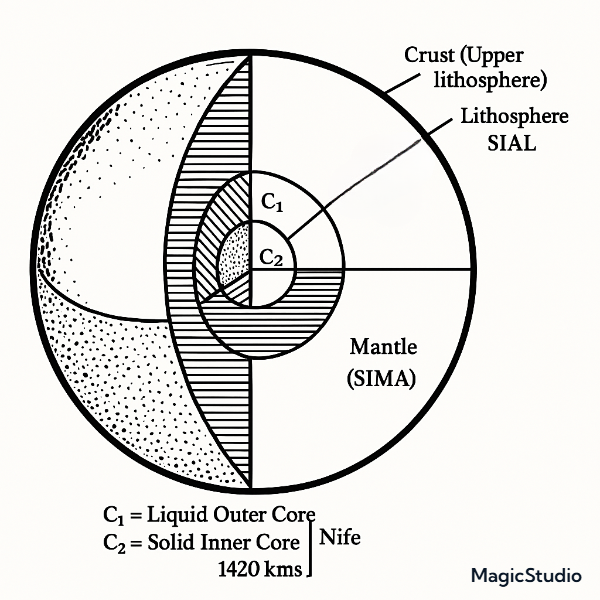
- Crust: The brittle, solid outermost layer supporting life.
- Mantle: The thick middle layer composed of semi-solid silicate rocks rich in iron and magnesium, facilitating convection currents.
- Outer Core: A molten layer of iron and nickel whose fluid motion generates Earth's magnetic field.
- Inner Core: A solid iron-nickel sphere maintained under immense gravitational pressure.
Temperature Gradient
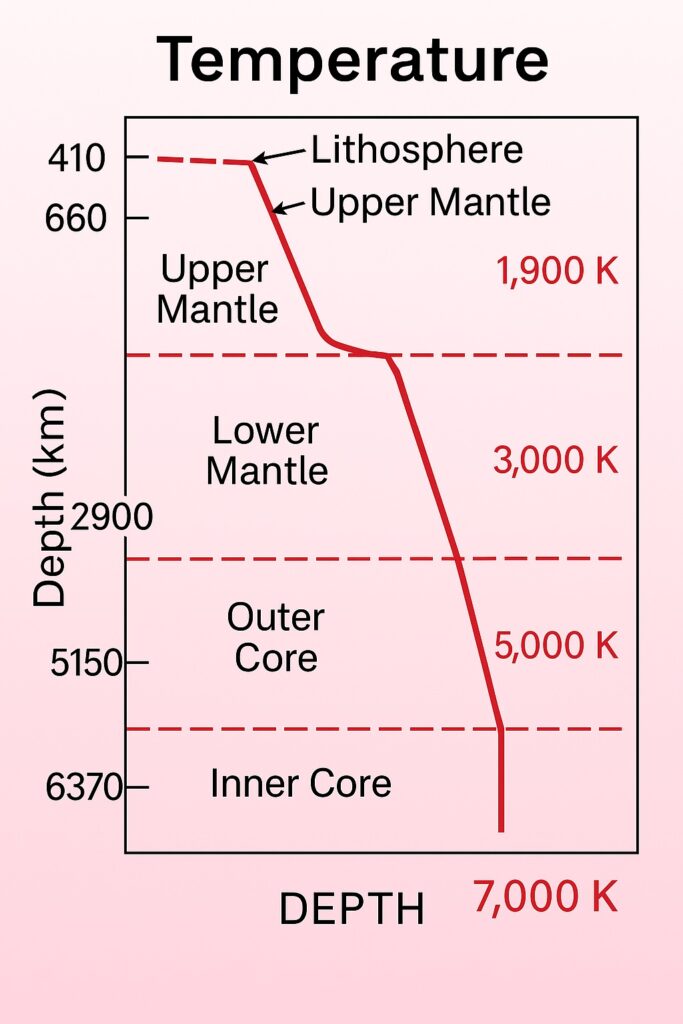
Temperature increases with depth, governed by geothermal gradients. Near the surface, temperature rises roughly \(25^\circ\text{C}\) to \(30^\circ\text{C}\) per kilometer, reaching core temperatures between \(5000^\circ\text{C}\) and \(6000^\circ\text{C}\).
Pressure and Density
As depth increases, overburden pressure mounts dramatically due to the weight of overlying rocks, reaching up to 3 to 4 million atmospheres at Earth's center. This extreme pressure elevates melting points and compresses matter, causing density (\(\rho = \frac{m}{V}\)) to increase progressively toward the dense core.
Conclusion
The intricate interplay of high temperatures, extreme pressures, and distinct material compositions within Earth's interior drives global tectonic activity, geodynamics, and landscape evolution.