The climate of Earth is regulated by the heat budget of the Earth. It is the account of the amount of energy entering the planet from the Sun and the amount of energy being released back into space. Heat budget of the Earth is a critical aspect of climate and weather patterns.
What is Heat Budget?
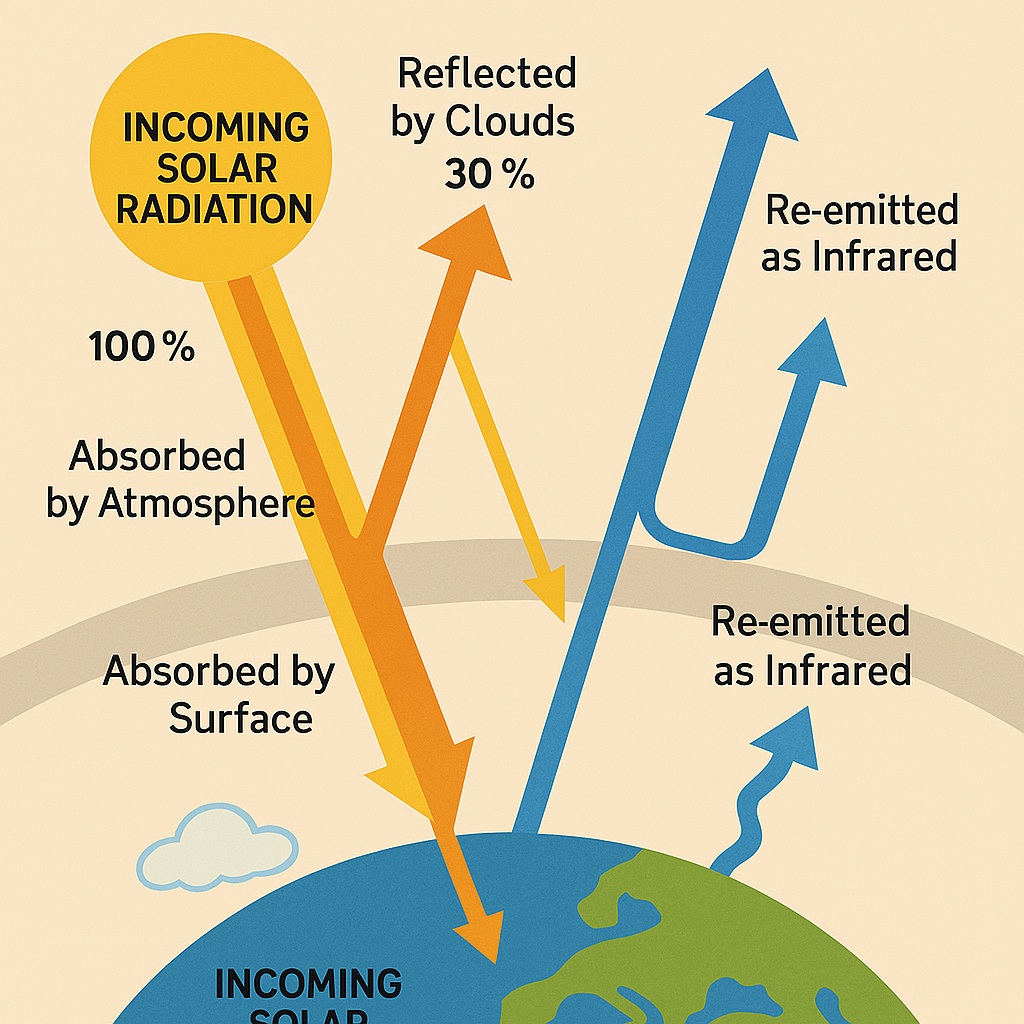
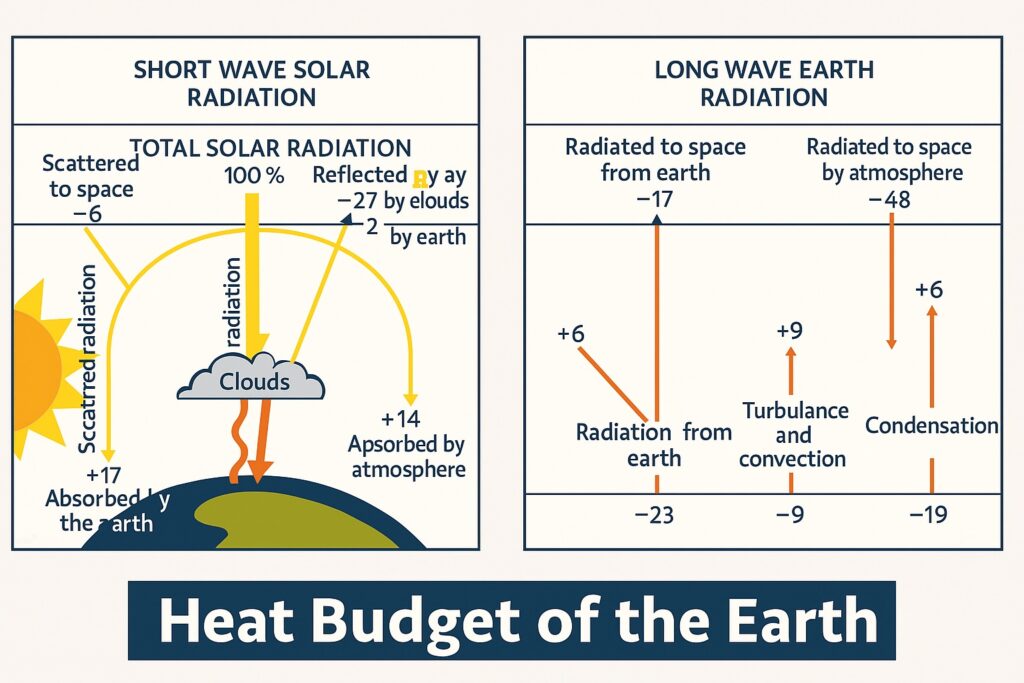
The Sun gives Earth energy in the form of short-wave radiation — this is called insolation. Earth also gives off energy as heat (long-wave radiation), just like any warm object. This outgoing energy is called terrestrial radiation.
Even though energy is always coming in and going out, Earth's average temperature stays steady. That's because there is a balance between the energy coming in and the energy going out. This balance is called the Earth's Heat Budget.
Incoming Short-Wave Solar Radiation (Insolation)
The main source of energy for the Earth's climate system is incoming solar radiation. The Sun emits energy in the form of short-wave radiation, which is absorbed by the Earth's atmosphere and surface. This absorbed energy is then re-emitted as long-wave radiation (infrared radiation).
- Atmosphere: Absorbs a significant amount of ultraviolet radiation (harmful to living organisms) — primarily by the ozone layer.
- Earth's surface: Absorbs a significant amount of visible and infrared radiation, which drives the planet's climate and weather patterns.
- Albedo effect: A portion of incoming solar radiation is reflected back by clouds, ice, and the surface — Earth's average albedo is about 30%.
Outgoing Long-Wave Radiation (Terrestrial Radiation)
The energy absorbed by the Earth's atmosphere and surface is re-emitted as long< long-wave radiation, which is then emitted back into space. This outgoing long-wave radiation is critical in regulating the Earth's temperature.
- Greenhouse effect: Greenhouse gases (CO₂, CH₄, H₂O, N₂O) trap some outgoing long-wave radiation and re-radiate it back towards the surface, increasing Earth's average temperature.
- Without the greenhouse effect: Earth's average temperature would be about -18°C instead of the current +15°C.
- Influencing factors: Atmospheric composition, cloud cover, and surface temperature all affect outgoing radiation.
How the Atmosphere Gets Heated and Cooled
Even though the Sun is the main source of heat, we don't feel it directly when we go higher in the atmosphere (like on mountains) — the air gets cooler. The atmosphere is heated through 4 processes:
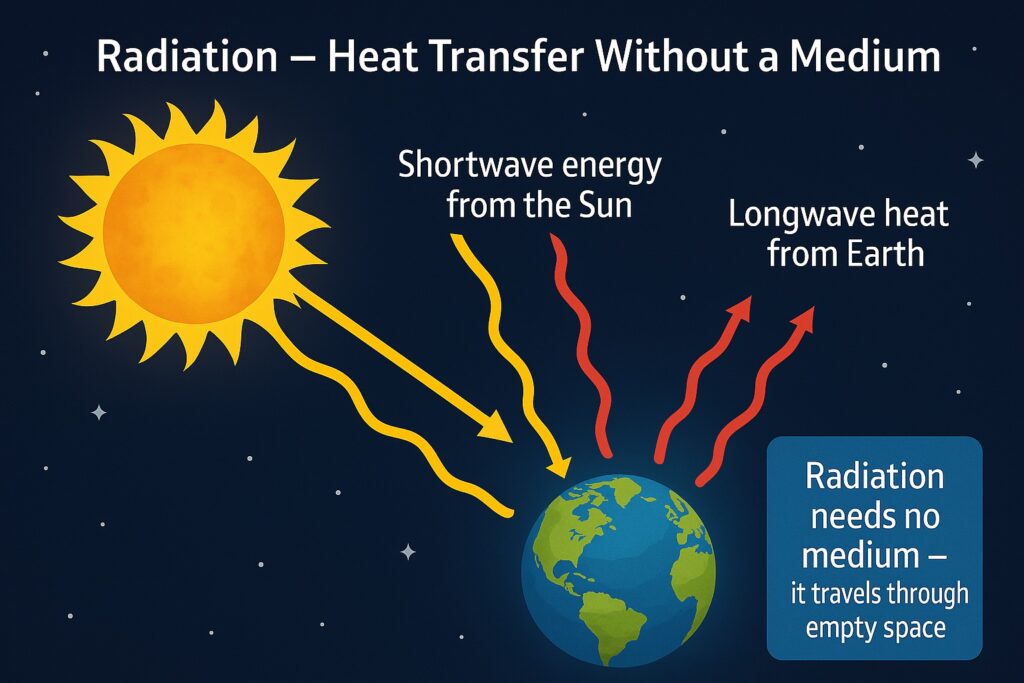
- Heat travels as waves, even through empty space.
- The Sun sends short-wave energy to Earth (called insolation).
- Earth gives back heat to the atmosphere as long waves (terrestrial radiation).
Key Facts about Radiation:
- Everything (hot or cold) gives off radiant energy.
- Hotter objects release more energy.
- Hotter objects give off shorter waves.
- Earth receives heat in short waves and sends it back in long waves.
- Heat moves from the hot Earth's surface to the air touching it.
- It happens only near the surface, where air touches the ground.
- Example: Like how a spoon gets hot when left in a hot pot — heat transfers through direct contact.
- Conduction is significant only in the lowermost layer of the atmosphere (a few millimeters to centimeters above the surface).
- After air near the surface gets hot (by conduction), it rises upward.
- This movement of hot air going up and cool air coming down is called convection.
- This keeps mixing the air and spreads heat in the lower atmosphere.
- Convection cells: Form the basis of atmospheric circulation — Hadley, Ferrel, and Polar cells.
- This is the sideways (horizontal) movement of heat through wind.
- Wind moves warm or cool air from one place to another horizontally.
- Example: Sea breeze is cool wind moving from sea to land during daytime; land breeze at night moves from land to sea.
- Advection is responsible for day-to-day weather changes — warm/cold fronts, air mass movement.
Heat Transfer Methods: Comparative Overview
| Process | Direction | Medium | Example |
|---|---|---|---|
| Radiation | All directions (through space) | No medium needed | Sun's energy reaching Earth |
| Conduction | Vertical (surface → air) | Direct contact needed | Spoon heating in a pot |
| Convection | Vertical (hot air ↑, cool air ↓) | Fluid (air/water) | Hot air rising from heated ground |
| Advection | Horizontal (wind-driven) | Fluid (air/water) | Sea breeze, warm/cold fronts |
Factors Affecting Heat Budget of the Earth
Cloud cover affects the Earth's heat budget by influencing both incoming solar radiation and outgoing long-wave radiation.
- Reflection (Albedo): Clouds reflect a significant portion of incoming solar radiation back into space, reducing energy absorbed by the surface.
- Trapping: Clouds trap a portion of outgoing long-wave radiation, resulting in an increase in energy re-radiated back towards the surface.
- Net effect: Low, thick clouds primarily cool the Earth; high, thin clouds primarily warm it.

- Influenced by incoming solar radiation, cloud cover, and atmospheric composition.
- Affects the amount of energy absorbed and re-emitted as long-wave radiation.
- Land vs. water: Land masses heat up and cool down more quickly than water masses, resulting in more variable surface temperature over continents.
- Differential heating of land and sea drives monsoon systems and coastal weather patterns.
- Play a crucial role by transporting heat and moisture around the planet.
- Driven by differences in temperature and salinity (thermohaline circulation).
- Warm currents (e.g., Gulf Stream) transport heat from equator to poles; cold currents (e.g., Labrador Current) bring polar water towards the equator.
- Critical in regulating regional climates — e.g., Western Europe is warmer than expected at its latitude due to the Gulf Stream.
Impact on Climate
The Earth's heat budget plays a critical role in determining the planet's climate and weather patterns. The balance between incoming solar radiation and outgoing long-wave radiation, along with the influence of cloud cover, surface temperature, and ocean currents, all contribute to global climate patterns.
- Greenhouse effect intensification: Rising greenhouse gas concentrations trap more outgoing radiation, increasing Earth's average temperature — leading to global warming.
- Sea level rise: Thermal expansion of oceans and melting of ice sheets.
- Extreme weather events: More intense hurricanes, droughts, heatwaves, and floods.
- Disruption of ocean currents: Melting Arctic ice could weaken the thermohaline circulation, altering regional climates dramatically.
Conclusion
The heat budget of the Earth is the fundamental mechanism governing our planet's climate. The delicate balance between incoming short-wave solar radiation (insolation) and outgoing long-wave terrestrial radiation maintains Earth's average temperature. However, human activities that increase greenhouse gas concentrations are disrupting this balance, leading to global warming and climate change. Understanding the heat budget — including the roles of radiation, conduction, convection, advection, cloud cover, and ocean currents — is essential for predicting, preparing for, and mitigating the impacts of climate change.