ISRO Scientist/Engineer CS Solved Papers
Prepare for ISRO ICRB examinations with verified solutions covering Algorithms, Theory of Computation, Compiler Design, Computer Architecture, OS, Discrete Mathematics, and Computer Networks.
All ISRO CS PYQs / All CS Subjects / All Topics
Marking scheme: +3.00 positive, -0.75 negative (ICRB Standard).
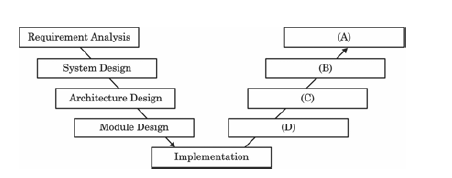
In the V Model of Software Testing shown below, please identify (A), (B), (C), (D):
For a software project, following information about the domain characteristics are given:
| Sl No | Description | Count | Average Weight factor |
|---|---|---|---|
| 1 | Number of user inputs | 30 | 4 |
| 2 | Number of user outputs | 60 | 5 |
| 3 | Number of user enquiries | 20 | 4 |
| 4 | Number of files | 5 | 10 |
| 5 | Number of external interfaces | 4 | 7 |
Assume that all complexity adjustment values are average having scale = 3. The function point value for the project will be
Consider the regular expression R over the alphabet $\{a, b\}$:
$$(a^*b)^* + (b^*a)^*$$Which of the following regular expressions below describe the same language as R?
Consider the deterministic finite-state automaton (DFA) below over the alphabet $\{a, b\}$. The state with a small incoming arrow is the initial state, while a double circle state denotes a final state.
Transitions:
Initial state $q_0$ (non-final): on 'a' goes to $q_1$; on 'b' goes to $q_2$.
State $q_1$ (final): on 'b' loops to $q_1$; on 'a' goes to $q_2$.
State $q_2$ (final): on 'a, b' loops to $q_2$.
The number of states in the MINIMAL DFA for the language accepted by this DFA is:
Consider the context-free grammar G below. Here S is the starting non-terminal symbol, while a and b are terminal symbols.
$$S \rightarrow aSb \mid T$$$$T \rightarrow bT \mid b$$The language generated by G is:
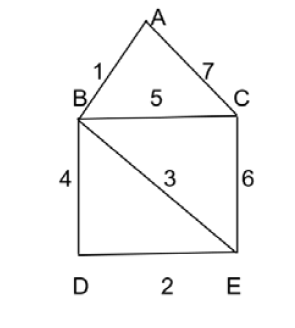
Find the minimum spanning distance and the corresponding number of edges for the following graph:
Match the following:
| Algorithm | Application / Problem |
|---|---|
| (A) Floyd Warshall | (i) Shortest path between two vertices |
| (B) Dijkstra | (ii) Single source shortest path |
| (C) Kruskal's | (iii) Minimum spanning tree |
| (D) Bellman Ford | (iv) Solving all pair shortest path |
Time complexity to find the diameter of a binary tree having $n$ nodes is:
The preorder traversal of a binary search tree is $(10, 5, 1, 7, 40, 50)$. The postorder traversal is:
The minimum number of arithmetic operations required to evaluate the expression $f(x) = 8x^{3} + 3x + 12$ is:
Maximum number of Simple graphs possible with $n$ vertices is:
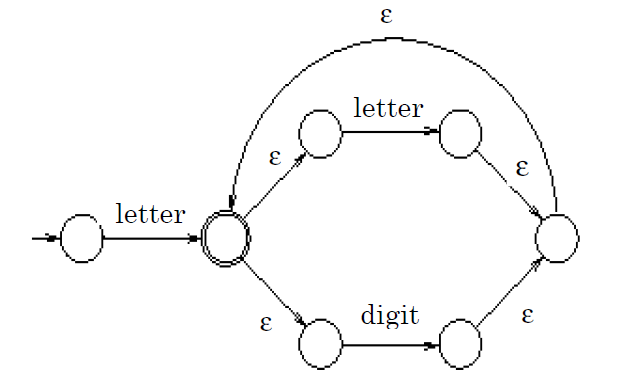
Consider the NFA with epsilon-transitions below, which is meant to accept strings corresponding to a lexical token id. Here the token digit corresponds to the extended regular expression [0-9] and letter corresponds to [a-zA-Z]. In the diagram, a small incoming edge indicates a start state while a double circle indicates a final state.
Which of the following extended regular expressions corresponds to the token id?
Consider the context-free grammar $G$ below for arithmetic expressions:
$$E \rightarrow E + E \mid E \times E \mid id$$Which of the following statements is TRUE:
Which of the following heap memory allocation strategies is likely to exploit spatial locality of memory accesses in a program, the most?
Which sequence below best describes the order in which the phases of a compiler typically work?
In the context of parsing techniques, LL(1) refers to:
A host in one organisation is connected to another host in other organisation using 1 Gbps link with 25m sec RTT. Network administrator of this network tuned the packet size to 1000 bytes to transfer large files optimally over this network. In order to have channel utilisation > 96%, how big window size (in terms of packets) should be (assuming ACK packets have no impact)?
In a computer network using CSMA/CD, the minimum frame size for data transfer is 1500 bytes. What will be the data transfer speed in this network over 1 Km cable, if the signal speed in the cable is 250000 Km/sec and no repeaters are used in this network?
For internal data communication through computer network, a 5 layer protocol hierarchy is proposed. Applications to be used in this network generate 270 bytes long messages. At each of the layers, a 6-byte header is added. What fraction of network bandwidth (in %) is wasted due to headers?
Match the following:
| Versions of 802.11 | Speed of Wireless LAN |
|---|---|
| (i) 802.11ac | (P) 7 Gbps |
| (ii) 802.11 a/g | (Q) 11 Mbps |
| (iii) 802.11 ad | (R) 54 Mbps |
| (iv) 802.11 b | (S) 3.5 Gbps |
Which of the following is true?
In Reverse Polish notation, expression $A * B + C * D$ is written as:
In a vectored interrupt:
For a given finite number of instructions to be executed, which architecture of the processor provides fastest execution?
An instruction pipeline can be implemented by means of: