The Laws of International Boundaries and Frontiers are a vital set of legal principles that define and regulate the borders between countries. They establish territorial integrity, sovereignty, and security, ensuring peaceful relations and cooperation between neighboring states.
What are International Boundaries and Frontiers?
International boundaries refer to the lines that demarcate the geographical and political limits between sovereign countries, which can be natural (rivers, mountain ranges) or man-made (walls, fences). Conversely, a frontier refers to the transitional buffer zone located between neighboring countries or territories.
[wpcode id="48169"]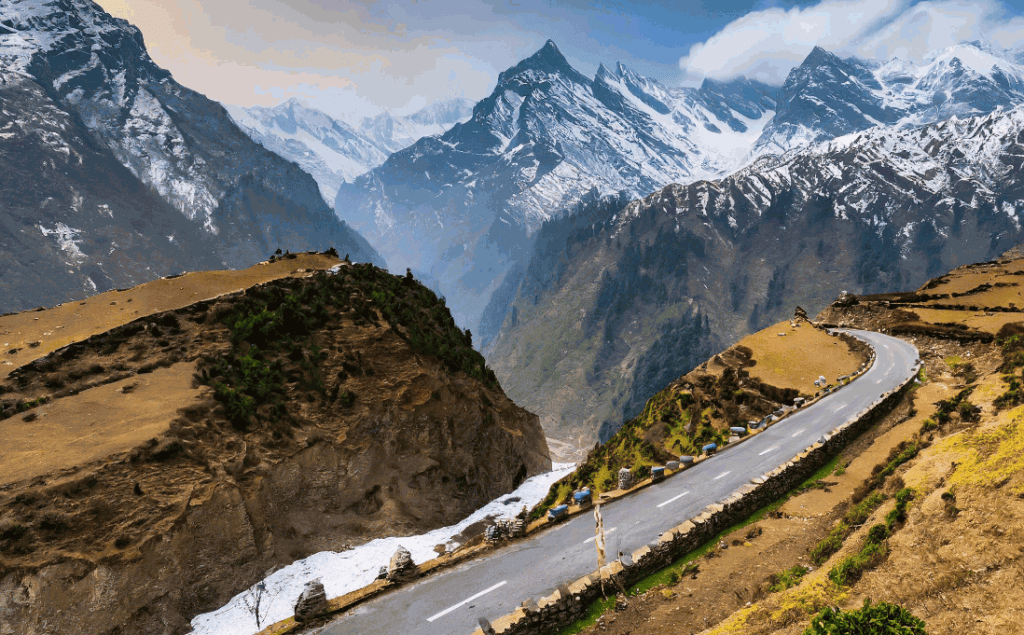
Case Study: McMahon Line
The McMahon Line is a demarcation line acting as the boundary between India and China. It was proposed by British colonial administrator Sir Henry McMahon during the Shimla Convention in 1914 between British India, Tibet, and China to address regional territorial disputes.

International boundaries and frontiers define the spatial limits of sovereign states, dictating jurisdiction and control. Their regulation relies on a complex framework of treaties, customary international law, judicial decisions, and diplomatic practices.
Principles of International Law
The United Nations Charter, the Vienna Convention on the Law of Treaties (1969), and regional agreements provide the legal basis for boundary creation and enforcement:
- Sovereign Equality of States: Each state has the inherent right to define and protect its territory.
- Territorial Integrity: No state should threaten or violate the established territorial boundaries of another.
- Peaceful Settlement of Disputes: Boundary disagreements must be resolved through dialogue, arbitration, or adjudication.
Customary Practices and Treaties
- Bilateral and Multilateral Treaties: Formal legal instruments that codify boundary agreements (e.g., Treaty of Tordesillas, 1494).
- Historical Usage: Long-standing customary practices often help determine contested borders.
Types of Boundaries
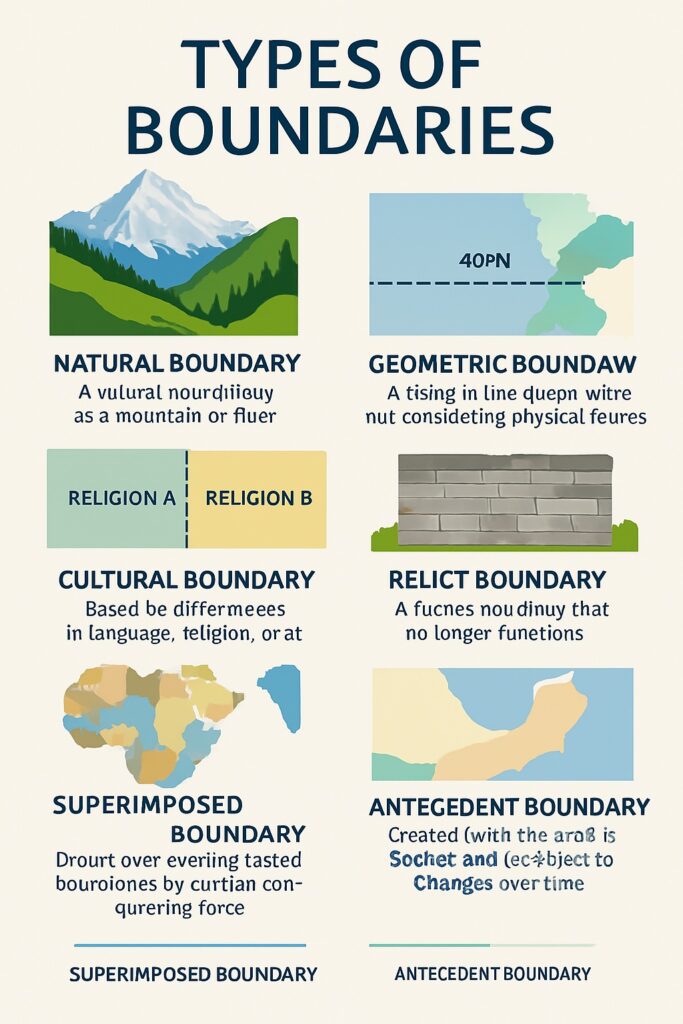
- Natural Boundaries: Rivers, mountains, and deserts (e.g., Himalayas between India and China).
- Geometric Boundaries: Defined by latitude and longitude lines (e.g., US-Canada border along the 49th parallel).
- Relict Boundaries: Borders that are no longer functional but remain visible in the cultural landscape (e.g., Berlin Wall remnants).
- Political Boundaries: Established through diplomatic negotiation or conflict resolution.
Boundary Demarcation and Delimitation
- Delimitation: The legal and cartographic process of describing boundaries in treaties and maps.
- Demarcation: The physical marking of boundaries on the ground using fences, posts, pillars, or walls.
- Maintenance: Ongoing monitoring and upkeep to prevent encroachments and resolve cross-border issues.
Disputes and Conflict Resolution
Boundary disputes arise from ambiguous treaties, colonial legacies, or resource competition. Resolution methods include:
- Negotiation and Mediation: Direct diplomatic talks.
- International Arbitration: Third-party rulings (e.g., Permanent Court of Arbitration).
- Judicial Settlement: Formal rulings by the International Court of Justice (ICJ).
Special Cases and Zones
- Maritime Boundaries: Regulated by the United Nations Convention on the Law of the Sea (UNCLOS).
- Air and Space Boundaries: Governed by international aviation treaties.
- Disputed Territories: Regions claimed by multiple states (e.g., Kashmir, Western Sahara).
Recent Trends and Challenges
- Climate Change: Rising sea levels altering coastline-dependent maritime boundaries.
- Geopolitical Conflicts: Expansionist policies and secessionist movements challenging established borders.
- Technological Advancements: Increased use of satellite imagery, remote sensing, and GIS in precise boundary mapping.
Frontiers: Zones of Transition
A frontier is a geographical zone or area located at the edge of a country, separating it from another country or unclaimed land. Unlike a fixed boundary, a frontier is broad, fluid, and less precise, representing a dynamic zone of transition and cultural exchange.
Key Features of a Frontier
- Undefined or Weakly Defined: Lacks exact legal or political demarcation lines, often stretching across kilometers.
- Zone of Transition: Acts as a meeting space for different cultures, serving as an arena for both conflict and cultural exchange.
- Dynamic in Nature: Can shift over time due to migration, conquest, or political treaties.
- Low State Control: Characterized by a weaker governmental presence, sometimes prone to smuggling or migration.
Types of Frontiers
- Political Frontier: Areas where control between states is contested (e.g., Kashmir).
- Cultural Frontier: Regions situated between distinct ethnic or cultural groups.
- Geographical Frontier: Physical barriers like deserts or mountain ranges.
- Historical Frontier: Associated with exploration and colonization (e.g., the 19th-century American frontier).
Examples of Frontiers
- Afghanistan–Pakistan Border: The Durand Line area functions as a classic frontier due to limited central control and tribal settlements.
- Western Frontier of India: Border regions in Rajasthan and Gujarat have historically been regarded as frontier zones.
Difference Between International Boundary and Frontiers
| Aspect | International Boundary | Frontiers |
|---|---|---|
| Definition | Precise demarcation separating one sovereign state from another | Broader concept encompassing areas along the international boundary where interactions occur |
| Establishment | Established through treaties, agreements, and customary practices | Areas of interaction beyond the boundary line |
| Static/Dynamic | Static and fixed | Dynamic and fluid |
| Regulation | Regulated by international law | Zones of interaction and exchange |
| Characteristics | Legally defined and recognized | Characterized by cultural, economic, social, and political exchanges |
| Examples | The border between India and Pakistan | The frontier regions along the India-Nepal border where cultural exchange occurs |
Conclusion
Understanding both international boundaries and fluid frontier zones is essential for political geography. While boundaries establish legal sovereignty and order, frontiers capture the living, dynamic socio-cultural interactions between nations.