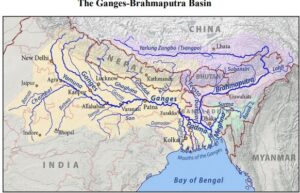
The Teesta River flows through India and Bangladesh over a distance of more than \(414\text{ km}\). Originating in the Himalayas, it serves as a critical right-bank tributary of the Brahmaputra River system.
Geography and Geology of the Teesta River
The Teesta originates from the Pahunri Glacier in Sikkim at an altitude exceeding \(7,000\text{ meters}\). Being snow-fed, its flow is highly seasonal, with peak discharge during the monsoon months and lean flows in winter.
Flora and Fauna
The river basin supports rich biodiversity, including aquatic species such as the golden Mahseer, Trout, and Catfish, alongside avian species like kingfishers, egrets, and herons. Riverbanks feature dense vegetation including Sal, Teak, and bamboo.
Economic Impact
The Teesta River is indispensable for regional agriculture, irrigation, and hydroelectric power generation through multiple power plants established along its course.
Environmental Issues and Water-Sharing Dispute
Dam construction has disrupted downstream flows, threatening fish populations and aquatic ecosystems. Furthermore, untreated industrial waste dumping has severely impacted water quality.
Politically, the river is at the center of a long-standing water-sharing dispute between India and Bangladesh, with Bangladesh seeking a fair allocation of water during the dry season.
Conclusion
The Teesta River is a vital transboundary lifeline supporting regional ecology, agriculture, and power generation, making collaborative environmental and diplomatic management essential.