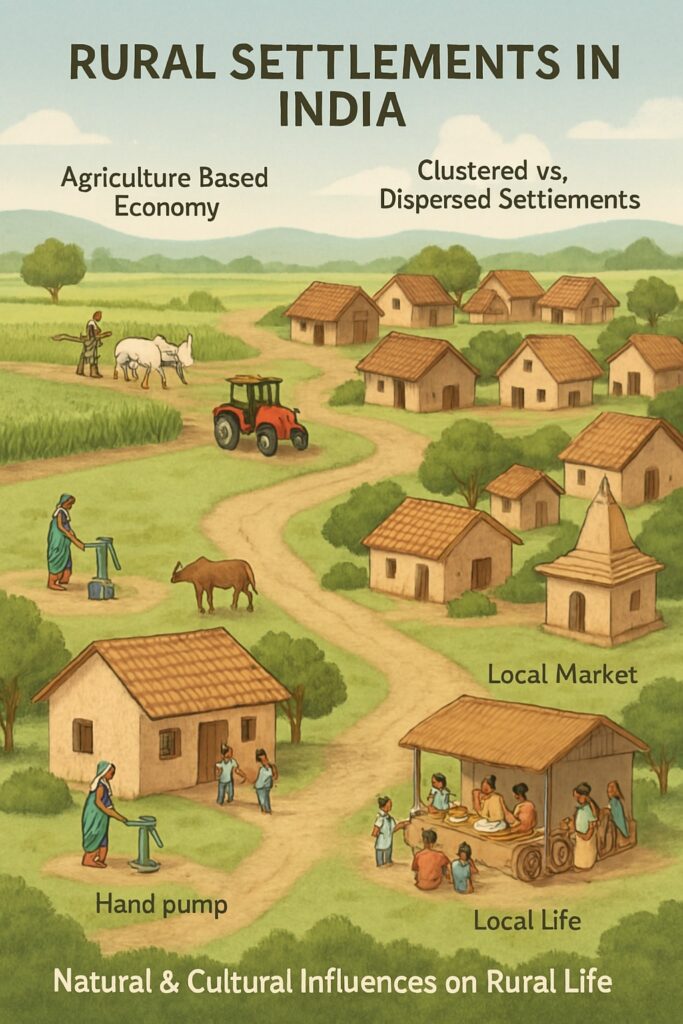
Rural settlements are small communities in non-urban areas where people primarily engage in agriculture and related activities. Their form, structure, and distribution depend on several natural and cultural factors, providing essential insights for regional planning and infrastructure development.
Types of Rural Settlements
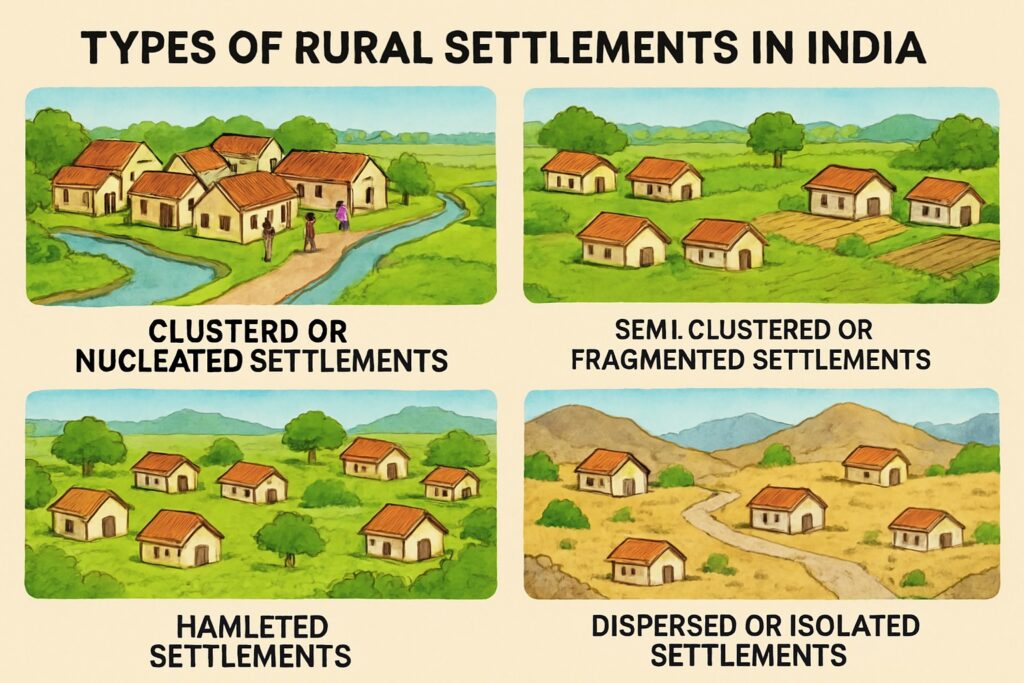
- Clustered or Nucleated Settlements: Compact settlements with houses grouped together in fertile plains with reliable water supply (e.g., villages in Punjab, Uttar Pradesh, and Bihar), offering enhanced social interaction and security.
- Semi-clustered or Fragmented Settlements: Settlements where homes are partly grouped but separated due to land division, social divisions, or family migration during agricultural expansion.
- Hamleted Settlements: Main villages broken into several small hamlets or tolas, often inhabited by specific castes or communities (common in tribal and hilly regions like Jharkhand and Chhattisgarh).
- Dispersed or Isolated Settlements: Houses scattered over large areas near farmland rather than centralized villages, typical in regions with rough terrain, poor soil, or limited water (e.g., parts of Rajasthan and the Himalayas).
Patterns of Rural Settlements
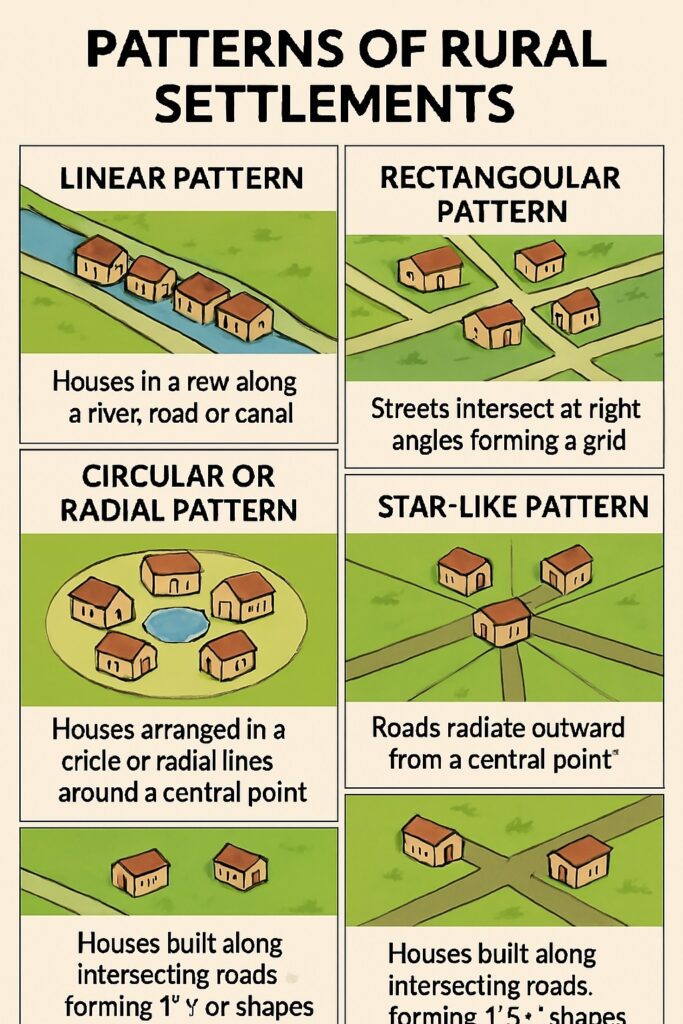
- Linear Pattern: Houses built along transportation routes like roads, rivers, or canals in river valleys and coastal zones.
- Rectangular Pattern: Settlements with streets crossing at right angles in flat areas with planned agricultural fields (e.g., Haryana and Punjab).
- Circular or Radial Pattern: Houses arranged around central features like a temple, pond, or marketplace for easy resource access in drier regions.
- Star-like Pattern: Houses built along routes spreading outward from a central point as road networks expand.
- T-shaped, Y-shaped, or Cross-shaped Pattern: Formed at road junctions or intersections in plain regions with strong transportation links.
Factors Influencing Rural Settlements
- Topography: Mountainous areas favor dispersed settlements, while flat plains support clustered villages.
- Climate and Water Availability: Adequate rainfall and irrigation encourage compact settlement forms.
- Soil Fertility: Fertile agricultural land promotes dense populations and nucleated structures.
- Social and Cultural Practices: Religion, caste systems, and land ownership patterns shape village organization.
- Historical and Security Reasons: Historical threats from wildlife or invaders previously encouraged people to cluster closely together.
Conclusion
Rural settlements reflect how human communities adapt to their surrounding environments and organize their lives around natural resources and cultural traditions. Understanding these settlement types and patterns is essential for effective rural planning and sustainable development.
Quick Knowledge Check
Answer the questions to test your understanding
Important Links