NEET (UG) Solved Papers Portal
Practice authentic previous years' questions for Physics, Chemistry, Botany, and Zoology with step-by-step NCERT-aligned solutions and full-width diagram references.
All NEET UG Papers / All Subjects / All Chapters
Marking pattern: +4.00 positive, -1.00 negative (Official NTA NEET Scheme).
The speed of light in vacuum is taken as unity. If light takes 6 min 40 s to reach the Earth from the Sun, the distance between the Sun and the Earth in new unit is:
Match List I with List II:
| List I | List II |
|---|---|
| A. Young's Modulus | I. $$\frac{\Delta d}{\Delta L}\left(\frac{L}{d}\right)$$ |
| B. Compressibility | II. $$\frac{FL}{A(\Delta L)}$$ |
| C. Bulk Modulus | III. $$-\frac{1}{\Delta P}\left(\frac{\Delta V}{V}\right)$$ |
| D. Poisson's Ratio | IV. $$-P\left(\frac{V}{\Delta V}\right)$$ |
Choose the correct answer from the options given below:
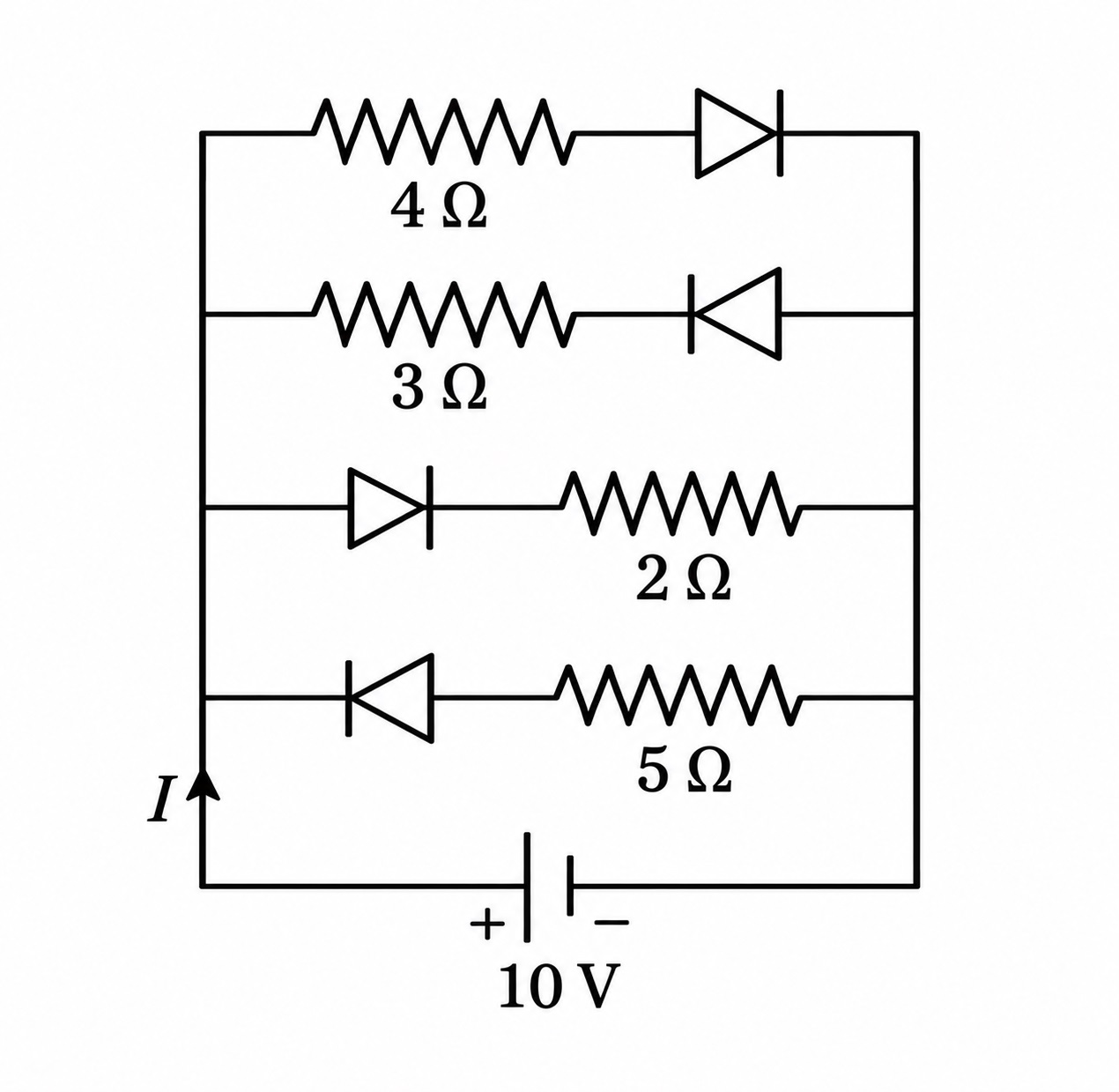
The current I in the circuit shown below is:
(All diodes are ideal and identical)
The angular speed of a flywheel is increased from 600 rpm to 1200 rpm in 10 s. The number of revolutions completed by the flywheel during this time is:
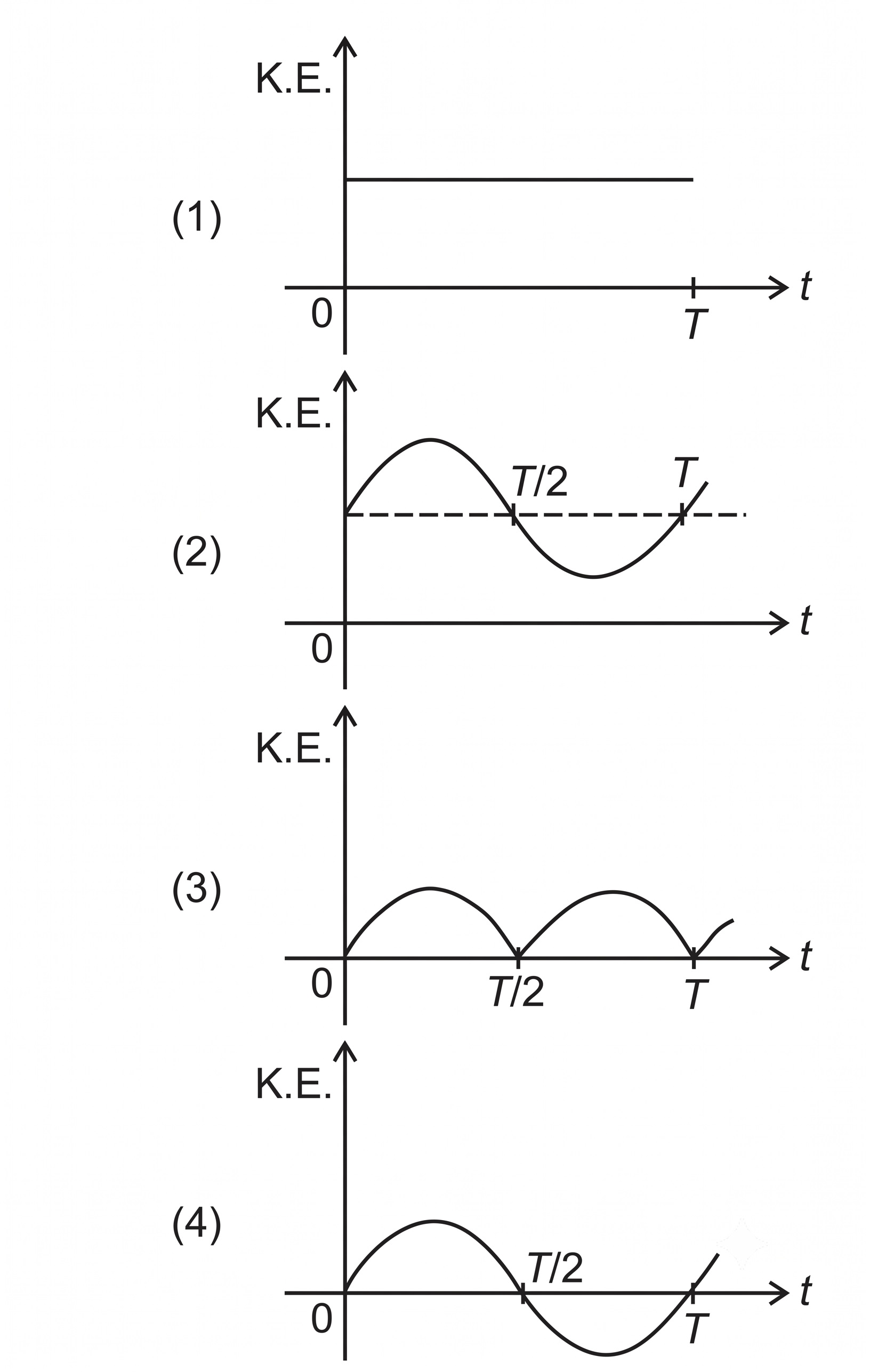
For a simple pendulum, having time period T, the variation of kinetic energy (K.E.) with time (t) is represented by:
A resistor is connected to a battery of 12 V emf and internal resistance 2 Ω. If the current in the circuit is 0.6 A, the terminal voltage of the battery is:
A flask contains argon and chlorine in the ratio of 2:1 by mass. The temperature of the mixture is 27°C. The ratio of root mean square speed of the molecules of the two gases $$\left(\frac{v_{rms}^{Ar}}{v_{rms}^{Cl}}\right)$$ is:
(Atomic mass of argon = 40.0 u and molecular mass of chlorine = 70.0 u)
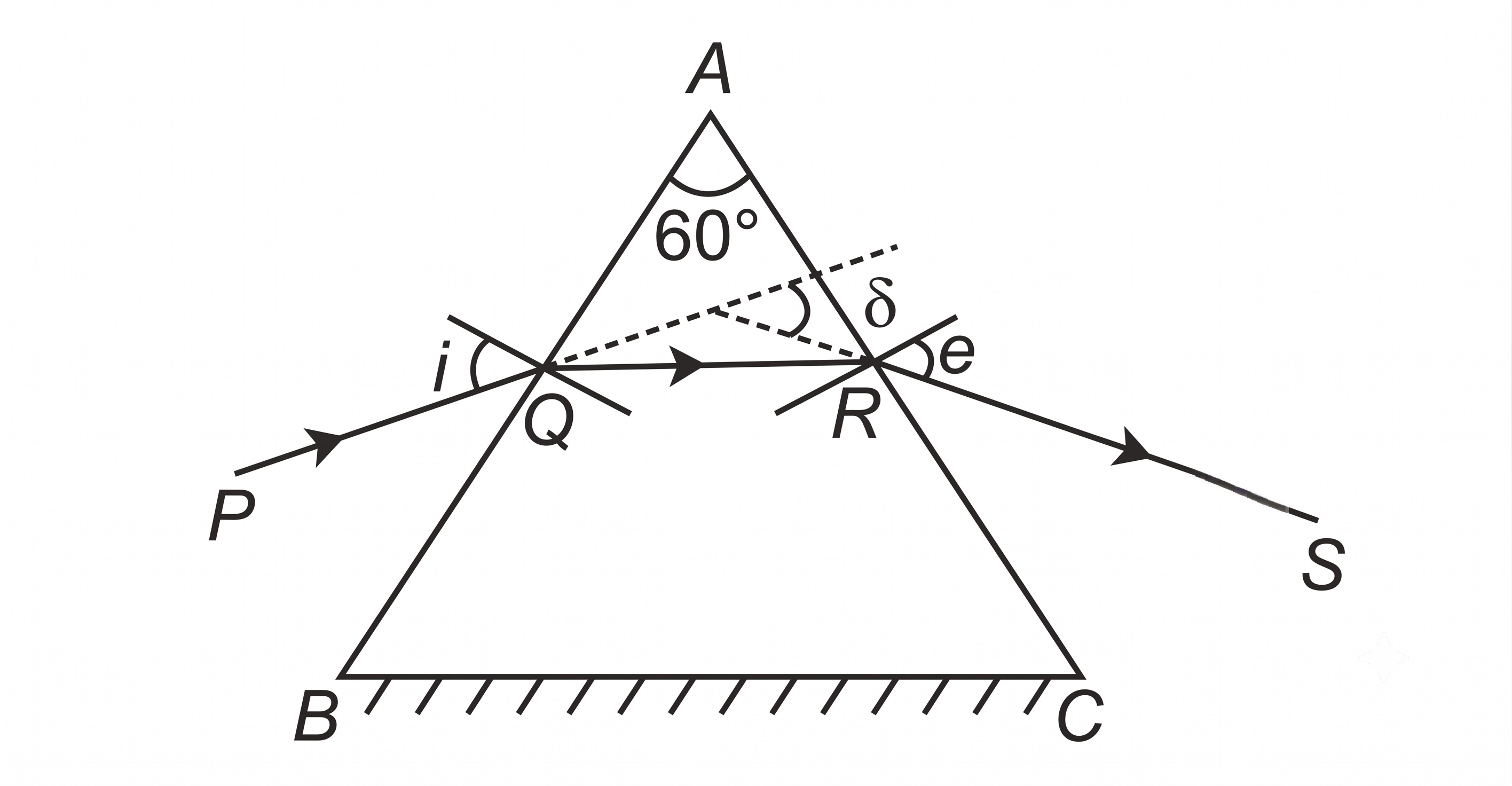
A ray of monochromatic light is passing through an equilateral prism (ABC) as shown in the figure. The refracted ray (QR) is parallel to its base (BC) and the angle of incidence (i) is 50°. Then the angle of deviation (δ) is:
Match List I with List II:
| List-I | List-II |
|---|---|
| A. $E = h\nu$ | I. de Broglie wavelength |
| B. Diffraction and Interference | II. Particle nature of light |
| C. $\lambda = h/p$ | III. Wave nature of light |
| D. Compton effect | IV. Energy of photon |
Choose the correct answer from the options given below.
In the first excited state of hydrogen atom, the energy of its electron is -3.4 eV. The radial distance of the electron from the hydrogen nucleus in this case is approximately:
(Take $1\text{ eV} = 1.6 \times 10^{-19}\text{ J}$, $e = 1.6 \times 10^{-19}\text{ C}$ and $\frac{1}{4\pi\varepsilon_0} = 9 \times 10^9\text{ N m}^2/\text{C}^2$)
A box of mass 15 kg is kept on the floor of a stationary trolley. The coefficient of static friction between the box and the trolley is 0.12. Keeping the box in stationary state over the trolley, the maximum acceleration with which the trolley can be moved horizontally in m s⁻² is:
(g = 10 m/s²)
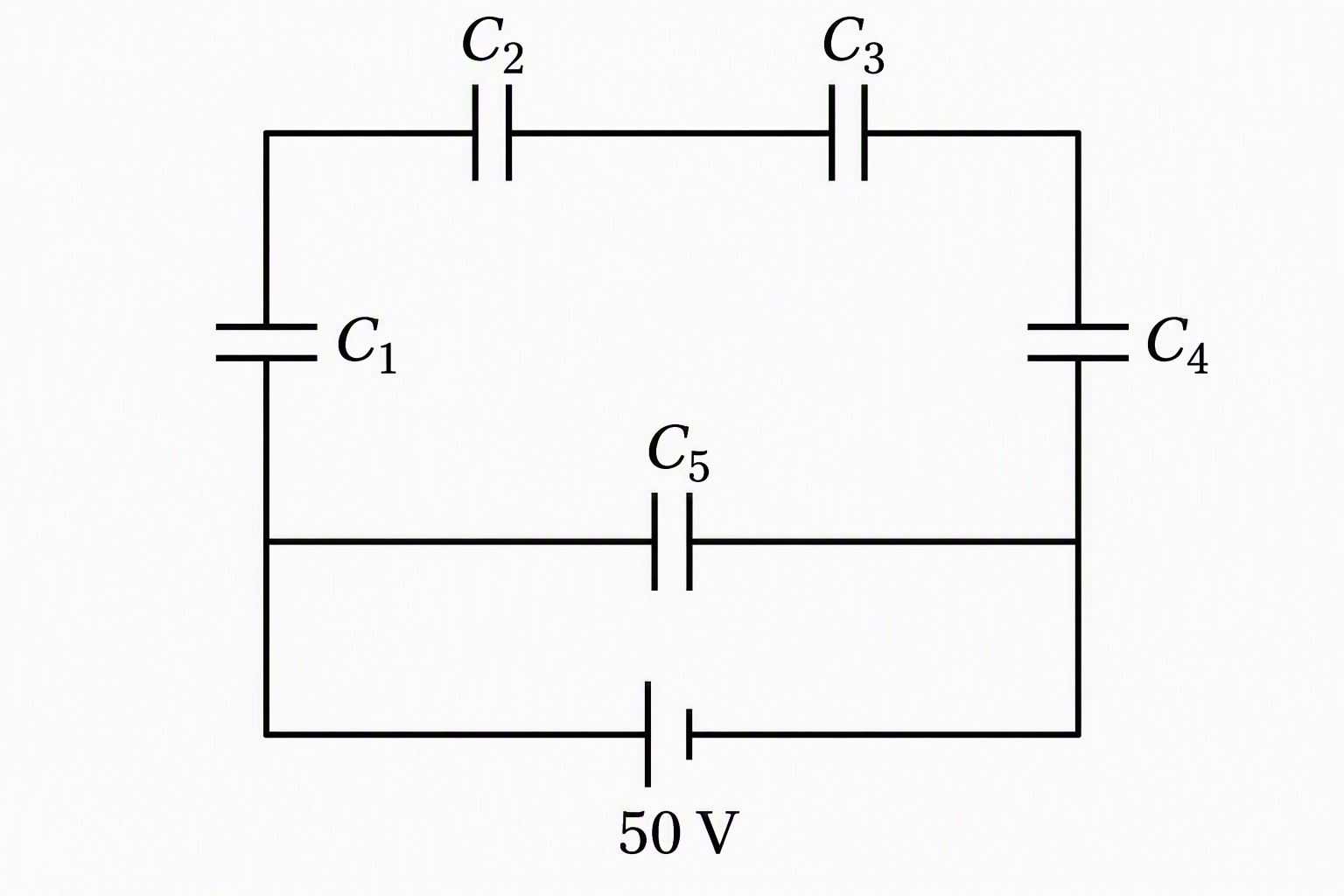
Five capacitors of capacitances C₁ = C₂ = C₃ = C₄ = 10 μF and C₅ = 2.5 μF are connected as shown, along with a battery of 50 V. The equivalent capacitance and the charges on each capacitor respectively are:
The amount of work done to raise a mass 'm' from the surface of the Earth to a height equal to the radius of the Earth 'R' will be
Each side of a metallic cube of mass 5.580 kg is measured to the 9.0 cm. Keeping the significant figures in view, the density of the material of the cube can be best expressed as $X \times 10^3\text{ kg m}^{-3}$ where the value of X is:
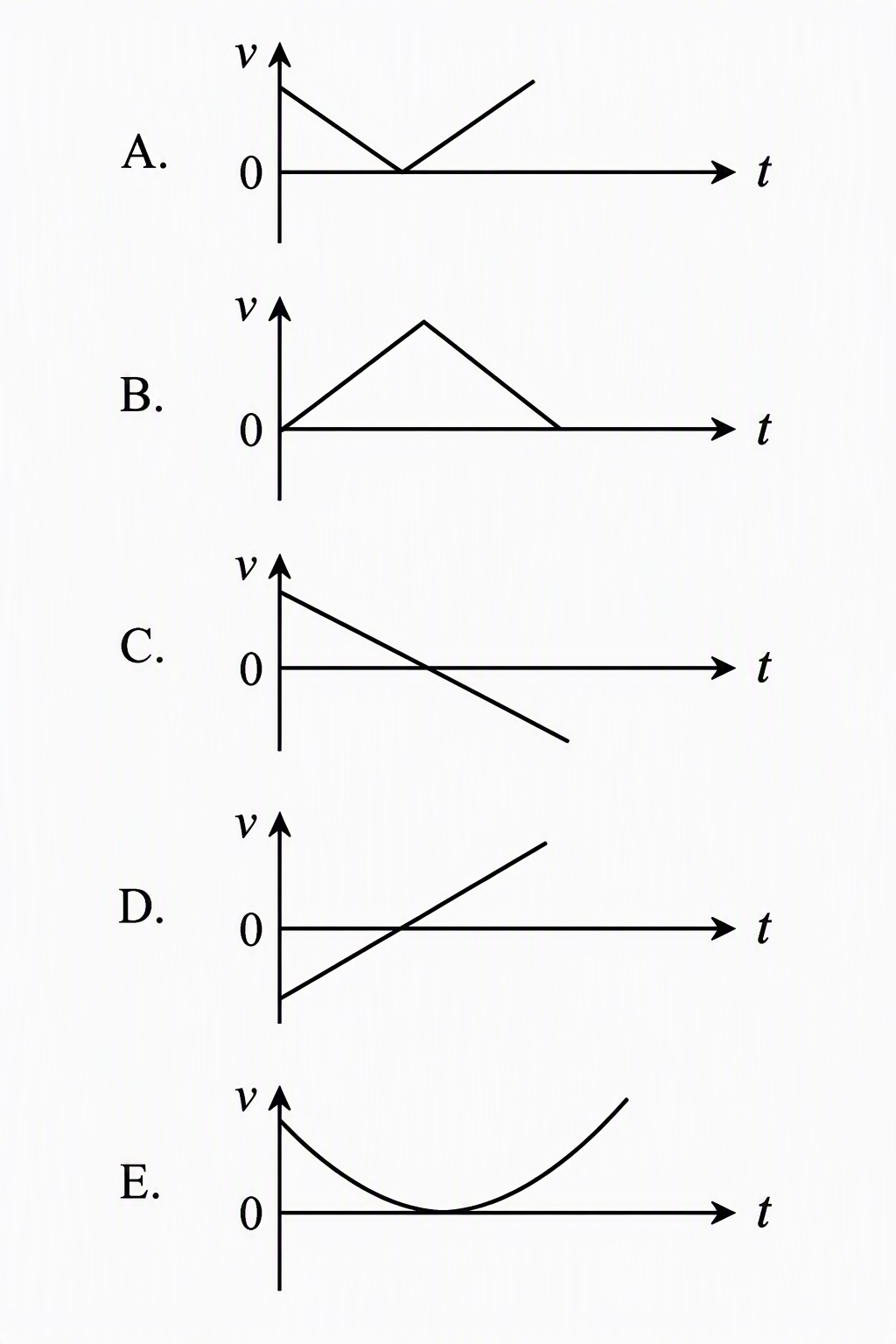
The following plots show variation of velocity (v) with time (t) of a ball thrown vertically upward, and falling back. Which of the following plots is/are correct?
The sum of kinetic energy and potential energy of a simple pendulum bob is 0.02 joule. The speed of the simple pendulum bob at equilibrium position is approximately:
(Consider mass of the bob = 20 g)
In Young's double slit experiment, using monochromatic light of wavelength λ, the intensity of light at a point on the screen where the path difference is λ, is K units. The intensity of light at a point where the path difference is λ/3 will be
In the circuit shown below, the voltage appearing across the diode D will be of the form:
An ac circuit contains a resistance of 1 Ω, a capacitor of 0.1 μF and an inductor of 1 mH connected in series. The resonance frequency of the circuit is approximately:
In interference and diffraction, the light energy is redistributed. If it reduces in one region, producing a dark fringe, it increases in another region, producing a bright fringe.
A. As there is no gain or loss of energy, these phenomena are consistent with the principle of conservation of energy.
B. Diffraction and interference are characteristics exhibited only by light waves.
Choose the correct answer from the options given below:
For a travelling harmonic wave $$y(x,t) = 2.0 \cos 2\pi(10t - 0.0080x + 0.35)$$, where x and y are in cm and t in s. The phase difference between oscillatory motion of two points separated by a distance of 0.5 m is:
The magnitude and direction of the acceleration produced in a body of mass 5 kg when two mutually perpendicular forces 8 N and 6 N act on it, are respectively:
Consider two uncharged capacitors of equal capacitance 200 pF. One of them is charged by a 100 V supply and disconnected. Now this capacitor is connected to the uncharged capacitor. The amount of electrostatic energy lost in the process is:
The power of a crane, which lifts a mass of 1000 kg to a height of 20 m in 10 s is:
(g = 9.8 m/s²)
In a vernier calliper, 20 VSD coincide with 16 MSD (each division of length 1 mm). The least count of the vernier callipers is: