ISRO Scientist/Engineer EE Solved Papers
Prepare for ISRO ICRB examinations with worked engineering solutions across Control Systems, Electrical Machines, Power Systems, Power Electronics, Signals & Systems, and Network Theory.
All ISRO EE PYQs / All EE Subjects / All Topics
Marking scheme: +3.00 positive, -0.75 negative (ICRB Standard).
V curves for a synchronous motor represent the relation between:
Which of the following is the reason behind an ideal synchronous motor not developing any starting torque?
Determine pitch factor for winding: 36 stator slots, 4 poles, coil span 1 to 6.
The ratio of starting torque to running torque in a synchronous motor is:
Which of the following is a characteristic of ideal transformer?
What type of transformer is used in AC welding?
Ratio of EMF between triplex lap winding and wave winding for same power is:
The number of terminals to be interchanged to reverse the direction of rotating magnetic field for a 5-phase windings and 5-phase currents are:
A 3-phase, $400\text{ V}$, $50\text{ Hz}$, 4-pole slip ring induction motor is excited with rated voltage and rated frequency. A centre zero ammeter is connected in the rotor circuit and it has been observed that it is completing $90$ oscillations per minute. What is the speed of rotor field in rpm?
A 3-phase, 6-pole, $400\text{ V}$ slip ring induction motor is running at a speed of $960\text{ rpm}$. What is the additional resistance required in rotor circuit to reduce the speed by $10\%$, if rotor resistance is $0.2\,\Omega$?
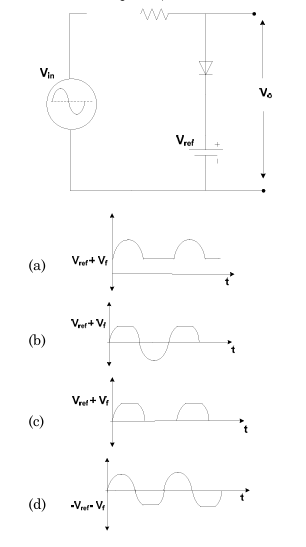
Find the voltage at $V_o$ (assume $V_{\text{in}} \gg V_{\text{ref}}$ and diode drop is $V_f$):
For a current series negative feedback amplifier, the effective output resistance:
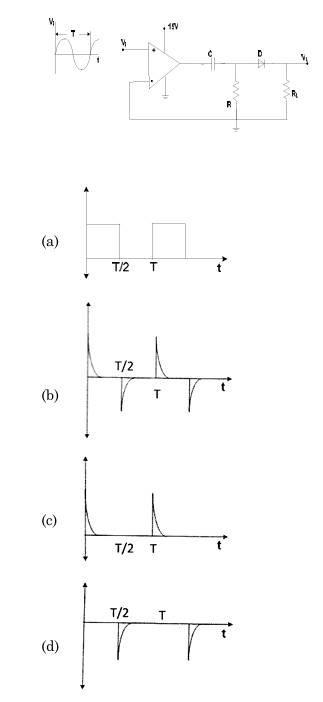
Find the output voltage at $V_L$ for the following circuit:
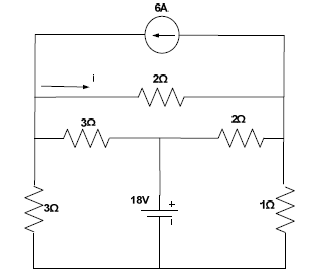
Find i in the following figure.
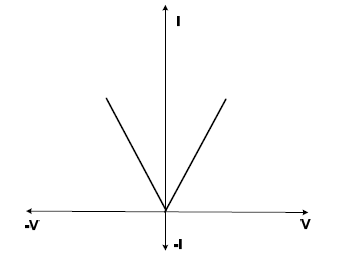
The VI characteristics of a particular component is shown in Figure. Identify the component
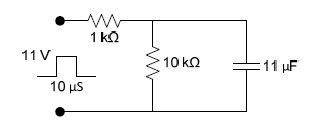
An 11 V pulse of 10 micro second duration is applied to the circuit in the given figure. Assuming that the capacitor is completely discharged prior to applying the pulse, the peak value of the capacitor voltage is
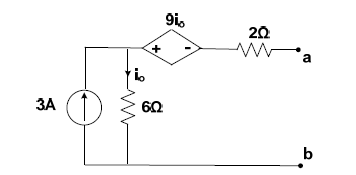
What is the Norton resistance across terminals a and b for the circuit given below?
An ideal voltage source is connected in parallel to an ideal current source, then its combination has
The energy stored in the magnetic field at a solenoid 50 cm long and 5 cm diameter wound with 1000 turns of wire carrying a current at 10 A is
Which one of the following combinations of open circuit voltage and the Thevenin's equivalent resistance represents the Thevenin's equivalent of the circuit shown in the given figure?
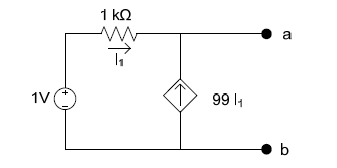
For the circuit in the given figure, the voltage Vo is
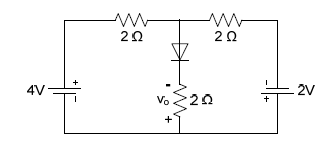
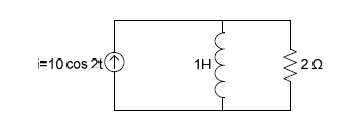
The phasor current through the inductance in the given circuit shown is
Which of the signals/systems are non-causal in nature?
(A) $y(n)=x(n^2)$
(B) $y(n)=(0.4)^n x(n)$
(C) $y(n)=[x(n)+x(n-1)+x(n+1)]/3$
(D) $y(n)=x(n)+x(n-4)$
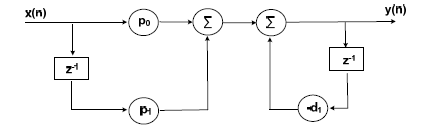
For the given digital filter, evaluate $Y(z)/X(z)$ where $p_0$, $p_1$ and $d_1$ are scalar and $z^{-1}$ represents delay element of time
$\frac{d}{dx}\sin^{-1}(3x-4x^3)$