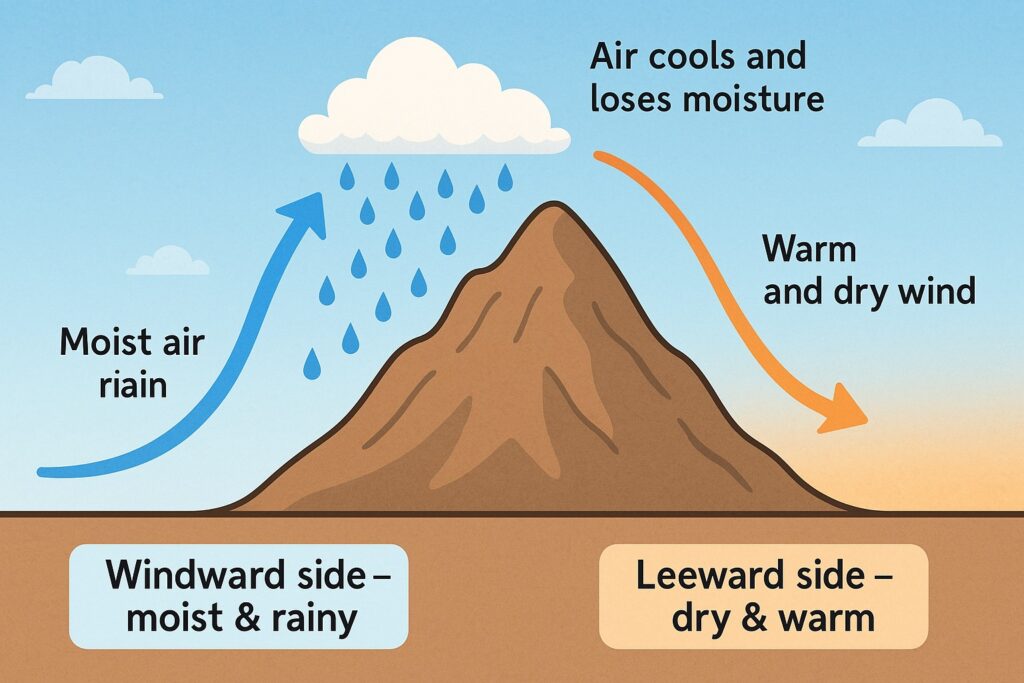
The Foehn wind (also associated with regional variants like Chinooks or Santa Anas) is a warm and dry wind generated when moist air is forced to ascend over a mountain barrier, releasing precipitation on the windward side and descending as a warm, dry air stream on the leeward slope. This phenomenon is prominent in major mountain ranges such as the Alps and the Rockies.
What is a Foehn Wind?
A Foehn wind is a dry, warm downslope wind that occurs on the leeward side of mountain ranges. As moisture-laden air ascends the windward slope, it cools and releases its moisture as orographic precipitation. Upon crossing the crest and descending the leeward slope, the air compresses and warms rapidly, resulting in hot and dry conditions.
Causes of Foehn Wind
The primary mechanism behind the Foehn wind is the orographic lifting of moist air over topographical obstacles. The latent heat released during condensation on the windward side, combined with adiabatic warming during descent on the leeward side, produces temperatures significantly higher than the starting elevation.
Impacts of Foehn Wind
Foehn winds carry both beneficial and adverse environmental and societal effects:
- Positive Impacts: Elevates local temperatures and creates dry conditions that can aid agricultural schedules and outdoor activities; helps clear stagnant air pollutants, improving regional air quality.
- Negative Impacts: The severe dryness and elevated heat dramatically increase wildfire risks by drying out vegetation; high-velocity gusts can also cause structural damage to buildings and infrastructure.
Mitigation and Preparedness
Managing the risks associated with Foehn winds requires proactive planning, including:
- Real-time meteorological monitoring and timely public hazard warnings.
- Implementing sound land management practices to reduce wildfire fuel loads.
- Designing resilient infrastructure capable of withstanding extreme dry wind conditions.
Conclusion
The Foehn wind is a powerful natural weather phenomenon with dual ecological impacts. Understanding its thermodynamic drivers enables communities to harness its seasonal benefits while mitigating risks like wildfires and structural damage.