In India, land use has undergone significant transformation due to population growth, economic development, urbanisation, and policy reforms. Land use refers to how land is utilised by humans—for agriculture, forestry, settlement, industry, transport, etc.—influenced by both physical and human factors.
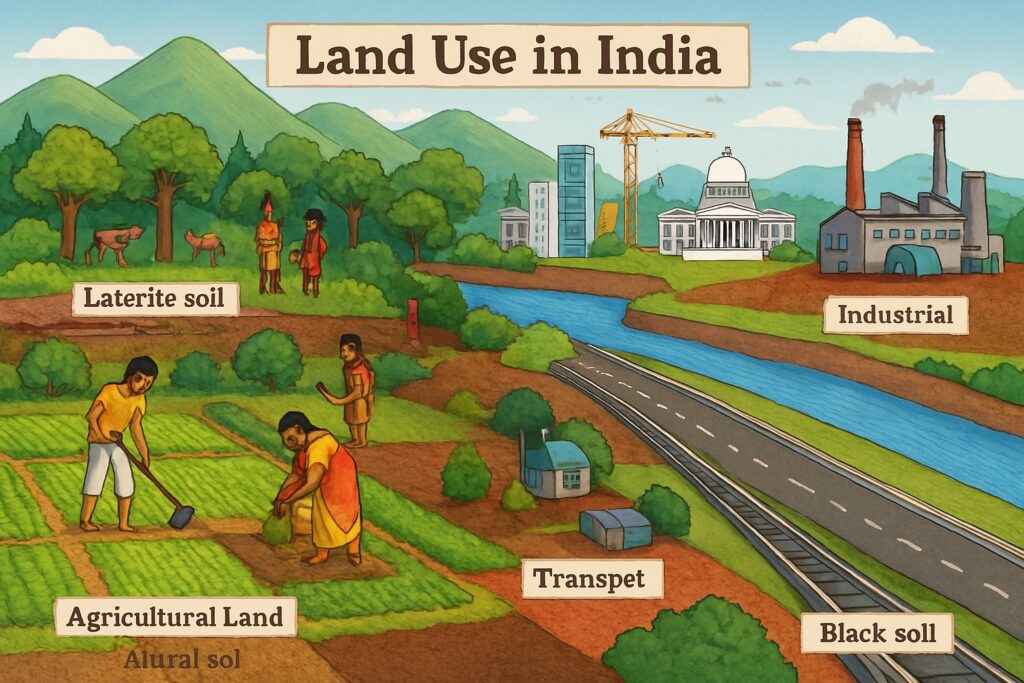
Major Changes in Land Use Patterns in India
- Decline and Recovery in Forest Area: Historical deforestation during colonial and early post-independence periods has been partially countered by afforestation initiatives, the Forest Conservation Act (1980), and CAMPA funds.
- Expansion of Agricultural Land: Net sown area increased post-Green Revolution (1960s) in northern states, though per capita agricultural land has declined due to demographic pressure.
- Rapid Urbanisation: Expansion of towns and cities has encroached upon fertile peri-urban agricultural acreage around metropolitan hubs like Delhi (NCR), Mumbai, and Bengaluru.
- Industrial and Infrastructure Development: Large-scale projects, Special Economic Zones (SEZs), and corridors like the Delhi-Mumbai Industrial Corridor (DMIC) have altered regional land dynamics.
- Wasteland Reclamation: Soil conservation and watershed management programs have converted barren land into productive agricultural or forested areas.
- Shrinking Common Property Resources: Village commons, grazing lands, and wetlands have contracted due to encroachment and privatization.
Driving Factors and Regional Variations
Land use transformations are driven by population growth, economic structural shifts, technological advancements, policy interventions, and climate change. Geographically, these patterns vary sharply:
- Indo-Gangetic Plain: High cultivation intensity with minimal fallow or wasteland.
- Peninsular Plateau: Mixed land use featuring agriculture, forests, and mineral extraction zones.
- North-East and Himalayan States: Dominated by shifting cultivation and forest-dependent livelihoods.
- Coastal Regions: Rapid urban-industrial expansion and aquaculture development.
Conclusion
India's shift from traditional agricultural dominance to a diversified economy highlights the critical need to balance growth with environmental sustainability and equity through advanced tools like remote sensing and GIS.