The shape of the Earth's surface is constantly evolving due to two primary natural forces: weathering, which breaks down rocks in place, and gradation, which transports weathered rock debris across landscapes via rivers, wind, glaciers, and waves.
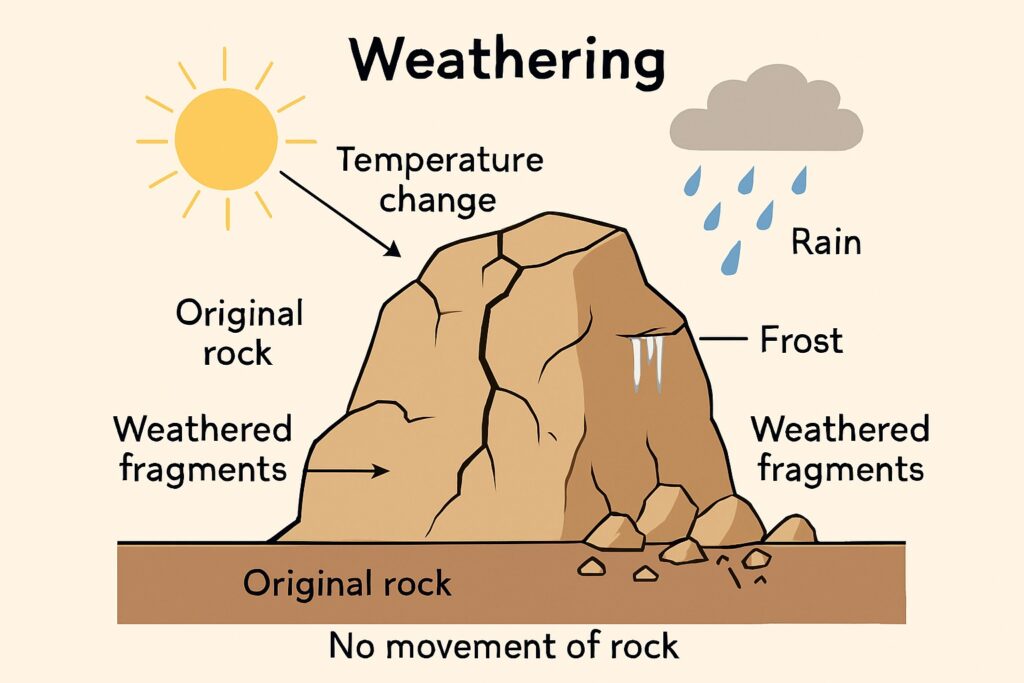
What is Weathering?
Weathering is the in-situ breakdown of rocks exposed at the Earth's surface driven by atmospheric conditions such as temperature fluctuations, rainfall, frost, and biological activity, without transporting the resulting debris.
Types of Weathering
Based on the mechanism of breakdown, weathering is divided into three primary categories:
1. Mechanical Weathering
Breaks rocks into smaller fragments without altering their chemical composition, common in dry or cold regions:
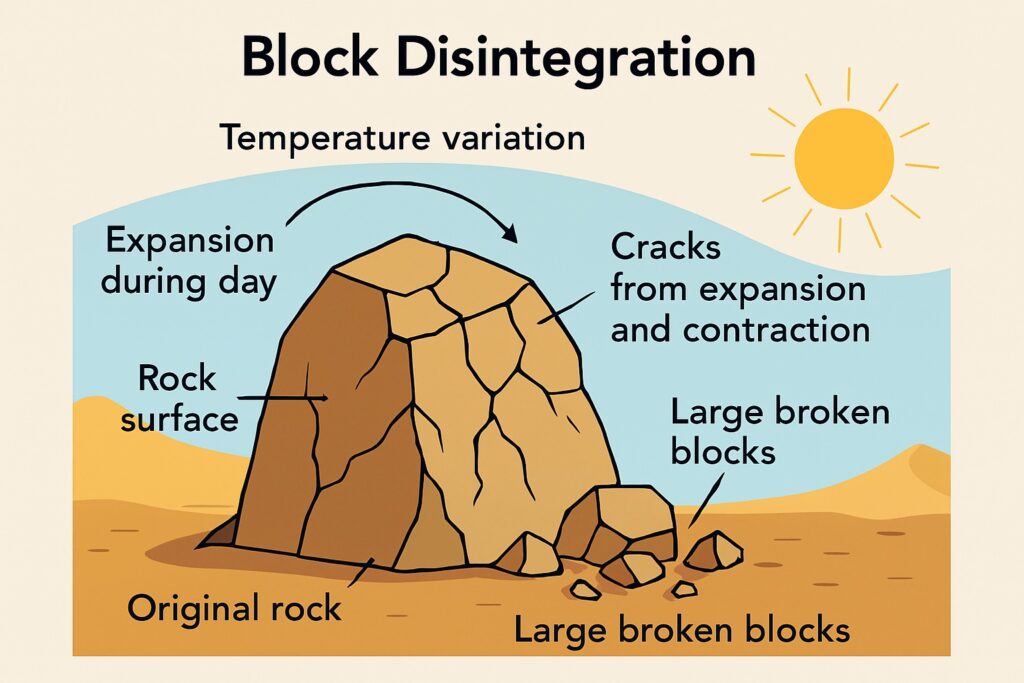
- Block Disintegration: Thermal expansion and contraction in hot deserts cause rocks to fracture into large blocks.
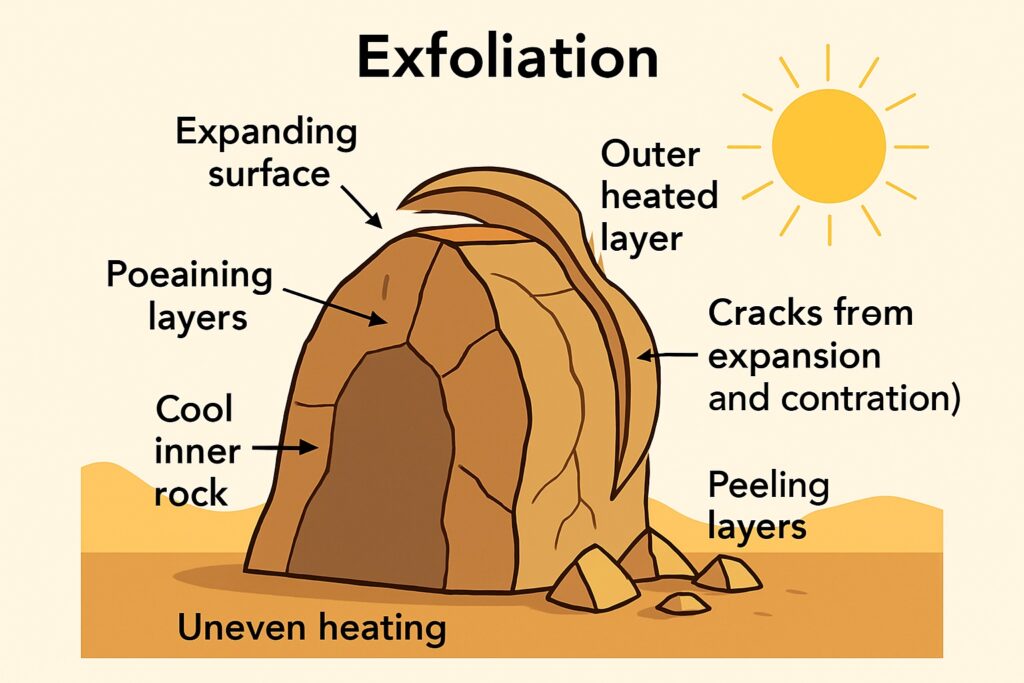
- Exfoliation: Outer rock layers heat up and peel off in concentric shells (onion-skin weathering), observable at Mahabalipuram and Jabalpur.
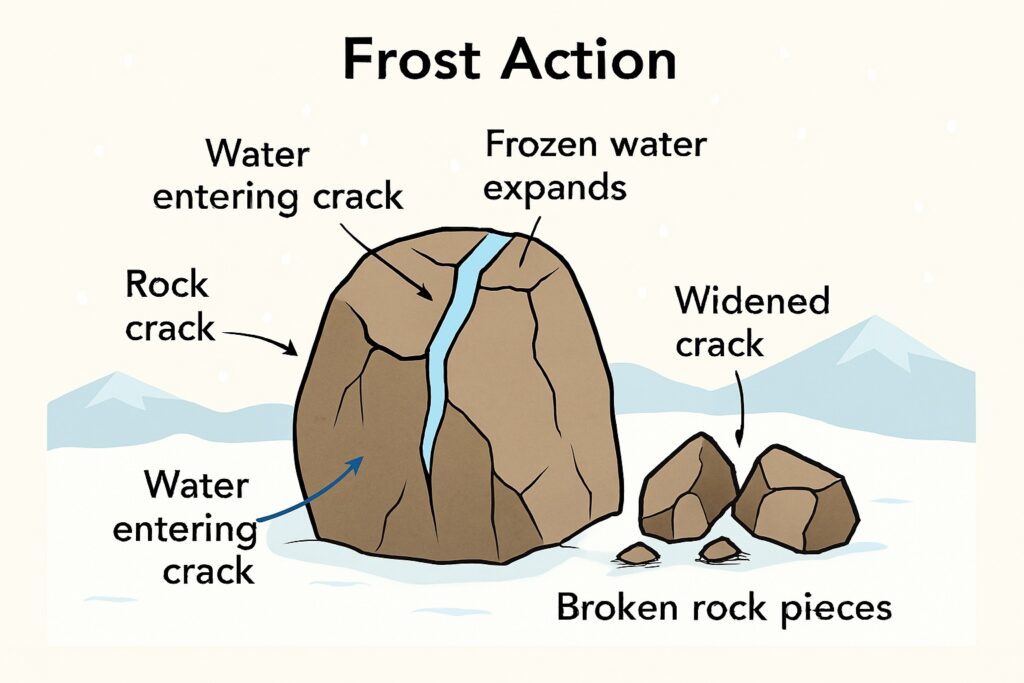
- Frost Action: Water freezes inside rock crevices, expanding and wedging the cracks wider over repeated freeze-thaw cycles.
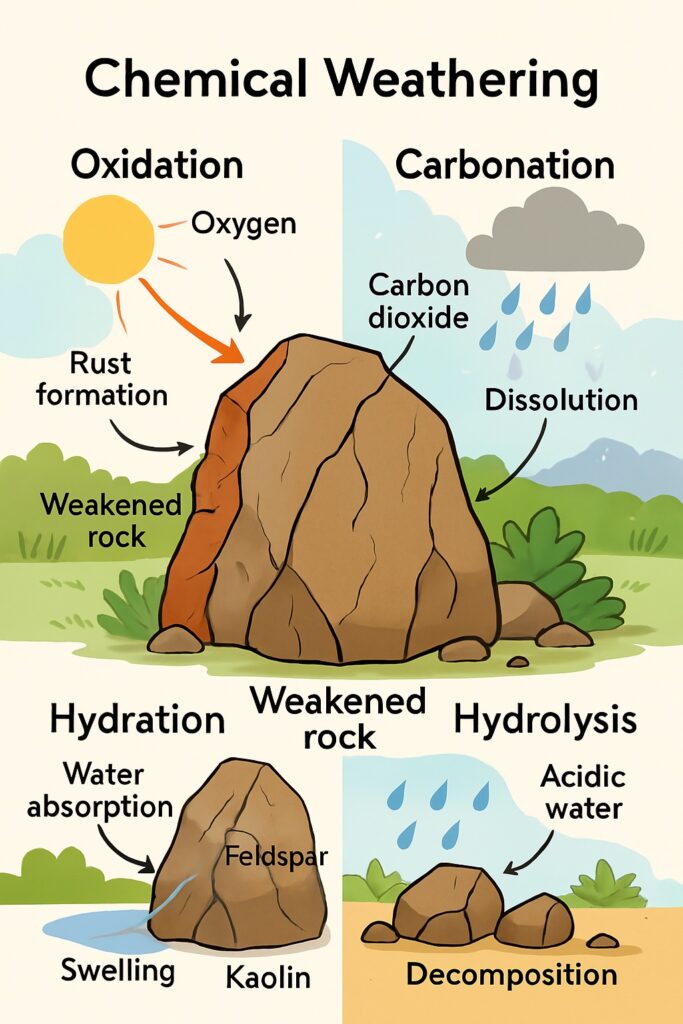
2. Chemical Weathering
Alters the chemical structure of rocks through agents like water, oxygen, and carbon dioxide, prominent in warm and humid climates:
- Oxidation: Oxygen reacts with iron-rich minerals to form rust, weakening the rock.
- Carbonation: Carbonic acid ($\text{H}_2\text{CO}_3$) forms when rainwater absorbs $\text{CO}_2$, dissolving carbonate rocks like limestone.
- Hydration: Minerals absorb water, swelling and weakening (e.g., feldspar converting to kaolin clay).
- Solution: Soluble minerals like rock salt and gypsum dissolve directly in water.
3. Biotic Weathering
Driven by living organisms:
- Plants: Roots wedge into rock crevices, mechanically splitting them apart.
- Animals: Burrowing creatures (earthworms, termites, ants) loosen material and aid pedogenesis.
- Humans: Agricultural activities, mining, and infrastructure development accelerate rock breakdown.
Gradation and Land Leveling
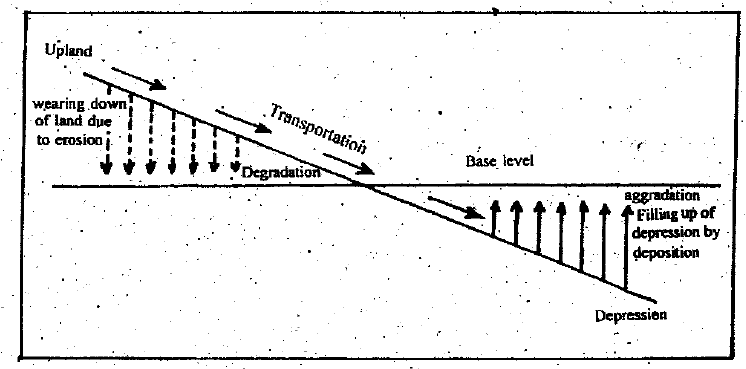
Gradation is the natural leveling of the Earth's surface through degradation (lowering high areas via erosion) and aggradation (raising low areas via deposition) executed by external geomorphic agents like rivers, winds, glaciers, and waves.
How Soil Forms (Pedogenesis)
Soil is a thin upper layer comprising mineral particles, organic matter, water, and air, controlled by five key factors:
- Passive Factors: Parent Rock (determines mineral composition and texture), Relief (slope steepness affects runoff and soil depth), and Time (pedogenesis requires long durations to reach maturity).
- Active Factors: Climate (controls weathering rates and organic decay) and Biological Activity (plants and animals contribute nutrient-rich humus).
Conclusion
Weathering and gradation are continuous geological processes that sculpt Earth's topography, drive landscape evolution, and produce life-sustaining soils essential for global ecosystems and agriculture.