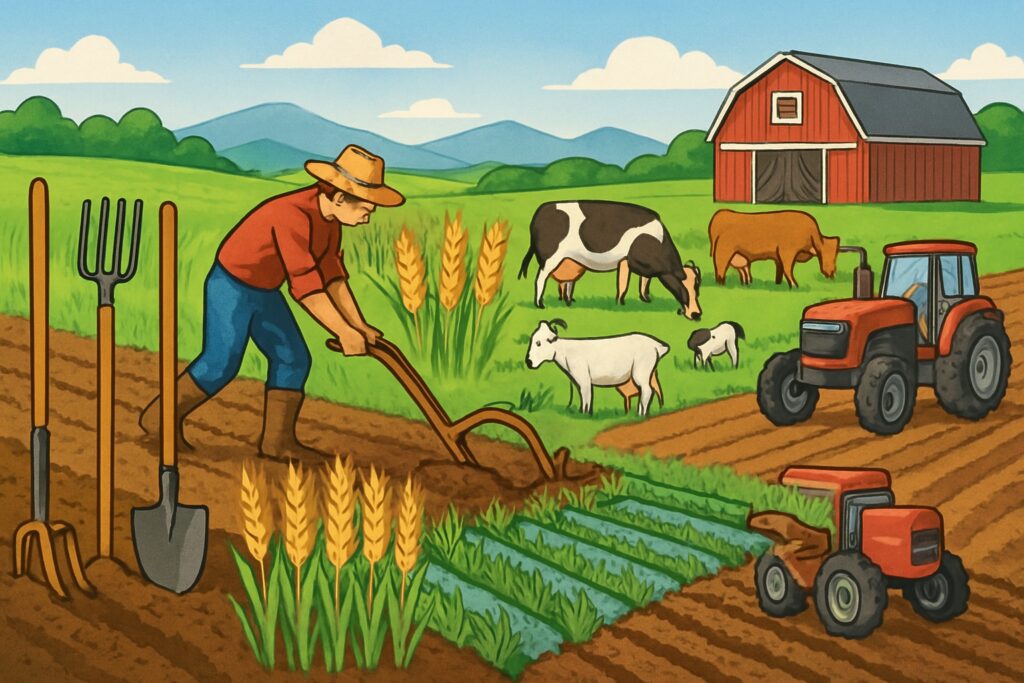
World agriculture is categorized into various types based on climate, farming practices, and economic factors. As the practice of cultivating soil, growing crops, and raising animals for food and fiber, agriculture forms the fundamental backbone of food security and rural economies worldwide.
Importance of Agriculture
- Primary Livelihood: Supports millions globally, particularly in developing nations.
- Source of Essentials: Provides vital food supplies, raw materials (cotton, rubber, sugar), and industrial inputs.
- Economic Contribution: Drives GDP and employment across numerous countries.
- Rural Development: Serves as the foundation for regional transformation and socioeconomic progress.
Types of Agriculture
- Subsistence Agriculture: Grown mainly for family consumption; characterized by small plots and traditional tools in Africa, South Asia, and Latin America.
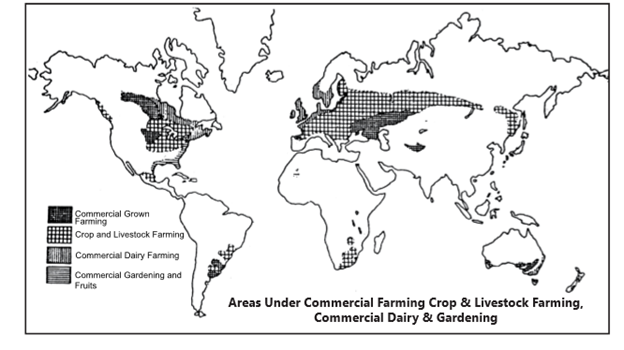
- Commercial Agriculture: High-input, mechanized, large-scale farming oriented toward domestic and export markets (USA, Canada, Europe, Australia).
- Shifting Cultivation: Tropical forest practice involving slash-and-burn vegetation clearing followed by fallow periods.
- Plantation Agriculture: Large estates focusing on single cash crops (tea, coffee, rubber) in tropical, export-oriented regions.
- Mixed Farming: Combined crop cultivation and livestock rearing providing economic stability.
- Pastoralism: Animal herding (nomadic or settled) practiced in arid and semi-arid regions.
- Intensive vs. Extensive Farming: High input/output per unit area vs. low input/output spread across large tracts of land.
Major Agricultural Regions of the World
- Monsoon Asia: Intensive rice cultivation.
- North America: Wheat, maize, and commercial livestock.
- Mediterranean: Grapes, olives, and citrus fruits.
- Europe: Mixed farming and dairy production.
- Tropical Africa: Subsistence farming alongside cocoa and coffee production.
- Latin America: Sugarcane, bananas, and soybeans.
Derwent Whittlesey’s Classification of Agricultural Regions
Proposed in 1936 by American geographer Derwent Whittlesey, this comprehensive typology divides world agriculture into 13 major agricultural regions based on physical environment, farming practices, crops grown, and economic development:
A. Six Agricultural Regions in Developed Countries
- Dairying: Northeastern USA, Northwestern Europe, New Zealand (focused on milk and dairy products near urban markets).
- Mixed Crop and Livestock Farming: Midwest USA, parts of Europe (integrating corn, soybeans, cattle, and pigs).
- Grain Farming: Great Plains of USA, Canada, Russia, Australia (highly mechanized commercial wheat and barley production).
- Livestock Ranching: Western USA, Argentina, Australia, Central Asia (extensive cattle and sheep grazing).
- Mediterranean Agriculture: Mediterranean Basin, California, Chile, South Africa, SW Australia (grapes, olives, citrus adapted to dry summers).
- Commercial Gardening and Fruit Farming (Truck Farming): Southeast USA, Europe (market-oriented vegetable and fruit production).
B. Seven Agricultural Regions in Developing Countries
- Shifting Cultivation: Tropical forests of Africa, Southeast Asia, Amazon (slash-and-burn yam, cassava, millets).
- Pastoral Nomadism: North Africa, Middle East, Central Asia (mobile camel, goat, and sheep herding in harsh climates).
- Intensive Subsistence Agriculture (Wet Rice Dominant): East, South, Southeast Asia (labor-intensive small plots focused on rice).
- Intensive Subsistence Agriculture (Not Wet Rice): Interior India, Northeast China (wheat, barley, millets in drier/colder regions).
- Plantation Farming: Latin America, Africa, Southeast Asia (export-oriented monoculture of tea, coffee, sugarcane, bananas).
- Commercial Grain-Livestock Farming: Transitional areas in developing regions approaching commercial scale.
- Sparse or No Agriculture: Deserts and Arctic regions with harsh climates and poor soil.
Significance: Whittlesey's classification helps analyze global spatial patterns, compare traditional versus modern practices, and understand how climate, culture, and economy shape agriculture.
Challenges and Modern Trends in Agriculture
Challenges: Climate change and weather extremes, soil degradation, water scarcity, unequal technology access, and price volatility in global trade.
Modern Trends: The Green Revolution (high-yield varieties and chemicals), organic farming, precision farming (GPS, sensors, and data analytics), agroforestry, climate-smart agriculture, and the rise of agribusiness supply chains.
Conclusion
World agriculture is dynamic and diverse, shaped by environmental, technological, and socioeconomic factors. Transitioning toward sustainable and equitable agricultural practices is essential to feed billions while protecting the planet for future generations.