Table of Contents
Rest and Motion
What is Rest?
A body is said to be at rest when its position does not change with respect to its surroundings (frame of reference) with the passage of time.
What is Motion?
A body is said to be in motion when its position changes with respect to its surroundings (frame of reference) with the passage of time. Rest and motion are relative terms. A body at rest in one frame of reference may be in motion in another frame of reference.
-
A body is said to be at rest if its position does not change with respect to a chosen frame of reference.
-
A body is said to be in motion if its position changes with respect to that frame of reference.
Frame of Reference
A frame of reference is a coordinate system with respect to which the position, motion, or other properties of an object are described. Since different observers can have different frames of reference, the same object can be at rest for one observer and in motion for another.
Example:
Consider a person sitting inside a moving train.
-
With respect to the train (frame of reference = train):
The person is at rest because their position relative to the seat does not change. -
With respect to the ground (frame of reference = earth):
The same person is in motion because the train (and hence the person) is moving along the track.
Point Object and Rigid Body
Point Object (Particle)
An object is considered a point object or particle when its size is negligible compared to the distance it travels. For example, Earth can be treated as a point object when studying its motion around the Sun.
Rigid Body
A rigid body is an object in which the distance between any two particles remains constant regardless of the external forces applied. Real bodies are never perfectly rigid, but many can be approximated as rigid for practical purposes.
Position and Displacement
Position: The location of a particle with respect to a chosen reference point (origin).
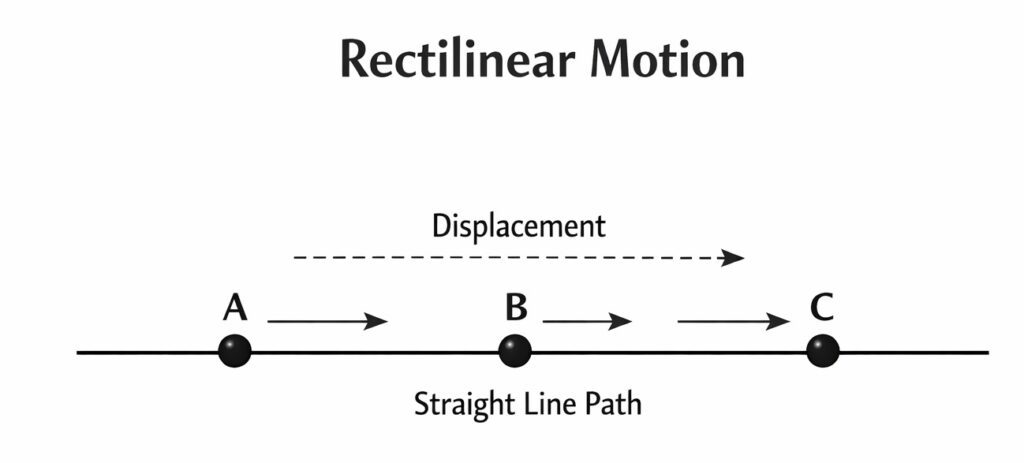
Displacement: The change in position of a particle. It is a vector quantity.
\[\Delta x = x_f – x_i\]
where \(x_i\) is initial position and \(x_f\) is final position.
Distance vs Displacement
Distance: Total path length covered (scalar quantity, always positive)
Displacement: Shortest distance between initial and final positions (vector quantity, can be positive, negative, or zero)
Speed and Velocity
Average Speed
\[v_{avg} = \frac{\text{Total Distance}}{\text{Total Time}}\]
Average Velocity
\[\vec{v}_{avg} = \frac{\Delta \vec{x}}{\Delta t} = \frac{x_f – x_i}{t_f – t_i}\]
Instantaneous Velocity
\[v = \lim_{\Delta t \to 0} \frac{\Delta x}{\Delta t} = \frac{dx}{dt}\]
Acceleration
Average Acceleration
\[a_{avg} = \frac{\Delta v}{\Delta t} = \frac{v_f – v_i}{t_f – t_i}\]
Instantaneous Acceleration
\[a = \lim_{\Delta t \to 0} \frac{\Delta v}{\Delta t} = \frac{dv}{dt} = \frac{d^2x}{dt^2}\]
Equations of Motion (Constant Acceleration)
For motion with uniform acceleration, we have three fundamental equations:
First Equation
\[v = u + at\]
Let:
- Initial velocity = \(u\)
- Final velocity = \(v\)
- Acceleration = \(a\)
- Time = \(t\)
Acceleration is defined as the rate of change of velocity:
\[
a = \frac{v – u}{t}
\]
Rearranging, we get:
\[
v – u = at
\]
\[
\boxed{v = u + at}
\]
This is the first equation of motion.
Second Equation
\[s = ut + \frac{1}{2}at^2\]
where \(s\) = displacement
Statement: The second equation of motion gives the relation between displacement, initial velocity, time, and acceleration.
Average velocity is given by:
\[
\text{Average velocity} = \frac{u + v}{2}
\]
Displacement is equal to average velocity multiplied by time:
\[
s = \frac{u + v}{2} \times t
\]
Using the first equation of motion \(v = u + at\), substitute for \(v\):
\[
s = \frac{u + (u + at)}{2} \times t
\]
\[
s = \frac{2u + at}{2} \times t
\]
\[
s = ut + \frac{1}{2}at^2
\]
\[
\boxed{s = ut + \frac{1}{2}at^2}
\]
This is the second equation of motion.
Third Equation
\[v^2 = u^2 + 2as\]
Statement: The third equation of motion gives the relation between final velocity, initial velocity, acceleration, and displacement.
From the first equation of motion:
\[
v = u + at
\]
Rearranging:
\[
t = \frac{v – u}{a}
\]
Substitute this value of \(t\) into the second equation of motion:
\[
s = ut + \frac{1}{2}at^2
\]
\[
s = u\left(\frac{v – u}{a}\right) + \frac{1}{2}a\left(\frac{v – u}{a}\right)^2
\]
Simplifying:
\[
2as = 2u(v – u) + (v – u)^2
\]
\[
2as = v^2 – u^2
\]
\[
\boxed{v^2 = u^2 + 2as}
\]
This is the third equation of motion.
Graphical Representation
Position-Time Graph
- Slope at any point gives instantaneous velocity: \(v = \frac{dx}{dt}\)
- Horizontal line indicates rest
- Straight line with constant slope indicates uniform motion
- Curved line indicates non-uniform motion (acceleration)
Velocity-Time Graph
- Slope at any point gives instantaneous acceleration: \(a = \frac{dv}{dt}\)
- Area under the curve gives displacement
- Horizontal line indicates uniform velocity (zero acceleration)
- Straight line indicates uniform acceleration
Acceleration-Time Graph
- Area under the curve gives change in velocity
Solved Examples
Q. A car accelerates uniformly from rest to a velocity of 30 m/s in 10 seconds. Find:
- The acceleration of the car
- The distance covered in this time
Solution:
Given: \(u = 0\) m/s, \(v = 30\) m/s, \(t = 10\) s
(a) Using \(v = u + at\)
\[30 = 0 + a(10)\]
\[a = 3 \text{ m/s}^2\]
(b) Using \(s = ut + \frac{1}{2}at^2\)
\[s = 0(10) + \frac{1}{2}(3)(10)^2\]
\[s = \frac{1}{2}(3)(100) = 150 \text{ m}\]
Q. Two trains A and B are moving on parallel tracks with velocities 72 km/h and 54 km/h respectively in the same direction. If the length of train A is 200 m and that of B is 150 m, find the time taken by A to completely overtake B.
Solution:
Converting velocities to m/s:
\[v_A = 72 \times \frac{5}{18} = 20 \text{ m/s}\]
\[v_B = 54 \times \frac{5}{18} = 15 \text{ m/s}\]
Relative velocity of A with respect to B:
\[v_{AB} = v_A – v_B = 20 – 15 = 5 \text{ m/s}\]
For complete overtaking, relative displacement needed:
\[s = L_A + L_B = 200 + 150 = 350 \text{ m}\]
Time taken:
\[t = \frac{s}{v_{AB}} = \frac{350}{5} = 70 \text{ seconds}\]
Q. A stone is thrown vertically upward with an initial velocity of 40 m/s. Taking \(g = 10\) m/s², find:
- Maximum height reached
- Time to reach maximum height
- Velocity after 3 seconds
- Total time of flight
Solution:
Taking upward direction as positive: \(u = 40\) m/s, \(a = -10\) m/s²
(a) At maximum height, \(v = 0\)
Using \(v^2 = u^2 + 2as\)
\[0 = (40)^2 + 2(-10)s\]
\[0 = 1600 – 20s\]
\[s = 80 \text{ m}\]
(b) Using \(v = u + at\)
\[0 = 40 + (-10)t\]
\[t = 4 \text{ seconds}\]
(c) Velocity after 3 seconds:
\[v = u + at = 40 + (-10)(3) = 10 \text{ m/s (upward)}\]
(d) Total time of flight = 2 × time to reach maximum height
\[T = 2 \times 4 = 8 \text{ seconds}\]
Q. A particle moves along a straight line such that its position is given by \(x = 2t^3 – 9t^2 + 12t + 3\) (in meters, t in seconds). Find:
- Velocity at t = 2 seconds
- Acceleration at t = 2 seconds
- When does the particle momentarily come to rest?
Solution:
Given: \(x = 2t^3 – 9t^2 + 12t + 3\)
(a) Velocity: \(v = \frac{dx}{dt}\)
\[v = 6t^2 – 18t + 12\]
At t = 2 s:
\[v = 6(2)^2 – 18(2) + 12 = 24 – 36 + 12 = 0 \text{ m/s}\]
(b) Acceleration: \(a = \frac{dv}{dt}\)
\[a = 12t – 18\]
At t = 2 s:
\[a = 12(2) – 18 = 6 \text{ m/s}^2\]
(c) For particle to come to rest, v = 0:
\[6t^2 – 18t + 12 = 0\]
\[t^2 – 3t + 2 = 0\]
\[(t – 1)(t – 2) = 0\]
\[t = 1 \text{ s or } t = 2 \text{ s}\]
The particle comes to rest at t = 1 s and t = 2 s.
Formula
| Quantity | Formula |
|---|---|
| Average Velocity | \(v_{avg} = \frac{\Delta x}{\Delta t}\) |
| Instantaneous Velocity | \(v = \frac{dx}{dt}\) |
| Average Acceleration | \(a_{avg} = \frac{\Delta v}{\Delta t}\) |
| Instantaneous Acceleration | \(a = \frac{dv}{dt} = \frac{d^2x}{dt^2}\) |
| First Equation | \(v = u + at\) |
| Second Equation | \(s = ut + \frac{1}{2}at^2\) |
| Third Equation | \(v^2 = u^2 + 2as\) |
| nth Second Displacement | \(s_n = u + \frac{a}{2}(2n-1)\) |
| Average Velocity (uniform acceleration) | \(v_{avg} = \frac{u+v}{2}\) |
H C Verma Solution
1. A man has to go 50m due north, 40m due east and 20m due south to reach a field.
(a)What distance he has to walk to reach the field?
(b)What is his displacement from his house to the field?
Solution:
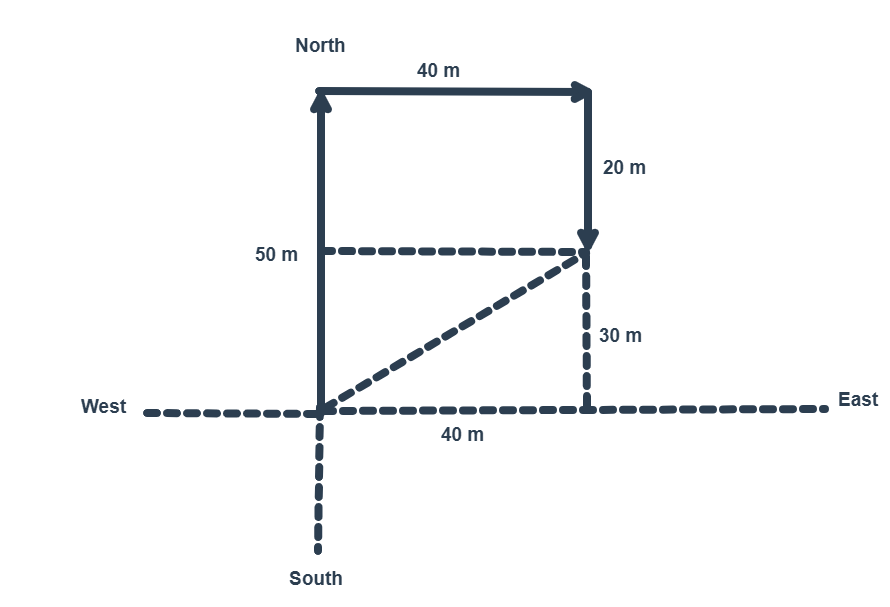
Step 1: Identify the Path Segments
The motion consists of three distinct parts. To analyze these, we treat the movements as individual segments of a total path.
- $d_1 = 50\text{ m}$ (North)
- $d_2 = 40\text{ m}$ (East)
- $d_3 = 20\text{ m}$ (South)
Step 2: Calculate Total Distance
The sources define distance as a scalar quantity representing the total area an object covers in motion. It is calculated by summing all segments using the formula $d=d_1+d_2+d_3$.
- $d = 50\text{ m} + 40\text{ m} + 20\text{ m}$
- Total Distance = $\mathbf{110\text{ m}}$
Step 3: Establish a Coordinate System for Displacement
Displacement is a vector quantity that indicates how far an object is from its destination. According to the sources, it is expressed as $x = x_f – x_i$, where $x_f$ is the final position and $x_i$ is the initial position. We set the starting point (house) as the origin $(0,0)$.
- After moving North: $(0, 50)$
- After moving East: $(40, 50)$
- After moving South: $(40, 50 – 20) = (40, 30)$
The final position $x_f$ is $(40, 30)$.
Step 4: Calculate the Magnitude of Displacement
Using the coordinates of the initial position $(0,0)$ and final position $(40,30)$, we find the magnitude (the straight-line distance):
- $|x| = \sqrt{(40 – 0)^2 + (30 – 0)^2}$
- $|x| = \sqrt{1600 + 900} = \sqrt{2500}$
- Magnitude = $\mathbf{50\text{ m}}$
Step 5: Determine the Direction
The sources emphasize that for displacement, it is mandatory to specify the direction of travel. We find the angle $\theta$ relative to the East axis:
- $\tan \theta = \frac{\text{Vertical Displacement}}{\text{Horizontal Displacement}} = \frac{30}{40} = 0.75$
- $\theta = \tan^{-1}(0.75) \approx \mathbf{37^\circ}$
- Final Displacement: $\mathbf{50\text{ m}}$ at $\mathbf{37^\circ \text{ North of East}}$.
Q. A particle starts from the origin, goes along the X-axis to the point \( (20\,\text{m}, 0) \) and then returns along the same line to the point \( (-20\,\text{m}, 0) \). Find the distance and displacement of the particle during the trip.
Solution:
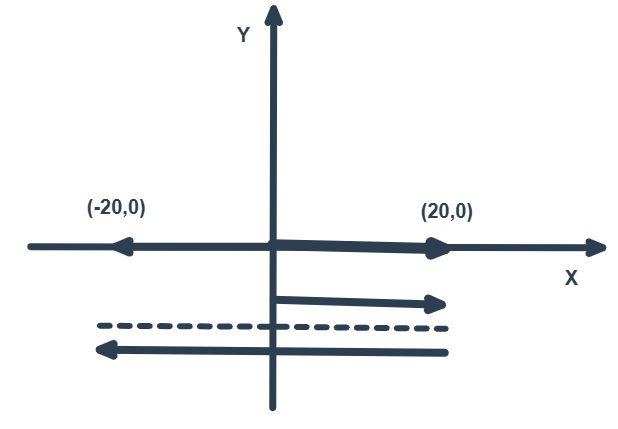
Step 1: Description of Motion
- Initial position: \( (0,0) \)
- Motion from origin to +20 m: \( 0 \rightarrow +20\,\text{m} \)
- Return motion from +20 m to −20 m: \( +20 \rightarrow -20\,\text{m} \)
(a) Distance Travelled
Distance is the total length of the actual path
travelled by the particle.
\[
\text{Distance} = 20 + 40 = \boxed{60\,\text{m}}
\]
(b) Displacement
Displacement is the change in position of the particle
from start to end.
\[
\text{Displacement} = x_f – x_i = (-20) – 0 = \boxed{-20\,\text{m}}
\]
The negative sign indicates that the displacement is along the
negative X-axis.
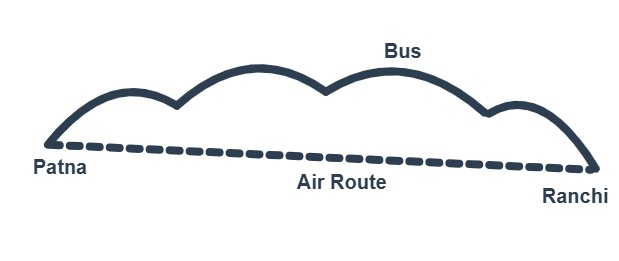
Distance by road = \(320 \, \text{km}\)
Time taken by aeroplane = \(30 \, \text{minutes} = 0.5 \, \text{hour}\)
Time taken by bus = \(8 \, \text{hours}\)
\[
\text{Average speed} = \frac{\text{Total distance}}{\text{Total time}}
\]
\[
= \frac{260}{0.5} = 520 \, \text{km/h}
\]
\text{Average speed} = \frac{320}{8} = 40 \, \text{km/h}
\]
\[
\text{Average velocity} = \frac{\text{Displacement}}{\text{Time}}
\]
\[
= \frac{260}{0.5} = 520 \, \text{km/h}
\]
Direction: from Patna to Ranchi
\[
\text{Average velocity} = \frac{260}{8} = 32.5 \, \text{km/h}
\]
Final meter reading = \(12416 \, \text{km}\)
Total time taken = \(2 \, \text{hours}\)
\text{Distance} = 12416 – 12352 = 64 \, \text{km}
\]
\[
\text{Average speed} = \frac{\text{Total distance}}{\text{Total time}}
\]
\[
= \frac{64}{2} = 32 \, \text{km/h}
\]
Therefore, displacement \(= 0\).
\[
\text{Average velocity} = \frac{\text{Displacement}}{\text{Time}} = \frac{0}{2} = 0 \, \text{km/h}
\]
\[
u = 0
\]
\[
v = 18 \times \frac{5}{18} = 5 \, \text{m/s}
\]
\[
t = 2 \, \text{s}
\]
\[
v = u + at
\]
5 = 0 + a(2)
\]
a = \frac{5}{2} = 2.5 \, \text{m/s}^2
\]
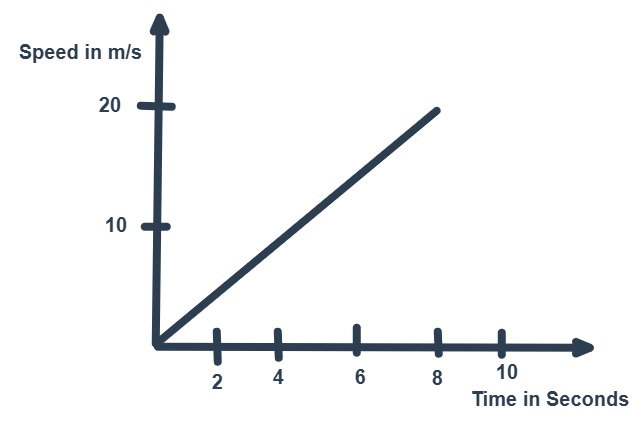
From the graph:
Initial speed, \(u = 0 \, \text{m/s}\)
Final speed, \(v = 20 \, \text{m/s}\)
Time taken, \(t = 8 \, \text{s}\)
Distance travelled is equal to the area under the speed–time graph.
The graph forms a triangle.
\text{Distance} = \frac{1}{2} \times \text{base} \times \text{height}
\]
\[
= \frac{1}{2} \times 8 \times 20 = 80 \, \text{m}
\]
\[
a = \frac{v – u}{t}
\]
\[
= \frac{20 – 0}{8} = 2.5 \, \text{m/s}^2
\]
Acceleration of the car = \(2.5 \, \text{m/s}^2\)
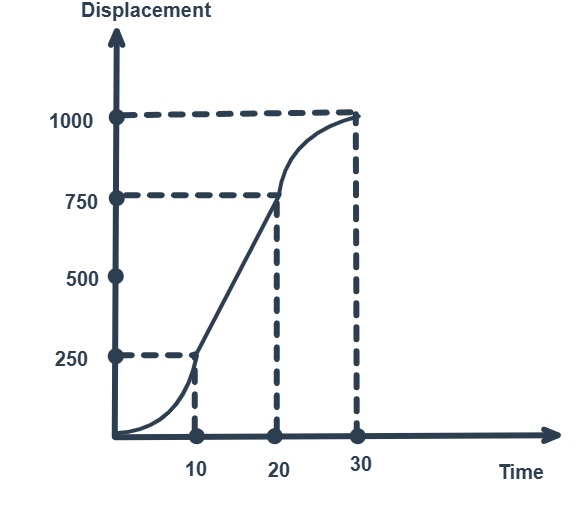
7. The acceleration of a cart started at t = 0 varies with time as shown in the figure. Find the distance travelled in 30 seconds and draw the position-time graph.
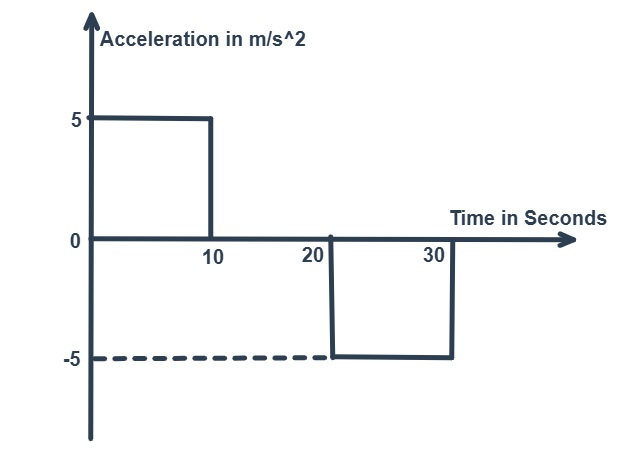
\[
u = 0
\]
\[
a = 5 \, \text{m/s}^2
\]
\[
v = u + at
\]
v = 0 + 5(10)
\]
v = 50 \, \text{m/s}
\]
a = 0 \Rightarrow v = 50 \, \text{m/s (constant)}
\]
a = -5 \, \text{m/s}^2
\]
v = 50 + (-5)(10)
\]
v = 0
\]
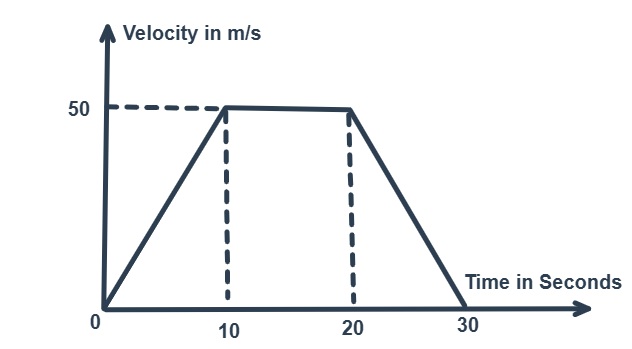
\text{Distance} = \frac{1}{2} \times (30 + 10) \times 50
\]
= \frac{1}{2} \times 40 \times 50
\]
= 1000 \, \text{m}
\]
(a) The acceleration
(b) The distance travelled in 0 to 10 s
(c) The displacement in 0 to 10 s
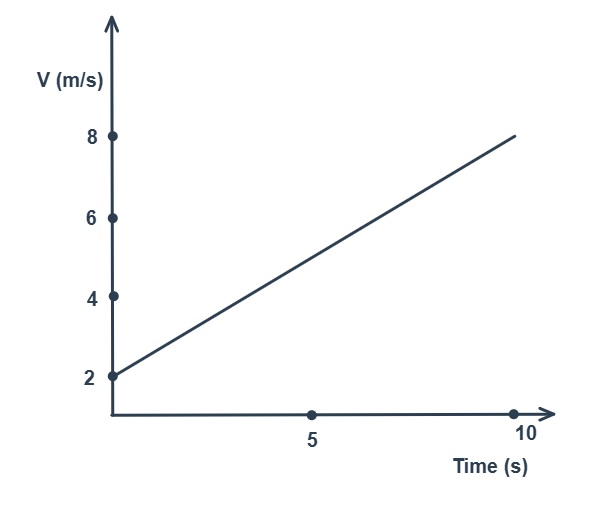
\[
a = \frac{v – u}{t}
\]
\[
= \frac{8 – 2}{10}
= 0.6 \, \text{m/s}^2
\]
\[
\text{Area} = \frac{1}{2} \times ( \text{sum of parallel sides} ) \times \text{height}
\]
\[
= \frac{1}{2} \times (2 + 8) \times 10
= 50 \, \text{m}
\]
displacement = area under the graph.
\[
\text{Displacement} = 50 \, \text{m}
\]
9. The given figure shows the graph of x-coordinate of a particle going along the X-axis as a function of time. Find:
(a) The average velocity during 0 to 10 s
(b) Instantaneous velocity at 2 s, 5 s, 8 s and 12 s.
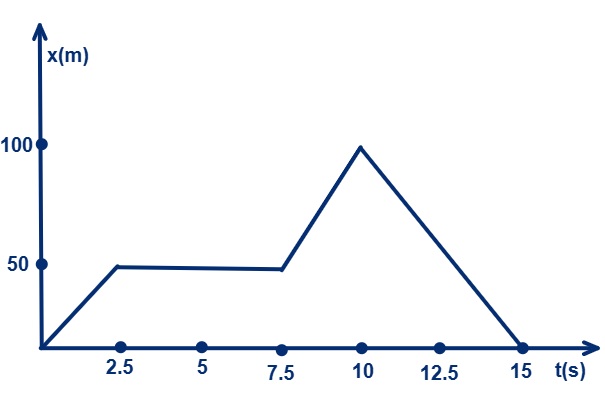
Displacement from 0 to 10 s:
Initial position at \(t = 0\), \(x = 0\)
Final position at \(t = 10\), \(x = 100 \, \text{m}\)
\text{Average velocity} = \frac{\text{Displacement}}{\text{Time}}
\]
\[
= \frac{100}{10} = 10 \, \text{m/s}
\]
\[
\text{Slope} = \frac{50 – 0}{2.5 – 0}
= \frac{50}{2.5}
= 20 \, \text{m/s}
\]
At \(t = 5 \, \text{s}\) (horizontal segment):
Slope \(= 0\)
\[
v = 0 \, \text{m/s}
\]
\[
\text{Slope} = \frac{100 – 50}{10 – 7.5}
= \frac{50}{2.5}
= 20 \, \text{m/s}
\]
\[
\text{Slope} = \frac{0 – 100}{15 – 10}
= \frac{-100}{5}
= -20 \, \text{m/s}
\]
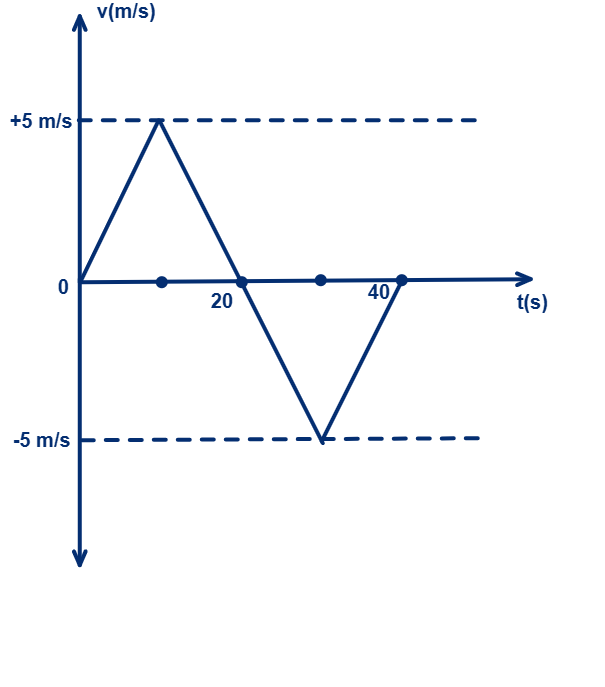
\text{Distance} =
\left( \frac{1}{2} \times 20 \times 5 \right)
+
\left( \frac{1}{2} \times 20 \times 5 \right)
\]
= 50 + 50 = 100 \, \text{m}
\]
\text{Displacement} =
\left( \frac{1}{2} \times 20 \times 5 \right)
+
\left( -\frac{1}{2} \times 20 \times 5 \right)
\]
= 50 – 50 = 0
\]
V_{\text{avg}} = \frac{\text{Displacement}}{\text{Time}}
\]
V_{\text{avg}} = \frac{0}{40} = 0 \, \text{m/s}
\]
11. The given figure shows x–t graph of a particle. Find the time \(t\) such that the average velocity of the particle during the period 0 to \(t\) is zero.
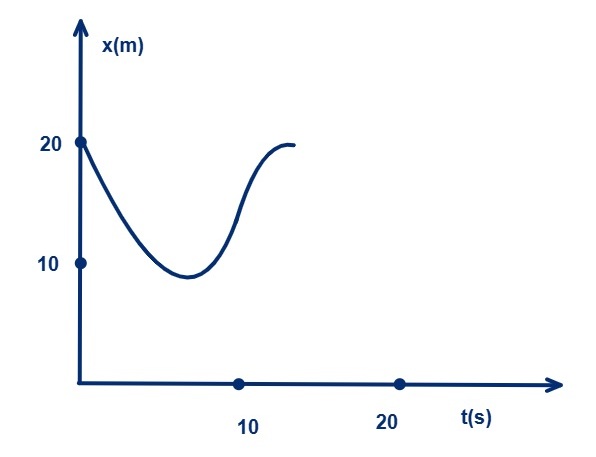
Solution:
Average velocity is given by:
\[
\text{Average velocity} = \frac{\text{Displacement}}{\text{Time}}
\]
For average velocity to be zero, displacement must be zero.
From the graph:
At \(t = 0\), \(x = 20\).
The particle again reaches \(x = 20\) at \(t = 12 \, \text{s}\).
Hence, displacement from 0 to 12 s is zero.
Required time, \(t = 12 \, \text{s}\).
12. A particle starts from a point A and travels along the solid curve shown in the given figure. Find approximately the position B of the particle such that the average velocity between the positions A and B has the same direction as the instantaneous velocity at B.
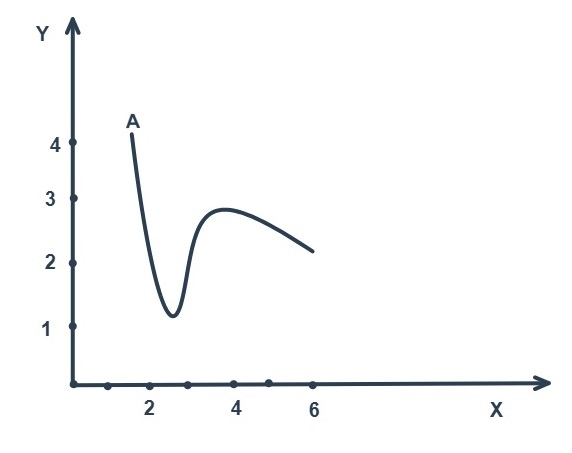
Solution: Average velocity between A and B is along the straight line joining A and B.
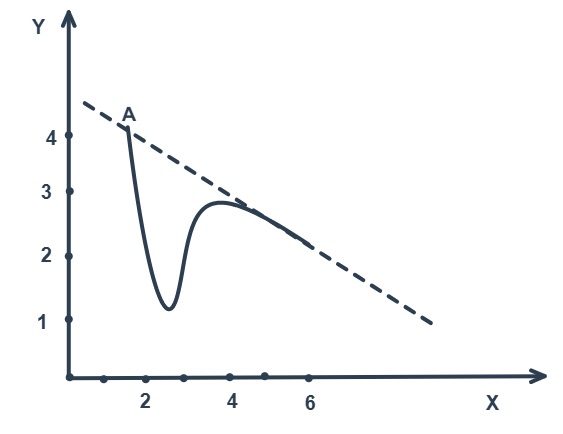
Instantaneous velocity at B is along the tangent to the curve at point B.
For both velocities to have the same direction, the straight line AB must be parallel to the tangent at B.
Hence, point B is approximately point (5,3) on the curve where the tangent drawn at B is parallel to the line joining A and B.
13. An object having a velocity 4.0 m/s is accelerated at the rate of 1.2 m/s² for 5.0 s. Find the distance travelled during the period of acceleration.
Solution:
Given:
\[
u = 4 \, \text{m/s}, \quad a = 1.2 \, \text{m/s}^2, \quad t = 5 \, \text{s}
\]
Distance travelled is given by:
\[
s = ut + \frac{1}{2}at^2
\]
\[
s = (4)(5) + \frac{1}{2}(1.2)(5)^2
\]
\[
s = 20 + \frac{1}{2}(1.2)(25)
\]
\[
s = 20 + 15 = 35 \, \text{m}
\]
Distance travelled = \(35 \, \text{m}\).
14. A person travelling at 43.2 km/h applies the brake giving a deceleration of 6.0 m/s² to his scooter. How far will it travel before stopping?
Solution:
Convert speed into m/s:
\[
u = 43.2 \times \frac{5}{18} = 12 \, \text{m/s}
\]
Final velocity,
\[
v = 0
\]
Acceleration (retardation),
\[
a = -6 \, \text{m/s}^2
\]
Using the equation:
\[
v^2 = u^2 + 2as
\]
\[
0^2 = (12)^2 + 2(-6)s
\]
\[
0 = 144 – 12s
\]
\[
12s = 144
\]
\[
s = 12 \, \text{m}
\]
Distance travelled before stopping = \(12 \, \text{m}\).
15. A train starts from rest and moved with a constant acceleration of 2.0 m/s² for half a minute. The brakes are then applied and the train comes to rest in one minute.
(a) Find the total distance moved by the train
(b) The maximum speed attained by the train
(c) The position(s) of the train at half the maximum speed.
Solution:
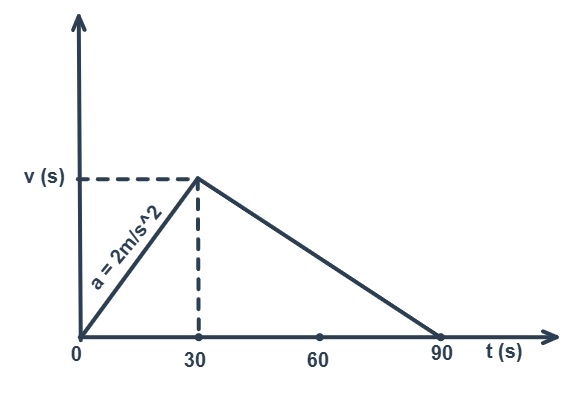
During the first 30 s, acceleration \(a = 2.0 \, \text{m/s}^2\).
\[
a = \frac{v}{t}
\]
\[
2 = \frac{v}{30}
\]
\[
v = 60 \, \text{m/s}
\]
(a) Total distance moved
Distance travelled = Area under the v–t graph.
The graph is a triangle with base \(90 \, \text{s}\) and height \(60 \, \text{m/s}\).
\[
\text{Distance} = \frac{1}{2} \times 90 \times 60
\]
\[
= 2700 \, \text{m}
\]
\[
= 2.7 \, \text{km}
\]
(b) Maximum speed
\[
V_{\text{max}} = 60 \, \text{m/s}
\]
(c) Position(s) at half the maximum speed
Half of maximum speed:
\[
\frac{60}{2} = 30 \, \text{m/s}
\]
Velocity \(30 \, \text{m/s}\) is reached at:
\[
t = 15 \, \text{s} \quad \text{and} \quad t = 60 \, \text{s}
\]
Distance in first 15 s:
\[
s = \frac{1}{2} \times 15 \times 30
\]
\[
s = 225 \, \text{m}
\]
Distance in first 60 s:
Area from 0–30 s:
\[
\frac{1}{2} \times 30 \times 60 = 900 \, \text{m}
\]
Area from 30–60 s:
\[
\frac{1}{2} (60 + 30) \times 30
\]
\[
= 1350 \, \text{m}
\]
Total distance up to 60 s:
\[
900 + 1350 = 2250 \, \text{m}
\]
\[
= 2.25 \, \text{km}
\]
Positions of the train at half maximum speed are \(225 \, \text{m}\) and \(2250 \, \text{m}\).
16. A bullet travelling with a velocity of 16 m/s penetrates a tree trunk and comes to rest in 0.4 m. Find the time taken during the retardation.
Solution:
Given:
\[
u = 16 \, \text{m/s}, \quad v = 0, \quad s = 0.4 \, \text{m}
\]
Using the equation of motion:
\[
v^2 = u^2 + 2as
\]
\[
0^2 = (16)^2 + 2(a)(0.4)
\]
\[
0 = 256 + 0.8a
\]
\[
a = -320 \, \text{m/s}^2
\]
Using:
\[
v = u + at
\]
\[
0 = 16 + (-320)t
\]
\[
t = \frac{16}{320} = 0.05 \, \text{s}
\]
Time taken during retardation = \(0.05 \, \text{s}\).
17. A bullet going with speed 350 m/s enters a concrete wall and penetrates a distance 5.0 cm before coming to rest. Find the deceleration.
Solution:
Given:
\[
u = 350 \, \text{m/s}, \quad v = 0, \quad s = 5 \times 10^{-2} \, \text{m}
\]
Using the equation of motion:
\[
v^2 = u^2 + 2as
\]
\[
0^2 = (350)^2 + 2(a)(0.05)
\]
\[
0 = 122500 + 0.1a
\]
\[
a = -1.225 \times 10^6 \, \text{m/s}^2
\]
Deceleration of the bullet = \(1.225 \times 10^6 \, \text{m/s}^2\).
18. A particle starting from rest moves with constant acceleration. If it takes 5.0 s to reach the speed 18.0 km/h. Find
(a) The average velocity during this period
(b) The distance travelled by the particle during this period.
Solution:
Given:
\[
u = 0, \quad t = 5 \, \text{s}
\]
Final velocity:
\[
v = 18 \times \frac{5}{18} = 5 \, \text{m/s}
\]
Using:
\[
v = u + at
\]
\[
5 = 0 + a(5)
\]
\[
a = 1 \, \text{m/s}^2
\]
(b) Distance travelled
\[
s = ut + \frac{1}{2}at^2
\]
\[
s = 0 + \frac{1}{2}(1)(5)^2
\]
\[
s = 12.5 \, \text{m}
\]
(a) Average velocity
\[
V_{\text{avg}} = \frac{\text{Distance}}{\text{Time}}
\]
\[
V_{\text{avg}} = \frac{12.5}{5} = 2.5 \, \text{m/s}
\]
Average velocity = \(2.5 \, \text{m/s}\),
Distance travelled = \(12.5 \, \text{m}\).
19. A driver takes 0.20 s to apply the brakes after he sees a need for it. This is called the reaction time of the driver. If he is driving a car at a speed of 54 km/h and the brakes cause a deceleration of 6.0 m/s², find the distance travelled by the car after he sees the need to put the brakes on.
Solution:
Speed of the car:
\[
v = 54 \times \frac{5}{18} = 15 \, \text{m/s}
\]
Distance travelled during reaction time:
\[
s_1 = vt = 15 \times 0.2 = 3 \, \text{m}
\]
When brakes are applied:
\[
u = 15 \, \text{m/s}, \quad v = 0, \quad a = -6 \, \text{m/s}^2
\]
Using the equation:
\[
v^2 = u^2 + 2as
\]
\[
0^2 = (15)^2 + 2(-6)s_2
\]
\[
0 = 225 – 12s_2
\]
\[
s_2 = 18.75 \, \text{m}
\]
Total distance travelled:
\[
s = s_1 + s_2 = 3 + 18.75 = 21.75 \, \text{m}
\]
\[
\approx 22 \, \text{m}
\]
Total distance travelled after seeing the need to brake = \(22 \, \text{m}\).
20. Complete the following table:
| Car Model | Driver X | Driver Y |
|---|---|---|
| A Deceleration on hard braking = 6.0 m/s² |
Speed = 54 km/h Braking distance a = ……………………. Total stopping distance b = …………………….. |
Speed = 54 km/h Braking distance a = ……………………. Total stopping distance b = …………………….. |
| Speed = 72 km/h Braking distance c = ……………………. Total stopping distance d = …………………….. |
Speed = 72 km/h Braking distance c = ……………………. Total stopping distance d = …………………….. |
|
| B Deceleration on hard braking = 7.5 m/s² |
Speed = 54 km/h Braking distance e = ……………………. Total stopping distance f = …………………….. |
Speed = 54 km/h Braking distance e = ……………………. Total stopping distance f = …………………….. |
| Speed = 72 km/h Braking distance g = ……………………. Total stopping distance h = …………………….. |
Speed = 72 km/h Braking distance g = ……………………. Total stopping distance h = …………………….. |
| Car Model | Driver X (Reaction time = 0.20 s) | Driver Y (Reaction time = 0.30 s) |
|---|---|---|
| A Deceleration on hard braking = 6.0 m/s² |
Speed = 54 km/h Braking distance a = 18.75 m Total stopping distance b = 21.75 m |
Speed = 54 km/h Braking distance a = 18.75 m Total stopping distance b = 23.25 m |
| Speed = 72 km/h Braking distance c = 33.33 m Total stopping distance d = 37.33 m |
Speed = 72 km/h Braking distance c = 33.33 m Total stopping distance d = 39.33 m |
|
| B Deceleration on hard braking = 7.5 m/s² |
Speed = 54 km/h Braking distance e = 15.0 m Total stopping distance f = 18.0 m |
Speed = 54 km/h Braking distance e = 15.0 m Total stopping distance f = 19.5 m |
| Speed = 72 km/h Braking distance g = 26.67 m Total stopping distance h = 30.67 m |
Speed = 72 km/h Braking distance g = 26.67 m Total stopping distance h = 32.67 m |
Explanation:
To complete the table, we calculate three quantities:
1. Speed in m/s
2. Braking distance
3. Reaction distance and total stopping distance
Step 1: Convert speed from km/h to m/s
\[
u = \text{Speed in km/h} \times \frac{5}{18}
\]
For 54 km/h:
\[
u = 54 \times \frac{5}{18} = 15 \, \text{m/s}
\]
For 72 km/h:
\[
u = 72 \times \frac{5}{18} = 20 \, \text{m/s}
\]
Step 2: Formula for braking distance
Braking distance is given by:
\[
s_b = \frac{u^2}{2a}
\]
where
\(u\) = initial speed,
\(a\) = deceleration on hard braking.
Car Model A (deceleration = 6.0 m/s²)
For speed 54 km/h (\(u = 15 \, \text{m/s}\)):
\[
s_b = \frac{15^2}{2 \times 6}
= \frac{225}{12}
= 18.75 \, \text{m}
\]
For speed 72 km/h (\(u = 20 \, \text{m/s}\)):
\[
s_b = \frac{20^2}{2 \times 6}
= \frac{400}{12}
= 33.33 \, \text{m}
\]
Car Model B (deceleration = 7.5 m/s²)
For speed 54 km/h (\(u = 15 \, \text{m/s}\)):
\[
s_b = \frac{15^2}{2 \times 7.5}
= \frac{225}{15}
= 15.0 \, \text{m}
\]
For speed 72 km/h (\(u = 20 \, \text{m/s}\)):
\[
s_b = \frac{20^2}{2 \times 7.5}
= \frac{400}{15}
= 26.67 \, \text{m}
\]
Step 3: Reaction distance
Reaction distance is given by:
\[
s_r = u \times t_r
\]
where \(t_r\) is reaction time.
Driver X (reaction time = 0.20 s)
For 54 km/h:
\[
s_r = 15 \times 0.20 = 3.0 \, \text{m}
\]
For 72 km/h:
\[
s_r = 20 \times 0.20 = 4.0 \, \text{m}
\]
Driver Y (reaction time = 0.30 s)
For 54 km/h:
\[
s_r = 15 \times 0.30 = 4.5 \, \text{m}
\]
For 72 km/h:
\[
s_r = 20 \times 0.30 = 6.0 \, \text{m}
\]
Step 4: Total stopping distance
\[
\text{Total stopping distance} = s_b + s_r
\]
Examples:
Car A, Driver X, 54 km/h:
\[
= 18.75 + 3.0 = 21.75 \, \text{m}
\]
Car A, Driver Y, 72 km/h:
\[
= 33.33 + 6.0 = 39.33 \, \text{m}
\]
Car B, Driver X, 72 km/h:
\[
= 26.67 + 4.0 = 30.67 \, \text{m}
\]
Car B, Driver Y, 54 km/h:
\[
= 15.0 + 4.5 = 19.5 \, \text{m}
\]
Conclusion:
Higher speed and longer reaction time increase the stopping distance,
while higher deceleration (better braking system) reduces the stopping distance.
21. A police jeep is chasing a culprit going on a motorbike. The motorbike crosses a turning at a speed of 72 km/h. The jeep follows it at a speed of 90 km/h, crossing the turning ten seconds later than the bike. Assuming that they travel at constant speeds, how far from the turning will the jeep catch up with the bike?
Solution:
Speed of the motorbike:
\[
V_{\text{bike}} = 72 \times \frac{5}{18} = 20 \,\text{m/s}
\]
Speed of the police jeep:
\[
V_{\text{jeep}} = 90 \times \frac{5}{18} = 25 \,\text{m/s}
\]
Distance travelled by the motorbike in 10 seconds:
\[
\text{Distance} = \text{Speed} \times \text{Time} = 20 \times 10 = 200 \,\text{m}
\]
Relative speed of the jeep with respect to the bike:
\[
V_{\text{relative}} = 25 – 20 = 5 \,\text{m/s}
\]
Time taken by the jeep to catch the bike:
\[
t = \frac{\text{Relative distance}}{\text{Relative speed}} = \frac{200}{5} = 40 \,\text{s}
\]
Distance travelled by the jeep in this time:
\[
\text{Distance} = 25 \times 40 = 1000 \,\text{m} = 1 \,\text{km}
\]
Answer: The police jeep will catch the motorbike at a distance of 1 km from the turning.
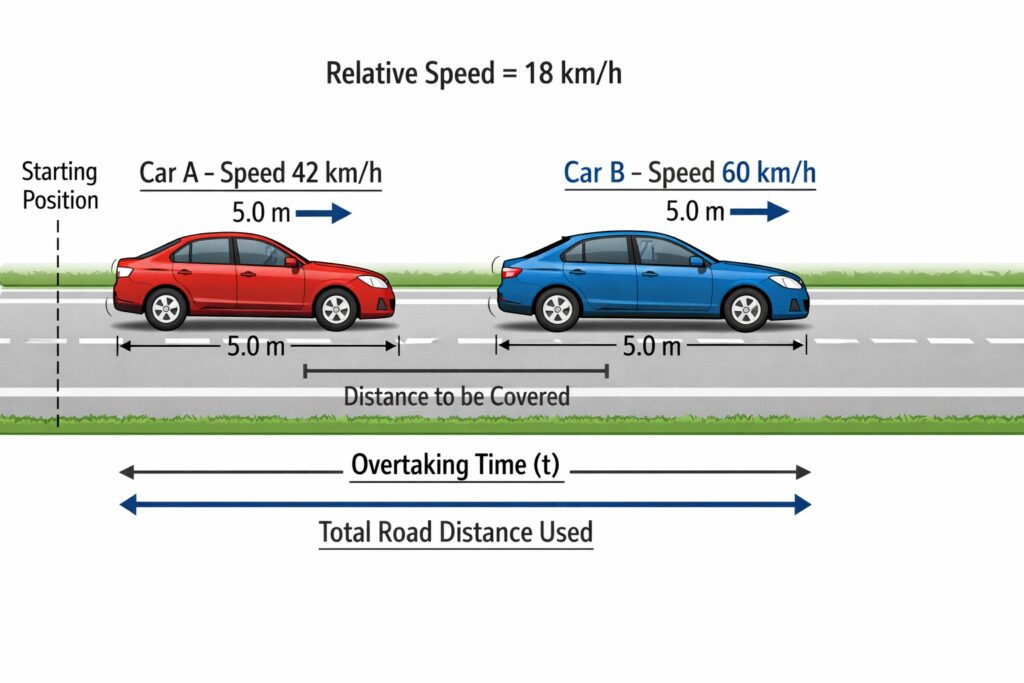
\[
V_1 = 60 \times \frac{5}{18} = 16.6 \text{ m/s}
\]
\[
V_2 = 42 \times \frac{5}{18} = 11.6 \text{ m/s}
\]
\[
V_{\text{rel}} = 16.6 – 11.6 = 5 \text{ m/s}
\]
\[
d_{\text{rel}} = 5 + 5 = 10 \text{ m}
\]
\[
t = \frac{d_{\text{rel}}}{V_{\text{rel}}} = \frac{10}{5} = 2 \text{ s}
\]
\[
d = 16.6 \times 2 = 33.2 \text{ m}
\]
\[
= 33.2 + 5 = 38.2 \text{ m} \approx 38 \text{ m}
\]