An Inverse Definite Minimum Time (IDMT) relay is a widely used protective relay in electrical power systems. It operates on the principle that the operating time of the relay decreases as the magnitude of the fault current increases, but it never becomes less than a fixed minimum time. This characteristic makes the relay very suitable for overcurrent protection in transmission lines, feeders, transformers, and distribution systems.
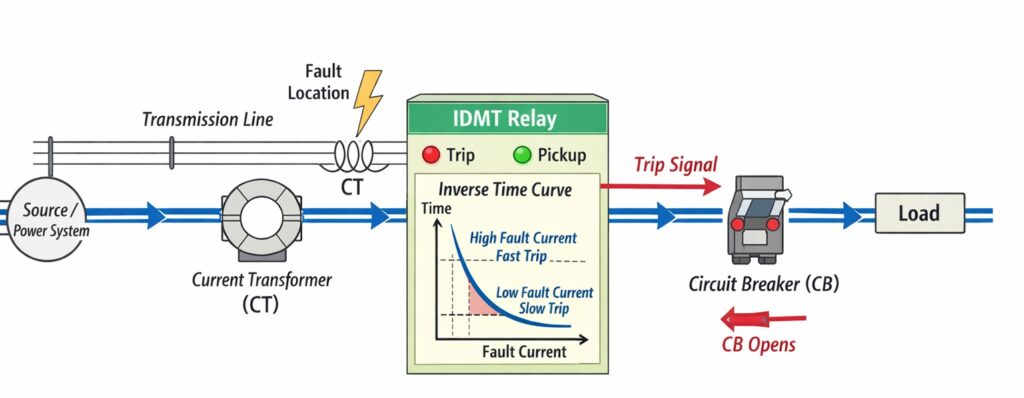
Table of Contents
Working Principle of IDMT Relay
The IDMT relay monitors the current flowing in a power system through a Current Transformer (CT). Under normal operating conditions, the current remains within the safe limit, so the relay does not operate. However, when a fault occurs, such as a short circuit or overload, the current rises significantly.
When the current exceeds the preset pickup value, the relay begins its timing operation. The operating time depends on the magnitude of the fault current. For a small overcurrent, the relay operates slowly, while for a large fault current, the relay operates very quickly. However, the relay always maintains a minimum operating time, which ensures stable coordination with other protective devices in the system.
Inverse Time Characteristic
The main feature of an IDMT relay is its inverse time-current characteristic. This means that the operating time is inversely proportional to the fault current magnitude. As the current increases, the time required for the relay to trip decreases.
This characteristic helps in selective protection, ensuring that the relay closest to the fault operates first while backup relays operate after a delay if the primary protection fails.
Types of IDMT Characteristics
IDMT relays can have different inverse characteristics depending on system requirements. The commonly used types are:
- Standard Inverse Relay
Used for general overcurrent protection in distribution systems. - Very Inverse Relay
Used where fault currents decrease rapidly with distance, such as in long transmission feeders. - Extremely Inverse Relay
Suitable for transformer and cable protection where high inrush currents may occur.
Main Components of an IDMT Relay
An IDMT relay typically consists of the following components:
- Current Transformer (CT) – Measures system current and supplies it to the relay.
- Relay Operating Coil – Produces magnetic force proportional to current.
- Time Dial Setting (TDS) – Adjusts the operating time of the relay.
- Plug Setting (Pickup Setting) – Determines the minimum current required to start relay operation.
- Trip Circuit – Sends a signal to the circuit breaker to isolate the faulty section.
Advantages of IDMT Relay
IDMT relays offer several advantages in power system protection:
- Provides reliable overcurrent protection
- Ensures proper coordination between primary and backup protection
- Reduces the chances of unnecessary tripping
- Suitable for radial distribution networks
Applications of IDMT Relay
IDMT relays are widely used in power systems for:
- Feeder protection in distribution networks
- Transmission line protection
- Transformer protection
- Backup protection for distance relays
- Industrial power systems
Conclusion
The IDMT relay plays a crucial role in modern power system protection. Its inverse time characteristic allows it to respond quickly to severe faults while maintaining proper coordination with other protective devices. Because of its reliability, flexibility, and adaptability, the IDMT relay remains one of the most commonly used relays in electrical power systems.