1. Consider the following characteristics regarding ideal operational amplifier:
1. An infinite output impedance and zero input impedance
2. The Op-Amp must have an extremely high inherent voltage gain
3. Zero slew rate
Which of the above characteristics is/are correct?
(a) 1 and 3
(b) 3 only
(c) 2 only
(d) 1 and 2
Answer: (c) 2 only
Solution:
S1: Incorrect: An ideal operational amplifier has infinite input impedance and zero output impedance. Infinite input impedance ensures that no current flows into the input terminals and the source is not loaded. Zero output impedance allows the amplifier to supply any required load current without voltage drop.
Mathematically,
\(R_{in} = \infty\)
\(R_{out} = 0\)

S2: Correct: An ideal operational amplifier has infinite open-loop voltage gain. This very large gain enables accurate amplification and allows the Op-Amp to perform mathematical operations in closed-loop configurations.
\(A_v = \infty\)
S3: Incorrect: An ideal operational amplifier has an infinite slew rate. This means the output voltage can change instantaneously with respect to time. If the slew rate were zero, the output voltage would not change at all, which is practically impossible for an amplifier.
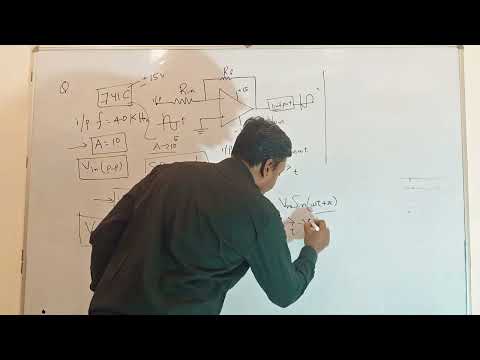
2. An inverting amplifier using the 741C must have a flat response up to 40 kHz. The gain of the amplifier is 10. What maximum peak-to-peak input signal can be applied without distorting the output?
(a) 0.398 V
(b) 3.98 V
(c) 30.98 V
(d) 0.0398 V
Answer: (a) 0.398 V
Solution:
Step 1: Identify the Slew Rate
For a standard 741C operational amplifier, the typical slew rate is
\(SR = 0.5 \, V/\mu s\)
Converting to volts per second:
\(SR = 0.5 \times 10^6 \, V/s\)
Step 2: Determine the Maximum Peak Output Voltage
To avoid distortion due to slew rate limitation, the following condition must be satisfied:
\(SR \ge 2\pi f V_{om}\)
Rearranging the equation:
\(V_{om} = \dfrac{SR}{2\pi f}\)
Substituting the values:
\(V_{om} = \dfrac{0.5 \times 10^6}{2\pi \times 40,000}\)
\(V_{om} \approx \dfrac{500,000}{251,327.4}\)
\(V_{om} \approx 1.989 \, V\) (Peak)
Step 3: Calculate Peak-to-Peak Output Voltage
\(V_{o(p-p)} = 2 \times V_{om}\)
\(V_{o(p-p)} = 2 \times 1.989 \approx 3.978 \, V\)
Step 4: Calculate Maximum Peak-to-Peak Input Voltage
The gain of the amplifier is
\(A = 10\)
Therefore,
\(V_{i(p-p)} = \dfrac{V_{o(p-p)}}{A}\)
\(V_{i(p-p)} = \dfrac{3.978}{10}\)
\(V_{i(p-p)} \approx 0.3978 \, V\)
Rounding to three decimal places,
\(V_{i(p-p)} \approx 0.398 \, V\)
3. Consider the following statements regarding bistable multivibrator:
1. The bistable multivibrator is used as memory elements in shift registers, counters.
2. It is used to generate sine wave by sending regular triggering pulse to the input.
3. It can also be used as a frequency divider.
Which of the above statements is/are correct?
(a) 1 and 3
(b) 3 only
(c) 2 only
(d) 1 and 2
Answer: (a) 1 and 3
Solution:
S1: Correct, a bistable multivibrator has two stable states and remains in one state until an external triggering signal is applied. This property makes it the basic building block of flip-flops. Flip-flops are widely used as memory elements in digital circuits such as shift registers and counters.
Statement 2 is incorrect: Bistable multivibrators are switching circuits that produce digital outputs such as pulses or square waves. They are not used to generate sine waves. Sine wave generation is typically achieved using oscillator circuits such as Wien Bridge oscillators, Hartley oscillators, or RC phase shift oscillators.
![]()
Statement 3 is correct: A bistable multivibrator toggles its state whenever a triggering pulse is applied. Because of this property, the output frequency becomes half of the input triggering frequency. Therefore, it can be used as a frequency divider.
\(f_{out} = \dfrac{f_{in}}{2}\)
4. What is the percentage of resolution of the eight-bit DAC?
(a) 0.0244%
(b) 0.392%
(c) 0.568%
(d) 0.0148%
Answer: (b) 0.392%
Solution:
Step 1: Understand Resolution
The resolution of a Digital-to-Analog Converter (DAC) represents the smallest change in analog output corresponding to a one-bit change in the digital input. For an \(n\)-bit DAC, the total number of output levels is:
\(2^n\)
Step 2: Formula for Percentage Resolution
\(\%\;Resolution = \dfrac{1}{2^n – 1} \times 100\)
Step 3: Substitute the Value
For an 8-bit DAC:
\(n = 8\)
\(\%\;Resolution = \dfrac{1}{2^8 – 1} \times 100\)
\(\%\;Resolution = \dfrac{1}{256 – 1} \times 100\)
\(\%\;Resolution = \dfrac{1}{255} \times 100\)
\(\%\;Resolution \approx 0.39215\%\)
Therefore, the percentage resolution of an 8-bit DAC is approximately 0.392%.
5. What is the value of the capacitance to use in a capacitor filter connected to a full-wave rectifier operating at a standard aircraft power frequency of 400 Hz, if the ripple factor is 10% for a load of 500 \( \Omega \)?
(a) 72.2 µF
(b) 87.6 µF
(c) 25.2 µF
(d) 102.4 µF
Answer: None
Solution:
Step 1: Given Data
Frequency \(f = 400\;Hz\)
Ripple factor \( \gamma = 10\% = 0.1\)
Load resistance \(R_L = 500\;\Omega\)
Step 2: Ripple Factor Formula for Full-Wave Rectifier with Capacitor Filter
\(\gamma = \dfrac{1}{4\sqrt{3}\; f\; C\; R_L}\)
Step 3: Rearranging for Capacitance
\(C = \dfrac{1}{4\sqrt{3}\; f\; \gamma\; R_L}\)
Step 4: Substituting the Values
\(C = \dfrac{1}{4 \times 1.732 \times 400 \times 0.1 \times 500}\)
\(C = \dfrac{1}{138560}\)
\(C \approx 7.217 \times 10^{-6}\;F\)