A semiconductor diode conducts current due to the movement of charge carriers across a PN junction. When the diode is forward biased, electrons and holes cross the junction and produce current known as emission current. Because the flow of charge carriers occurs in discrete particles (electrons), the current is not perfectly smooth and contains small random fluctuations known as shot noise.
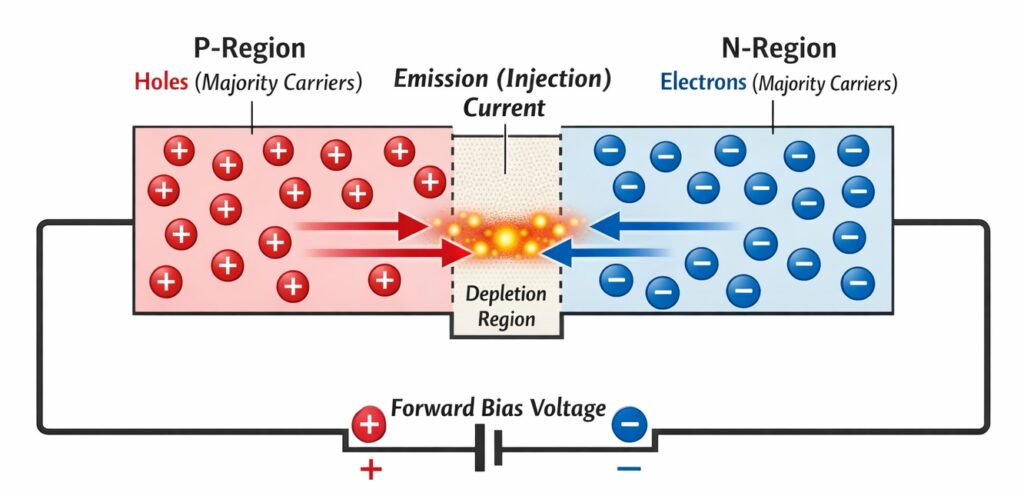
Table of Contents
Emission Current in a Diode
Emission current is the current that flows due to the injection of charge carriers across the PN junction when the diode is forward biased. When a positive voltage is applied to the P-region relative to the N-region, the potential barrier of the junction decreases and charge carriers
cross the junction easily.
The current through a diode is described by the diode equation
\[
I = I_s \left(e^{\frac{qV}{\eta kT}} – 1\right)
\]
where
\(I\) = diode current
\(I_s\) = reverse saturation current
\(q\) = electronic charge \( (1.6 \times 10^{-19} \, C) \)
\(V\) = applied voltage across the diode
\(k\) = Boltzmann constant
\(T\) = absolute temperature
\(\eta\) = emission coefficient (typically between 1 and 2)
For forward bias conditions, the exponential term dominates and the diode current increases rapidly.
\[
I \approx I_s e^{\frac{qV}{\eta kT}}
\]
What is Shot Noise?
Although the average current through a diode may appear steady, the actual flow of electrons occurs in discrete packets of charge. The arrival of these electrons at the junction is random and independent. This randomness produces fluctuations in the current known as shot noise.
Shot noise is present in semiconductor devices such as diodes, photodiodes, and transistors. It becomes important in circuits that handle very small signals.
Shot Noise Current
The rms value of shot noise current in a diode is given by
\[
i_n = \sqrt{2 q I B}
\]
where
\(i_n\) = rms shot noise current
\(q\) = charge of an electron
\(I\) = average diode current
\(B\) = bandwidth in Hz
Important Observations
• Shot noise increases with diode current.
• Shot noise increases with bandwidth.
• Shot noise is independent of temperature.
• Shot noise arises due to the discrete nature of electric charge.
Physical Interpretation
In a diode carrying current, electrons cross the PN junction individually. The number of electrons crossing the junction per second is not perfectly constant but fluctuates randomly. These random fluctuations produce noise in the current. Because this noise originates from the discrete nature
of electric charge, it is sometimes called quantum noise.