The Ward–Leonard System is a classical and highly effective method used for smooth speed control of a DC motor. It was widely used in industries before the development of modern electronic drives and is especially useful where precise and wide-range speed control is required.
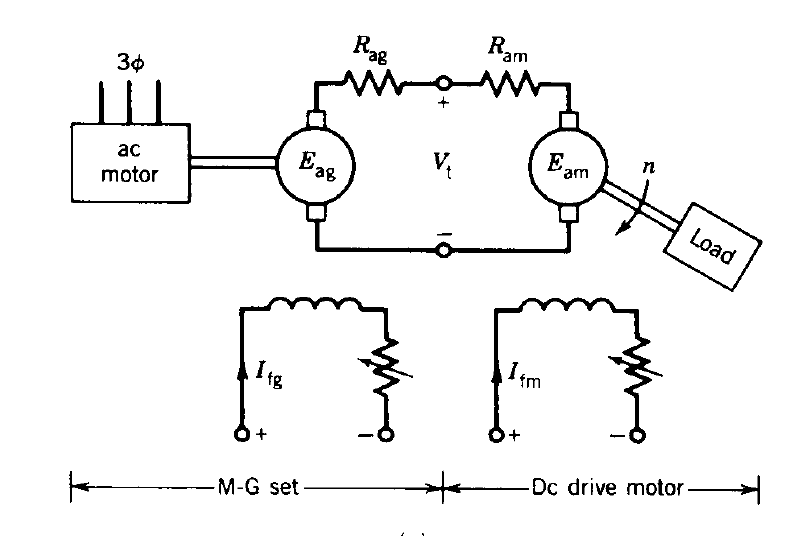
Table of Contents
Basic Principle
The Ward–Leonard system controls the speed of a DC motor by varying the voltage applied to its armature. Since the speed of a DC motor depends mainly on the armature voltage, changing this voltage allows smooth speed variation from zero to rated speed and even above rated speed.
The voltage supplied to the DC motor is not taken directly from the power supply. Instead, it is obtained from a DC generator, whose output voltage can be varied easily.
The speed equation of a DC motor is:
\[
N = \frac{V – I_a R_a}{k\phi}
\]
Where:
- \(N\) = Speed of the motor
- \(V\) = Armature voltage
- \(I_a\) = Armature current
- \(R_a\) = Armature resistance
- \(\phi\) = Flux per pole
- \(k\) = Machine constant
Construction
A typical Ward–Leonard system consists of three main machines mounted on the same shaft:
- AC Motor (Prime mover)
- DC Generator
- DC Motor (Load motor)
Arrangement
- The AC motor runs at constant speed from the AC supply.
- It mechanically drives the DC generator.
- The output of the DC generator is connected to the armature of the DC motor whose speed is to be controlled.
Working of the Ward–Leonard System
- The AC motor drives the DC generator at constant speed.
- The field current of the DC generator is varied using a field rheostat.
- When the generator field current changes, the generator output voltage changes.
- This variable voltage is applied to the armature of the DC motor.
- Since the motor speed depends on armature voltage, the motor speed varies smoothly.
Thus, speed control is achieved by controlling the generator field current.
Speed Control Range
The Ward–Leonard system provides a very wide range of speed control:
- Zero speed to rated speed by varying generator voltage
- Above rated speed by weakening the motor field
It also allows smooth reversal of motor direction by reversing the generator voltage polarity.
Advantages
- Very smooth and precise speed control
- Wide speed range (from zero to above rated speed)
- Good speed regulation
- Quick reversal of motor direction
- Suitable for heavy loads and frequent starting
Disadvantages
- High initial cost (three machines required)
- Large size and space requirement
- Higher maintenance due to multiple machines
- Lower overall efficiency compared to modern electronic drives
Because of these disadvantages, the Ward–Leonard system has largely been replaced by solid-state DC drives.
Applications
The Ward–Leonard system was traditionally used in applications requiring precise and smooth speed control, such as:
- Electric elevators
- Cranes and hoists
- Rolling mills
- Mine winders
- Printing presses