The efficiency of a DC motor is defined as the ratio of mechanical output power to the electrical input power supplied to the motor. It indicates how effectively the motor converts electrical energy into mechanical energy. Efficiency is an important parameter used to evaluate the performance of DC machines.
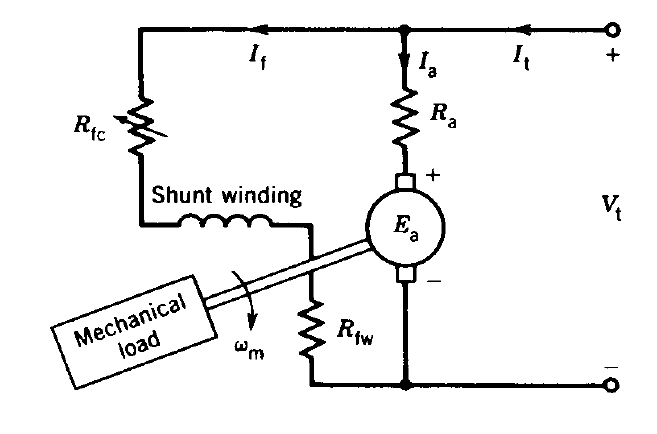
Table of Contents
Definition of Efficiency
Efficiency \((\eta)\) of a DC motor is given by
\[
\eta = \frac{\text{Output Power}}{\text{Input Power}}
\]
or
\[
\eta = \frac{P_{out}}{P_{in}}
\]
If expressed as a percentage,
\[
\eta = \frac{P_{out}}{P_{in}} \times 100
\]
where
- \(P_{out}\) = mechanical output power
- \(P_{in}\) = electrical input power
Input Power of DC Motor
The electrical input power supplied to the motor is
\[
P_{in} = V I
\]
where
- \(V\) = supply voltage
- \(I\) = line current
Output Power of DC Motor
The mechanical power developed by the motor is
\[
P_{out} = T \omega
\]
where
- \(T\) = torque (N·m)
- \(\omega\) = angular speed (rad/s)
Alternatively,
\[
P_{out} = \frac{2\pi N T}{60}
\]
where
- \(N\) = speed in rpm
Power Losses in DC Motor
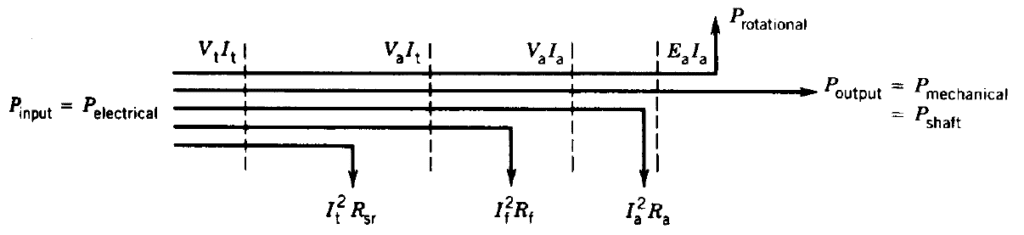
The efficiency of a DC motor is affected by several losses occurring inside the machine.
Copper Losses
These losses occur due to resistance in the windings.
- Armature copper loss
\[
P_{a} = I_a^2 R_a
\] - Field copper loss
\[
P_{f} = I_f^2 R_f
\]
Iron (Core) Losses
These occur in the armature core due to alternating magnetic fields.
Types include:
- Hysteresis loss
- Eddy current loss
Mechanical Losses
Mechanical losses occur due to:
- Friction in bearings
- Brush friction
- Windage (air resistance)
Stray Load Losses
These are additional small losses due to leakage flux and irregular current distribution.
Efficiency Expression Including Losses
The efficiency of a DC motor can also be written as
\[
\eta = \frac{\text{Input Power} – \text{Losses}}{\text{Input Power}}
\]
or
\[
\eta = \frac{P_{in} – \text{Total Losses}}{P_{in}}
\]
Condition for Maximum Efficiency
Maximum efficiency occurs when
\[
\text{Variable losses} = \text{Constant losses}
\]
where
- Variable losses = armature copper loss
- Constant losses = iron loss + mechanical loss
Typical Efficiency Values
Typical efficiencies of DC motors are:
- Small DC motors: 70% – 80%
- Medium DC motors: 80% – 90%
- Large DC motors: 90% – 95%
Methods to Improve Efficiency
Efficiency can be improved by:
- Using low resistance conductors
- Reducing core losses
- Improving cooling and lubrication
- Designing motors with better magnetic materials