A synchronous motor is widely used in power systems and industries due to its ability to operate at constant speed (synchronous speed) and improve power factor. However, one major limitation is that it is not self-starting, which makes its starting process an important topic of study.
Table of Contents
Why a Synchronous Motor is Not Self-Starting?
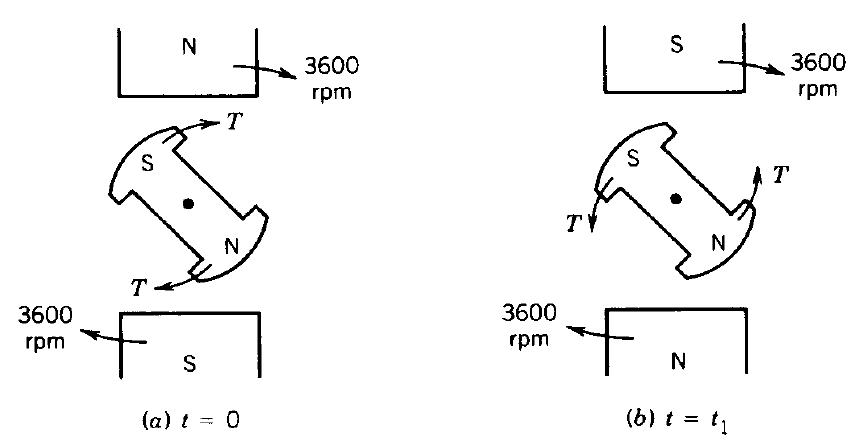
To understand why a synchronous motor cannot start by itself, we analyze the magnetic interaction between stator and rotor at the instant of starting.
1. Stator: Rotating Magnetic Field
When a 3-phase AC supply is given to the stator, it produces a rotating magnetic field (RMF) at synchronous speed:
\[
N_s = \frac{120f}{P}
\]
- \(f\): Supply frequency
- \(P\): Number of poles
2. Rotor: Stationary Magnetic Field
- Rotor is excited with DC supply
- Produces fixed N and S poles
- At starting, rotor speed \(N = 0\)
3. Instantaneous Torque
- First half cycle: Like poles repel → torque in one direction
- Next half cycle: Unlike poles attract → torque in opposite direction
Torque direction keeps changing rapidly due to rotating magnetic field.
4. Result
- Rotor has inertia
- Cannot respond to rapid torque reversal
- Average torque over a cycle becomes zero
Therefore, the motor does not start and only vibrates.
Starting Methods
- Damper Windings: Provide induction motor starting torque
- Pony Motor: External motor brings rotor to near synchronous speed
- VFD: Starts at low frequency and gradually increases speed
Condition for Starting
To start successfully:
- The rotor must be brought close to synchronous speed
- Then DC excitation is applied
- Rotor locks with stator field and runs at synchronous speed
3. Methods of Starting a Synchronous Motor
(a) Using Damper Winding (Most Common Method)
Construction:
- Copper bars embedded in rotor poles (like squirrel cage)
- Short-circuited at both ends
Working:
- Initially, field winding is not excited
- Motor behaves like an induction motor
- Damper winding produces starting torque
- Rotor accelerates close to synchronous speed
- DC excitation is switched ON
- Rotor pulls into synchronism
Advantages:
- Simple and widely used
- No external starting device required
(b) Using External Prime Mover
Working:
- Motor is first driven by an external machine (like DC motor)
- Speed is brought near synchronous speed
- DC excitation is applied
- Motor locks into synchronism
Disadvantage:
- Costly and rarely used
(c) Using Pony Motor
- A small auxiliary motor is used to start the synchronous motor
- Similar to prime mover method
- Used in large installations
(d) Using Variable Frequency Drive (VFD)
Working:
- Supply frequency is gradually increased from zero
- Motor accelerates smoothly
- Reaches synchronous speed
- Operates normally
Advantages:
- Smooth and controlled starting
- Modern and efficient method
4. Starting with Damper Winding
- Apply 3-phase AC supply to stator
- Keep field winding open or shorted through resistor
- Motor starts as an induction motor
- Rotor speed increases
- At ~95–98% of synchronous speed, apply DC excitation
- Rotor locks with RMF → synchronous operation begins