Starting a synchronous motor directly from the supply is difficult because it cannot produce starting torque on its own. Traditionally, damper windings or pony motors were used. However, with modern drives, a Variable Frequency Drive (VFD) provides a smooth and highly controlled starting method.
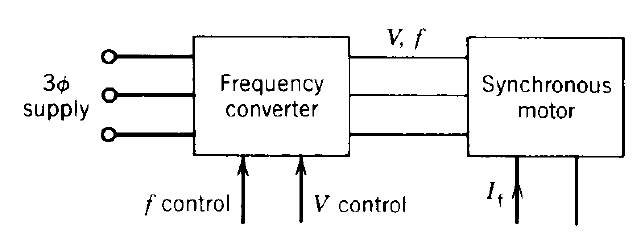
Table of Contents
Why VFD Starting is Required?
A synchronous motor:
- Requires DC excitation on the rotor
- Needs to run at synchronous speed to lock with the rotating magnetic field
- Cannot self-start under normal AC supply.
- A VFD solves this problem by gradually building speed from zero.
Basic Principle of VFD Starting
A VFD controls:
- Frequency (f) → controls speed
- Voltage (V) → maintains flux
Speed relation:
\[
N_s = \frac{120f}{P}
\]
\begin{align*}
N_s &= \text{Synchronous speed} \\
f &= \text{Supply frequency} \\
P &= \text{Number of poles}
\end{align*}
By starting at low frequency, the motor starts at low speed, and speed increases gradually as frequency increases.