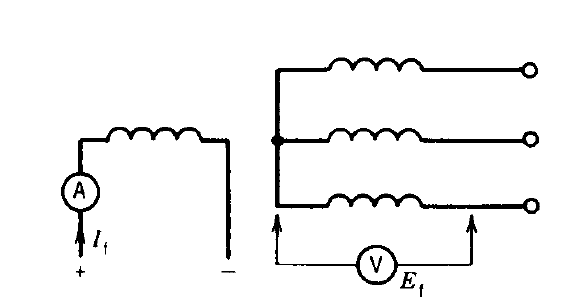
The Open Circuit Test of a synchronous machine is performed to determine the relationship between the field excitation current and the generated armature voltage when no load is connected. It shows the relationship between field current and generated EMF.
This test is mainly used to:
- Obtain the Open Circuit Characteristic (OCC)
- Determine magnetic saturation
- Calculate synchronous impedance (when combined with the short-circuit test)
The machine is run at rated speed with no load, and the generated voltage is measured for different values of field current.
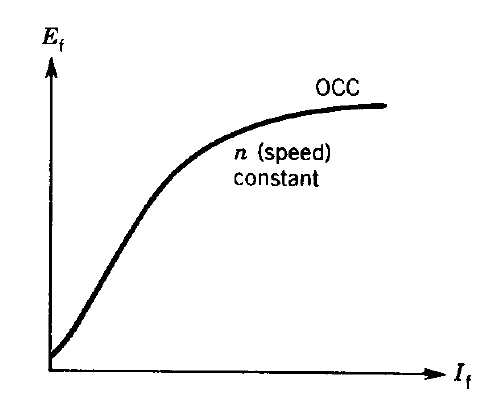
Table of Contents
Procedure of Open Circuit Test of Synchronous Motor
Driving the Machine
The machine is driven at rated synchronous speed using a prime mover and operated as a generator.
Armature terminals are kept open:
\[
I_a = 0
\]
Varying Field Excitation
- Field current \(I_f\) is increased gradually
- Open-circuit voltage \(V_{OC}\) is measured
- Readings taken up to 125% of rated voltage
OCC Curve
- X-axis: Field current \(I_f\)
- Y-axis: Open-circuit voltage \(V_{OC}\)
This graph is called the Open Circuit Characteristic (OCC).
Analysis of OCC
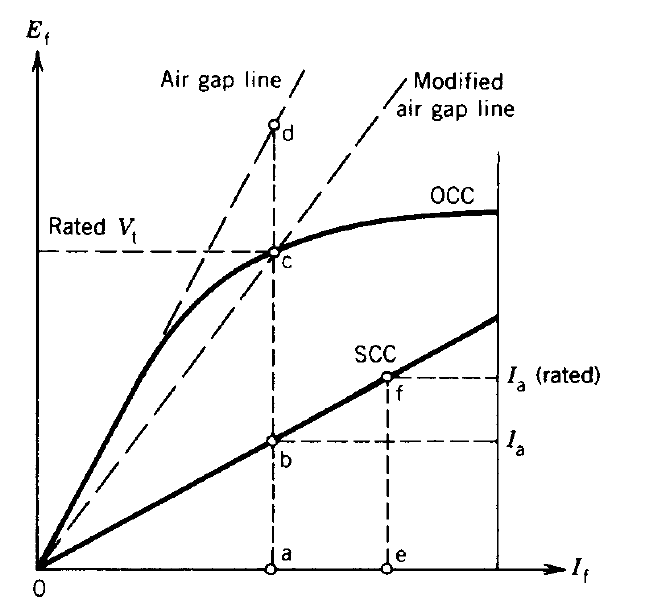
Air-Gap Line
- Initial linear portion
- Magnetic circuit unsaturated
Saturation Region
- Curve becomes nonlinear
- Due to core saturation
Significance
- Determines synchronous reactance \(X_s\)
- Used for voltage regulation
- Shows magnetic behavior
Conclusion
The Open Circuit Test helps determine the relationship between field current and generated voltage, and is essential for analyzing synchronous machine performance.