A transducer is a fundamental component in measurement and instrumentation systems. It is used to convert a physical quantity (non-electrical) into an electrical signal, which can be easily measured, processed, and recorded. Transducers act as a bridge between the physical world and electronic systems.
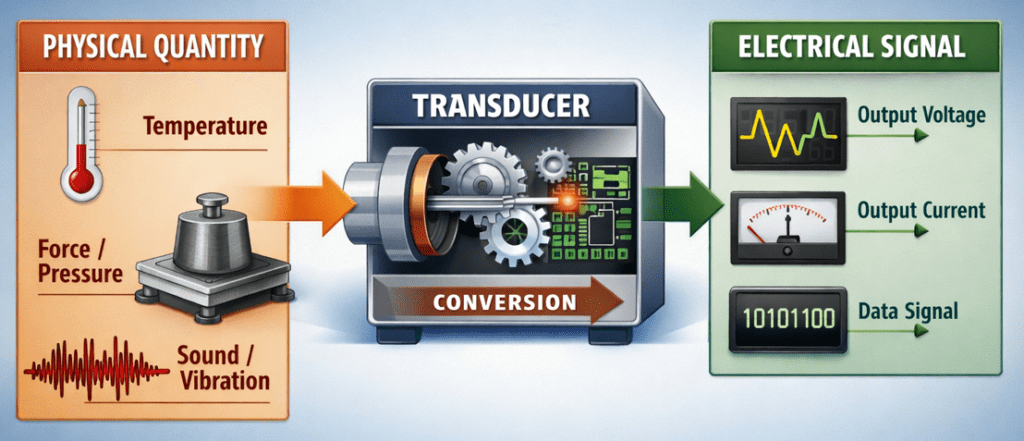
Table of Contents
Basic Measurement System
A typical measurement system consists of:
- Measurand (physical quantity)
- Transducer
- Signal conditioning unit
- Output/display device
Example:
Temperature → Transducer → Electrical signal → Display
Types of Transducers
Based on Energy Source
Active Transducers
- Generate output without external power
- Convert energy directly into electrical form
Examples:
- Thermocouple
- Piezoelectric transducer
Passive Transducers
- Require external power supply
- Output is obtained by variation in electrical parameters
Examples:
- Strain gauge
- RTD (Resistance Temperature Detector)

Based on Output
Analog Transducers
- Provide continuous output
- Output varies smoothly with input
Digital Transducers
- Provide discrete output
- Output is in digital form (0s and 1s)
Based on Measurand
- Temperature transducers (Thermocouple, RTD)
- Pressure transducers
- Displacement transducers (LVDT)
- Flow transducers
- Light transducers (Photodiodes)
Characteristics of Transducers
Static Characteristics
- Accuracy – closeness to true value
- Precision – repeatability
- Sensitivity – change in output per unit input
- Linearity – proportionality between input and output
- Resolution – smallest detectable change
Dynamic Characteristics
- Speed of response
- Fidelity
- Lag
Advantages of Transducers
- Enable electrical measurement of physical quantities
- Suitable for remote monitoring
- Easy integration with digital systems
- Provide fast and accurate measurements
Disadvantages
- May require calibration
- Sensitive to environmental conditions
- Some require external power
Applications
- Industrial automation
- Process control systems
- Biomedical instruments
- Robotics
- Aerospace systems