Table of Contents
The Firing Constraint: Minimum Angle ($\theta_1$)
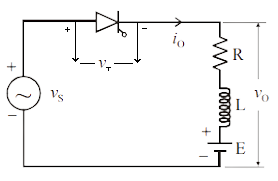
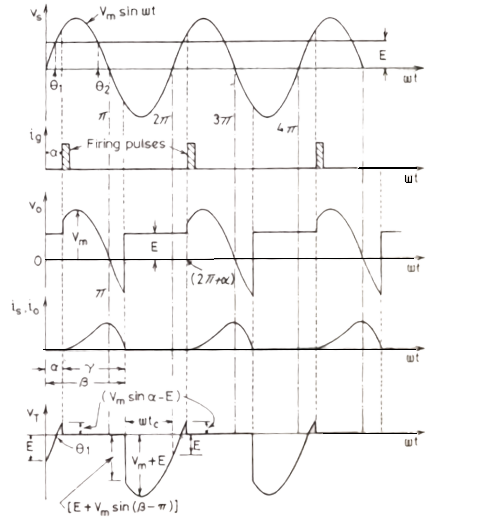
Unlike R or RL loads, the SCR cannot conduct as soon as the AC source becomes positive. It can only turn ON when the supply voltage $V_s$ exceeds the DC source voltage $E$.
The threshold angle ($\theta_1$) is defined as:
$$\theta_1 = \sin^{-1} \left( \frac{E}{V_m} \right)$$
Crucial Rule: If the firing angle $\alpha < \theta_1$, the SCR remains reverse-biased and will not trigger, even with a gate pulse.
Principle of Operation
- Conduction Phase ($\alpha \le \omega t \le \beta$): Once triggered at $\alpha$, the SCR conducts. The output voltage $V_o$ follows the AC supply $V_m \sin(\omega t)$. The inductor stores energy during this period.
- Extinction Angle ($\beta$): Due to the inductor, current continues to flow even after the supply voltage falls below $E$. The SCR turns off only when the current hits zero at angle $\beta$.
- Off Phase ($\beta \le \omega t \le 2\pi + \alpha$): When the SCR is OFF, the load is isolated. With no current flowing, the voltage drops across $R$ and $L$ are zero, meaning the output voltage $V_o = E$.
Mathematical Analysis
The circuit is governed by the Kirchhoff’s Voltage Law (KVL) equation:
$$V_m \sin(\omega t) = Ri_o + L \frac{di_o}{dt} + E$$
Average Output Voltage ($V_{dc}$)
The average voltage is calculated by integrating over a full cycle ($2\pi$):
$$V_{dc} = \frac{1}{2\pi} \left[ \int_{\alpha}^{\beta} V_m \sin(\omega t) \, d(\omega t) + \int_{\beta}^{2\pi+\alpha} E \, d(\omega t) \right]$$
Average Load Current ($I_{dc}$)
$$I_{dc} = \frac{1}{2\pi R} \left[ V_m(\cos \alpha – \cos \beta) – E(\beta – \alpha) \right]$$
Summary of Characteristics
| Parameter | Behavior with RLE Load |
|---|---|
| Output Voltage ($V_o$) when SCR is OFF | Equal to DC source voltage ($E$) |
| Minimum Firing Angle | Must be $\ge \theta_1$ |
| Current Waveform | Starts at $\alpha$, peaks, and decays to zero at $\beta$ |
| Power Flow | Power is delivered to both the resistor ($R$) and the DC source ($E$) |