1. The dimensions of \( \frac{1}{2} \varepsilon_0 E^2 \) is
(1) \( MLT^{-2} \)
(2) \( ML^{-1}T^{-2} \)
(3) \( MLT^{-1} \)
(4) \( ML^{-1}T^{-1} \)
Answer: (2)
Explanation:
The expression \( u_e = \frac{1}{2} \varepsilon_0 E^2 \) represents electric energy density, which means the electrical energy stored per unit volume in an electric field.
In classical electromagnetism, energy is not only associated with charges but is also stored in the electric field itself.
This can be understood using a parallel-plate capacitor:
- The total energy stored is \( U = \frac{1}{2}CV^2 \).
- For a parallel-plate capacitor, \( C = \frac{\varepsilon_0 A}{d} \) and \( V = Ed \).
- Substituting these values:
\[
U = \frac{1}{2} \left(\frac{\varepsilon_0 A}{d}\right)(Ed)^2 = \frac{1}{2} \varepsilon_0 E^2 (Ad)
\]
Here, \( Ad \) represents the volume between the plates. Therefore, the energy per unit volume is:
\[
u_e = \frac{U}{\text{Volume}} = \frac{1}{2} \varepsilon_0 E^2
\]
Energy is dimensionally equal to work (i.e., Force × Distance):
\[
[E] = [MLT^{-2}] \times [L] = [ML^2T^{-2}]
\]
Volume is:
\[
[V] = [L^3]
\]
Therefore,
\[
[u] = \frac{[ML^2T^{-2}]}{[L^3]} = [ML^{-1}T^{-2}]
\]
Hence, the dimensions of \( \frac{1}{2} \varepsilon_0 E^2 \) are \( ML^{-1}T^{-2} \).
2. A wooden cubic block of relative density 0.4 is floating in water. Side of cubic block is \( 10 \, \text{cm} \). When a coin is placed on the block the block dips 0.3 cm in equilibrium. Weight of coin is
(1) \( 0.2 \, \text{N} \)
(2) \( 30 \, \text{N} \)
(3) \( 0.3 \, \text{N} \)
(4) \( 3 \, \text{N} \)
Answer: (3)
Explanation:
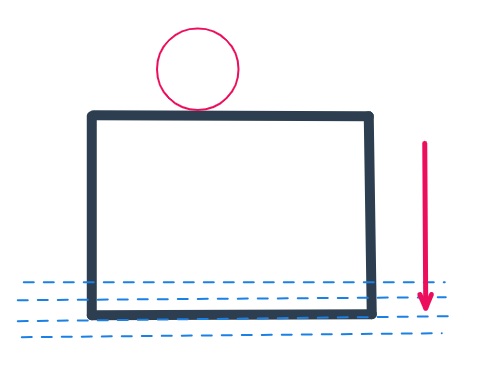
The cube has side \( 10 \, \text{cm} \), so the area of the base is:
\[
\text{Area} = 10 \times 10 = 100 \, \text{cm}^2
\]
When the coin is placed, the block sinks an additional \( 0.3 \, \text{cm} \), so the extra volume of water displaced is:
\[
\text{Extra Volume} = 100 \times 0.3 = 30 \, \text{cm}^3
\]
According to Archimedes’ Principle, the weight of the coin equals the buoyant force due to this extra displaced water.
Using \( \rho = 1000 \, \text{kg/m}^3 \), \( V = 30 \times 10^{-6} \, \text{m}^3 \), and \( g = 10 \, \text{m/s}^2 \):
\[
\text{Weight} = \rho \times V \times g
\]
\[
\text{Weight} = 1000 \times (30 \times 10^{-6}) \times 10
\]
\[
\text{Weight} = 0.3 \, \text{N}
\]
Thus, the weight of the coin is \( 0.3 \, \text{N} \).
3. Consider two arrangements of wires, find ratio of magnetic field at centre of the semi-circular part.
(1) \( \frac{\pi + 4}{\pi – 1} \)
(2) \( \frac{\pi + 4}{\pi + 2} \)
(3) \( \frac{\pi + 2}{\pi + 1} \)
(4) \( \frac{\pi – 2}{\pi + 1} \)
Answer: (3)
Explanation:
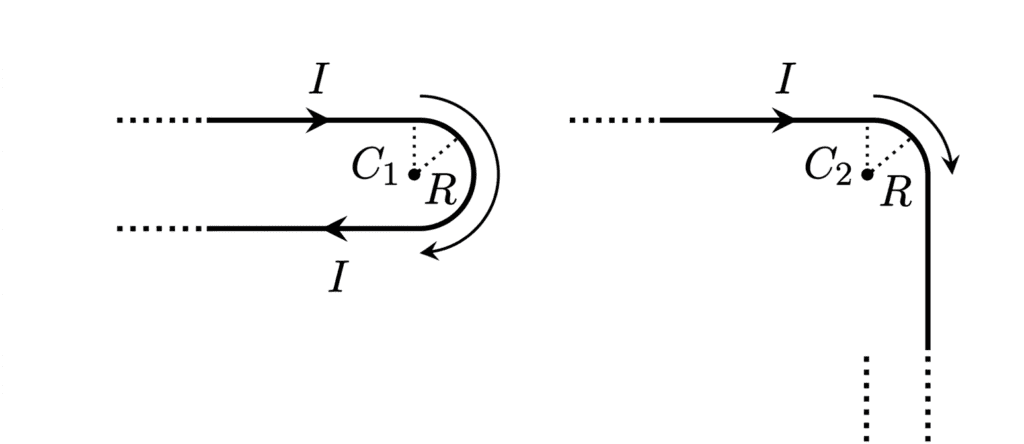
To find the magnetic field at centers \( C_1 \) and \( C_2 \), we use the Biot–Savart Law and the principle of superposition, i.e., the total field is the vector sum of contributions from each segment.
To calculate the magnetic field at \( C_1 \), we divide the wire into three segments and apply the Biot–Savart Law, then take the vector sum of all contributions.
For the top semi-infinite straight wire, the magnetic field at distance \( R \) is:
\[
B_{straight} = \frac{\mu_0 I}{4 \pi R} (\sin \theta_1 + \sin \theta_2)
\]
Here, \( \theta_1 = 90^\circ \) and \( \theta_2 = 0^\circ \), so:
\[
B_1 = \frac{\mu_0 I}{4 \pi R} (1 + 0) = \frac{\mu_0 I}{4 \pi R}
\]
The direction is into the page \( (\otimes) \) by the right-hand rule.
For the semi-circular arc, the magnetic field at the center is:
\[
B_{arc} = \frac{\mu_0 I}{4 \pi R} \cdot \phi
\]
Since \( \phi = \pi \) (semi-circle):
\[
B_2 = \frac{\mu_0 I}{4 R}
\]
The direction is also into the page \( (\otimes) \).
For the bottom semi-infinite straight wire,
\[
B_3 = \frac{\mu_0 I}{4 \pi R}
\]
This contribution is again into the page \( (\otimes) \).
Since all contributions are in the same direction, we add them:
\[
B_{C1} = B_1 + B_2 + B_3
\]
\[
B_{C1} = \frac{\mu_0 I}{4 \pi R} + \frac{\mu_0 I}{4 R} + \frac{\mu_0 I}{4 \pi R}
\]
\[
B_{C1} = \frac{2\mu_0 I}{4 \pi R} + \frac{\mu_0 I}{4 R}
\]
Taking common factor:
\[
B_{C1} = \frac{\mu_0 I}{4 R} \left( 1 + \frac{2}{\pi} \right)
\]
The final magnetic field is into the page \( (\otimes) \).
For point \( C_1 \), there are three
- Semi-infinite straight wire (top):
\[
B_1 = \frac{\mu_0 I}{4\pi R}
\]
(direction: into the page) - Semi-circular arc:
\[
B_2 = \frac{\mu_0 I}{4R}
\]
(direction: into the page) - Semi-infinite straight wire (bottom):
\[
B_3 = \frac{\mu_0 I}{4\pi R}
\]
(direction: into the page)
Adding all contributions:
\[
B_{C1} = B_1 + B_2 + B_3 = \frac{\mu_0 I}{4\pi R} + \frac{\mu_0 I}{4R} + \frac{\mu_0 I}{4\pi R}
\]
\[
B_{C1} = \frac{\mu_0 I}{4R} \left( 1 + \frac{2}{\pi} \right)
\]
For point \( C_2 \), again three contributions:
- Semi-infinite straight wire:
\[
B_1 = \frac{\mu_0 I}{4\pi R}
\]
(direction: into the page) - Quarter-circular arc:
\[
B_2 = \frac{\mu_0 I}{8R}
\]
(direction: into the page) - Vertical wire through center:
\[
B_3 = 0
\]
(because \( \sin\theta = 0 \), hence no magnetic field)
Total field at \( C_2 \):
\[
B_{C2} = \frac{\mu_0 I}{4\pi R} + \frac{\mu_0 I}{8R}
\]
\[
B_{C2} = \frac{\mu_0 I}{4R} \left( \frac{1}{2} + \frac{1}{\pi} \right)
\]
Final results:
- At \( C_1 \): \( \frac{\mu_0 I}{4R} \left( 1 + \frac{2}{\pi} \right) \)
- At \( C_2 \): \( \frac{\mu_0 I}{4R} \left( \frac{1}{2} + \frac{1}{\pi} \right) \)
4. In isobaric reversible process on a diatomic gas, ratio of \( \Delta Q : \Delta U : W \) shall be
(1) \( 7 : 5 : 2 \)
(2) \( 5 : 3 : 2 \)
(3) \( 3 : 2 : 1 \)
(4) \( 6 : 5 : 1 \)
Answer: (1)
Explanation: In an isobaric process, heat \( \Delta Q = nC_p\Delta T \), internal energy \( \Delta U = nC_v\Delta T \), and work \( W = nR\Delta T \). For a diatomic gas, \( C_p = \frac{7}{2}R \) and \( C_v = \frac{5}{2}R \). Therefore, the ratio \( C_p : C_v : R \) simplifies to \( 7 : 5 : 2 \).
5. In circular motion, angular position \( \theta \) and time \( t \) are related as \( \theta = \frac{5t^4}{4} – \frac{t^3}{3} \). Then angular acceleration at \( t = 10 \) sec is
(1) \( 1180 \, \text{rad/s}^2 \)
(2) \( 130 \, \text{rad/s}^2 \)
(3) \( 1480 \, \text{rad/s}^2 \)
(4) \( 98 \, \text{rad/s}^2 \)
Answer: (3)
Explanation:
The correct answer is (3) \( 1480 \, \text{rad/s}^2 \).
To find the angular velocity \( \omega \), we differentiate the given angular position with respect to time:
\[
\omega = \frac{d\theta}{dt} = \frac{d}{dt} \left( \frac{5t^4}{4} – \frac{t^3}{3} \right)
\]
\[
\omega = 5t^3 – t^2
\]
Now, to find the angular acceleration \( \alpha \), we again differentiate:
\[
\alpha = \frac{d\omega}{dt} = \frac{d}{dt} \left( 5t^3 – t^2 \right)
\]
\[
\alpha = 15t^2 – 2t
\]
Substituting \( t = 10 \, \text{s} \):
\[
\alpha = 15(10)^2 – 2(10)
\]
\[
\alpha = 1500 – 20 = 1480 \, \text{rad/s}^2
\]
The angular acceleration at \( t = 10 \, \text{s} \) is \( 1480 \, \text{rad/s}^2 \).
6. For an ideal gas having \( C_p = 3R \) and \( C_v = 2R \). Find work done by one mole of the gas in adiabatic expansion when pressure reduces from 8 bar to 1 bar. (Initial temperature = \( 140^\circ C \))
(1) 140R
(2) 70R
(3) 826R
(4) 413R
Answer: (4) 413R
Explanation: First, find the adiabatic exponent \( \gamma = \frac{C_p}{C_v} = \frac{3R}{2R} = \frac{3}{2} \).
For an adiabatic process:
\[
\frac{T_2}{T_1} = \left(\frac{P_2}{P_1}\right)^{\frac{\gamma-1}{\gamma}}
\]
\[
\frac{T_2}{T_1} = \left(\frac{1}{8}\right)^{\frac{1/2}{3/2}} = \left(\frac{1}{8}\right)^{1/3} = \frac{1}{2}
\]
Initial temperature \( T_1 = 140^\circ C = 413 \, K \), so \( T_2 = \frac{413}{2} \, K \).
Work done in adiabatic process:
\[
W = n C_v \Delta T = (1)(2R)\left(413 – \frac{413}{2}\right) = 413R
\]
7. In YDSE experiment wavelength of light used is 620 nm and separation between slits is 0.2 mm. Find angular fringe width.
(1) \( 3 \times 10^{-4} \)
(2) \( 3.1 \times 10^{-3} \)
(3) \( 1.2 \times 10^{-3} \)
(4) \( 6.2 \times 10^{-4} \)
Answer: (2) \( 3.1 \times 10^{-3} \)
Explanation: The angular fringe width is given by:
\[
\theta = \frac{\lambda}{d}
\]
\[
\theta = \frac{620 \times 10^{-9}}{0.2 \times 10^{-3}} = 3.1 \times 10^{-3} \, \text{rad}
\]
8. Photons of wavelength \( \lambda \) & \( 3\lambda \) incident on a metal surface. If stopping potential for the ejected photoelectrons are \( 4V_0 \) & \( V_0 \) respectively, find threshold wavelength.
(1) \( 6\lambda \)
(2) \( 9\lambda \)
(3) \( 2\lambda \)
(4) \( 8\lambda \)
Answer: (2) \( 9\lambda \)
Explanation: Using Einstein’s photoelectric equation:
\[
eV_s = \frac{hc}{\lambda} – \phi
\]
\[
4eV_0 = \frac{hc}{\lambda} – \phi
\]
\[
eV_0 = \frac{hc}{3\lambda} – \phi
\]
Solving, we get:
\[
\phi = \frac{hc}{9\lambda}
\]
Thus, threshold wavelength:
\[
\lambda_{th} = 9\lambda
\]
9. For the given spherical surface of curvature radius \( R = 20 \, cm \), object of height \( h_0 = 2 \, mm \) is placed at distance 40 cm. Mediums have refractive indices \( \mu_1 = 1 \), \( \mu_2 = 1.5 \). Find height of image.
(1) 2 mm
(2) 1.5 mm
(3) 1 mm
(4) 4 mm
Answer: (3) 1 mm
Explanation:
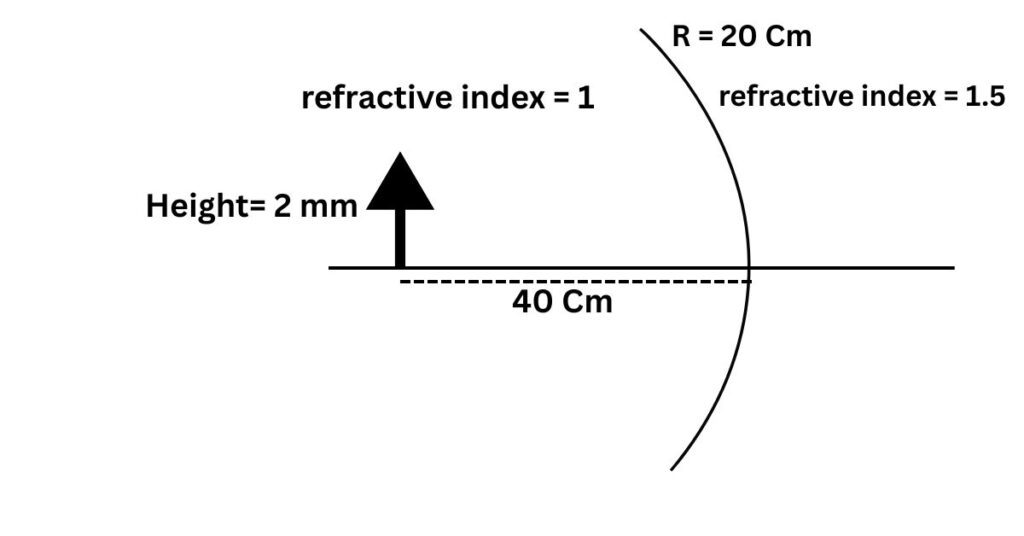
Using refraction at spherical surface:
\[
\frac{\mu_2}{v} – \frac{\mu_1}{u} = \frac{\mu_2 – \mu_1}{R}
\]
Substituting values gives \( v = -30 \, cm \).
Magnification:
\[
M = \frac{\mu_1 v}{\mu_2 u} = \frac{1(-30)}{1.5(-40)} = 0.5
\]
\[
h_i = M \cdot h_0 = 0.5 \times 2 = 1 \, mm
\]
10. Find change in surface energy if 512 small drops of radius \( r = 2 \, mm \) merge into a single drop. (surface tension = S)
(1) \( \pi S \times 7.168 \times 10^{-3} \)
(2) \( \pi S \times 3.584 \times 10^{-3} \)
(3) \( \pi S \times 1.792 \times 10^{-3} \)
(4) \( \pi S \times 6.284 \times 10^{-3} \)
Answer: (1)
Explanation: Using volume conservation:
\[
512 \cdot \frac{4}{3}\pi r^3 = \frac{4}{3}\pi R^3 \Rightarrow R = 8r
\]
Change in surface energy:
\[
\Delta U = S \cdot (n \cdot 4\pi r^2 – 4\pi R^2)
\]
\[
\Delta U = 4\pi S (512r^2 – 64r^2) = 4\pi S (448r^2)
\]
\[
\Delta U = \pi S \times 7.168 \times 10^{-3} \, \text{J}
\]
11 One fourth volume of an empty capacitor of capacitance \( C_0 \) is filled with dielectric of constant \( K = 5 \). Surface area of dielectric is \( A/2 \) & width \( d/2 \). If \( A \gg d^2 \), then new capacitance is
(1) \( \frac{3}{2}C_0 \)
(2) \( \frac{4}{3}C_0 \)
(3) \( \frac{5}{4}C_0 \)
(4) \( \frac{7}{6}C_0 \)
Answer: (2) \( \frac{4}{3}C_0 \)
Explanation: The capacitor is divided into series and parallel parts. The dielectric part has capacitance:
\[
C_1 = \frac{K\epsilon_0 (A/2)}{d/2} = KC_0 = 5C_0
\]
This is in series with air part:
\[
C_2 = \frac{\epsilon_0 (A/2)}{d/2} = C_0
\]
\[
C_{eq1} = \frac{5C_0 \cdot C_0}{5C_0 + C_0} = \frac{5}{6}C_0
\]
The remaining part is parallel:
\[
C_3 = \frac{\epsilon_0 (A/2)}{d} = \frac{C_0}{2}
\]
\[
C = \frac{5}{6}C_0 + \frac{1}{2}C_0 = \frac{4}{3}C_0
\]
12 Two hollow conducting spheres are separated by large distance and connected by a wire. If \( E_1 \) and \( E_2 \) are electric fields near their surfaces, find \( \frac{E_1}{E_2} \).
(1) \( \frac{9}{2} \)
(2) \( \frac{9}{4} \)
(3) \( \frac{2}{9} \)
(4) \( \frac{4}{9} \)
Answer: (2) \( \frac{9}{4} \)
Explanation: When connected, both spheres have same potential:
\[
\frac{kq_1}{r_1} = \frac{kq_2}{r_2}
\]
Using \( E = \frac{\sigma}{\epsilon_0} \), we get:
\[
\frac{E_1}{E_2} = \frac{r_2}{r_1} = \frac{18}{8} = \frac{9}{4}
\]
13 A charged particle of charge \( 1 \, \mu C \) moves along y-axis. Electric field is \( E = 600\sin(\omega t – kx)\hat{j} \). Find maximum electric force.
(1) \( 8 \times 10^{4} \)
(2) \( 6 \times 10^{-4} \)
(3) \( 2 \times 10^{-4} \)
(4) \( 41 \times 10^{-4} \)
Answer: (2) \( 6 \times 10^{-4} \, N \)
Explanation: Electric force is:
\[
F = qE
\]
Maximum field \( E_0 = 600 \), so:
\[
F_{max} = (1 \times 10^{-6})(600) = 6 \times 10^{-4} \, N
\]
14 Two satellites revolve around planets. Find ratio of time periods.
(1) \( \frac{1}{2} \)
(2) \( \frac{1}{3} \)
(3) \( \frac{1}{4} \)
(4) \( \frac{1}{\sqrt{2}} \)
Answer: (1) \( \frac{1}{2} \)
Explanation: Time period:
\[
T = 2\pi \sqrt{\frac{r^3}{GM}}
\]
\[
T_2 = 2\pi \sqrt{\frac{(2r)^3}{G(2M)}} = 2T_1
\]
\[
\frac{T_1}{T_2} = \frac{1}{2}
\]
21 Power dissipated in an inductor coil is \( P \). New coil has doubled turns, length and area. If power becomes \( \alpha\sqrt{2}P \), find \( \alpha \).
Answer: 2
Explanation: Power:
\[
P = I^2R
\]
Resistance depends on:
\[
R = \rho \frac{L}{A}
\]
New resistance becomes \( 2\sqrt{2}R \), hence:
\[
P’ = 2\sqrt{2}P
\Rightarrow \alpha = 2
\]
22 For a thin prism, deviation \( \delta = 8 \). If refractive index \( \mu = 1.5 \), find \( \frac{A}{\delta} \).
Answer: 2
Explanation: For thin prism:
\[
\delta = (\mu – 1)A
\]
\[
8 = 0.5A \Rightarrow A = 16
\]
\[
\frac{A}{\delta} = \frac{16}{8} = 2
\]
1 (Chemistry) Increasing order of bond length:
(1) \( O_2^+ < O_2 < O_2^- < O_2^{2-} \)
(2) \( O_2^+ < O_2 < O_2^{2-} < O_2^- \)
(3) \( O_2^{2-} < O_2^- < O_2 < O_2^+ \)
(4) \( O_2^- < O_2^{2-} < O_2^+ < O_2 \)
Answer: (1)
Explanation: Bond length is inversely proportional to bond order. Order:
\[
O_2^+ > O_2 > O_2^- > O_2^{2-}
\]
Thus, bond length increases accordingly.
2 (Chemistry) Order of rate of reaction with \( PhN_2Cl \):
Answer: (1) R > P > Q
Explanation: Depends on electron density and resonance. Steric hindrance reduces reactivity in P and Q.
3 (Chemistry) Match vitamins:
Answer: (2)
Explanation:
Vitamin C → Ascorbic Acid
Vitamin B1 → Thiamine
Vitamin B6 → Pyridoxine
Vitamin B2 → Riboflavin
4 (Chemistry) Increasing priority order:
Answer: (3)
Explanation:
\( -CONH_2 > -CN > -CHO > -C=O > -NH_2 > -C \equiv C \)
5 (Chemistry) Electrophilic attack position:
Answer: (1)
Explanation: Activated ring with \( -NH \) group increases electron density; para position is most reactive.
6 (Chemistry) Apple green flame:
Answer: (1) BaSO_4
Explanation: Barium ions give apple green color.
7 (Chemistry) Alkane formula:
Answer: (2) \( C_5H_{12} \)
Explanation:
\[
\frac{3n+1}{2} = 8 \Rightarrow n = 5
\]
8 (Chemistry) Mass of Fe:
Answer: (3) 42 g
Explanation:
\[
3Fe + 4H_2O \rightarrow Fe_3O_4 + 4H_2
\]
\[
72g \, H_2O \rightarrow 168g \, Fe
\Rightarrow 18g \rightarrow 42g
\]
9 (Chemistry) Solubility ratio:
Answer: (2)
Explanation:
\[
S_1 = 2x^{1/3}, \quad S_2 = 2y^{1/2}
\Rightarrow \frac{S_1}{S_2} = \frac{x^{1/3}}{y^{1/2}}
\]
10 (Chemistry) Energy of electron:
Answer: (1) -0.38 eV
Explanation:
\[
\frac{nh}{2\pi} = \frac{3h}{\pi} \Rightarrow n=6
\]
\[
E = -\frac{13.6}{36} = -0.38 \, eV
\]
11. One fourth volume of an empty capacitor of capacitance \(C_0\) is filled with dielectric of constant \(K = 5\). Surface area of dielectric is \(A/2\) & width \(d/2\). If \(A \gg d^2\), then new capacitance is
(1) \(\frac{3}{2}C_0\)
(2) \(\frac{4}{3}C_0\)
(3) \(\frac{5}{4}C_0\)
(4) \(\frac{7}{6}C_0\)
Answer: (2)
Explanation: The capacitor is divided into parts. The dielectric part has capacitance \(C_1 = \frac{K\epsilon_0(A/2)}{d/2} = KC_0 = 5C_0\). This is in series with an air part \(C_2 = \frac{\epsilon_0(A/2)}{d/2} = C_0\). Their equivalent is \(C_{eq1} = \frac{5C_0 \cdot C_0}{5C_0 + C_0} = \frac{5}{6}C_0\). The remaining half is air-filled with \(C_3 = \frac{\epsilon_0(A/2)}{d} = \frac{C_0}{2}\). Since they are in parallel, total capacitance is \(\frac{5}{6}C_0 + \frac{1}{2}C_0 = \frac{4}{3}C_0\).
12. Two hollow conducting spheres are separated by large distance and connected by a wire. If \(E_1\) & \(E_2\) are electric fields near surfaces, find \(\frac{E_1}{E_2}\).
(1) \(\frac{9}{2}\)
(2) \(\frac{9}{4}\)
(3) \(\frac{2}{9}\)
(4) \(\frac{4}{9}\)
Answer: (2)
Explanation: When connected, both spheres have equal potential, so \(\frac{kq_1}{r_1} = \frac{kq_2}{r_2}\). This gives \(\sigma_1 r_1 = \sigma_2 r_2\). Since \(E = \frac{\sigma}{\epsilon_0}\), we get \(\frac{E_1}{E_2} = \frac{r_2}{r_1}\). Using given radii \(r_1 = 8\text{ cm}, r_2 = 18\text{ cm}\), \(\frac{E_1}{E_2} = \frac{18}{8} = \frac{9}{4}\).
13. A charge \(1\,\mu C\) moves in an EM wave \(E = 600\sin(\omega t – kx)\,\hat{j}\). Find maximum electric force.
(1) \(8 \times 10^4\) N
(2) \(6 \times 10^4\) N
(3) \(2 \times 10^{-4}\) N
(4) \(41 \times 10^{-4}\) N
Answer: (2)
Explanation: Electric force is \(\vec{F} = q\vec{E}\). Maximum occurs at peak field \(E_0 = 600\). Thus \(F_{max} = qE_0 = (1 \times 10^{-6})(600) = 6 \times 10^{-4}\text{ N}\).
14. Two satellites revolve around planets. Find ratio of time periods.
(1) \(\frac{1}{2}\)
(2) \(\frac{1}{3}\)
(3) \(\frac{1}{4}\)
(4) \(\frac{1}{\sqrt{2}}\)
Answer: (1)
Explanation: Time period \(T = 2\pi\sqrt{\frac{r^3}{GM}}\). For second satellite, \(r \rightarrow 2r, M \rightarrow 2M\), so \(T_2 = 2T_1\). Hence \(\frac{T_1}{T_2} = \frac{1}{2}\).
21. Power dissipated in coil changes to \(\alpha\sqrt{2}P\). Find \(\alpha\).
Answer: (2)
Explanation: Power \(P = I^2R\). Resistance \(R = \rho \frac{L}{A}\). On doubling turns, length and area, new resistance becomes \(R’ = 2\sqrt{2}R\). Thus \(P’ = 2\sqrt{2}P\). Comparing with \(\alpha\sqrt{2}P\), we get \(\alpha = 2\).
22. For thin prism, find \(\frac{A}{\delta}\).
Answer: (2)
Explanation: For thin prism \(\delta = (\mu – 1)A\). Substituting \(\mu = 1.5\), \(8 = 0.5A \Rightarrow A = 16\). Thus \(\frac{A}{\delta} = \frac{16}{8} = 2\).
11 (Chemistry). Increasing order of \(\Delta_0\)
Answer: (1)
Explanation: Using spectrochemical series: \(F^- < NH_3 < en < CN^-\). Hence order is \((b) < (c) < (d) < (a)\).
12 (Chemistry). Energy for \(Li^{2+} \rightarrow Li^{3+}\)
Answer: (2)
Explanation: For hydrogen-like atom \(E = 13.6Z^2\). With \(Z=3\), \(E = 13.6 \times 9 = 122.4\text{ eV}\).
13 (Chemistry). Find \(K_a\)
Answer: (1)
Explanation: Using \(\Delta T_f = iK_f m\), find \(i\) then \(\alpha\). Finally \(K_a = C\alpha^2 \approx 1.18 \times 10^{-3}\).
14 (Chemistry). Work done
Answer: (2)
Explanation: For isothermal process \(W = -2.303 P_iV_i \log\left(\frac{V_f}{V_i}\right)\). Substituting gives \(-8.3\text{ L·atm}\).
15 (Chemistry). Matching
Answer: (3)
Explanation: Ethanol → Ceric ammonium nitrate, Phenol → \(FeCl_3\), Acid → \(NaHCO_3\), Aldehyde → Schiff reagent.
16 (Chemistry). Order reaction relation
Answer: (2)
Explanation: First order reactions never reach 100% completion, so time is infinite.
17 (Chemistry). Products of Cumene
Answer: (1)
Explanation: Cumene process gives Phenol + Acetone.
18 (Chemistry). Ionization energy statements
Answer: (1)
Explanation: Both statements are incorrect based on actual trends.
21 (Chemistry). Find temperature
Answer: 41
Explanation: Using Arrhenius equation, solving gives \(T \approx 314K = 41^\circ C\).
22 (Chemistry). Number of isomers
Answer: 7
Explanation: Only cycloalkanes do not react with \(KMnO_4\). Total isomers = 7.