Table of Contents
QUESTIONS FOR SHORT ANSWER
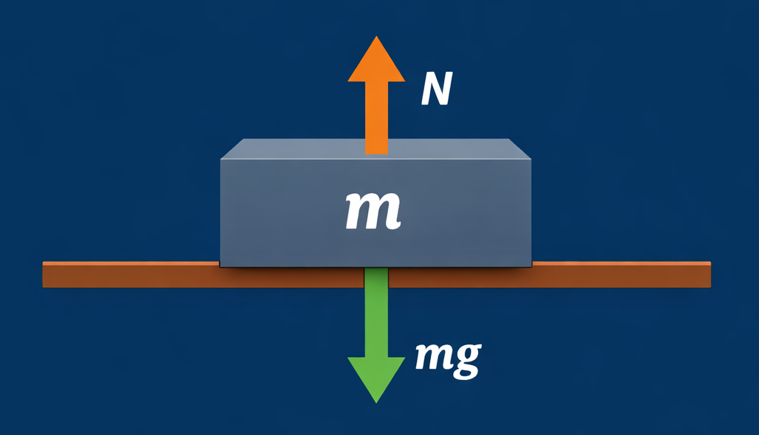
1. A body of mass \( m \) is placed on a table. The earth is pulling the body with a force \( mg \). Taking this force to be the action what is the reaction ?
Answer: The reaction is the gravitational force with which the body pulls the earth.
Explanation: According to Newton’s Third Law of Motion, every action has an equal and opposite reaction. These forces always act on two different objects. If the earth pulls a body of mass \( m \) with a gravitational force \( mg \), then the body must exert an identical gravitational force of magnitude \( mg \) on the earth in the opposite direction.
2. A boy is sitting on a chair placed on the floor of a room. Write as many action-reaction pairs of forces as you can.
Answer: Several action-reaction pairs exist involving the boy, chair, floor, and earth.
Explanation: The main pairs are:
(1) The boy exerts a downward normal force on the chair, and the chair exerts an equal upward normal force on the boy.
(2) The chair exerts a downward normal force on the floor, and the floor exerts an equal upward normal force on the chair.
(3) The earth pulls the boy downward with a gravitational force \( mg \), and the boy pulls the earth upward with an equal gravitational force \( mg \).
(4) The earth pulls the chair downward with a gravitational force \( mg \), and the chair pulls the earth upward with an equal gravitational force \( mg \).
(5) Frictional forces between the boy’s clothing and the chair, and between the chair legs and the floor, also form action-reaction pairs.
3. A lawyer alleges in court that the police has forced his client to issue a statement of confession. What kind of force is this ?
Answer: This is not a physical force as defined in physics.
Explanation: In physics, a force is a quantitative description of an interaction, like gravity or electromagnetism, that can cause acceleration or deformation. The “force” mentioned by the lawyer refers to psychological pressure or legal coercion, which does not involve the physical pushes or pulls studied in classical mechanics.
4. When you hold a pen and write on your notebook, what kind of force is exerted by you on the pen ? By the pen on the notebook ? By you on the notebook ?
Answer: These are all electromagnetic contact forces.
Explanation: When you hold a pen, your fingers exert normal forces and friction on the pen to provide grip. The pen tip exerts a normal force and friction on the notebook paper to create marks. Your hand resting on the notebook also exerts a normal force and friction. Fundamental to all these contact forces are the electromagnetic interactions between the atoms of the surfaces in contact.
5. Is it true that the reaction of a gravitational force is always gravitational, of an electromagnetic force is always electromagnetic and so on ?
Answer: Yes.
Explanation: Newton’s Third Law states that action and reaction forces are the result of a mutual interaction between two bodies. Because they represent the same interaction, they must be of the same nature. If the earth attracts a satellite gravitationally, the satellite attracts the earth gravitationally. If two magnets interact, both the action and reaction forces are electromagnetic.
6. Suppose the magnitude of Nuclear force between two protons varies with the distance between them as shown in figure (4-Q1). Estimate the ratio “Nuclear force/Coulomb force” for (a) \( x = 8 \, \text{fm} \) (b) \( x = 4 \, \text{fm} \), (c) \( x = 2 \, \text{fm} \) and (d) \( x = 1 \, \text{fm} \) \( (1 \, \text{fm} = 10^{-15} \, \text{m}) \).
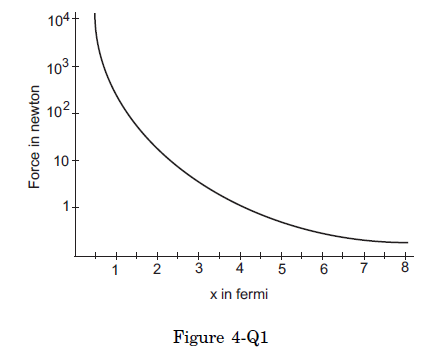
Answer: (a) ~0 (b) ~0 (c) ~35 (d) ~43.
Explanation: The Coulomb force between two protons is given by
\( F_c = \frac{1}{4\pi\epsilon_0} \frac{q^2}{x^2} \).
At \( x = 1 \, \text{fm} \), this force is approximately \( 230 \, \text{N} \), and at \( x = 2 \, \text{fm} \), it is about \( 57.6 \, \text{N} \). The nuclear force is extremely short-ranged. At \( x = 4 \, \text{fm} \) and \( x = 8 \, \text{fm} \), it is nearly zero, so the ratio is approximately zero. At \( x = 1 \, \text{fm} \) and \( x = 2 \, \text{fm} \), the nuclear force becomes much stronger (of the order of \( 10^4 \, \text{N} \)), leading to a large ratio.
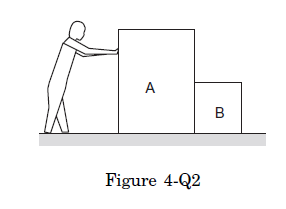
7. List all the forces acting on the block B in figure (4-Q2).
Answer: Weight, normal forces, and friction.
Explanation: The forces acting on block B are:
(1) Its weight acting vertically downward due to gravity.
(2) The upward normal force exerted by the surface it rests on.
(3) The downward normal force exerted by block A resting on top of it.
(4) Frictional force from the ground and possibly from block A if there is a tendency for relative motion.
8. List all the forces acting on (a) the pulley A, (b) the boy and (c) the block C in figure (4-Q3).
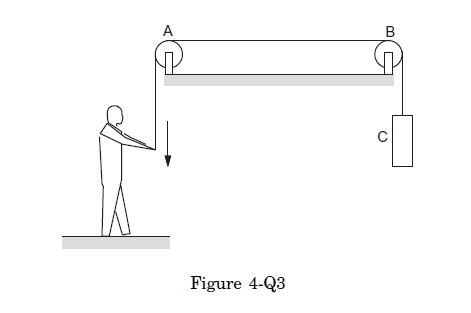
Answer: (a) Tension and support force; (b) Weight, normal force, and tension; (c) Weight and tension.
Explanation:
(a) Pulley A experiences tension from the string on both sides and a support force at its center.
(b) The boy experiences his weight downward, an upward normal force from the ground, and tension from the string.
(c) Block C experiences its weight downward and an upward tension from the string.
9. Figure (4-Q4) shows a boy pulling a wagon on a road. List as many forces as you can which are relevant with this figure. Find the pairs of forces connected by Newton’s third law of motion.
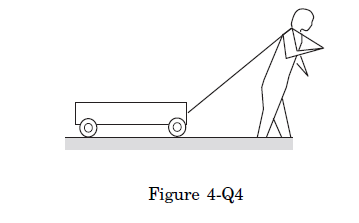
Answer: Gravitational forces, normal forces, friction, and tension.
Explanation: Relevant forces include the weights of the boy and wagon, normal forces and frictional forces from the ground, and tension in the handle.
Action-reaction pairs include:
(1) The boy pulls the handle forward; the handle pulls the boy backward.
(2) The boy’s feet push the ground backward; the ground pushes the boy forward.
(3) The earth pulls the boy downward; the boy pulls the earth upward.
(4) The wagon wheels push the ground downward; the ground pushes the wheels upward.
10. Figure (4-Q5) shows a cart. Complete the table shown below.
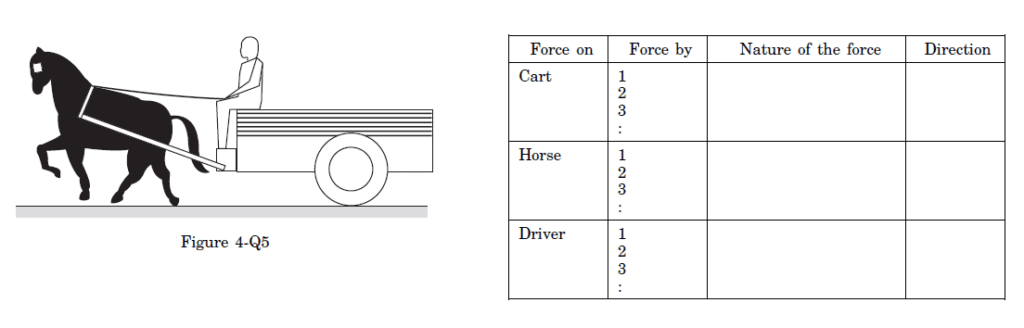
Explanation:
For the Cart: The force by the Horse is tension (forward), the force by the Ground is normal (upward), and the force by the Ground is friction (backward).
For the Horse: The force by the Cart is tension (backward), the force by the Ground is friction (forward), and the force by the Earth is gravitational force (downward).
For the Driver: The force by the Seat is normal force (upward), the force by the Earth is gravitational force (downward), and the force by the Seat is friction (forward).
OBJECTIVE I
1. When Neils Bohr shook hand with Werner Heisenberg, what kind of force they exerted ? (a) Gravitational (b) Electromagnetic (c) Nuclear (d) Weak.
Answer: (b)
Explanation: A handshake is an interaction between two surfaces in contact. When surfaces touch, the atoms come into close proximity, and their charged constituents exert significant forces on each other. The resulting force is electromagnetic in nature.
2. Let \( E \), \( G \) and \( N \) represent the magnitudes of electromagnetic, gravitational and nuclear forces between two electrons at a given separation. Then (a) \( N > E > G \) (b) \( E > N > G \) (c) \( G > N > E \) (d) \( E > G > N \).
Answer: (d)
Explanation: Nuclear forces act specifically between nucleons (protons and neutrons). Since electrons are not nucleons, the nuclear force between them is effectively zero. The ratio of electromagnetic force to gravitational force between two electrons is extremely large (about \( 4.17 \times 10^{42} \)), showing that electromagnetic force is much stronger than gravitational force. Hence, \( E > G > N \).
3. The sum of all electromagnetic forces between different particles of a system of charged particles is zero (a) only if all the particles are positively charged (b) only if all the particles are negatively charged (c) only if half the particles are positively charged and half are negatively charged (d) irrespective of the signs of the charges.
Answer: (d)
Explanation: According to Newton’s Third Law of Motion, forces between particles occur in action-reaction pairs. Each force has an equal and opposite counterpart, so when all internal forces are summed, they cancel out. Therefore, the total force is zero irrespective of the signs of the charges.
4. A \( 60 \, \text{kg} \) man pushes a \( 40 \, \text{kg} \) man by a force of \( 60 \, \text{N} \). The 40 kg man has pushed the other man with a force of (a) 40 N (b) 0 (c) 60 N (d) 20 N.
Answer: (c)
Explanation: According to Newton’s Third Law, for every action, there is an equal and opposite reaction. When the \( 60 \, \text{kg} \) man exerts a force of \( 60 \, \text{N} \), the other man exerts an equal force of \( 60 \, \text{N} \) in the opposite direction. This is independent of their masses.
OBJECTIVE II
1. A neutron exerts a force on a proton which is
(a) gravitational
(b) electromagnetic
(c) nuclear
(d) weak.
Answer: (a), (c)
Explanation: Neutrons and protons have mass, so they exert gravitational force on each other. They also interact via the strong nuclear force, which binds nucleons in the nucleus. Since neutrons are electrically neutral, they do not experience electromagnetic force.
2. A proton exerts a force on a proton which is
(a) gravitational
(b) electromagnetic
(c) nuclear
(d) weak.
Answer: (a), (b), (c)
Explanation: Protons possess mass, so they attract each other via gravitational force. Being positively charged, they also experience electromagnetic (Coulomb) repulsion. Additionally, when close enough, they interact through the strong nuclear force.
3. Mark the correct statements :
(a) The nuclear force between two protons is always greater than the electromagnetic force between them.
(b) The electromagnetic force between two protons is always greater than the gravitational force between them.
(c) The gravitational force between two protons may be greater than the nuclear force between them.
(d) Electromagnetic force between two protons may be greater than the nuclear force acting between them.
Answer: (b), (c), (d)
Explanation: The electromagnetic force between protons is much stronger than their gravitational force. The nuclear force is short-ranged and becomes negligible at large distances. Hence, at larger separations, both gravitational and electromagnetic forces can exceed the nuclear force.
4. If all matter were made of electrically neutral particles such as neutrons,
(a) there would be no force of friction
(b) there would be no tension in the string
(c) it would not be possible to sit on a chair
(d) the earth could not move around the sun.
Answer: (a), (b), (c)
Explanation: Common contact forces like friction, tension, and normal reaction are fundamentally electromagnetic in nature. If matter were made only of neutral particles, these forces would not exist. However, gravitational force depends only on mass, so planetary motion like the earth orbiting the sun would still occur.
5. Which of the following systems may be adequately described by classical physics ?
(a) motion of a cricket ball
(b) motion of a dust particle
(c) a hydrogen atom
(d) a neutron changing to a proton.
Answer: (a), (b)
Explanation: Classical physics applies well to objects with sizes larger than about \( 10^{-6} \, \text{m} \), such as a cricket ball or a dust particle. However, atomic and subatomic phenomena like a hydrogen atom or nuclear decay require quantum mechanics.
6. The two ends of a spring are displaced along the length of the spring. All displacements have equal magnitudes. In which case or cases the tension or compression in the spring will have a maximum magnitude ?
(a) the right end is displaced towards right and the left end towards left
(b) both ends are displaced towards right
(c) both ends are displaced towards left
(d) the right end is displaced towards left and the left end towards right.
Answer: (a), (d)
Explanation: The magnitude of tension or compression depends on the total change in the length of the spring. When both ends move in opposite directions, the net extension or compression is maximum. When both ends move in the same direction, there is no change in length.
7. Action and reaction
(a) act on two different objects
(b) have equal magnitude
(c) have opposite directions
(d) have resultant zero.
Answer: (a), (b), (c), (d)
Explanation: According to Newton’s Third Law, action and reaction forces act on different bodies, have equal magnitude, and are in opposite directions. Their vector sum for the combined system is zero.
EXERCISES
1. The gravitational force acting on a particle of \( 1 \, \text{g} \) due to a similar particle is equal to \( 6.67 \times 10^{-17} \, \text{N} \). Calculate the separation between the particles.
Answer: \( 1 \, \text{m} \)
Explanation:
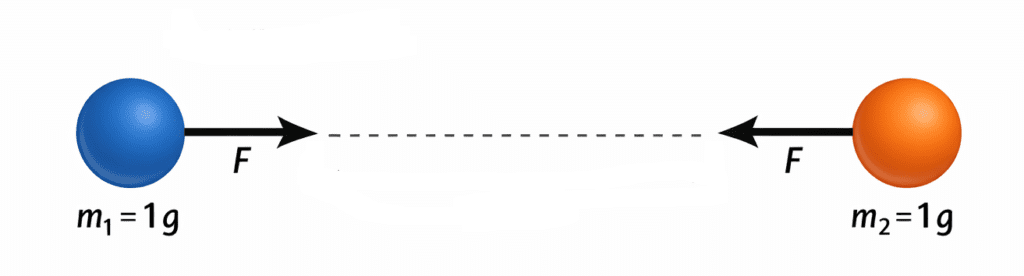
The gravitational force between two particles is given by:
\( F = \dfrac{G m_1 m_2}{r^2} \)
Here, \( F = 6.67 \times 10^{-17} \, \text{N} \), \( m_1 = m_2 = 1 \, \text{g} = 10^{-3} \, \text{kg} \), and \( G = 6.67 \times 10^{-11} \, \text{N m}^2/\text{kg}^2 \).
Substituting values:
\( 6.67 \times 10^{-17} = \dfrac{6.67 \times 10^{-11} \times (10^{-3} \times 10^{-3})}{r^2} \)
\( \Rightarrow 6.67 \times 10^{-17} = \dfrac{6.67 \times 10^{-17}}{r^2} \)
\( \Rightarrow r^2 = 1 \)
\( \Rightarrow r = 1 \, \text{m} \)
Thus, the separation between the particles is \( 1 \, \text{m} \).
2. Calculate the force with which you attract the earth.
Answer: Equal to your weight \( (mg) \)
Explanation:
The force of attraction between you and the earth is given by Newton’s law of gravitation. This force is the same as your weight.
\( F = mg \)
where \( m \) is your mass and \( g \approx 9.8 \, \text{m/s}^2 \) is the acceleration due to gravity.
Thus, the force with which you attract the earth is equal to your weight.
3. At what distance should two charges, each equal to \( 1 \, \text{C} \), be placed so that the force between them equals your weight ?
Answer: \( r = \sqrt{\dfrac{k q_1 q_2}{W}} \)
Explanation:
The electrostatic force between two charges is given by Coulomb’s law:
\( F = \dfrac{k q_1 q_2}{r^2} \)
where \( k = 9 \times 10^9 \, \text{N·m}^2/\text{C}^2 \), \( q_1 = q_2 = 1 \, \text{C} \), and \( F = W \) (your weight).
Rearranging:
\( r^2 = \dfrac{k q_1 q_2}{W} \)
\( \Rightarrow r = \sqrt{\dfrac{k q_1 q_2}{W}} \)
Thus, the distance depends on your weight. For example, if your mass is \( 60 \, \text{kg} \), then \( W = 60 \times 9.8 \approx 588 \, \text{N} \).
\( r = \sqrt{\dfrac{9 \times 10^9}{588}} \approx \sqrt{1.53 \times 10^7} \approx 3910 \, \text{m} \)
Therefore, the charges must be placed at a distance of about 3.9 km.
4. Two spherical bodies, each of mass \( 50 \, \text{kg} \), are placed at a separation of \( 20 \, \text{cm} \). Equal charges are placed on the bodies and it is found that the force of Coulomb repulsion equals the gravitational attraction in magnitude. Find the magnitude of the charge placed on either body.
Answer: \( 4.3 \times 10^{-9} \, \text{C} \)
Explanation:
The Coulomb force and gravitational force are equal:
\( \dfrac{k q^2}{r^2} = \dfrac{G m^2}{r^2} \)
Cancelling \( r^2 \):
\( k q^2 = G m^2 \)
\( q = \sqrt{\dfrac{G}{k}} \cdot m \)
Substituting values:
\( q = \sqrt{\dfrac{6.67 \times 10^{-11}}{9 \times 10^9}} \times 50 \)
\( q \approx 4.3 \times 10^{-9} \, \text{C} \)
Thus, the charge on each body is \( 4.3 \times 10^{-9} \, \text{C} \).
5. A monkey is sitting on a tree limb. The limb exerts a normal force of \( 48 \, \text{N} \) and a frictional force of \( 20 \, \text{N} \). Find the magnitude of the total force exerted by the limb on the monkey.
Answer: \( 52 \, \text{N} \)
Explanation:
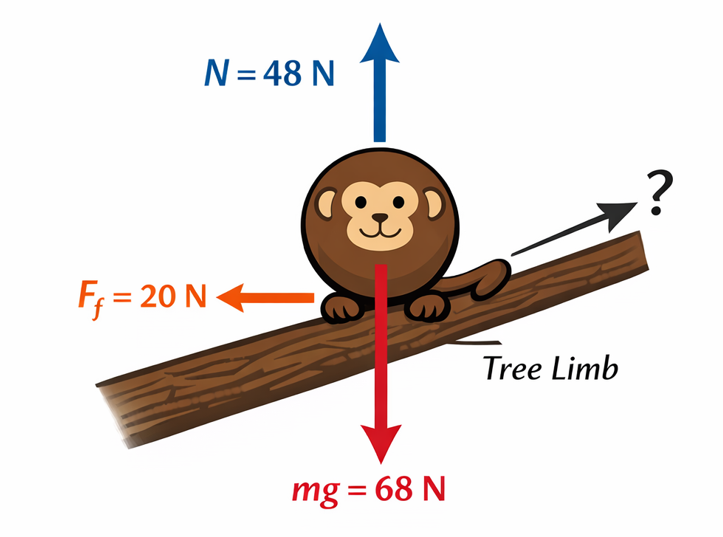
The total force is the vector sum of the normal force and the frictional force:
\( F = \sqrt{N^2 + f^2} \)
Substituting values:
\( F = \sqrt{48^2 + 20^2} = \sqrt{2304 + 400} = \sqrt{2704} = 52 \, \text{N} \)
Thus, the total force exerted by the limb is \( 52 \, \text{N} \).
6. A body builder exerts a force of \( 150 \, \text{N} \) against a bullworker and compresses it by \( 20 \, \text{cm} \). Calculate the spring constant of the spring in the bullworker.
Answer: \( 750 \, \text{N/m} \)
Explanation:
The spring constant is calculated using Hooke’s law:
\( F = kx \)
where \( F = 150 \, \text{N} \) and \( x = 20 \, \text{cm} = 0.20 \, \text{m} \).
\( k = \dfrac{F}{x} = \dfrac{150}{0.20} = 750 \, \text{N/m} \)
Thus, the spring constant is \( 750 \, \text{N/m} \).
7. A satellite is projected vertically upwards from an earth station. At what height above the earth’s surface will the force on the satellite due to the earth be reduced to half its value at the earth station? (Radius of the earth is \( 6400 \, \text{km} \).)
Answer: \( h \approx 2650 \, \text{km} \)
Explanation:
The gravitational force varies inversely with the square of the distance from the earth’s center:
\( F \propto \dfrac{1}{r^2} \)
Let \( R = 6400 \, \text{km} \) and height \( = h \). Then distance from center \( = R + h \).
Given:
\( \dfrac{F’}{F} = \dfrac{1}{2} \)
\( \Rightarrow \dfrac{R^2}{(R + h)^2} = \dfrac{1}{2} \)
Taking square root:
\( \dfrac{R}{R + h} = \dfrac{1}{\sqrt{2}} \)
\( \Rightarrow R + h = \sqrt{2} R \)
\( \Rightarrow h = (\sqrt{2} – 1) R \)
Substituting \( R = 6400 \, \text{km} \):
\( h = (1.414 – 1) \times 6400 \approx 0.414 \times 6400 \approx 2650 \, \text{km} \)
Thus, the required height is approximately \( 2650 \, \text{km} \).
8. Two charged particles placed at a separation of \( 20 \, \text{cm} \) exert \( 20 \, \text{N} \) of Coulomb force on each other. What will be the force if the separation is increased to \( 25 \, \text{cm} \) ?
Answer: \( 12.8 \, \text{N} \)
Explanation:
The Coulomb force varies inversely with the square of the distance:
\( F \propto \dfrac{1}{r^2} \)
So,
\( F_2 = F_1 \left( \dfrac{r_1}{r_2} \right)^2 \)
Substituting values:
\( F_2 = 20 \left( \dfrac{0.20}{0.25} \right)^2 = 20 \times (0.8)^2 = 20 \times 0.64 = 12.8 \, \text{N} \)
Thus, the force becomes \( 12.8 \, \text{N} \).
9. The force with which the earth attracts an object is called the weight of the object. Calculate the weight of the moon from the following data : The universal constant of gravitation \( G = 6.67 \times 10^{-11} \, \text{N·m}^2/\text{kg}^2 \), mass of the moon \( = 7.36 \times 10^{22} \, \text{kg} \), mass of the earth \( = 6 \times 10^{24} \, \text{kg} \) and the distance between the earth and the moon \( = 3.8 \times 10^5 \, \text{km} \).
Answer: \( 1.99 \times 10^{20} \, \text{N} \)
Explanation:
The gravitational force is given by:
\( F = \dfrac{G m_1 m_2}{r^2} \)
Given:
\( m_1 = 6 \times 10^{24} \, \text{kg} \),
\( m_2 = 7.36 \times 10^{22} \, \text{kg} \),
\( r = 3.8 \times 10^5 \, \text{km} = 3.8 \times 10^8 \, \text{m} \).
Substituting:
\( F = \dfrac{6.67 \times 10^{-11} \times 6 \times 10^{24} \times 7.36 \times 10^{22}}{(3.8 \times 10^8)^2} \)
\( = \dfrac{2.94 \times 10^{37}}{1.44 \times 10^{17}} \approx 2.04 \times 10^{20} \, \text{N} \)
Thus, the weight of the moon is approximately \( 2.0 \times 10^{20} \, \text{N} \).
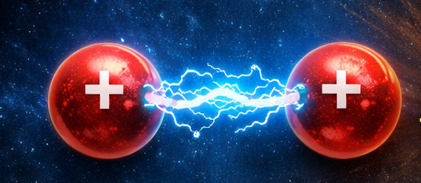
10. Find the ratio of the magnitude of the electric force to the gravitational force acting between two protons.
Answer: \( 1.2 \times 10^{36} \)
Explanation:
The electric force is given by:
\( F_e = \dfrac{k q^2}{r^2} \)
The gravitational force is:
\( F_g = \dfrac{G m^2}{r^2} \)
Taking the ratio:
\( \dfrac{F_e}{F_g} = \dfrac{k q^2}{G m^2} \)
Substituting values:
\( k = 9 \times 10^9 \), \( q = 1.6 \times 10^{-19} \, \text{C} \),
\( G = 6.67 \times 10^{-11} \), \( m = 1.67 \times 10^{-27} \, \text{kg} \)
\( \dfrac{F_e}{F_g} = \dfrac{9 \times 10^9 \times (1.6 \times 10^{-19})^2}{6.67 \times 10^{-11} \times (1.67 \times 10^{-27})^2} \)
\( \approx \dfrac{2.3 \times 10^{-28}}{1.86 \times 10^{-64}} \approx 1.2 \times 10^{36} \)
Thus, the electric force is \( 1.2 \times 10^{36} \) times stronger.
11. The average separation between the proton and the electron in a hydrogen atom in ground state is \( 5.3 \times 10^{-11} \, \text{m} \). (a) Calculate the Coulomb force between them at this separation. (b) When the atom goes into its first excited state the separation becomes four times. What is the Coulomb force in this state ?
Answer: (a) \( 8.2 \times 10^{-8} \, \text{N} \), (b) \( 5.1 \times 10^{-9} \, \text{N} \)
Explanation:
The Coulomb force is given by:
\( F = \dfrac{k q_1 q_2}{r^2} \), where \( k = 9 \times 10^9 \, \text{N·m}^2/\text{C}^2 \), \( q_1 = q_2 = 1.6 \times 10^{-19} \, \text{C} \).
(a) For \( r = 5.3 \times 10^{-11} \, \text{m} \):
\( F = \dfrac{9 \times 10^9 \times (1.6 \times 10^{-19})^2}{(5.3 \times 10^{-11})^2} \)
\( \approx \dfrac{2.3 \times 10^{-28}}{2.8 \times 10^{-21}} \approx 8.2 \times 10^{-8} \, \text{N} \)
(b) In the first excited state, \( r = 4 \times 5.3 \times 10^{-11} = 2.12 \times 10^{-10} \, \text{m} \):
\( F = \dfrac{9 \times 10^9 \times (1.6 \times 10^{-19})^2}{(2.12 \times 10^{-10})^2} \)
\( \approx \dfrac{2.3 \times 10^{-28}}{4.5 \times 10^{-20}} \approx 5.1 \times 10^{-9} \, \text{N} \)
Thus, the Coulomb force decreases with increase in separation.
12. The geostationary orbit of the Earth is at a distance of \( 36{,}000 \, \text{km} \) from the Earth’s surface. Find the weight of a \( 120 \, \text{kg} \) equipment placed in a geostationary satellite. The radius of the Earth is \( 6{,}400 \, \text{km} \).
Answer: \( \approx 27 \, \text{N} \)
Explanation:
Given:
\( m = 120 \, \text{kg} \),
\( R = 6400 \, \text{km} \),
\( h = 36000 \, \text{km} \),
\( r = R + h = 42400 \, \text{km} \).
The acceleration due to gravity at height is:
\( g’ = g \left( \dfrac{R}{R + h} \right)^2 \)
\( g’ = 9.8 \left( \dfrac{6400}{42400} \right)^2 \approx 9.8 \times (0.1509)^2 \approx 0.223 \, \text{m/s}^2 \)
Weight:
\( W = mg’ = 120 \times 0.223 \approx 26.8 \, \text{N} \approx 27 \, \text{N} \)