Table of Contents
QUESTIONS FOR SHORT ANSWER
1. The apparent weight of an object increases in an elevator while accelerating upward. A moongphaliwala sells his moongphali using a beam balance in an elevator. Will he gain more if the elevator is accelerating up ?
Answer: No
Explanation: The beam balance works on the principle of comparison of masses. When the elevator accelerates upward, the apparent weight of both the moongphali and the standard weights increases by the same factor. Therefore, the moongphaliwala will not gain more even if the elevator is accelerating upward. (Licchavi Lyceum)
2. A boy puts a heavy box of mass M on his head and jumps down from the top of a multistoried building to the ground. How much is the force exerted by the box on his head during his free fall ? Does the force greatly increase during the period he balances himself after striking the ground ?
Answer: Zero during free fall, greatly increases after striking the ground
Explanation: During free fall, both the boy and the box are accelerated downward with the same acceleration due to gravity. Hence, the box exerts no force on the boy’s head, and the force is zero.
However, when the boy strikes the ground and tries to balance himself, the box exerts a large force on his head because the motion is suddenly stopped and the momentum changes rapidly. Therefore, the force greatly increases during the period after striking the ground. (Licchavi Lyceum)
3. A person drops a coin. Describe the path of the coin as seen by the person if he is in (a) a car moving at constant velocity and (b) in a freely falling elevator.
Answer: (a) The coin appears to fall vertically downward. (b) The coin appears to remain stationary relative to the person.
Explanation: (a) In a car moving at constant velocity, both the coin and the person share the same horizontal velocity. When the coin is dropped, it continues to move forward with the same velocity as the car. Hence, relative to the person, the coin appears to fall vertically downward.
(b) In a freely falling elevator, both the coin and the person are accelerated downward with the same acceleration due to gravity. Therefore, relative to the person, the coin appears to be stationary and does not fall, as both are in the same state of free fall.
4. Is it possible for a particle to describe a curved path if no force acts on it ? Does your answer depend on the frame of reference chosen to view the particle ?
Answer: No in an inertial frame, Yes in a non-inertial frame
Explanation: In an inertial frame of reference, if no force acts on a particle, it continues to move in a straight line according to the law of inertia. Hence, it is not possible for the particle to describe a curved path without a force. However, in a non-inertial frame of reference, due to the presence of fictitious forces, the particle may appear to follow a curved path. Thus, the answer depends on the frame of reference chosen to observe the particle.
5. You are riding in a car. The driver suddenly applies the brakes and you are pushed forward. Who pushed you forward ?
Answer: Nobody pushed you forward, it is due to inertia.
Explanation: When the driver suddenly applies the brakes, the car slows down but your body tends to continue moving forward with the same velocity due to the property of inertia of motion. It appears as if you are pushed forward, but in reality, no external force pushes you. Instead, your body resists the change in motion, which is why you move forward relative to the car.
6. It is sometimes heard that inertial frame of reference is only an ideal concept and no such inertial frame actually exists. Comment.
Answer: Yes, it is an ideal concept.
Explanation: An inertial frame of reference is defined as a frame in which Newton’s laws of motion hold true without the need for fictitious forces. In reality, every frame is subject to some gravitational influence or acceleration, making it impossible to find a perfect inertial frame. However, for most practical purposes, frames moving with uniform velocity and negligible external influences can be treated as approximately inertial. Thus, the concept of an inertial frame is mainly an idealization used for simplifying the study of motion.
7. An object is placed far away from all the objects that can exert force on it. A frame of reference is constructed by taking the origin and axes fixed in this object. Will the frame be necessarily inertial ?
Answer: Yes, the frame will be inertial.
Explanation: If an object is placed far away from all other objects, it experiences no external force. According to Newton’s first law of motion, such an object will either remain at rest or continue to move with uniform velocity in a straight line. Hence, a frame of reference fixed in this object will satisfy the conditions of an inertial frame. Therefore, the frame constructed in this situation will be necessarily inertial.
8. Figure (5-Q1) shows a light spring balance connected to two blocks of mass 20 kg each. The graduations in the balance measure the tension in the spring. (a) What is the reading of the balance (b) Will the reading change if the balance is heavy say 2.0 kg (c) What will happen if the spring is light but the blocks have unequal masses?
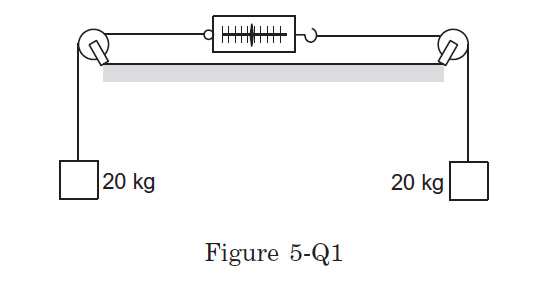
Answer: (a) 20 kg (b) Yes (c) The system accelerates and the reading lies between the two massesIn part (a) the spring balance measures the tension in the spring. Both sides are pulled by equal forces due to 20 kg masses so the system is in equilibrium. Each block exerts force equal to \( mg \) so tension is \( 20g \) and the balance reads 20 kg. It is important that a spring balance measures tension not total force.
In part (b) if the balance is heavy its own mass affects the system. The tension may not remain uniform and due to its weight or motion the reading can change.
In part (c) when masses are unequal the system is no longer in equilibrium and accelerates toward the heavier mass. The tension lies between the two weights and the balance shows an effective value between the two masses depending on their magnitudes.
9. The acceleration of a particle is zero as measured from an inertial frame of reference. Can we conclude that no force acts on the particle ?
Answer: No, we cannot conclude that.
Explanation: If the acceleration of a particle is zero, it means the net force acting on it is zero according to Newton’s second law of motion. However, this does not imply that no force acts on the particle. It is possible that several forces act on the particle but they are balanced and cancel each other out, resulting in zero net force. Hence, we cannot conclude that no force acts on the particle.
10. Suppose you are running fast in a field when you suddenly find a snake in front of you. You stop quickly. Which force is responsible for your deceleration ?
Answer: The frictional force between your feet and the ground.
Explanation: When you try to stop quickly, your muscles exert a backward push against the ground. The ground reacts by exerting a frictional force in the opposite direction of your motion. This frictional force is responsible for reducing your velocity and causing deceleration. Without friction, you would not be able to stop suddenly and would continue moving forward.
11. If you jump barefooted on a hard surface, your legs get injured. But they are not injured if you jump on a soft surface like sand or pillow. Explain.
Answer: Hard surface causes injury, soft surface prevents injury.
Explanation: When you jump on a hard surface, the time of impact is very short, so the rate of change of momentum is very large, resulting in a large force on your legs. This large force causes injury. On the other hand, when you jump on a soft surface like sand or pillow, the time of impact increases, which reduces the rate of change of momentum. Hence, the force exerted on your legs is smaller, preventing injury.
12. According to Newton’s third law each team pulls the opposite team with equal force in a tug of war. Why then one team wins and the other loses ?
Answer: The team with greater frictional force wins.
Explanation: In a tug of war, both teams exert equal and opposite forces on each other according to Newton’s third law. However, the winning team is the one that can exert a greater backward force on the ground through their feet. The ground reacts by providing a greater frictional force to that team, allowing them to pull more effectively. Thus, the difference in frictional force between the teams determines which team wins or loses.
13. A spy jumps from an airplane with his parachute. The spy accelerates downward for some time when the parachute opens. The acceleration is suddenly checked and the spy slowly falls on the ground. Explain the action of parachute in checking the acceleration.
Answer: The parachute increases air resistance, reducing acceleration.
Explanation: When the parachute opens, its large surface area increases the air resistance (drag force) acting on the spy. This upward force quickly balances the downward gravitational force, thereby reducing the net force and checking the acceleration. As a result, the spy descends with a much smaller acceleration and eventually falls slowly and safely to the ground.
14. Consider a book lying on a table. The weight of the book and the normal force by the table on the book are equal in magnitude and opposite in direction. Is this an example of Newton’s third law ?
Answer: No, it is not an example of Newton’s third law.
Explanation: The weight of the book is the gravitational force exerted by the Earth on the book, while the normal force is the reaction force exerted by the table on the book. These two forces act on the same body (the book) and balance each other, making them an example of Newton’s first law (equilibrium condition). According to Newton’s third law, action and reaction forces act on different bodies. For example, the book exerts a downward force on the table, and the table exerts an equal upward force on the book. Hence, the situation described is not an example of Newton’s third law.
15. Two blocks of unequal masses are tied by a spring. The blocks are pulled stretching the spring slightly and the system is released on a frictionless horizontal platform. Are the forces due to the spring on the two blocks equal and opposite ? If yes, is it an example of Newton’s third law ?
Answer: Yes, the forces are equal and opposite, and it is an example of Newton’s third law.
Explanation: When the spring is stretched, it exerts a restoring force on both blocks. The force on each block is equal in magnitude but opposite in direction. These forces act on different bodies, satisfying the condition of Newton’s third law of motion. Hence, the spring force on the two blocks is an example of action and reaction forces.
16. When a train starts, the head of a standing passenger seems to be pushed backward. Analyse the situation from the ground frame. Does it really go backward ? Coming back to the train frame, how do you explain the backward movement of the head on the basis of Newton’s laws ?
Answer: From the ground frame, the head does not go backward. From the train frame, the backward movement is due to inertia.
Explanation: From the ground frame, when the train starts, the passenger’s body tends to remain at rest due to inertia of rest. The train moves forward, so the lower part of the body in contact with the train moves forward, but the head appears to lag behind, giving the impression of moving backward relative to the train.
From the train frame, the head seems to move backward because the body resists the forward motion due to inertia. Thus, the apparent backward movement of the head is explained by Newton’s first law of motion.
17. A plumb bob is hung from the ceiling of a train compartment. If the train moves with an acceleration ‘a’ along a straight horizontal track, the string supporting the bob makes an angle tan⁻¹(a/g) with the normal to the ceiling. Suppose the train moves on an inclined straight track with uniform velocity. If the angle of incline is tan⁻¹(a/g), the string again makes the same angle with the normal to the ceiling. Can a person sitting inside the compartment tell by looking at the plumb line whether the train is accelerated on a horizontal straight track or it is going on an incline ? If yes, how ? If no, suggest a method to do so.
Answer: No, by looking at the plumb line alone it cannot be distinguished. A method is to drop a particle inside the compartment.
Explanation: In both cases, the plumb line makes the same angle tan⁻¹(a/g) with the normal to the ceiling, so an observer inside the train cannot distinguish whether the train is accelerated on a horizontal track or moving with uniform velocity on an incline merely by observing the plumb line.
To differentiate, one can drop a particle inside the compartment:
- On a horizontal track with acceleration, the particle will appear to fall at an angle relative to the vertical due to the pseudo force acting opposite to the train’s acceleration.
- On an inclined track with uniform velocity, the particle will fall vertically downward relative to the compartment.
Thus, by performing such an experiment, the true situation can be identified.
OBJECTIVE I
1. A body of weight \( w_1 \) is suspended from the ceiling of a room through a chain of weight \( w_2 \). The ceiling pulls the chain by a force:
(a) \( w_1 \)
(b) \( w_2 \)
(c) \( w_1 + w_2 \)
(d) \( \frac{w_1 + w_2}{2} \)
Answer: (c) \( w_1 + w_2 \)
Explanation: The total downward force is the sum of the weights \( w_1 \) and \( w_2 \). For the system to remain at rest, the upward pull by the ceiling must balance this total weight. Hence, the force exerted by the ceiling is \( w_1 + w_2 \). It is important that in equilibrium, the upward force equals total downward weight.
2. When a horse pulls a cart, the force that helps the horse to move forward is the force exerted by:
(a) the cart on the horse
(b) the ground on the horse
(c) the ground on the cart
(d) the horse on the ground
Answer: (b) the ground on the horse
Explanation: According to Newton third law, the horse pushes the ground backward with a force. The ground exerts an equal and opposite forward force on the horse. This reaction force helps the horse move forward. The key idea is that motion is caused by an external reaction force from the ground.
3 A car accelerates on a horizontal road due to the force exerted by:
(a) the engine of the car
(b) the driver of the car
(c) the earth
(d) the road
Answer: (d) the road
Explanation: To accelerate forward, an external force must act on the car. While the engine rotates the wheels, motion is possible due to interaction with the road. The wheels push the road backward, and according to Newton third law, the road exerts an equal and opposite forward force on the car. This reaction force from the road causes the car to move forward.
4. A block of mass 10 kg is suspended through two light spring balances as shown in figure (5-Q2).
(a) Both the scales will read 10 kg.
(b) Both the scales will read 5 kg.
(c) The upper scale will read 10 kg and the lower zero.
(d) The readings may be anything but their sum will be 10 kg.
Answer: (a) Both the scales will read 10 kg.
Explanation: In this series arrangement, the system is in equilibrium and the tension is the same throughout. The weight of the block is \( 10g \), which produces a uniform tension in both spring scales. Since both scales experience the same tension equal to the weight of the block, each scale reads 10 kg.
5. A block of mass m is placed on a smooth inclined plane of inclination \( \theta \) with the horizontal. The force exerted by the plane on the block has a magnitude
(a) mg
(b) mg/cos\( \theta \)
(c) mg cos\( \theta \)
(d) mg tan\( \theta \)
Answer: (c) mg cos\( \theta \)
Explanation: On a smooth inclined plane, only two forces act on the block: its weight (mg) and the normal reaction. There is no friction. The normal reaction equals the perpendicular component of weight, which is \( mg \cos \theta \). Hence, the force exerted by the plane is \( mg \cos \theta \).
6. A block of mass m is placed on a smooth wedge of inclination \( \theta \). The whole system is accelerated horizontally so that the block does not slip on the wedge. The force exerted by the wedge on the block has a magnitude
(a) mg
(b) mg/cos\( \theta \)
(c) mg cos\( \theta \)
(d) mg tan\( \theta \)
Answer: (b) mg/cos\( \theta \)
Explanation: For the block to remain at rest relative to the wedge, the system must have a suitable horizontal acceleration. In this condition, the block experiences a normal reaction from the wedge. This normal force becomes \( \frac{mg}{\cos \theta} \), which is greater than \( mg \) due to the effect of acceleration. Hence, the force exerted by the wedge is \( \frac{mg}{\cos \theta} \).
7. Neglect the effect of rotation of the earth. Suppose the earth suddenly stops attracting objects placed near its surface. A person standing on the surface of the earth will
(a) fly up
(b) slip along the surface
(c) fly along a tangent to the earth’s surface
(d) remain standing
Answer: (c) fly along a tangent to the earth’s surface
Explanation: If the earth suddenly stops attracting objects, the gravitational force disappears. The person has tangential velocity due to the earth’s rotation. Without gravity to hold him, the person will move along the tangent to the earth’s surface. Hence, the motion will be along a tangential path.
8. Three rigid rods are joined to form an equilateral triangle ABC of side 1 m. Three particles carrying charges 20 mC each are attached to the vertices of the triangle. The whole system is at rest in an inertial frame. The resultant force on the charged particle at A has the magnitude
(a) zero
(b) 3.6 N
(c) 3.6√3 N
(d) 7.2 N
Answer: (c) 3.6√3 N
Explanation: Each charge exerts a repulsive force on the charge at A. Using Coulomb’s law, \( F = \dfrac{k q^2}{r^2} \), where \( q = 20 \times 10^{-3} \, C \), \( r = 1 \, m \), and \( k = 9 \times 10^9 \). The force between two charges is \( 3.6 \, N \). The two forces act at an angle of 60°. The resultant force is \( F_{res} = \sqrt{F^2 + F^2 + 2F^2 \cos 60^\circ} = \sqrt{3}F \). Hence, \( F_{res} = 3.6\sqrt{3} \, N \).
9. A force F1 acts on a particle so as to accelerate it from rest to a velocity v. The force F1 is then replaced by F2 which decelerates it to rest.
(a) F1 must be equal to F2
(b) F1 may be equal to F2
(c) F1 must be unequal to F2
(d) none of these
Answer: (b) F1 may be equal to F2
Explanation: The force required to accelerate a particle from rest to velocity v depends on the time duration and the acceleration. Similarly, the force required to decelerate it back to rest depends on the time duration of deceleration. If the time intervals are the same, then F1 = F2. If the time intervals differ, then F1 and F2 will be different. Hence, F1 may be equal to F2.
10. Two objects A and B are thrown upward simultaneously with the same speed. The mass of A is greater than the mass of B. Suppose the air exerts a constant and equal force of resistance on the two bodies.
(a) The two bodies will reach the same height.
(b) A will go higher than B.
(c) B will go higher than A.
(d) Any of the above three may happen depending on the speed with which the objects are thrown.
Answer: (b) A will go higher than B
Explanation: Both objects experience gravitational acceleration, but the air resistance force is equal for both. Since A has greater mass, the effect of air resistance on A is less significant compared to its weight. For B, which has smaller mass, the same air resistance has a greater effect. Hence, B loses speed faster and reaches a smaller height, while A goes higher.
11. A smooth wedge A is fitted in a chamber hanging from a fixed ceiling near the earth’s surface. A block B placed at the top of the wedge takes a time T to slide down the length of the wedge. If the block is placed at the top of the wedge and the cable supporting the chamber is broken at the same instant, the block will (a) take a time longer than T to slide down the wedge (b) take a time shorter than T to slide down the wedge (c) remain at the top of the wedge (d) jump off the wedge.
Answer: (c) remain at the top of the wedge
Explanation: When the cable is broken, the entire chamber along with the wedge and block goes into free fall. In this state, both the block and the wedge are accelerated downward with the same acceleration due to gravity. As a result, there is no relative motion between the block and the wedge. Hence, the block will remain at the top of the wedge and will not slide down.
12. In an imaginary atmosphere, the air exerts a small force F on any particle in the direction of the particle’s motion. A particle of mass m projected upward takes a time t1 in reaching the maximum height and t2 in the return journey to the original point. Then (a) t1 < t2 (b) t1 > t2 (c) t1 = t2 (d) the relation between t1 and t2 depends on the mass of the particle.
Answer: (a) t1 < t2
Explanation: When the particle is projected upward, the air resistance force F acts upward (same direction as motion), effectively reducing the net downward force. This makes the particle take less time to reach maximum height. On the return journey, the particle moves downward, but the air resistance force still acts downward (same direction as motion), thereby increasing the net downward force. This causes the particle to take a longer time to return. Hence, t1 < t2.
13. A person standing on the floor of an elevator drops a coin. The coin reaches the floor of the elevator in a time t1 if the elevator is stationary and in time t2 if it is moving uniformly. Then (a) t1 = t2 (b) t1 < t2 (c) t1 > t2 (d) t1 < t2 or t1 > t2 depending on whether the lift is going up or down.
Answer: (a) t1 = t2
Explanation: If the elevator is stationary or moving with uniform velocity (either upward or downward), it is equivalent to an inertial frame of reference. In such frames, the acceleration of the coin relative to the elevator is simply g, the acceleration due to gravity. Therefore, the time taken to reach the floor remains the same in both cases. Hence, t1 = t2.
14. A free ²³⁸U nucleus kept in a train emits an alpha particle. When the train is stationary, a nucleus decays and a passenger measures that the separation between the alpha particle and the recoiling nucleus becomes x at time t after the decay. If the decay takes place while the train is moving at a uniform velocity v, the distance between the alpha particle and the recoiling nucleus at a time t after the decay as measured by the passenger is
(a) x + vt
(b) x – vt
(c) x
(d) depends on the direction of the train
Answer: (c) x
Explanation: When the train moves with uniform velocity, both the alpha particle and the recoiling nucleus initially share the same velocity v. After decay, their motion relative to each other depends only on the internal forces involved in the decay. Since the passenger is in the same inertial frame as the train, the relative separation between the two particles after time t remains unchanged. Hence, the distance is the same as in the stationary case, i.e., x.
OBJECTIVE II
1. A reference frame attached to the earth
(a) is an inertial frame by definition
(b) cannot be an inertial frame because the earth is revolving around the sun
(c) is an inertial frame because Newton’s laws are applicable in this frame
(d) cannot be an inertial frame because the earth is rotating about its axis.
Answer: (c) is an inertial frame because Newton’s laws are applicable in this frame
Explanation: Strictly speaking, the earth is not a perfect inertial frame because it both rotates about its axis and revolves around the sun. However, for most practical purposes in mechanics, the effects of these motions are negligible, and Newton’s laws of motion can be applied successfully in the earth frame. Therefore, the earth frame is treated as an inertial frame in everyday physics problems.
2. A particle stays at rest as seen in a frame. We can conclude that
(a) the frame is inertial
(b) resultant force on the particle is zero
(c) the frame may be inertial but the resultant force on the particle is zero
(d) the frame may be noninertial but there is a nonzero resultant force.
Answer: (c) the frame may be inertial but the resultant force on the particle is zero
Explanation: If a particle is at rest in a frame, it means that the net force acting on it is zero relative to that frame. However, this does not guarantee that the frame itself is inertial. The frame could be non-inertial, and in that case, the particle might be at rest because a pseudo force balances the real forces. Thus, the correct conclusion is that the frame may be inertial, but in any case, the resultant force on the particle is zero.
3. A particle is found to be at rest when seen from a frame S1 and moving with a constant velocity when seen from another frame S2 . Mark out the possible options.
(a) Both the frames are inertial.
(b) Both the frames are noninertial.
(c) S1 is inertial and S2 is noninertial.
(d) S1 is noninertial and S2 is inertial.
Answer: (a) Both the frames are inertial.
Explanation: If a particle is at rest in one frame and moving with constant velocity in another, the two frames differ by a constant relative velocity. Such frames are inertial frames. In noninertial frames, motion would involve acceleration. Hence, both S1 and S2 are inertial.
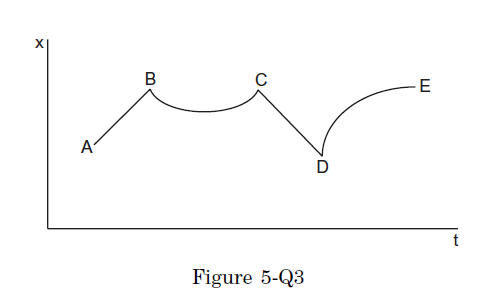
4. Figure (5-Q3) shows the displacement of a particle going along the X-axis as a function of time. The force acting on the particle is zero in the region
(a) AB
(b) BC
(c) CD
(d) DE
Answer: (a) and (c)
Explanation: The force is related to acceleration by Newton second law. In a displacement-time graph, acceleration is zero when the graph is a straight line with constant slope, indicating constant velocity. In region BC, the graph is linear, so acceleration is zero and hence force is zero.
6. The force exerted by the floor of an elevator on the foot of a person standing there is more than the weight of the person if the elevator is
(a) going up and slowing down
(b) going up and speeding up
(c) going down and slowing down
(d) going down and speeding up
Answer: (b) going up and speeding up, (c) going down and slowing down
Explanation: The apparent weight is given by \( N = mg + ma \). If the elevator has upward acceleration, then \( N > mg \). When it is going up and speeding up, acceleration is upward. Also, when it is going down and slowing down, acceleration is again upward. In both cases, the normal force becomes greater than weight.
7. If the tension in the cable supporting an elevator is equal to the weight of the elevator, the elevator may be
(a) going up with increasing speed
(b) going down with increasing speed
(c) going up with uniform speed
(d) going down with uniform speed
Answer: (c) going up with uniform speed, (d) going down with uniform speed
Explanation: The tension is given by \( T = mg + ma \). If \( T = mg \), then acceleration is zero. This means the elevator is moving with uniform velocity or is at rest. Hence, it may be going up with uniform speed or down with uniform speed.
8. A particle is observed from two frames S1 and S2. The frame S2 moves with respect to S1 with an acceleration a. Let F1 and F2 be the pseudo forces on the particle when seen from S1 and S2 respectively. Which of the following are not possible?
(a) F1 = 0, F2 ≠ 0
(b) F1 ≠ 0, F2 = 0
(c) F1 ≠ 0, F2 ≠ 0
(d) F1 = 0, F2 = 0
Answer: (b) F1 ≠ 0, F2 = 0
Explanation: A pseudo force appears only in a non-inertial frame. If S1 is inertial, then F1 = 0. Since S2 is accelerating with respect to S1, it is non-inertial, so F2 ≠ 0, making option (a) possible. If S1 is non-inertial, then F1 ≠ 0, and S2, being accelerated relative to S1, is also non-inertial, so F2 ≠ 0, making option (c) possible. If both frames are inertial, then F1 = 0, F2 = 0, so option (d) is possible. Hence, the case F1 ≠ 0, F2 = 0 is not possible.
9. A person says that he measured the acceleration of a particle to be nonzero while no force was acting on the particle. (a) He is a liar. (b) His clock might have run slow. (c) His meter scale might have been longer than the standard. (d) He might have used noninertial frame.
Answer: (d) He might have used noninertial frame
Explanation: According to Newton’s second law, a particle can have nonzero acceleration only if a net force acts on it. If someone claims that the particle accelerated without any force, the most logical explanation is that the observation was made from a non-inertial frame of reference. In a non-inertial frame, pseudo forces appear, which can cause apparent acceleration even when no real force acts on the particle.
Thus, the correct option is (d).
EXERCISES
1. A block of mass 2 kg placed on a long frictionless horizontal table is pulled horizontally by a constant force F. It is found to move 10 m in the first two seconds. Find the magnitude of F.
Answer: 10 N
Explanation: Using the equation of motion \( s = ut + \tfrac{1}{2} a t^2 \), where \( u = 0 \), \( s = 10 \, m \), and \( t = 2 \, s \). Substituting, \( 10 = \tfrac{1}{2} a (2^2) = 2a \), so \( a = 5 \, m/s^2 \). Using Newton second law, \( F = ma = 2 \times 5 = 10 \, N \). Hence, the required force is \( 10 \, N \).
2. A car moving at 40 km/h is to be stopped by applying brakes in the next 4.0 m. If the car weighs 2000 kg, what average force must be applied on it?
Answer: 3.1 × 10⁴ N (opposite to motion)
Explanation: Convert speed \( 40 \, \text{km/h} = \frac{40 \times 1000}{3600} = 11.1 \, \text{m/s} \). Using \( v^2 = u^2 + 2as \), where \( v = 0 \), \( u = 11.1 \, \text{m/s} \), \( s = 4.0 \, \text{m} \), we get \( 0 = (11.1)^2 + 2a(4) \). Hence, \( a = -\frac{(11.1)^2}{8} \approx -15.4 \, \text{m/s}^2 \). Using Newton second law, \( F = ma = 2000 \times (-15.4) \approx -3.08 \times 10^4 \, \text{N} \). The negative sign shows the force is opposite to motion.
3. In a TV picture tube electrons are ejected from the cathode with negligible speed and reach a velocity of \(5 \times 10^6 \, \text{m/s}\) in travelling one centimeter. Assuming straight line motion, find the constant force exerted on the electron. The mass of the electron is \(9.1 \times 10^{-31} \, \text{kg}\).
Answer: \(1.1 \times 10^{-15} \, \text{N}\)
Explanation: Using \( v^2 = u^2 + 2as \), with \( u = 0 \), \( v = 5 \times 10^6 \, \text{m/s} \), \( s = 0.01 \, \text{m} \), we get \( (5 \times 10^6)^2 = 2a(0.01) \). Thus, \( a = 1.25 \times 10^{15} \, \text{m/s}^2 \). Using Newton second law, \( F = ma = (9.1 \times 10^{-31})(1.25 \times 10^{15}) \approx 1.14 \times 10^{-15} \, \text{N} \). Hence, the force is approximately \(1.1 \times 10^{-15} \, \text{N}\).
2 A car moving at 40 km h is to be stopped by applying brakes in the next 4.0 m. If the car weighs 2000 kg what average force must be applied on it
Answer: \( 7.7 \times 10^{4} \, N \)
First convert speed into meter per second so \( 40 \, km h = \frac{40 \times 1000}{3600} = 11.1 \, m s^{-1} \). Using the equation \( v^2 = u^2 + 2as \) with final velocity zero we get \( a = -\frac{u^2}{2s} \). Substituting values gives \( a = -\frac{(11.1)^2}{2 \times 4} \approx -15.4 \, m s^{-2} \). Using \( F = ma \) the force becomes \( F = 2000 \times 15.4 \approx 7.7 \times 10^{4} \, N \). The negative sign shows direction opposite to motion but magnitude is considered. The key idea is retardation brings the car to rest.
3 In a TV picture tube electrons are ejected from the cathode with negligible speed and reach a velocity of 5 \times 10^{6} m s^{-1} in travelling one centimeter. Assuming straight line motion find the constant force exerted on the electron. The mass of the electron is 9.1 \times 10^{-31} kg
Answer: \( 1.1 \times 10^{-15} \, N \)
Initial velocity is nearly zero and distance is \( 1 \, cm = 0.01 \, m \). Using \( v^2 = u^2 + 2as \) we get \( a = \frac{v^2}{2s} = \frac{(5 \times 10^{6})^2}{2 \times 0.01} \). This gives \( a = 1.25 \times 10^{15} \, m s^{-2} \). Using \( F = ma \) the force is \( F = 9.1 \times 10^{-31} \times 1.25 \times 10^{15} \approx 1.1 \times 10^{-15} \, N \). The important concept is constant acceleration due to uniform force.
4. A block of mass 0.2 kg is suspended from the ceiling by a light string. A second block of mass 0.3 kg is suspended from the first block through another string. Find the tensions in the two strings. Take \( g = 10 \, \text{m/s}^2 \).
Answer: Upper string = 5 N, Lower string = 3 N
Explanation: For the lower block (0.3 kg), the tension balances its weight, so \( T_2 = mg = 0.3 \times 10 = 3 \, \text{N} \). For the upper block (0.2 kg), the tension must balance its own weight plus the pull due to the lower string. Thus, \( T_1 = (0.2 \times 10) + 3 = 2 + 3 = 5 \, \text{N} \). Hence, the upper string carries total load while the lower string carries only the lower block’s weight.
5. Two blocks of equal mass \( m \) are tied to each other through a light string and placed on a smooth horizontal table. One of the blocks is pulled along the line joining them with a constant force \( F \). Find the tension in the string joining the blocks.
Answer: \( \tfrac{F}{2} \)
Explanation: The total mass of the system is \( 2m \), so the acceleration is \( a = \frac{F}{2m} \). The tension is the force required to accelerate the second block of mass \( m \). Thus, \( T = m \cdot a = m \cdot \frac{F}{2m} = \frac{F}{2} \). Hence, the tension equals half of the applied force.
6. A particle of mass 50 g moves on a straight line. The variation of speed with time is shown in figure (5-E1). Find the force acting on the particle at \( t = 2, 4 \) and \( 6 \) seconds.
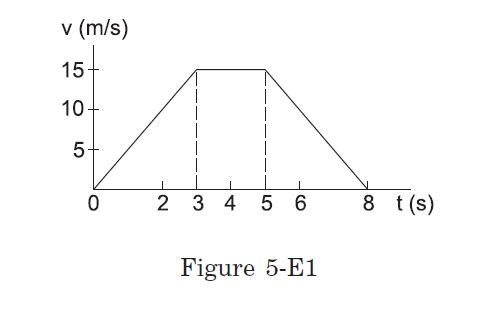
Answer: At \( t = 2 \, s \): 0.25 N, at \( t = 4 \, s \): 0 N, at \( t = 6 \, s \): -0.25 N
Explanation: Using Newton second law, \( F = ma \). The acceleration is obtained from the slope of the speed-time graph. The mass is \( 50 \, g = 0.05 \, kg \). From the graph, in the first region (0 to 3 s), the slope is \( \frac{15}{3} = 5 \, m/s^2 \), so at \( t = 2 \, s \), \( F = 0.05 \times 5 = 0.25 \, N \). In the second region (3 to 5 s), the speed is constant, so acceleration is zero and \( F = 0 \). In the third region (5 to 8 s), the slope is \( \frac{0 – 15}{3} = -5 \, m/s^2 \), so at \( t = 6 \, s \), \( F = 0.05 \times (-5) = -0.25 \, N \). The negative sign indicates force is opposite to motion.
7. Two blocks A and B of mass \( m_A \) and \( m_B \) respectively are kept in contact on a frictionless table. The experimenter pushes the block A from behind so that the blocks accelerate. If the block A exerts a force \( F \) on the block B, what is the force exerted by the experimenter on A?
Answer: \( F \left(\frac{m_A + m_B}{m_B}\right) \)
Explanation: For block B, the only horizontal force is \( F \), so using Newton second law, \( F = m_B a \), giving \( a = \frac{F}{m_B} \). For the entire system, the total mass is \( m_A + m_B \), and the applied force is \( P \). Thus, \( P = (m_A + m_B)a \). Substituting \( a \), we get \( P = (m_A + m_B)\frac{F}{m_B} \). Hence, the required force is \( F \left(\frac{m_A + m_B}{m_B}\right) \).
8. Raindrops of radius 1 mm and mass 4 mg are falling with a speed of 30 m/s on the head of a bald person. The drops splash on the head and come to rest. Assuming equivalently that the drops cover a distance equal to their radii on the head, estimate the force exerted by each drop on the head.
Answer: 1.8 N
Explanation: Given \( m = 4 \times 10^{-6} \, kg \), \( u = 30 \, m/s \), \( v = 0 \), \( s = 10^{-3} \, m \). Using \( v^2 = u^2 + 2as \), we get \( 0 = 900 + 2a(10^{-3}) \), so \( a = -4.5 \times 10^5 \, m/s^2 \). Using Newton second law, \( F = ma = (4 \times 10^{-6})(4.5 \times 10^5) = 1.8 \, N \). The force magnitude is \( 1.8 \, N \).
9. A particle of mass 0.3 kg is subjected to a force \( F = -kx \) with \( k = 15 \, \text{N/m} \). What will be its initial acceleration if it is released from a point \( x = 20 \, \text{cm} \)?
Answer: \( -10 \, \text{m/s}^2 \)
Explanation: Using the relation \( F = -kx \), with \( k = 15 \, \text{N/m} \) and \( x = 0.2 \, \text{m} \), we get \( F = -3 \, \text{N} \). Applying Newton second law, \( F = ma \), so \( a = \frac{-3}{0.3} = -10 \, \text{m/s}^2 \). The negative sign indicates the acceleration is towards the origin, opposite to displacement.
10. Both the springs shown in figure (5-E2) are unstretched. If the block is displaced by a distance \( x \) and released, what will be the initial acceleration?
Answer: \( \frac{(k_1 + k_2)x}{m} \) (opposite to displacement)
Explanation: When the block is displaced, both springs exert restoring forces in the same direction, opposite to displacement. The left spring is stretched and the right spring is compressed, giving forces \( -k_1 x \) and \( -k_2 x \). The net force is \( -(k_1 + k_2)x \). Using Newton second law, \( F = ma \), we get \( a = \frac{-(k_1 + k_2)x}{m} \). Hence, the acceleration is proportional to displacement and directed towards equilibrium.
11. A small block B is placed on another block A of mass 5 kg and length 20 cm. Initially the block B is near the right end of block A (figure 5-E3). A constant horizontal force of 10 N is applied to the block A. All the surfaces are assumed frictionless. Find the time elapsed before the block B separates from A.
Answer: 0.45 s
Explanation: For block A, the applied force is 10 N and mass is 5 kg, so using Newton second law, acceleration \( a = \frac{F}{m} = \frac{10}{5} = 2 \, \text{m/s}^2 \). For block B, since the surface is frictionless, there is no horizontal force, so it remains at rest relative to the ground. Separation occurs when block A moves a distance equal to its length (0.2 m). Using \( s = \tfrac{1}{2} a t^2 \), we get \( 0.2 = \tfrac{1}{2} \cdot 2 \cdot t^2 \Rightarrow t^2 = 0.2 \Rightarrow t = \sqrt{0.2} \approx 0.45 \, \text{s} \).
12. A man has fallen into a ditch of width \( d \) and two of his friends are slowly pulling him out using a light rope and two fixed pulleys as shown in figure (5-E4). Show that the force exerted by each friend on the rope increases as the man moves up. Find the force when the man is at a depth \( h \).
Answer: \( \frac{mg \sqrt{d^2 + 4h^2}}{4h} \)
Explanation: Let the tension in each rope be \( T \). The system is in equilibrium, so the vertical components of the two tensions balance the weight: \( 2T \cos \theta = mg \). From geometry, \( \cos \theta = \frac{2h}{\sqrt{4h^2 + d^2}} \). Substituting, \( T = \frac{mg}{2 \cos \theta} = \frac{mg \sqrt{d^2 + 4h^2}}{4h} \). As the man moves up, \( h \) decreases, so the term increases and hence the tension increases.
13. The elevator shown in figure (5-E5) is descending with an acceleration of \( 2 \, \text{m/s}^2 \). The mass of the block A is \( 0.5 \, \text{kg} \). What force is exerted by the block A on the block B?
Answer: 4 N
Explanation: For block A, forces are weight \( m_A g \) downward and normal force \( N \) upward. Since the elevator accelerates downward, the effective acceleration is \( g – a \). Using Newton second law, \( N = m_A (g – a) = 0.5 (10 – 2) = 4 \, \text{N} \). Hence, the force exerted by A on B is 4 N.
14. A pendulum bob of mass 50 g is suspended from the ceiling of an elevator. Find the tension in the string if the elevator (a) goes up with acceleration 1.2 m/s², (b) goes up with deceleration 1.2 m/s², (c) goes up with uniform velocity, (d) goes down with acceleration 1.2 m/s², (e) goes down with deceleration 1.2 m/s² and (f) goes down with uniform velocity.
Answer: (a) 0.55 N (b) 0.43 N (c) 0.49 N (d) 0.43 N (e) 0.55 N (f) 0.49 N
Explanation: Using \( T = m(g \pm a) \) with \( m = 0.05 \, kg \) and \( g = 9.8 \, m/s^2 \). For upward acceleration, \( T = m(g + a) = 0.55 \, N \). For downward acceleration, \( T = m(g – a) = 0.43 \, N \). For uniform velocity, \( a = 0 \), so \( T = mg = 0.49 \, N \). Thus, tension depends on direction of acceleration and is greater when acceleration is upward.
15. A person is standing on a weighing machine placed on the floor of an elevator. The elevator starts going up with some acceleration, moves with uniform velocity for a while and finally decelerates to stop. The maximum and the minimum weights recorded are 72 kg and 60 kg. Assuming that the magnitudes of the acceleration and the deceleration are the same, find (a) the true weight of the person and (b) the magnitude of the acceleration. Take \( g = 9.9 \, m/s^2 \).
Answer: True weight = 66 kg, Acceleration = 0.9 m/s²
Explanation: The weighing machine reads apparent weight. Using \( W’ = \frac{m(g \pm a)}{g} \), we get equations \( 72g = mg + ma \) and \( 60g = mg – ma \). Adding gives \( 132g = 2mg \), so \( m = 66 \, kg \). Substituting back, \( a = \frac{g}{11} = 0.9 \, m/s^2 \). Thus, the true weight is 66 kg and the acceleration is 0.9 m/s².
16. Find the reading of the spring balance shown in figure (5-E6). The elevator is going up with an acceleration of \( g/10 \), the pulley and the string are light and the pulley is smooth.
Answer: 4.4 kg
Explanation: Since the elevator accelerates upward, the effective gravity becomes \( g’ = g + \frac{g}{10} = \frac{11g}{10} \). For the pulley system with masses \( 1.5 \, kg \) and \( 3 \, kg \), the tension is \( T = \frac{2m_1m_2}{m_1 + m_2} g’ = 2.2g \, N \). The spring balance supports both sides, so the total force is \( 2T = 4.4g \, N \). Hence, the reading of the balance is \( \frac{4.4g}{g} = 4.4 \, kg \).
17. A block of 2 kg is suspended from the ceiling through a massless spring of spring constant \( k = 100 \, \text{N/m} \). What is the elongation of the spring? If another 1 kg is added to the block, what would be the further elongation?
Answer: Initial elongation = 0.2 m, Further elongation = 0.1 m
Explanation: Using Hooke law, \( F = kx \). For 2 kg, \( F = mg = 20 \, N \), so \( x_1 = \frac{20}{100} = 0.2 \, m \). When mass becomes 3 kg, \( F = 30 \, N \), so \( x_2 = \frac{30}{100} = 0.3 \, m \). The additional elongation is \( x_2 – x_1 = 0.1 \, m \).
18. Suppose the ceiling in the previous problem is that of an elevator which is going up with an acceleration of \( 2.0 \, \text{m/s}^2 \). Find the elongations.
Answer: Initial elongation = 0.24 m, Further elongation = 0.12 m
Explanation: When the elevator accelerates upward, the effective gravity becomes \( g’ = g + a = 10 + 2 = 12 \, \text{m/s}^2 \). Using Hooke law, \( mg’ = kx \). For 2 kg, \( 2 \times 12 = 100x_1 \Rightarrow x_1 = 0.24 \, m \). For total mass 3 kg, \( 3 \times 12 = 100x_2 \Rightarrow x_2 = 0.36 \, m \). Hence, the additional elongation is \( x_2 – x_1 = 0.12 \, m \).
19. The force of buoyancy exerted by the atmosphere on a balloon is \( B \) in the upward direction and remains constant. The force of air resistance on the balloon acts opposite to the direction of velocity and is proportional to it. The balloon carries a mass \( M \) and is found to fall down near the earth’s surface with a constant velocity \( v \). How much mass should be removed from the balloon so that it may rise with a constant velocity \( v \)?
Answer: \( 2\left(M – \frac{B}{g}\right) \)
Explanation: When the balloon falls with constant velocity, the net force is zero, so \( Mg = B + f \). When it rises with the same speed, the air resistance remains the same but acts downward. For the new mass \( (M – m) \), equilibrium gives \( B = (M – m)g + f \). Substituting \( f = Mg – B \), we get \( B = Mg – mg + Mg – B \). Solving, \( 2B = 2Mg – mg \), hence \( m = 2\left(M – \frac{B}{g}\right) \). This is the required mass to be removed.
20. An empty plastic box of mass \( m \) is found to accelerate up at the rate of \( g/6 \) when placed deep inside water. How much sand should be put inside the box so that it may accelerate down at the rate of \( g/6 \)?
Answer: \( \frac{2m}{5} \)
Explanation: For the empty box, the buoyant force \( B \) and weight \( mg \) give \( B – mg = m \frac{g}{6} \), so \( B = \frac{7mg}{6} \). After adding sand of mass \( M \), total mass becomes \( (m + M) \). Now \( (m + M)g – B = (m + M)\frac{g}{6} \). Substituting \( B \), we get \( (m + M)g – \frac{7mg}{6} = \frac{(m + M)g}{6} \). Solving gives \( M = \frac{2m}{5} \). Hence, the required mass of sand is \( \frac{2m}{5} \).
21. A force \( \vec{F} = \vec{v} \times \vec{A} \) is exerted on a particle in addition to the force of gravity, where \( \vec{v} \) is the velocity of the particle and \( \vec{A} \) is a constant vector in the horizontal direction. With what minimum speed a particle of mass \( m \) be projected so that it continues to move undeflected with a constant velocity?
Answer: \( \frac{mg}{A} \)
Explanation: For motion with constant velocity, net force must be zero. So the force \( \vec{v} \times \vec{A} \) must balance gravity: \( |\vec{v} \times \vec{A}| = mg \). Using \( |\vec{v} \times \vec{A}| = vA \sin \theta \), we get \( v = \frac{mg}{A \sin \theta} \). The minimum speed occurs when \( \sin \theta = 1 \), giving \( v = \frac{mg}{A} \).
22. In a simple Atwood machine, two unequal masses \( m_1 \) and \( m_2 \) are connected by a string going over a clamped light smooth pulley. In a typical arrangement \( m_1 = 300 \, \text{g} \) and \( m_2 = 600 \, \text{g} \). The system is released from rest. (a) Find the distance travelled by the first block in the first two seconds. (b) Find the tension in the string. (c) Find the force exerted by the clamp on the pulley.
Answer: (a) 6.5 m (b) 3.9 N (c) 7.8 N
Explanation: The acceleration of the system is \( a = \frac{m_2 – m_1}{m_1 + m_2} g = \frac{9.8}{3} \, \text{m/s}^2 \). (a) Using \( s = \tfrac{1}{2} a t^2 \), \( s = 6.5 \, \text{m} \). (b) The tension is \( T = \frac{2m_1 m_2}{m_1 + m_2} g = 3.9 \, \text{N} \). (c) The force by the clamp is \( 2T = 7.8 \, \text{N} \).
23. Consider the Atwood machine of the previous problem. The larger mass is stopped for a moment 2.0 s after the system is set into motion. Find the time elapsed before the string is tight again.
Answer: \( \frac{2}{3} \, \text{s} \)
Explanation: At \( t = 2 \, \text{s} \), the velocity is \( v = at = \frac{19.6}{3} \, \text{m/s} \). When the heavier mass is stopped, the string becomes slack and both masses move under gravity. The string becomes tight again when relative motion restores tension, giving \( t = \frac{v}{g} = \frac{2}{3} \, \text{s} \).
24. Figure (5-E8) shows a uniform rod of length 30 cm having a mass of 3.0 kg. The strings shown in the figure are pulled by constant forces of 20 N and 32 N. Find the force exerted by the 20 cm part of the rod on the 10 cm part. All the surfaces are smooth and the strings and the pulleys are light.
Answer: 24 N
Explanation: The net force on the rod is \( 32 – 20 = 12 \, \text{N} \), so the acceleration is \( a = \frac{12}{3} = 4 \, \text{m/s}^2 \). The mass per unit length is \( \frac{3}{30} = 0.1 \, \text{kg/cm} \), so the 10 cm part has mass \( 1 \, \text{kg} \). For this part, applying Newton second law, \( T – 20 = 1 \times 4 \), giving \( T = 24 \, \text{N} \). Hence, the force between the parts is 24 N.
25. Consider the situation shown in figure (5-E9). All the surfaces are frictionless and the string and the pulley are light. Find the magnitude of the acceleration of the two blocks.
Answer: \( \frac{g}{10} \)
Explanation: The only driving force is the weight of the hanging block \( = 0.5g \). The total mass of the system is \( 4.5 + 0.5 = 5 \, \text{kg} \). Using Newton second law, \( a = \frac{F}{M} = \frac{0.5g}{5} = \frac{g}{10} \). Hence, the acceleration of the system is \( \frac{g}{10} \).
26. A constant force \( F = m_2g/2 \) is applied on the block of mass \( m_1 \) as shown in figure (5-E10). The string and the pulley are light and the surface of the table is smooth. Find the acceleration of \( m_1 \).
Answer: \( \frac{m_2 g}{2(m_1 + m_2)} \)
Explanation: For \( m_2 \), \( m_2 g – T = m_2 a \) and for \( m_1 \), \( T – F = m_1 a \). Adding gives \( m_2 g – F = (m_1 + m_2)a \). Substituting \( F = \frac{m_2 g}{2} \), we get \( \frac{m_2 g}{2} = (m_1 + m_2)a \). Hence, the acceleration is \( \frac{m_2 g}{2(m_1 + m_2)} \).
27. In figure (5-E11) \( m_1 = 5 \, \text{kg} \), \( m_2 = 2 \, \text{kg} \) and \( F = 1 \, \text{N} \). Find the acceleration of either block. Describe the motion of \( m_1 \) if the string breaks but \( F \) continues to act.
Answer: Acceleration = 4.3 m/s², After break: \( g + 0.2 \, \text{m/s}^2 \) downward
Explanation: The net driving force is \( (m_1 g + F) – m_2 g \). Using Newton second law, \( a = \frac{(5g + 1) – 2g}{7} \approx 4.3 \, \text{m/s}^2 \). If the string breaks, only weight and \( F \) act on \( m_1 \), so acceleration becomes \( g + \frac{F}{m_1} = g + 0.2 \, \text{m/s}^2 \) downward.
28. Let \( m_1 = 1 \, \text{kg}, m_2 = 2 \, \text{kg} \) and \( m_3 = 3 \, \text{kg} \) in figure (5-E12). Find the accelerations of \( m_1, m_2 \) and \( m_3 \). The string from the upper pulley to \( m_1 \) is 20 cm when the system is released from rest. How long will it take before \( m_1 \) strikes the pulley?
Answer: \( a_1 = \frac{19}{29}g \) upward, \( a_2 = \frac{17}{29}g \) downward, \( a_3 = \frac{21}{29}g \) downward, Time = 0.25 s
Explanation: Let the tension in the lower string be \( T \), then the upper string has tension \( 2T \). Applying Newton second law to each mass and solving simultaneously, we get the accelerations: \( a_1 = \frac{19}{29}g \), \( a_2 = \frac{17}{29}g \), \( a_3 = \frac{21}{29}g \). Using \( s = \tfrac{1}{2}at^2 \) with \( s = 0.2 \, \text{m} \), we get \( t \approx 0.25 \, \text{s} \).
29. In the previous problem, suppose \( m_2 = 2.0 \, \text{kg} \) and \( m_3 = 3.0 \, \text{kg} \). What should be the mass \( m \) so that it remains at rest?
Answer: 4.8 kg
Explanation: For the mass \( m \) to remain at rest, the system must be in equilibrium. The tension in the lower string is \( T = \frac{2m_2m_3}{m_2 + m_3}g = 2.4g \). The upper string supports two tensions, so \( 2T = 4.8g \). Equating with \( mg \), we get \( m = 4.8 \, \text{kg} \). Hence, the required mass is 4.8 kg.
30. Calculate the tension in the string shown in figure (5-E13). The pulley and the string are light and all surfaces are frictionless. Take \( g = 10 \, \text{m/s}^2 \).
Answer: 5 N
Explanation: For the hanging block, \( m_2 g – T = m_2 a \Rightarrow 10 – T = a \). For the block on the table, \( T = m_1 a \Rightarrow T = a \). Substituting, \( 10 – a = a \Rightarrow a = 5 \, \text{m/s}^2 \). Hence, the tension is \( T = 5 \, \text{N} \).
31. Consider the situation shown in figure (5-E14). Both the pulleys and the string are light and all the surfaces are frictionless. (a) Find the acceleration of the mass \( M \). (b) Find the tension in the string. (c) Calculate the force exerted by the clamp on the pulley A in the figure.
Answer: (a) \( \frac{2g}{3} \) (b) \( \frac{Mg}{3} \) (c) \( \frac{\sqrt{2}Mg}{3} \)
Explanation: Due to the movable pulley, the acceleration of block \( 2M \) is half that of mass \( M \). Using Newton second law, we get \( Mg – T = M a_M \) and \( 2T = 2M a_{2M} \). Solving gives \( a_M = \frac{2g}{3} \) and \( T = \frac{Mg}{3} \). The force on the clamp is due to two perpendicular tensions, so \( F = \sqrt{T^2 + T^2} = \frac{\sqrt{2}Mg}{3} \).
32. Find the acceleration of the block of mass M in the situation shown in figure (5-E15). All the surfaces are frictionless and the pulleys and the string are light.
Solution:
Step 1: Constraint relation
Let the acceleration of block M up the incline be a.
The hanging block (2M) is attached to a movable pulley, so its acceleration is a/2 downward.
Step 2: Apply Newton’s Second Law
For block M (on incline):
T − Mg sin30° = Ma
T − 0.5Mg = Ma …(1)
For block 2M (hanging):
2Mg − 2T = (2M)(a/2)
2Mg − 2T = Ma …(2)
Step 3: Solve equations
Multiply (1) by 2:
2T − Mg = 2Ma
Add with (2):
Mg = 3Ma
a = g/3
Answer: The acceleration of block M is g/3 (up the plane).
33. Find the mass M of the hanging block in figure (5-E16) which will prevent the smaller block from slipping over the triangular block. All the surfaces are frictionless and the strings and the pulleys are light.
Solution:
Step 1: Condition for no slipping
Pseudo force balances component of gravity:
ma cosθ = mg sinθ
a = g tanθ
Step 2: Acceleration of system
For hanging mass M:
Mg − T = Ma ⇒ T = M(g − a)
For system (M’ + m):
T = (M’ + m)a
Equating tensions:
M(g − a) = (M’ + m)a
Mg = (M’ + m + M)a
a = Mg / (M’ + m + M)
Step 3: Substitute a = g tanθ
g tanθ = Mg / (M’ + m + M)
(M’ + m + M) tanθ = M
M(1 − tanθ) = (M’ + m) tanθ
M = (M’ + m) tanθ / (1 − tanθ)
Using cotθ = 1/tanθ:
M = (M’ + m) / (cotθ − 1)
Answer: Required mass is (M’ + m) / (cotθ − 1).
34. Find the acceleration of the blocks A and B in the three situations shown in figure (5-E17).
(a) mA = 4 kg, mB = 5 kg
Solution:
Constraint: aA = 2aB. Let aB = a ⇒ aA = 2a.
Equations:
4g − T = 8a
2T − 5g = 5a
Solving:
T = 4g − 8a
2(4g − 8a) − 5g = 5a
3g = 21a ⇒ a = g/7
Answer:
aA = 2g/7 (downward)
aB = g/7 (upward)
(b) mA = 2 kg, mB = 5 kg
Solution:
Constraint: aA = 2aB
Equations:
T = 4a
5g − 2T = 5a
Solving:
5g − 8a = 5a
5g = 13a ⇒ a = 5g/13
Answer:
aA = 10g/13 (forward)
aB = 5g/13 (downward)
(c) mA = 1 kg, mB = 2 kg
Solution:
Constraint: aB = 2aA
Equations:
2g − T = 4a
2T − g = a
Solving:
T = 2g − 4a
2(2g − 4a) − g = a
3g = 9a ⇒ a = g/3
Answer:
aB = 2g/3 (downward)
aA = g/3 (upward)
35. Find the acceleration of the 500 g block in figure (5-E18).
Solution:
Step 1: Given masses
m₁ = 0.5 kg, m₂ = 0.1 kg, m₃ = 0.05 kg
Total mass = 0.65 kg
Step 2: Net force
Driving force = 0.5g − 0.05g − 0.05g = 0.4g
Step 3: Acceleration
a = F/M = 0.4g / 0.65 = 8g/13
Answer: Acceleration = 8g/13 downward
38. The monkey B is holding on to the tail of monkey A which is climbing up a rope. The masses of A and B are 5 kg and 2 kg respectively. If A can tolerate a tension of 30 N in its tail, what force should it apply on the rope to carry B? (g = 10 m/s²)
Solution:
Step 1: For monkey B
Tt − mBg = mBa
Tt = mB(g + a)
Step 2: Limits of acceleration
Minimum case (a = 0):
Tt = 2 × 10 = 20 N
Maximum case:
30 = 2(10 + a)
15 = 10 + a
a = 5 m/s²
Step 3: Force applied by monkey A
F = (mA + mB)(g + a)
Minimum force:
F = 7 × 10 = 70 N
Maximum force:
F = 7 × 15 = 105 N
Answer: Required force lies between 70 N and 105 N.
39. A man of mass 60 kg stands on a weighing machine inside a box of mass 30 kg. The box is hanging from a pulley and the man holds the other end of the rope. If the box is at rest, what is the reading of the machine? What force should he exert to see his correct weight?
Solution:
Part 1: Box at rest
For man:
T + N = Mg = 600 …(1)
For box:
T − N = mg = 300 …(2)
Solving:
Adding (1) and (2):
2T = 900 ⇒ T = 450 N
From (1): N = 600 − 450 = 150 N
Answer:
Machine reading = 150 N = 15 kg
Part 2: For correct weight (N = 600 N)
For man:
T + N − Mg = Ma
T = Ma
For box:
T − Mg − mg = ma
Substitute T = Ma:
Ma − (M + m)g = ma
(M − m)a = (M + m)g
(60 − 30)a = (60 + 30) × 10
30a = 900 ⇒ a = 30 m/s²
Force applied:
T = Ma = 60 × 30 = 1800 N
Final Answer:
Machine reading = 15 kg
Required force = 1800 N
40 A block A can slide on a frictionless incline of angle \( \theta \) and length \( l \) kept inside an elevator going up with uniform velocity \( v \) Find the time taken by the block to slide down the length of the incline if it is released from the top of the incline
Answer: \( \sqrt{\frac{2l}{g \sin \theta}} \)
Since the elevator is moving with uniform velocity its acceleration is zero so it behaves as an inertial frame. Hence no pseudo force acts on the block. The only force along the incline is the component of gravity \( mg \sin \theta \) giving acceleration \( g \sin \theta \). Using the equation \( s = ut + \tfrac{1}{2} at^2 \) with initial velocity zero and distance \( l \), we get \( l = \tfrac{1}{2} g \sin \theta \, t^2 \). Solving gives \( t = \sqrt{\frac{2l}{g \sin \theta}} \). The key idea is that uniform velocity means zero acceleration so motion is governed only by gravity.
41 A car is speeding up on a horizontal road with an acceleration \( a \) Consider the following situations in the car (i) A ball is suspended from the ceiling through a string and is maintaining a constant angle with the vertical Find this angle (ii) A block is kept on a smooth incline and does not slip on the incline Find the angle of the incline with the horizontal
Answer: (i) \( \tan^{-1}(a/g) \) (ii) \( \tan^{-1}(a/g) \)
In an accelerating car we analyze motion in a non inertial frame where a pseudo force \( ma \) acts opposite to the direction of acceleration. In part (i) the suspended ball is in equilibrium under three forces tension weight and pseudo force. Resolving forces gives \( T \cos \theta = mg \) and \( T \sin \theta = ma \). Dividing gives \( \tan \theta = \frac{a}{g} \). In part (ii) for the block on incline the component of pseudo force along the incline balances the component of gravity so \( ma \cos \theta = mg \sin \theta \). This again gives \( \tan \theta = \frac{a}{g} \). The important concept is that pseudo force balances real forces in a non inertial frame leading to equilibrium conditions.
42 A block is kept on the floor of an elevator at rest. The elevator starts descending with an acceleration of 12 m s\(^{-2}\). Find the displacement of the block during the first 0.2 s after the start. Take \( g = 10 \, m s^{-2} \)
Answer: \( 0.04 \, m \) upward relative to the elevator floor
When the elevator accelerates downward with \( 12 \, m s^{-2} \) which is greater than \( g \), the block goes into a state of free fall relative to the elevator. The relative acceleration is \( a = g – 12 = -2 \, m s^{-2} \) which means the block accelerates upward relative to the elevator. Using the equation \( s = ut + \tfrac{1}{2} at^2 \) with initial velocity zero and time \( 0.2 \, s \), we get displacement \( s = \tfrac{1}{2} \times (-2) \times (0.2)^2 = -0.04 \, m \). The negative sign indicates upward motion relative to the elevator. The key idea is that when elevator acceleration exceeds gravity the object loses contact and moves upward relative to it.