1. Can the centre of mass of a body be at a point outside the body?
Answer: Yes
Explanation: The centre of mass (COM) is the point where the entire mass of a body can be considered to be concentrated for the purpose of analyzing motion. It depends on the distribution of mass and not necessarily on the physical boundaries of the body.
- For uniform, symmetric bodies (like a solid sphere or cube), the COM lies inside the body.
- For hollow or ring-shaped bodies, the COM lies at the geometric centre, which is outside the material of the body.
- Example: In a ring or hollow sphere, the COM is at the centre of the ring/sphere, a point where there is no actual matter.
2. If all the particles of a system lie in X–Y plane, is it necessary that the centre of mass be in X–Y plane?
Answer: Yes
Explanation:
The centre of mass (COM) is defined as the weighted average of the positions of all particles in the system. Mathematically,
\[
\vec{R}_{CM} = \frac{\sum m_i \vec{r}_i}{\sum m_i}
\]
If every particle has coordinates \((x_i, y_i, 0)\), i.e. all lie in the X–Y plane, then:
\[
\vec{R}_{CM} = \left(\frac{\sum m_i x_i}{M}, \frac{\sum m_i y_i}{M}, \frac{\sum m_i \cdot 0}{M}\right)
\]
\[
\vec{R}_{CM} = \left(X_{CM}, Y_{CM}, 0\right)
\]
Thus, the z-coordinate of the COM is zero, meaning the COM also lies in the X–Y plane.
So, whenever all particles of a system are confined to a plane, the centre of mass must lie in the same plane.
3. If all the particles of a system lie in a cube, is it necessary that the centre of mass be in the cube?
Answer: No, not necessarily.
Explanation: The centre of mass (COM) is the weighted average of the positions of all particles. If all particles are confined inside a cube, the COM will lie within the convex hull of those particles.
- If the cube is solid and uniformly filled, the COM will indeed lie inside the cube.
- However, if the particles are arranged only at certain corners or edges, the COM can shift outside the cube.
Example:
- Suppose we place three equal masses at three corners of a cube. The COM will lie at the centroid of those three points, which may fall outside the cube.
- Similarly, if particles are distributed along one face or edge, the COM can lie outside the cube’s volume, though still within the geometric region defined by the particles.
So, unlike the X–Y plane case (where confinement guarantees the COM lies in the plane), confinement inside a cube does not guarantee that the COM lies inside the cube itself.
4. The centre of mass is defined as \( R = \frac{1}{M} \sum m_i r_i \). Suppose we define “centre of charge” as \( R_C = \frac{1}{Q} \sum q_i r_i \) where \( q_i \) represents the ith charge placed at \( r_i \) and \( Q \) is the total charge of the system. (a) Can the centre of charge of a two-charge system be outside the line segment joining the charges? (b) If all the charges of a system are in X-Y plane, is it necessary that the centre of charge be in X-Y plane? (c) If all the charges of a system lie in a cube, is it necessary that the centre of charge be in the cube?
Answer:
- (a) Yes. Unlike mass, charge can be negative. If the charges have opposite signs, the centre of charge can lie outside the line segment joining them.
- (b) Yes. If all charges have \( z = 0 \), then the calculated centre of charge will also have \( z = 0 \), hence it lies in the X-Y plane.
- (c) No. Because charges can be negative, the weighted average is not restricted to the interior of the cube.
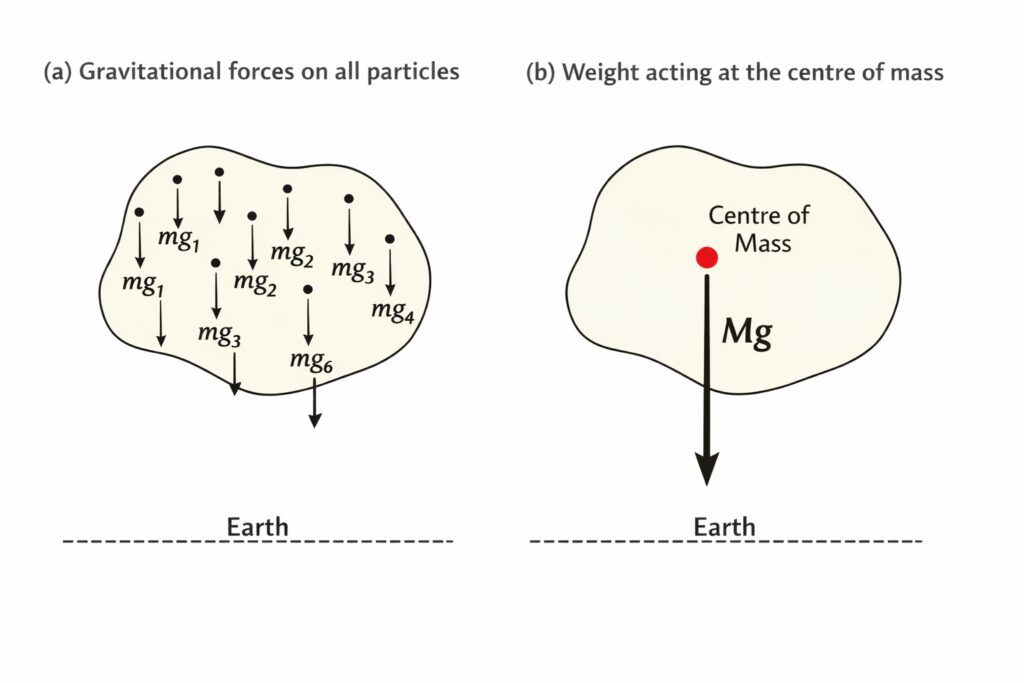
5. The weight \(Mg\) of an extended body is generally shown in a diagram to act through the centre of mass. Does it mean that the earth does not attract other particles?
Answer: No, it does not mean that.
Explanation:
- The earth attracts every particle of the body individually with a gravitational force.
- However, when analyzing the motion of the whole body, it is convenient to represent the
net gravitational force as a single force acting at the
centre of mass (COM). - This is a simplification: instead of drawing many small forces on each particle, we replace them with
one equivalent force \(Mg\) acting at the COM. - This works because the gravitational field near the Earth’s surface is
uniform (same magnitude and direction for all particles). In such a uniform field,
the resultant force is exactly equal to the total weight acting at the COM.
So, the diagram showing weight at the COM is a representation tool, not a literal statement that Earth ignores other particles.
Earth’s gravity acts on every particle, but the combined effect can be treated as if it acts at the COM.
6. A bob suspended from the ceiling of a car which is accelerating on a horizontal road. The bob stays at rest with respect to the car with the string making an angle θ with the vertical. The linear momentum of the bob as seen from the road is increasing with time. Is it a violation of conservation of linear momentum? If not, where is the external force which changes the linear momentum?
Answer: No, it is not a violation of conservation of linear momentum.
Explanation: The law of conservation of linear momentum holds only for an isolated system, i.e., one on which no external force acts. In this case, the bob is not isolated — it is connected to the car by a string.
As the car accelerates forward, the string exerts a horizontal tension on the bob. This tension provides the external force that changes the bob’s momentum with respect to the road.
From the car’s frame, the bob appears stationary because the tension balances the pseudo‑force due to acceleration. But from the road’s frame, the bob’s velocity and hence its linear momentum increase with time, caused by the horizontal component of tension acting on it.
Therefore, the increase in momentum is due to an external force (tension in the string), and there is no violation of the conservation of linear momentum.
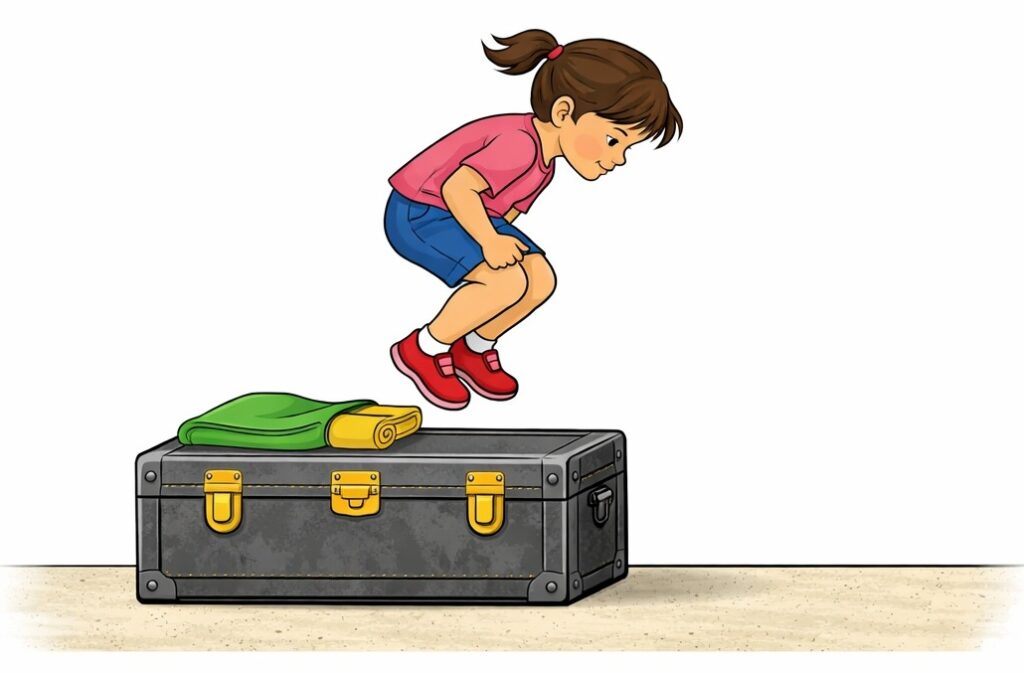
7. You are waiting for a train on a railway platform. Your three‑year‑old niece is standing on your iron trunk containing the luggage. Why does the trunk not recoil as she jumps off on the platform?
Answer: The trunk does not recoil because the external force of friction between the trunk and the ground prevents it from moving.
Explanation: When your niece jumps off, she exerts a downward and backward force on the trunk. According to Newton’s third law, the trunk exerts an equal and opposite force on her. If the trunk were on a smooth, frictionless surface, this backward force would make it recoil slightly. However, on the rough platform, the static friction between the trunk and the ground provides an external force that opposes this motion. This frictional force prevents the trunk from moving, so its momentum remains unchanged.
Hence, there is no violation of conservation of momentum, because the system (trunk + Earth) is not isolated — the Earth exerts friction on the trunk, absorbing the tiny impulse.
8. In a head‑on collision between two particles, is it necessary that the particles will acquire a common velocity at least for one instant?
Answer: No, it is not necessary.
Explanation: A head‑on collision means the particles move along the same straight line before and after impact. Whether they acquire a common velocity at any instant depends on the nature of the collision:
- In a perfectly elastic collision, the particles exchange momentum and energy but do not necessarily have the same velocity at any instant. They approach each other, interact, and then separate with different velocities.

- In a perfectly inelastic collision, the particles stick together after impact and move with a common velocity immediately after collision.
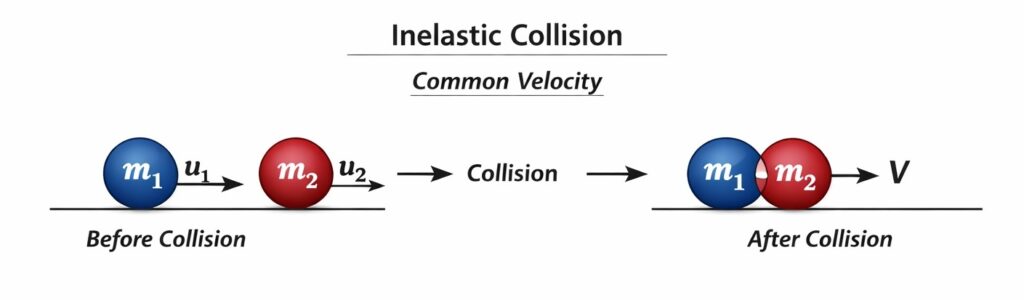
- In partially elastic collisions, they may momentarily have the same velocity during contact, but this is not guaranteed—it depends on the details of the interaction forces and masses.
Thus, acquiring a common velocity is not a necessary condition for all head‑on collisions; it occurs only in completely inelastic collisions.
9. A collision experiment is done on a horizontal table kept in an elevator. Do you expect a change in the results if the elevator is accelerated up or down because of the noninertial character of the frame?
Answer: No, the results of the collision experiment will not change.
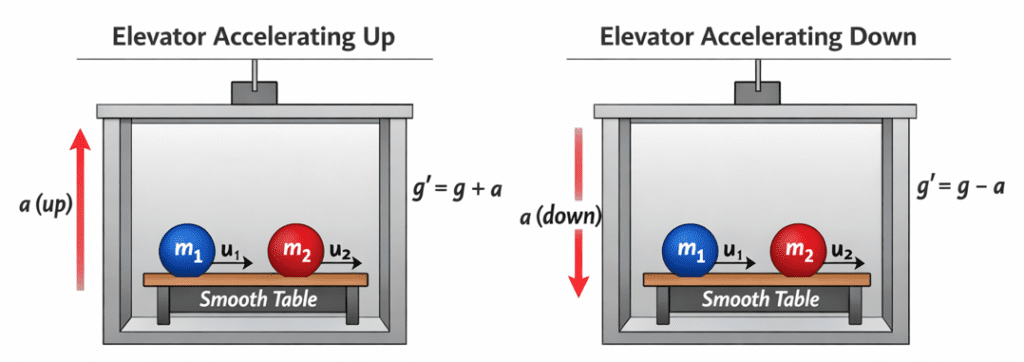
Explanation: When the elevator accelerates upward or downward, the effective acceleration due to gravity inside the elevator changes:
- If the elevator accelerates upward, effective gravity becomes
. - If the elevator accelerates downward, effective gravity becomes
.
However, in a horizontal collision experiment, the motion and momentum exchange occur along the horizontal direction, while gravity (and its variation) acts vertically. Thus, the vertical change in effective gravity does not affect the horizontal motion or the results of the collision — provided the table is smooth and horizontal.
The only effect is a change in the normal reaction between the table and the bodies, but this does not influence the horizontal momentum conservation or the collision outcomes.
Hence, the results of the collision experiment remain unchanged, even though the elevator is a noninertial frame.
10. Two bodies make an elastic head‑on collision on a smooth horizontal table kept in a car. Do you expect a change in the result if the car is accelerated on a horizontal road because of the noninertial character of the frame? Does the equation “Velocity of separation = Velocity of approach” remain valid in an accelerating car? Does the equation “final momentum = initial momentum” remain valid in the accelerating car?
Answer: Yes, the results will change if the car is accelerated, because the car becomes a noninertial frame.
Explanation:
- When the car accelerates, a pseudo force acts on each body opposite to the direction of acceleration.
- This pseudo force is external to the two‑body system (from the car’s frame viewpoint).
- Therefore, the system is not isolated, and the law of conservation of momentum does not hold in the accelerating frame.
- The equation “final momentum = initial momentum” is valid only in an inertial frame, so it fails in the accelerating car.
EXERCISES
1. Three particles of masses \(1.0 \, \text{kg}\), \(2.0 \, \text{kg}\) and \(3.0 \, \text{kg}\) are placed at the corners A, B and C respectively of an equilateral triangle ABC of edge \(1 \, \text{m}\). Locate the centre of mass of the system.
Solution: To locate the center of mass, we first establish a coordinate system. We take corner A as the origin \((0, 0)\) and the side AB along the X-axis.
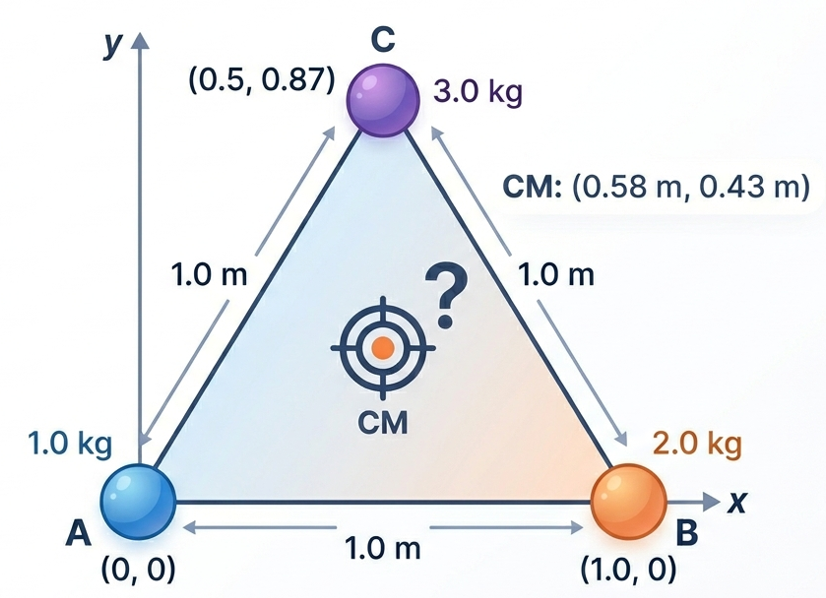
1. Identify the Coordinates of the Masses:
Since the triangle is equilateral with a side length of \(1 \, \text{m}\):
- Mass \(m_1 = 1.0 \, \text{kg}\) at A: \((x_1, y_1) = (0, 0)\)
- Mass \(m_2 = 2.0 \, \text{kg}\) at B: \((x_2, y_2) = (1, 0)\)
- Mass \(m_3 = 3.0 \, \text{kg}\) at C:
Using properties of an equilateral triangle:
\(x_3 = 0.5\),
\(y_3 = 1 \cdot \sin 60^\circ = \frac{\sqrt{3}}{2}\)Therefore, \((x_3, y_3) = \left(0.5, \frac{\sqrt{3}}{2}\right)\)
2. Calculate the Total Mass (\(M\)):
\[
M = m_1 + m_2 + m_3 = 1.0 + 2.0 + 3.0 = 6.0 \, \text{kg}
\]
3. Apply the Center of Mass Formula:
\[
R = \frac{1}{M} \sum m_i r_i
\]
X-coordinate (\(X_{cm}\)):
\[
X_{cm} = \frac{m_1 x_1 + m_2 x_2 + m_3 x_3}{M}
\]
\[
X_{cm} = \frac{(1.0 \times 0) + (2.0 \times 1) + (3.0 \times 0.5)}{6.0}
\]
\[
X_{cm} = \frac{0 + 2.0 + 1.5}{6.0} = \frac{3.5}{6.0} = \frac{7}{12} \, \text{m}
\]
Y-coordinate (\(Y_{cm}\)):
\[
Y_{cm} = \frac{m_1 y_1 + m_2 y_2 + m_3 y_3}{M}
\]
\[
Y_{cm} = \frac{(1.0 \times 0) + (2.0 \times 0) + \left(3.0 \times \frac{\sqrt{3}}{2}\right)}{6.0}
\]
\[
Y_{cm} = \frac{\frac{3\sqrt{3}}{2}}{6.0} = \frac{3\sqrt{3}}{12} = \frac{\sqrt{3}}{4} \, \text{m}
\]
Final Answer:
The center of mass of the system is located at
\[
\left( \frac{7}{12} \, \text{m}, \frac{\sqrt{3}}{4} \, \text{m} \right).
\]
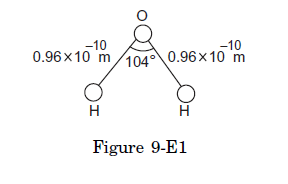
2. The structure of a water molecule is shown in figure (9-E1). Find the distance of the centre of mass of the molecule from the centre of the oxygen atom.
Solution:
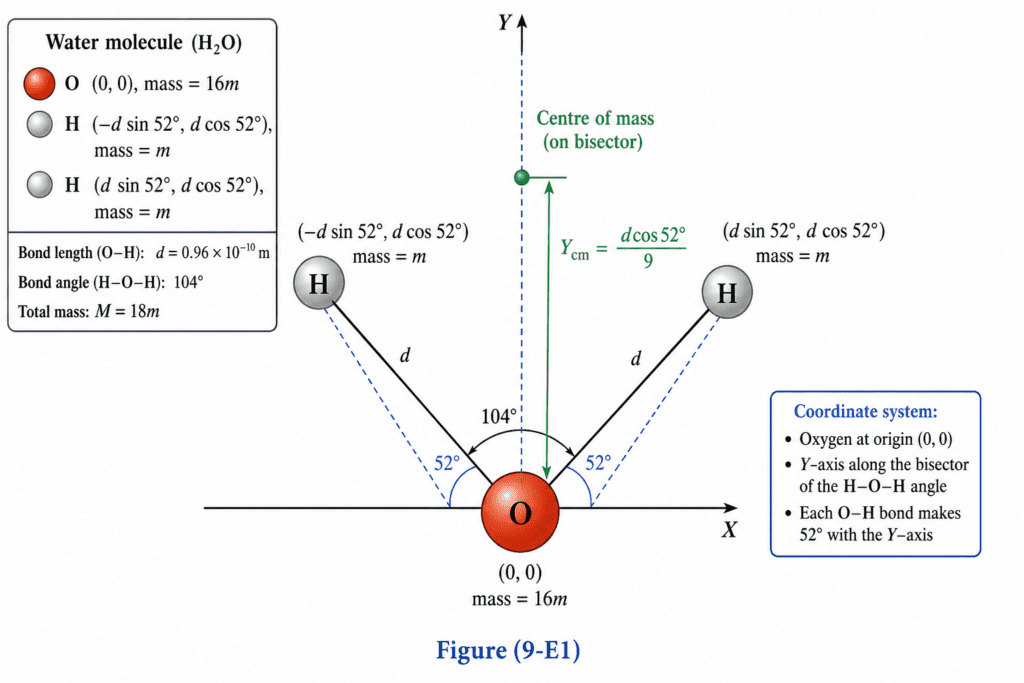
We use the standard geometry of a water molecule \((H_2O)\).
1. Given Data:
- Bond length \((O\!-\!H)\): \(d = 0.96 \times 10^{-10}\,\text{m}\)
- Bond angle: \(\theta = 104^\circ\)
- Mass of oxygen: \(m_O = 16m\)
- Mass of hydrogen: \(m_H = m\)
- Total mass:
\[
M = 16m + m + m = 18m
\]
2. Choice of Coordinate System:
- Place oxygen at origin: \((0,0)\)
- Take Y-axis along the bisector of the \(H\!-\!O\!-\!H\) angle
- Each bond makes an angle:
\[
\frac{104^\circ}{2} = 52^\circ
\]
with the Y-axis
3. Coordinates of Atoms:
- Oxygen: \((0,0)\)
- Hydrogen atoms:
\[
(-d\sin 52^\circ,\; d\cos 52^\circ), \quad (d\sin 52^\circ,\; d\cos 52^\circ)
\]
4. Centre of Mass:
\[
Y_{cm} = \frac{\sum m_i y_i}{M}
\]
\[
Y_{cm} = \frac{m\cdot d\cos 52^\circ + m\cdot d\cos 52^\circ}{18m}
\]
\[
Y_{cm} = \frac{2d\cos 52^\circ}{18} = \frac{d\cos 52^\circ}{9}
\]
5. Numerical Calculation:
\[
Y_{cm} = \frac{0.96 \times 10^{-10} \times 0.6157}{9}
\]
\[
Y_{cm} \approx 6.6 \times 10^{-12}\,\text{m}
\]
Final Answer:
Distance of centre of mass from oxygen atom:
\[
\boxed{6.6 \times 10^{-12}\,\text{m}}
\]
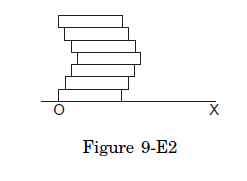
3. Seven homogeneous bricks, each of length \(L\), are arranged as shown in figure (9-E2). Each brick is displaced with respect to the one in contact by \( \frac{L}{10} \). Find the x-coordinate of the centre of mass relative to the origin shown.
Solution:
We treat each brick as a point mass located at its geometric centre.
1. Coordinate System and Mass:
- Origin is at the left edge of the bottom brick
- Each brick has length \(L\), so its centre is at a distance \( \frac{L}{2} \) from its left edge
- Let mass of each brick be \(m\)
- Total mass:
\[
M = 7m
\]
2. Positions of Centres of Bricks:
Left edges shift by \( \frac{L}{10} \) successively and then reverse:
- \(x_1 = \frac{L}{2}\)
- \(x_2 = \frac{L}{10} + \frac{L}{2} = 0.6L\)
- \(x_3 = \frac{2L}{10} + \frac{L}{2} = 0.7L\)
- \(x_4 = \frac{3L}{10} + \frac{L}{2} = 0.8L\)
- \(x_5 = \frac{2L}{10} + \frac{L}{2} = 0.7L\)
- \(x_6 = \frac{L}{10} + \frac{L}{2} = 0.6L\)
- \(x_7 = \frac{L}{2}\)
3. Centre of Mass Formula:
\[
X_{cm} = \frac{1}{M} \sum m_i x_i
\]
Since all masses are equal:
\[
X_{cm} = \frac{x_1 + x_2 + x_3 + x_4 + x_5 + x_6 + x_7}{7}
\]
\[
X_{cm} = \frac{0.5L + 0.6L + 0.7L + 0.8L + 0.7L + 0.6L + 0.5L}{7}
\]
\[
X_{cm} = \frac{4.4L}{7}
\]
4. Simplification:
\[
X_{cm} = \frac{44L}{70} = \frac{22L}{35}
\]
Final Answer:
\[
\boxed{X_{cm} = \frac{22L}{35}}
\]
4. A uniform disc of radius \(R\) is put over another uniform disc of radius \(2R\) of the same thickness and density. The peripheries of the two discs touch each other. Locate the centre of mass of the system.
Solution:
We treat each disc as a point mass located at its geometric centre.
1. Choice of Coordinate System:
- Take the centre of the larger disc as origin: \((0,0)\)
- Both discs have the same thickness and density, so mass is proportional to area \((\pi r^2)\)
2. Mass of the Discs:
\[
m_l \propto \pi (2R)^2 = 4\pi R^2, \quad m_s \propto \pi R^2
\]
Let mass of smaller disc be \(m\), then:
\[
m_s = m, \quad m_l = 4m
\]
3. Position of Centres:
- Centre of larger disc: \((0,0)\)
- Since the peripheries touch externally, distance between centres:
\[
2R – R = R
\] - Hence, centre of smaller disc is at:
\[
(R,0)
\]
4. Centre of Mass Formula:
\[
X_{cm} = \frac{\sum m_i x_i}{\sum m_i}
\]
\[
X_{cm} = \frac{(4m \cdot 0) + (m \cdot R)}{4m + m}
\]
\[
X_{cm} = \frac{mR}{5m} = \frac{R}{5}
\]
Final Answer:
The centre of mass lies at a distance
\[
\boxed{\frac{R}{5}}
\]
from the centre of the larger disc, towards the smaller disc.
5. A disc of radius \(R\) is cut out from a larger disc of radius \(2R\) in such a way that the edge of the hole touches the edge of the disc. Locate the centre of mass of the residual disc.
Solution:
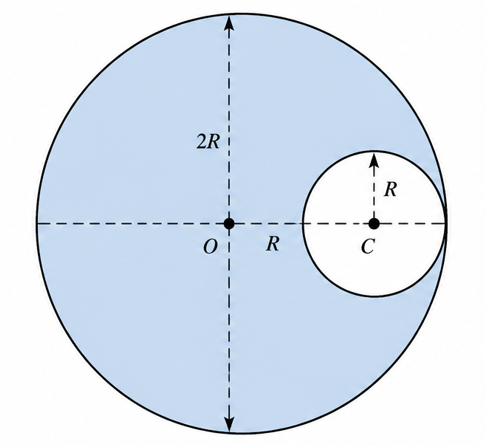
We use the negative mass method, treating the removed portion (hole) as a disc of negative mass.
1. Choice of Coordinate System:
- Take the centre of the original disc as origin: \((0,0)\)
- Assume the system lies along the X-axis for simplicity
2. Masses and Positions:
Let \(\sigma\) be the mass per unit area.
- Original disc:
- Radius = \(2R\)
- Mass:
\[
m_1 = \sigma \pi (2R)^2 = 4\sigma \pi R^2
\] - Position: \((0,0)\)
- Removed disc (hole):
- Radius = \(R\)
- Mass:
\[
m_2 = \sigma \pi R^2
\] - Since edges touch externally, distance between centres:
\[
2R – R = R
\] - Position: \((R,0)\)
3. Centre of Mass of Residual Disc:
\[
X_{cm} = \frac{m_1 x_1 – m_2 x_2}{m_1 – m_2}
\]
\[
X_{cm} = \frac{(4\sigma \pi R^2 \cdot 0) – (\sigma \pi R^2 \cdot R)}{4\sigma \pi R^2 – \sigma \pi R^2}
\]
\[
X_{cm} = \frac{-\sigma \pi R^3}{3\sigma \pi R^2} = -\frac{R}{3}
\]
4. Interpretation:
The negative sign indicates that the centre of mass lies on the side opposite to the hole.
Final Answer:
The centre of mass is located at a distance
\[
\boxed{\frac{R}{3}}
\]
from the centre of the original disc, away from the hole.
6. A square plate of edge \(d\) and a circular disc of diameter \(d\) are placed touching each other at the midpoint of an edge of the plate as shown in figure (9-Q2). Locate the centre of mass of the combination, assuming same mass per unit area for the two plates.
Solution:
We treat both the square plate and the circular disc as point masses located at their geometric centres.
1. Masses of the Plates:
Let \(\sigma\) be the mass per unit area.
- Circular disc:
- Radius \(r = \frac{d}{2}\)
- Area:
\[
A_1 = \pi \left(\frac{d}{2}\right)^2 = \frac{\pi d^2}{4}
\] - Mass:
\[
m_1 = \sigma A_1 = \frac{\sigma \pi d^2}{4}
\]
- Square plate:
- Area:
\[
A_2 = d^2
\] - Mass:
\[
m_2 = \sigma d^2
\]
- Area:
2. Coordinate System:
- Take the centre of the circular disc as origin: \((0,0)\)
- The disc and square touch at the midpoint of the square’s side
- Distance from disc centre to contact point = \(\frac{d}{2}\)
- Distance from contact point to square centre = \(\frac{d}{2}\)
- Hence, centre of square is at:
\[
(d, 0)
\]
3. Centre of Mass Formula:
\[
X_{cm} = \frac{m_1 x_1 + m_2 x_2}{m_1 + m_2}
\]
\[
M = m_1 + m_2 = \frac{\sigma \pi d^2}{4} + \sigma d^2 = \sigma d^2 \left(1 + \frac{\pi}{4}\right)
\]
\[
X_{cm} = \frac{\left(\frac{\sigma \pi d^2}{4} \cdot 0\right) + (\sigma d^2 \cdot d)}{\sigma d^2 \left(1 + \frac{\pi}{4}\right)}
\]
\[
X_{cm} = \frac{\sigma d^3}{\sigma d^2 \left(\frac{4 + \pi}{4}\right)} = \frac{d}{\frac{4 + \pi}{4}}
\]
\[
X_{cm} = \frac{4d}{4 + \pi}
\]
Final Answer:
The centre of mass is located at a distance
\[
\boxed{\frac{4d}{4 + \pi}}
\]
to the right of the centre of the circular disc.
7. Calculate the velocity of the centre of mass of the system of particles shown in figure (9-E3).
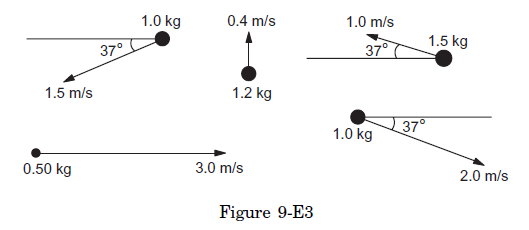
Solution:
To find the velocity of the centre of mass \(\vec{v}_{cm}\), we use:
\[
\vec{v}_{cm} = \frac{\sum m_i \vec{v}_i}{\sum m_i}
\]
Use approximations: \(\cos 37^\circ \approx 0.8\), \(\sin 37^\circ \approx 0.6\).
1. Velocity Components of Each Particle
| Mass (kg) | Velocity (m/s) | Angle | \(v_x\) | \(v_y\) |
|---|---|---|---|---|
| \(1.0\) | \(1.5\) | \(180^\circ + 37^\circ\) | \(-1.2\) | \(-0.9\) |
| \(1.2\) | \(0.4\) | \(90^\circ\) | \(0\) | \(0.4\) |
| \(1.5\) | \(1.0\) | \(180^\circ – 37^\circ\) | \(-0.8\) | \(0.6\) |
| \(0.5\) | \(3.0\) | \(0^\circ\) | \(3.0\) | \(0\) |
| \(1.0\) | \(2.0\) | \(360^\circ – 37^\circ\) | \(1.6\) | \(-1.2\) |
2. Centre of Mass Velocity
Total Mass:
\[
M = 1.0 + 1.2 + 1.5 + 0.5 + 1.0 = 5.2 \, \text{kg}
\]
X-component:
\[
v_{cm,x} = \frac{1.0(-1.2) + 1.2(0) + 1.5(-0.8) + 0.5(3.0) + 1.0(1.6)}{5.2}
\]
\[
v_{cm,x} = \frac{-1.2 + 0 – 1.2 + 1.5 + 1.6}{5.2}
= \frac{0.7}{5.2}
\approx 0.135 \, \text{m/s}
\]
Y-component:
\[
v_{cm,y} = \frac{1.0(-0.9) + 1.2(0.4) + 1.5(0.6) + 0.5(0) + 1.0(-1.2)}{5.2}
\]
\[
v_{cm,y} = \frac{-0.9 + 0.48 + 0.9 + 0 – 1.2}{5.2}
= \frac{-0.72}{5.2}
\approx -0.138 \, \text{m/s}
\]
Final Result
Velocity (vector form):
\[
\vec{v}_{cm} \approx (0.135\,\hat{i} – 0.138\,\hat{j}) \, \text{m/s}
\]
Magnitude:
\[
v_{cm} = \sqrt{(0.135)^2 + (-0.138)^2} \approx 0.193 \, \text{m/s}
\]
Direction:
Approximately \(45.6^\circ\) below the positive X-axis.
8. Two blocks of masses \(10\,\text{kg}\) and \(20\,\text{kg}\) are placed on the X-axis. The first mass is moved on the axis by a distance of \(2\,\text{cm}\). By what distance should the second mass be moved to keep the position of the centre of mass unchanged?
Solution:
To keep the centre of mass unchanged, the net shift must be zero.
1. Given Data:
- \(m_1 = 10\,\text{kg}\)
- \(m_2 = 20\,\text{kg}\)
- \(\Delta x_1 = 2\,\text{cm}\)
- \(\Delta x_2 = ?\)
2. Condition for No Shift in Centre of Mass:
\[
m_1 \Delta x_1 + m_2 \Delta x_2 = 0
\]
3. Substitute Values:
\[
10 \times 2 + 20 \times \Delta x_2 = 0
\]
\[
20 + 20\Delta x_2 = 0
\]
\[
20\Delta x_2 = -20
\]
\[
\Delta x_2 = -1\,\text{cm}
\]
4. Interpretation:
The negative sign indicates motion in the opposite direction.
Final Answer:
The second block should be moved by
\[
\boxed{1\,\text{cm}}
\]
in the opposite direction.
9. Two blocks of masses \(10\,\text{kg}\) and \(30\,\text{kg}\) are placed along a vertical line. The first block is raised through a height of \(7\,\text{cm}\). By what distance should the second mass be moved to raise the centre of mass by \(1\,\text{cm}\)?
Solution:
We use the relation between the displacement of individual masses and the displacement of the centre of mass.
1. Given Data:
- \(m_1 = 10\,\text{kg}\)
- \(m_2 = 30\,\text{kg}\)
- \(\Delta z_1 = +7\,\text{cm}\)
- \(\Delta Z_{cm} = +1\,\text{cm}\)
2. Formula:
\[
\Delta Z_{cm} = \frac{m_1 \Delta z_1 + m_2 \Delta z_2}{m_1 + m_2}
\]
3. Substitute Values:
\[
1 = \frac{10 \times 7 + 30 \times \Delta z_2}{40}
\]
4. Solve:
\[
40 = 70 + 30\Delta z_2
\]
\[
-30 = 30\Delta z_2
\]
\[
\Delta z_2 = -1\,\text{cm}
\]
5. Interpretation:
The negative sign shows that the second mass must move downward.
Final Answer:
The second block should be moved
\[
\boxed{1\,\text{cm downward}}
\]
10. Consider a gravity-free hall in which a tray of mass \(M\), carrying a cubical block of ice of mass \(m\) and edge \(L\), is at rest in the middle (figure 9-E4). If the ice melts, by what distance does the centre of mass of “the tray plus the ice” system descend?
Solution:
1. External Forces Analysis:
- The system is in a gravity-free environment, so no gravitational force acts on it.
- Melting of ice is an internal process within the system.
- No external force acts on the system.
2. Principle of Centre of Mass Motion:
\[
\vec{a}_{CM} = \frac{\vec{F}_{\text{ext}}}{M_{\text{total}}}
\]
Since \(\vec{F}_{\text{ext}} = 0\):
\[
\vec{a}_{CM} = 0
\]
This means:
- The centre of mass has no acceleration
- Since it was initially at rest, its velocity remains zero
- Therefore, its position remains unchanged
3. Conclusion:
Even though the ice changes shape during melting, this is an internal rearrangement of mass. Without external forces, the centre of mass of the system does not move.
Final Answer:
The centre of mass descends by
\[
\boxed{0}
\]
11. Find the centre of mass of a uniform plate having semicircular inner and outer boundaries of radii \(R_1\) and \(R_2\) (figure 9-E5).
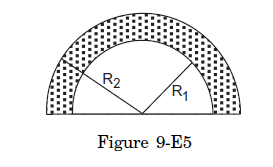
Solution: We treat the given plate as a large semicircle of radius \(R_2\) with a smaller semicircle of radius \(R_1\) removed from it.
1. Masses and Individual Centres:
Let \(\sigma\) be the mass per unit area.
- Large semicircle:
- Area:
\[
A_2 = \frac{1}{2}\pi R_2^2
\] - Mass:
\[
m_2 = \sigma \frac{\pi R_2^2}{2}
\] - Centre of mass:
\[
y_2 = \frac{4R_2}{3\pi}
\]
- Area:
- Removed semicircle:
- Area:
\[
A_1 = \frac{1}{2}\pi R_1^2
\] - Mass:
\[
m_1 = \sigma \frac{\pi R_1^2}{2}
\] - Centre of mass:
\[
y_1 = \frac{4R_1}{3\pi}
\]
- Area:
2. Centre of Mass of Residual Plate:
\[
Y_{cm} = \frac{m_2 y_2 – m_1 y_1}{m_2 – m_1}
\]
\[
Y_{cm} = \frac{\left(\sigma \frac{\pi R_2^2}{2} \cdot \frac{4R_2}{3\pi}\right) – \left(\sigma \frac{\pi R_1^2}{2} \cdot \frac{4R_1}{3\pi}\right)}{\sigma \frac{\pi}{2}(R_2^2 – R_1^2)}
\]
3. Simplification:
\[
Y_{cm} = \frac{\frac{4}{3\pi}(R_2^3 – R_1^3)}{R_2^2 – R_1^2}
\]
Using identities:
\[
R_2^3 – R_1^3 = (R_2 – R_1)(R_2^2 + R_1R_2 + R_1^2)
\]
\[
R_2^2 – R_1^2 = (R_2 – R_1)(R_2 + R_1)
\]
\[
Y_{cm} = \frac{4}{3\pi} \cdot \frac{R_2^2 + R_1R_2 + R_1^2}{R_2 + R_1}
\]
Final Answer:
The centre of mass is located at
\[
\boxed{\frac{4(R_1^2 + R_1R_2 + R_2^2)}{3\pi (R_1 + R_2)}}
\]
above the centre along the axis of symmetry.
12. Mr. Verma (50 kg) and Mr. Mathur (60 kg) are sitting at the two extremes of a 4 m long boat (40 kg) standing still in water. To discuss a mechanics problem, they come to the middle of the boat. Neglecting friction with water, how far does the boat move on the water during the process?
Solution:
1. Physical Principle:
- No external horizontal force acts on the system (friction neglected).
- Therefore, the centre of mass remains at the same position.
2. Initial Positions (take left end as \(x=0\)):
- Mr. Verma (50 kg): \(x = 0\)
- Mr. Mathur (60 kg): \(x = 4\,\text{m}\)
- Boat (40 kg): centre at \(x = 2\,\text{m}\)
3. Let the boat move by \(x\) to the right.
- Final position of both men (middle of boat): \(2 + x\)
- Final position of boat’s centre: \(2 + x\)
4. Displacements:
- \(\Delta x_V = 2 + x\)
- \(\Delta x_M = (2 + x) – 4 = x – 2\)
- \(\Delta x_b = x\)
5. Apply Centre of Mass Condition:
\[
50(2 + x) + 60(x – 2) + 40x = 0
\]
\[
100 + 50x + 60x – 120 + 40x = 0
\]
\[
150x – 20 = 0
\]
\[
x = \frac{20}{150} = \frac{2}{15}\,\text{m}
\]
6. Conversion:
\[
x = \frac{2}{15} \times 100 \approx 13.3\,\text{cm}
\]
Final Answer:
The boat moves by
\[
\boxed{\frac{2}{15}\,\text{m} \approx 13.3\,\text{cm}}
\]
13. A cart of mass \(M\) is at rest on a frictionless horizontal surface and a pendulum bob of mass \(m\) hangs from the roof of the cart (figure 9-E6). The string breaks, the bob falls on the floor, makes several collisions on the floor and finally lands up in a small slot made in the floor. The horizontal distance between the string and the slot is \(L\). Find the displacement of the cart during this process.
Solution:
1. External Forces:
- The surface is frictionless, so no external horizontal force acts.
- Hence, the centre of mass has no horizontal acceleration.
2. Principle Used:
Since the system is initially at rest and no external horizontal force acts,
the horizontal position of the centre of mass remains unchanged.
3. Displacements:
- Let displacement of the cart be \(x\).
- The bob moves a distance \(L\) relative to the cart.
- So, displacement of the bob relative to ground = \(x + L\).
4. Apply Centre of Mass Condition:
\[
Mx + m(x + L) = 0
\]
\[
Mx + mx + mL = 0
\]
\[
(M + m)x = -mL
\]
\[
x = -\frac{mL}{M + m}
\]
5. Interpretation:
The negative sign indicates that the cart moves in the opposite direction to the motion of the bob.
Final Answer:
The displacement of the cart is
\[
\boxed{\frac{mL}{M + m}}
\]
in the direction opposite to the bob’s motion.
14. The balloon, the light rope and the monkey shown in figure (9-E7) are at rest in the air. If the monkey reaches the top of the rope, by what distance does the balloon descend? Mass of the balloon = \(M\), mass of the monkey = \(m\) and the length of the rope ascended by the monkey = \(L\).
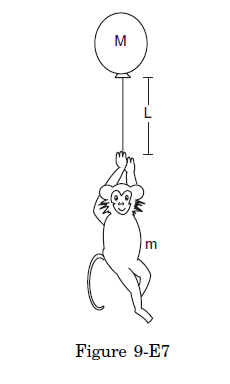
Solution:
1. Physical Principle:
- The system (balloon + monkey) is initially at rest.
- The buoyant force balances the total weight \((M + m)g\), so the net external force is zero.
- Hence, the centre of mass remains at the same position.
2. Displacements:
- Let the balloon descend by \(y\) (downward).
- The monkey climbs a distance \(L\) relative to the balloon.
- So, displacement of monkey relative to ground = \(L – y\) (upward).
3. Apply Centre of Mass Condition:
(Taking upward as positive)
\[
M(-y) + m(L – y) = 0
\]
\[
-My + mL – my = 0
\]
\[
mL = (M + m)y
\]
\[
y = \frac{mL}{M + m}
\]
Final Answer:
The balloon descends by
\[
\boxed{\frac{mL}{M + m}}
\]
15. Find the ratio of the linear momenta of two particles of masses \(1.0\,\text{kg}\) and \(4.0\,\text{kg}\) if their kinetic energies are equal.
Solution:
1. Relation Between Momentum and Kinetic Energy:
\[
p = \sqrt{2mK}
\]
2. Given:
- \(m_1 = 1.0\,\text{kg}\)
- \(m_2 = 4.0\,\text{kg}\)
- \(K_1 = K_2 = K\)
3. Ratio of Momenta:
\[
\frac{p_1}{p_2} = \frac{\sqrt{2m_1K}}{\sqrt{2m_2K}}
\]
\[
\frac{p_1}{p_2} = \sqrt{\frac{m_1}{m_2}}
\]
4. Substitution:
\[
\frac{p_1}{p_2} = \sqrt{\frac{1}{4}} = \frac{1}{2}
\]
Final Answer:
\[
\boxed{p_1 : p_2 = 1 : 2}
\]
16. A uranium-238 nucleus, initially at rest, emits an alpha particle with a speed of \(1.4 \times 10^7\) m/s. Calculate the recoil speed of the residual nucleus thorium-234. Assume that the mass of a nucleus is proportional to the mass number.
(a) \(2.4 \times 10^5\) m/s
(b) \(1.4 \times 10^7\) m/s
(c) \(5.6 \times 10^6\) m/s
(d) \(9.8 \times 10^4\) m/s
Answer: (a) \(2.4 \times 10^5\) m/s
Explanation:
According to the principle of conservation of linear momentum, total momentum before and after emission remains constant.
Initially, the uranium nucleus is at rest, so total momentum is zero:
\(0 = m_{\alpha} v_{\alpha} + m_{Th} v_{Th}\)
Taking magnitudes:
\(m_{Th} v_{Th} = m_{\alpha} v_{\alpha}\)
Given:
\(m_{\alpha} = 4,\; m_{Th} = 234\)
\(v_{\alpha} = 1.4 \times 10^7\) m/s
\[
v_{Th} = \frac{m_{\alpha} \cdot v_{\alpha}}{m_{Th}}
= \frac{4 \times 1.4 \times 10^7}{234}
\approx 2.4 \times 10^5 \text{ m/s}
\]
Therefore, the recoil speed of the thorium nucleus is \(2.4 \times 10^5\) m/s.
17. A man of mass 50 kg starts moving on the earth and acquires a speed of 1.8 m/s. With what speed does the earth recoil? (Mass of earth = \(6 \times 10^{24}\) kg)
(a) \(1.5 \times 10^{-23}\) m/s
(b) \(3.0 \times 10^{-22}\) m/s
(c) \(9.0 \times 10^{-24}\) m/s
(d) \(1.5 \times 10^{-21}\) m/s
Answer: (a) \(1.5 \times 10^{-23}\) m/s
Explanation:
Using the principle of conservation of linear momentum, total momentum of the system remains constant.
Initially, both man and earth are at rest:
Total initial momentum = 0
After motion:
\(0 = m_{man} v_{man} + M_{earth} v_{earth}\)
Taking magnitudes:
\(M_{earth} \cdot v_{earth} = m_{man} \cdot v_{man}\)
Substituting values:
\(m_{man} = 50\) kg, \(v_{man} = 1.8\) m/s, \(M_{earth} = 6 \times 10^{24}\) kg
\[
v_{earth} = \frac{50 \times 1.8}{6 \times 10^{24}}
= \frac{90}{6 \times 10^{24}}
= 1.5 \times 10^{-23} \text{ m/s}
\]
Therefore, the recoil speed of the earth is \(1.5 \times 10^{-23}\) m/s.
18. A neutron initially at rest decays into a proton, an electron and an antineutrino. The ejected electron has a momentum of \(1.4 \times 10^{-26}\) kg·m/s and the antineutrino \(6.4 \times 10^{-27}\) kg·m/s. Find the recoil speed of the proton (a) if the electron and the antineutrino are ejected along the same direction and (b) if they are ejected along perpendicular directions. (Mass of proton = \(1.67 \times 10^{-27}\) kg)
(a) 12.2 m/s, 9.2 m/s
(b) 9.2 m/s, 12.2 m/s
(c) 10.5 m/s, 8.0 m/s
(d) 8.0 m/s, 10.5 m/s
Answer: (a) 12.2 m/s, 9.2 m/s
Explanation:
By the principle of conservation of linear momentum, total initial momentum is zero. Hence,
\(\vec{P}_{proton} = -(\vec{P}_{electron} + \vec{P}_{antineutrino})\)
(a) Same direction:
Total momentum:
\[
P = (1.4 \times 10^{-26} + 6.4 \times 10^{-27})
= 2.04 \times 10^{-26} \text{ kg·m/s}
\]
\[
v = \frac{P}{m} = \frac{2.04 \times 10^{-26}}{1.67 \times 10^{-27}} \approx 12.2 \text{ m/s}
\]
(b) Perpendicular directions:
Resultant momentum:
\[
P = \sqrt{(1.4 \times 10^{-26})^2 + (6.4 \times 10^{-27})^2}
\approx 1.539 \times 10^{-26} \text{ kg·m/s}
\]
\[
v = \frac{1.539 \times 10^{-26}}{1.67 \times 10^{-27}} \approx 9.2 \text{ m/s}
\]
Therefore, recoil speeds are 12.2 m/s and 9.2 m/s.
19. A man of mass \(M\) having a bag of mass \(m\) slips from the roof of a tall building of height \(H\). When at a height \(h\) from the ground, he throws the bag horizontally in the direction opposite to a pond located at a horizontal distance \(x\). What is the minimum horizontal velocity imparted to the bag so that the man lands in the pond? If he just succeeds, where will the bag land?
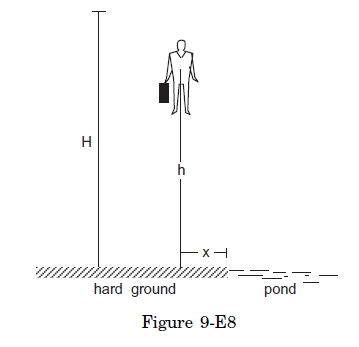
(a) \(u = \dfrac{Mx\sqrt{g}}{m(\sqrt{2H}-\sqrt{2(H-h)})}\), bag at \(\dfrac{Mx}{m}\) opposite side
(b) \(u = \dfrac{mx\sqrt{g}}{M(\sqrt{2H}-\sqrt{2(H-h)})}\), bag at \(\dfrac{mx}{M}\)
(c) \(u = \dfrac{Mx}{m}\), bag at \(x\)
(d) \(u = \dfrac{mx}{M}\), bag at \(\dfrac{Mx}{m}\)
Answer: (a)
Explanation:
1. Time remaining for fall:
Remaining time:
\[
t = \sqrt{\frac{2H}{g}} – \sqrt{\frac{2(H-h)}{g}}
= \frac{1}{\sqrt{g}} \left(\sqrt{2H} – \sqrt{2(H-h)}\right)
\]
2. Conservation of horizontal momentum:
Initially momentum is zero:
\(Mv = mu \Rightarrow v = \frac{mu}{M}\)
3. Condition to reach pond:
\[
x = v t = \frac{mu}{M} \cdot \frac{1}{\sqrt{g}}(\sqrt{2H} – \sqrt{2(H-h)})
\]
Solving for \(u\):
\[
u = \frac{Mx\sqrt{g}}{m(\sqrt{2H} – \sqrt{2(H-h)})}
\]
4. Position of the bag:
Center of mass remains fixed:
\(Mx = m x_b \Rightarrow x_b = \frac{Mx}{m}\)
Hence, the bag lands at a distance \(\frac{Mx}{m}\) opposite to the pond.
20. A ball of mass 50 g moving at a speed of 2.0 m/s strikes a plane surface at an angle of incidence 45°. The ball is reflected with the same speed and angle. Calculate (a) the magnitude of the change in momentum of the ball (b) the change in the magnitude of the momentum of the ball.
(a) 0.14 kg·m/s, 0
(b) 0.10 kg·m/s, 0.10 kg·m/s
(c) 0.20 kg·m/s, 0
(d) 0.14 kg·m/s, 0.10 kg·m/s
Answer: (a) 0.14 kg·m/s, 0
Explanation:
1. Given:
Mass \(m = 0.05\) kg, speed \(v = 2.0\) m/s, angle \(45^\circ\)
2. Momentum components:
Parallel component remains unchanged, perpendicular component reverses direction.
3. Change in momentum:
Only perpendicular component changes:
\[
|\Delta p| = 2mv\cos45^\circ
= 2 \times 0.05 \times 2 \times \frac{1}{\sqrt{2}}
\approx 0.14 \text{ kg·m/s}
\]
4. Change in magnitude of momentum:
Initial momentum = Final momentum = \(mv = 0.10\) kg·m/s
Hence, change = 0
Therefore, (a) 0.14 kg·m/s and (b) 0.
21. Light in certain cases may be considered as a stream of particles called photons. Each photon has a linear momentum h/λ where h is the Planck’s constant and λ is the wavelength of the light. A beam of light of wavelength λ is incident on a plane mirror at an angle of incidence θ. Calculate the change in the linear momentum of a photon as the beam is reflected by the mirror.
(a) \( \frac{h}{\lambda} \sin \theta \)
(b) \( \frac{2h}{\lambda} \sin \theta \)
(c) \( \frac{2h}{\lambda} \cos \theta \)
(d) \( \frac{h}{\lambda} \cos \theta \)
Answer: (c) \( \frac{2h}{\lambda} \cos \theta \)
Explanation:
1. Photon momentum:
\( p = \frac{h}{\lambda} \)
2. Components of momentum:
Parallel component remains unchanged, perpendicular component reverses direction.
3. Change in momentum:
Change occurs only in perpendicular direction:
\[
\Delta p = 2p \cos \theta = \frac{2h}{\lambda} \cos \theta
\]
Therefore, the change in linear momentum of the photon is \(\frac{2h}{\lambda} \cos \theta\).
22. A block at rest explodes into three equal parts. Two parts move along X and Y axes respectively with equal speeds of 10 m/s. Find the velocity of the third part.
(a) \(10\sqrt{2}\) m/s at 225° from +X-axis
(b) \(20\) m/s along negative X-axis
(c) \(10\) m/s along negative Y-axis
(d) \(5\sqrt{2}\) m/s at 135° from +X-axis
Answer: (a) \(10\sqrt{2}\) m/s at 225° from +X-axis
Explanation:
1. Conservation of momentum:
Initial momentum = 0 ⇒ vector sum of final momenta = 0
\[
\vec{v}_1 + \vec{v}_2 + \vec{v}_3 = 0
\Rightarrow \vec{v}_3 = -(\vec{v}_1 + \vec{v}_2)
\]
2. Given velocities:
\(\vec{v}_1 = 10\hat{i}, \quad \vec{v}_2 = 10\hat{j}\)
\[
\vec{v}_3 = -(10\hat{i} + 10\hat{j}) = -10\hat{i} -10\hat{j}
\]
3. Magnitude:
\[
v_3 = \sqrt{(-10)^2 + (-10)^2} = \sqrt{200} = 10\sqrt{2}\ \text{m/s}
\]
4. Direction:
Vector lies in third quadrant ⇒ angle = \(225^\circ\) from +X-axis.
Therefore, the velocity of the third part is \(10\sqrt{2}\) m/s at \(225^\circ\).
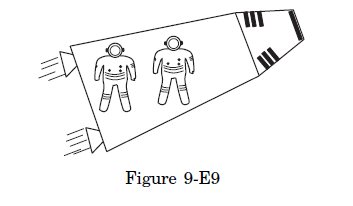
23. Two astronauts each of mass 120 kg are travelling in a closed spaceship moving at 15 km/s in outer space. The total mass of the spaceship and its contents is 660 kg. If each astronaut reduces their mass to 90 kg through exercise, what will be the velocity of the spaceship?
(a) 12 km/s
(b) 18 km/s
(c) 15 km/s
(d) 10 km/s
Answer: (c) 15 km/s
Explanation:
1. Conservation of momentum:
No external force acts on the system ⇒ total momentum remains constant.
2. Total mass consideration:
The spaceship is a closed system. Any mass lost by astronauts remains inside the spaceship.
Hence, total mass remains \(660\) kg.
3. Apply momentum conservation:
\[
M_i v_i = M_f v_f
\]
Since \(M_i = M_f\),
\[
v_f = v_i = 15 \text{ km/s}
\]
Therefore, the spaceship continues with the same velocity 15 km/s.
24. During a heavy rain, hailstones of average diameter 1.0 cm fall with a speed of 20 m/s. If 2000 hailstones strike every m² of a 10 m × 10 m roof per second and do not rebound, calculate the average force exerted on the roof. (Density = 900 kg/m³)
(a) 900 N
(b) 1900 N
(c) 3800 N
(d) 1500 N
Answer: (b) 1900 N
Explanation:
1. Mass of one hailstone:
Radius \(r = 0.005\) m
\[
V = \frac{4}{3}\pi r^3 \approx 5.236 \times 10^{-7} \text{ m}^3
\]
\[
m = \rho V = 900 \times 5.236 \times 10^{-7} \approx 4.712 \times 10^{-4} \text{ kg}
\]
2. Number of hailstones per second:
Area = \(100\) m²
Total number = \(2000 \times 100 = 2 \times 10^5\)
3. Change in momentum:
Each hailstone stops ⇒ \(\Delta v = 20\) m/s
\[
\Delta p = N m v = 2 \times 10^5 \times 4.712 \times 10^{-4} \times 20 \approx 1885 \text{ kg·m/s}
\]
4. Force:
\[
F = \frac{\Delta p}{\Delta t} = \frac{1885}{1} \approx 1900 \text{ N}
\]
Therefore, the average force is 1900 N.
25. A ball of mass \(m\) is dropped onto a floor from a certain height. The collision is perfectly elastic and the ball rebounds to the same height repeatedly. Find the average force exerted by the ball on the floor during a long time interval.
(a) \(mg\)
(b) \(2mg\)
(c) \(\frac{mg}{2}\)
(d) 0
Answer: (a) \(mg\)
Explanation:
1. Velocity at impact:
\[
v = \sqrt{2gh}
\]
2. Time period of one cycle:
\[
T = 2\sqrt{\frac{2h}{g}}
\]
3. Change in momentum per collision:
Velocity changes from \(-v\) to \(+v\):
\[
\Delta p = 2mv = 2m\sqrt{2gh}
\]
4. Average force:
\[
F_{avg} = \frac{\Delta p}{T}
= \frac{2m\sqrt{2gh}}{2\sqrt{2h/g}}
= m\sqrt{g^2} = mg
\]
Thus, over a long time interval, the average force exerted by the ball on the floor is \(mg\).
26. A railroad car of mass \(M\) is at rest on frictionless rails when a man of mass \(m\) starts moving on the car towards the engine. If the car recoils with speed \(v\) backward, with what velocity is the man approaching the engine?
(a) \(v\left(\frac{M}{m}\right)\)
(b) \(v\left(1 + \frac{M}{m}\right)\)
(c) \(v\left(1 – \frac{M}{m}\right)\)
(d) \(\frac{v}{2}\)
Answer: (b) \(v\left(1 + \frac{M}{m}\right)\)
Explanation:
1. Conservation of momentum:
Initially, total momentum = 0
\[
-Mv + mV_{mg} = 0
\Rightarrow V_{mg} = \frac{Mv}{m}
\]
2. Relative velocity:
Velocity of man relative to car:
\[
V_{mc} = V_{mg} – V_{cg}
= \frac{Mv}{m} – (-v)
= \frac{Mv}{m} + v
\]
\[
V_{mc} = v\left(1 + \frac{M}{m}\right)
\]
Therefore, the man approaches the engine with velocity \(v\left(1 + \frac{M}{m}\right)\).
27. A gun is mounted on a railroad car. The mass of the car, the gun, the shells and the operator is 50 m where m is the mass of one shell. If the velocity of the shell with respect to the gun (in its state before firing) is 200 m/s, what is the recoil speed of the car after the second shot ? Neglect friction.
(a) \(200\left(\frac{1}{49} + \frac{1}{48}\right)\) m/s
(b) \(200\left(\frac{1}{50} + \frac{1}{49}\right)\) m/s
(c) \(\frac{200}{49}\) m/s
(d) \(\frac{200}{48}\) m/s
Answer: (a) \(200\left(\frac{1}{49} + \frac{1}{48}\right)\) m/s
Explanation:
1. First shot:
Initial momentum = 0
\[
m(200) + 49mV_1 = 0
\Rightarrow V_1 = -\frac{200}{49}
\]
2. Second shot:
Velocity of shell w.r.t ground = \(200 + V_1\)
Applying conservation of momentum:
\[
49mV_1 = m(200 + V_1) + 48mV_2
\]
\[
49V_1 = 200 + V_1 + 48V_2
\Rightarrow 48V_1 – 200 = 48V_2
\Rightarrow V_2 = V_1 – \frac{200}{48}
\]
Substituting \(V_1\):
\[
V_2 = -\frac{200}{49} – \frac{200}{48}
= -200\left(\frac{1}{49} + \frac{1}{48}\right)
\]
Therefore, recoil speed (magnitude) is \(200\left(\frac{1}{49} + \frac{1}{48}\right)\) m/s.
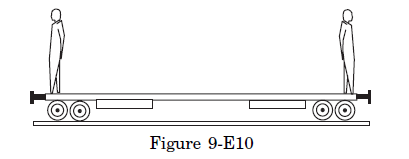
28. Two persons each of mass m are standing at the two extremes of a railroad car of mass M resting on a smooth track (figure 9-E10). The person on left jumps to the left with a horizontal speed u with respect to the state of the car before the jump. Thereafter, the other person jumps to the right, again with the same horizontal speed u with respect to the state of the car before his jump. Find the velocity of the car after both the persons have jumped off.
(a) \(\frac{m^2 u}{M(M+m)}\) to the right
(b) \(\frac{m^2 u}{M(M+m)}\) to the left
(c) \(\frac{mu}{M+m}\) to the right
(d) \(\frac{mu}{M}\) to the left
Answer: (b) \(\frac{m^2 u}{M(M+m)}\) to the left
Explanation:
1. First jump:
\[
0 = -mu + (M+m)v_1
\Rightarrow v_1 = \frac{mu}{M+m}
\]
2. Second jump:
Velocity of second person = \(v_1 + u\)
\[
(M+m)v_1 = m(v_1 + u) + Mv_2
\]
\[
Mv_1 = mu + Mv_2
\Rightarrow v_2 = v_1 – \frac{mu}{M}
\]
3. Substitute \(v_1\):
\[
v_2 = \frac{mu}{M+m} – \frac{mu}{M}
= mu\left(\frac{1}{M+m} – \frac{1}{M}\right)
\]
\[
v_2 = -\frac{m^2 u}{M(M+m)}
\]
Negative sign ⇒ motion towards left.
Hence, velocity = \(\frac{m^2 u}{M(M+m)}\) to the left.
29. Figure (9-E11) shows a small block of mass $m$ which is started with a speed $v$ on the horizontal part of the bigger block of mass $M$ placed on a horizontal floor. The curved part of the surface shown is semicircular. All the surfaces are frictionless. Find the speed of the bigger block when the smaller block reaches the point A of the surface.
(a) \(\frac{mv}{M}\)
(b) \(\frac{mv}{M+m}\)
(c) \(\frac{(M+m)v}{m}\)
(d) \(\frac{Mv}{M+m}\)
Answer: (b) \(\frac{mv}{M+m}\)
Explanation:
1. Conservation of horizontal momentum:
No external horizontal force ⇒ momentum conserved.
2. Initial momentum:
\[
P_i = mv
\]
3. At point A:
The small block is momentarily at rest relative to the big block ⇒ both move with same velocity \(V\).
4. Final momentum:
\[
P_f = (M+m)V
\]
5. Equating:
\[
mv = (M+m)V
\Rightarrow V = \frac{mv}{M+m}
\]
Therefore, the speed of the bigger block is \(\frac{mv}{M+m}\).
30. In a typical Indian Bugghi (a luxury cart drawn by horses), a wooden plate is fixed on the rear on which one person can sit. A bugghi of mass 200 kg is moving at a speed of 10 km/h. As it overtakes a school boy walking at a speed of 4 km/h, the boy sits on the wooden plate. If the mass of the boy is 25 kg, what will be the new velocity of the bugghi ?
(a) \( \frac{28}{3} \) km/h
(b) 12 km/h
(c) 8 km/h
(d) 10 km/h
Answer: (a) \( \frac{28}{3} \) km/h
Explanation:
1. Initial momentum:
\[
P_i = (200 \times 10) + (25 \times 4) = 2000 + 100 = 2100
\]
2. Final state:
Total mass = \(200 + 25 = 225\) kg
3. Conservation of momentum:
\[
2100 = 225 \cdot V
\Rightarrow V = \frac{2100}{225} = \frac{28}{3} \text{ km/h}
\]
Therefore, the new velocity is \(\frac{28}{3}\) km/h.