In measurement and instrumentation, instruments are broadly classified into absolute instruments and secondary instruments based on how they measure and display the value of a physical quantity.
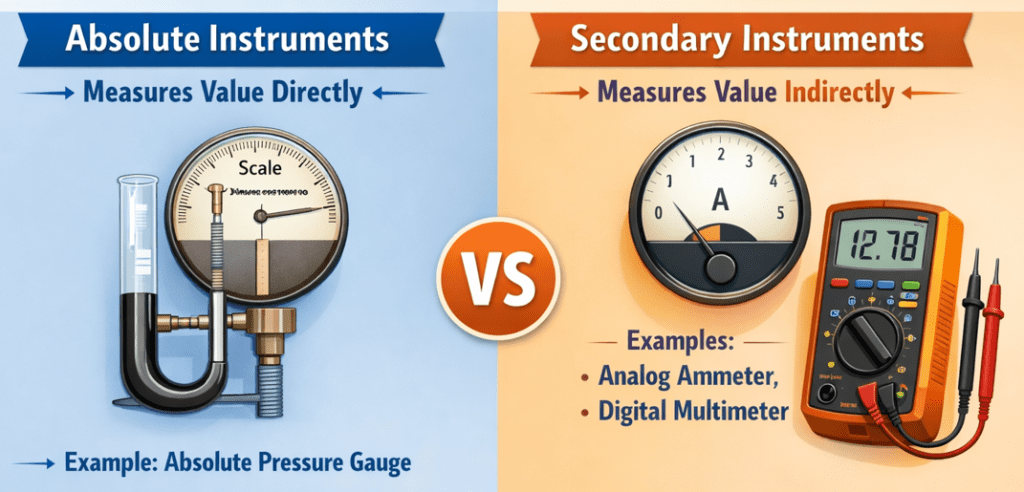
Table of Contents
Absolute Instruments
Definition
An absolute instrument is one that measures the value of a quantity in terms of physical constants and instrument dimensions, without requiring prior calibration. It gives the true value of the measured quantity directly from its defining equation.
Characteristics
- Does not require calibration
- Output is obtained using mathematical calculations
- Generally used as standard instruments
- Not suitable for routine measurements
Examples
- Tangent galvanometer
- Rayleigh current balance
Advantages
- Provides high accuracy
- Used for standardization and calibration
Disadvantages
- Complex construction
- Time-consuming calculations
- Not convenient for direct reading
Secondary Instruments
A secondary instrument is one that gives the value of the measured quantity directly, but it must be calibrated against an absolute instrument or standard.
Characteristics
- Requires calibration
- Provides direct reading
- Widely used in practical applications
Examples
- Ammeter
- Voltmeter
- Wattmeter
Advantages
- Simple to use
- Provide quick readings
- Suitable for continuous monitoring
Disadvantages
- Require periodic calibration
- Accuracy depends on calibration quality
Comparison Between Absolute and Secondary Instruments
| Feature | Absolute Instruments | Secondary Instruments |
|---|---|---|
| Calibration | Not required | Required |
| Output | Calculated | Direct reading |
| Use | Standard/reference | Practical measurement |
| Accuracy | Very high | Moderate to high |
| Complexity | High | Low |