In electrical engineering, circuit elements are primarily classified into Active and Passive elements based on their ability to deliver, control, or absorb energy within a network.
Table of Contents
Active Elements
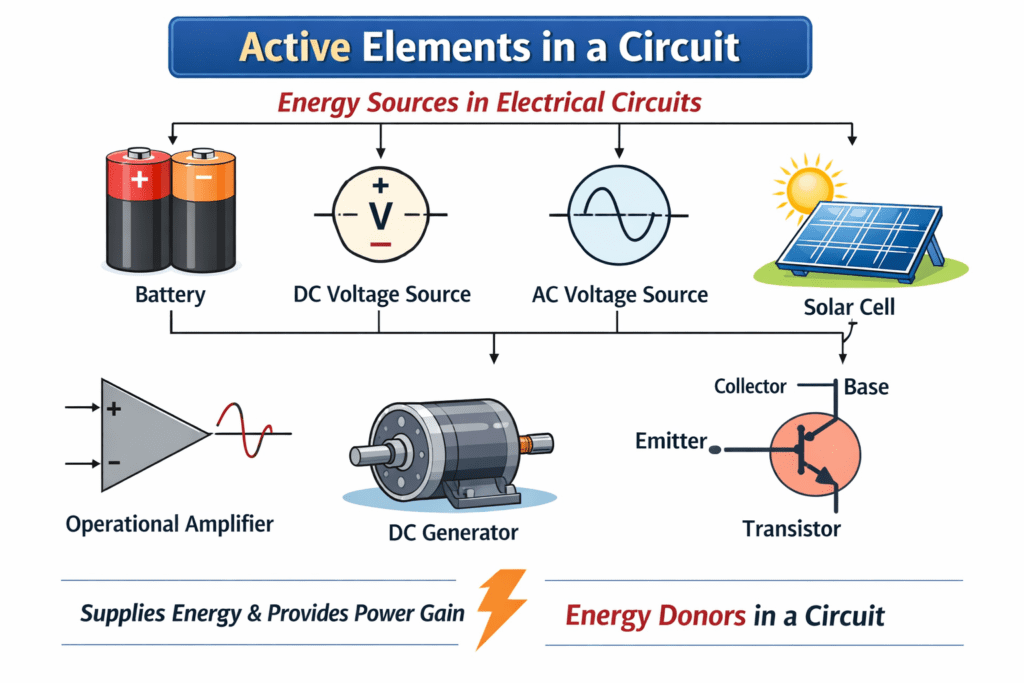
Active elements are known as the “energy sources” or “energy donors” of a circuit. These elements are capable of supplying energy or providing power gain (amplification) over a period of time.
Key Characteristics
- Energy Supply: Can deliver energy to the circuit
- Power Gain: Capable of amplification (gain (> 1))
- Control Action: Control the flow of current or voltage
- External Requirement: Usually require an external power source (biasing)
Examples
- Voltage and Current Sources: Batteries, generators (supply continuous energy)
- Transistors: BJT, MOSFET (used in switching and amplification)
- Operational Amplifiers (Op-Amps): Used in signal processing and amplification
- Diodes: Control current flow in a nonlinear manner
Passive Elements
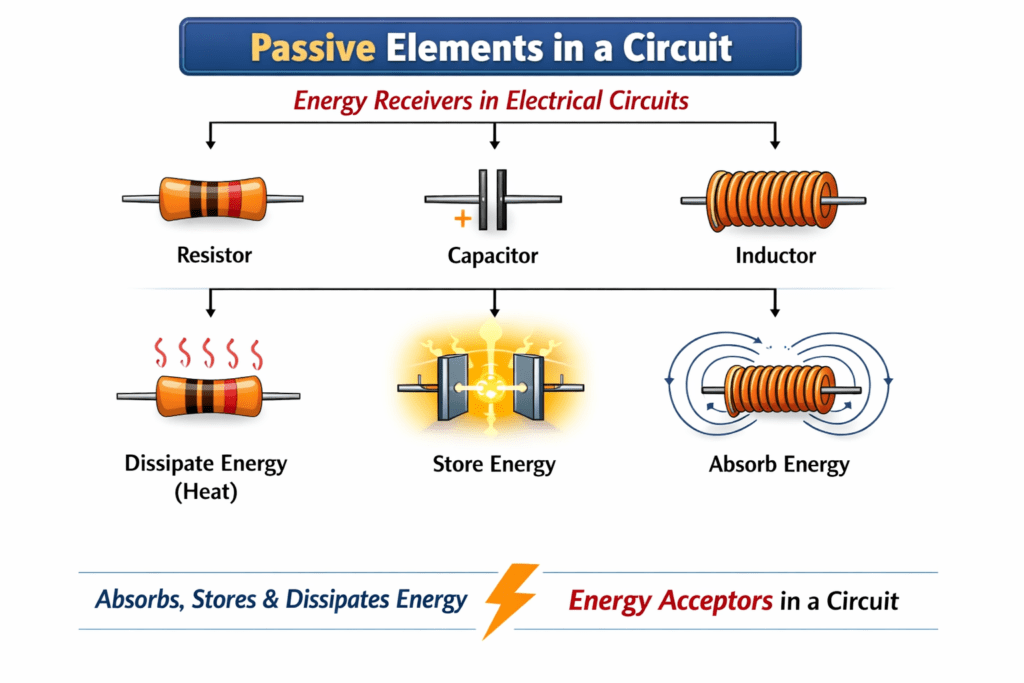
Passive elements are called “energy receivers” or “energy acceptors.” They cannot generate energy; instead, they absorb, store, or dissipate the energy supplied by active elements.
Key Characteristics
- Energy Behavior: Absorb or store energy
- No Power Gain: Gain is always less than unity ((< 1))
- No External Source: Do not require an external power supply
- Circuit Role: Shape circuit response (filtering, timing, etc.)
Examples
- Resistors (R): Dissipate energy as heat and limit current
- Capacitors (C): Store energy in an electric field; block DC and pass AC
- Inductors (L): Store energy in a magnetic field; oppose change in current
- Transformers: Transfer energy between circuits without generating it
Comparison
| Property | Active Elements | Passive Elements |
|---|---|---|
| Energy Role | Supply energy | Absorb/store energy |
| Power Gain | Gain (> 1) possible | Gain (< 1) only |
| Function | Control and amplify signals | Store or dissipate energy |
| External Power | Required (usually) | Not required |
| V–I Characteristics | May have negative slope | Always positive slope |