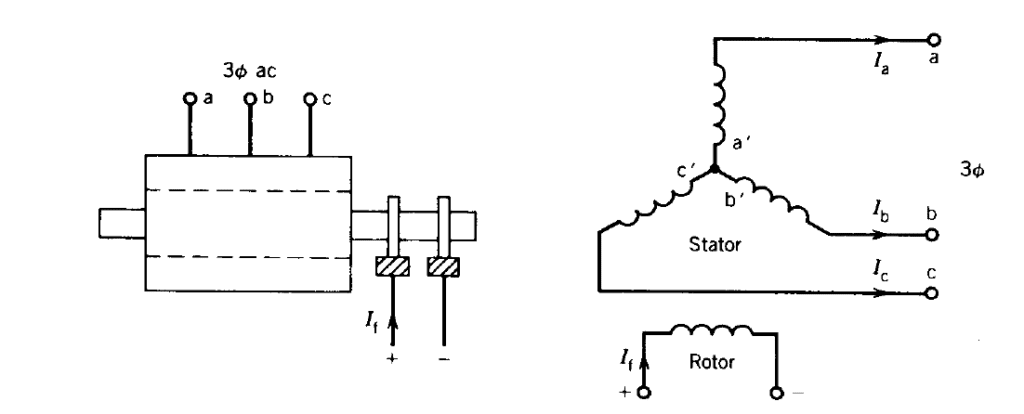
An Automatic Voltage Regulator (AVR) is a crucial control device used in alternators (synchronous generators) to maintain a constant terminal voltage by automatically controlling the field excitation current. It ensures stable operation of power systems under varying load conditions.
Mechanism of Voltage Control
The Automatic Voltage Regulator (AVR) controls the terminal voltage of an alternator by continuously adjusting the field excitation current based on system requirements. This is achieved through a closed-loop feedback control mechanism.
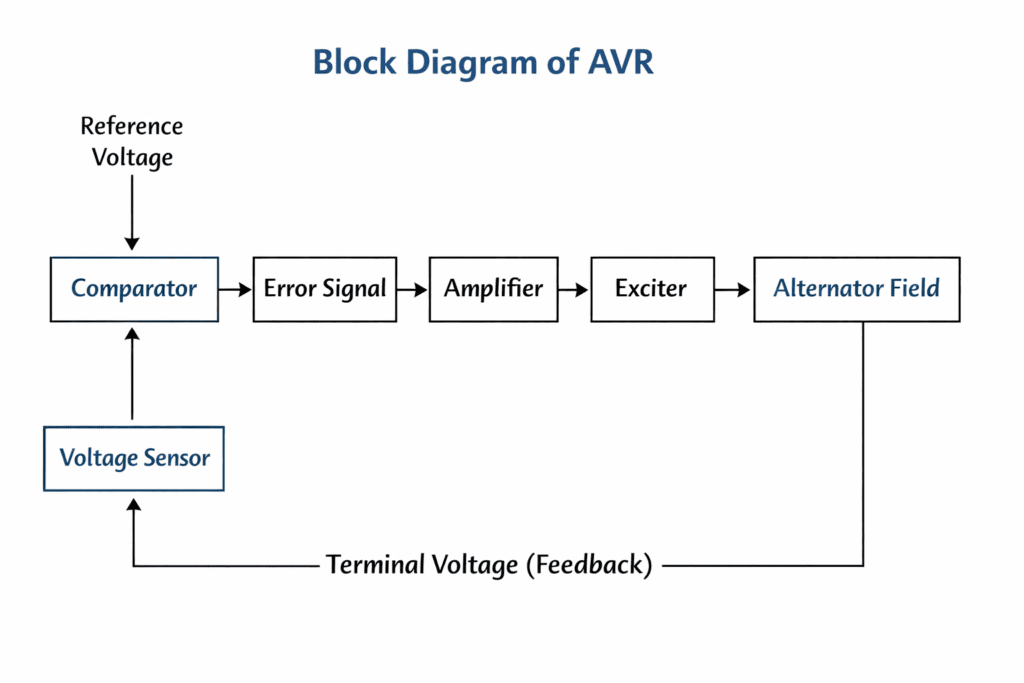
Step-by-step operation:
- Voltage Sensing
The terminal voltage of the alternator is measured using a Potential Transformer (PT). - Comparison
The sensed voltage is compared with a reference (set) voltage. - Error Signal Generation
The difference between actual and reference voltage produces an error signal. - Amplification
The error signal is amplified using electronic circuits. - Excitation Control
The amplified signal controls the field excitation current.
Alternator Stator and Rotor - Correction
- If voltage ↓ → Field current ↑ → Voltage restored
- If voltage ↑ → Field current ↓ → Voltage normalized