A capacitor is a fundamental passive electrical component that stores electrical energy in an electric field. It consists of two conducting surfaces (plates) separated by an insulating material called a dielectric. When a potential difference is applied across the plates, electric charges accumulate on them, creating an electric field in the dielectric medium.
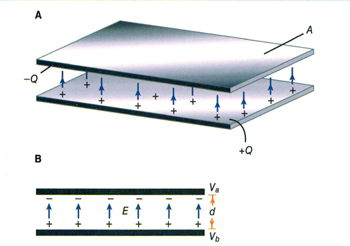
Table of Contents
Basic Principles and Capacitance
The capacitance of a capacitor is defined as the ratio of the magnitude of charge Q on either conductor to the potential difference V between them:
C = Q/V
The SI unit of capacitance is the farad (F), where 1 farad = 1 coulomb/volt. In practice, capacitors typically have values in microfarads (μF), nanofarads (nF), or picofarads (pF).
For a parallel plate capacitor with plate area A, separation d, and dielectric constant ε, the capacitance is given by:
C = ε₀εᵣA/d
where ε₀ is the permittivity of free space (8.85 × 10⁻¹² F/m) and εᵣ is the relative permittivity of the dielectric material.
Energy Stored in a Capacitor
When a capacitor is charged, energy is stored in the electric field between its plates. The energy U stored in a capacitor is:
U = ½CV² = ½Q²/C = ½QV
This energy is stored in the electric field, and the energy density (energy per unit volume) in the field is:
u = ½ε₀εᵣE²
where E is the electric field strength.
Types of Capacitors
Based on Construction
Parallel Plate Capacitors are the simplest form, consisting of two parallel conducting plates separated by a dielectric. They are commonly used in theoretical analysis and some practical applications.
Cylindrical Capacitors consist of two coaxial cylinders with a dielectric between them. Coaxial cables utilize this geometry. The capacitance per unit length is:
C/L = 2πε₀εᵣ/ln(b/a)
where a and b are the inner and outer radii respectively.
Spherical Capacitors comprise two concentric spherical shells. The capacitance is:
C = 4πε₀εᵣab/(b-a)
where a and b are the inner and outer radii.
Based on Dielectric Material
Air Capacitors use air as the dielectric and are primarily used in radio frequency applications where variable capacitance is needed.
Paper Capacitors employ paper impregnated with oil or wax as the dielectric. They were historically common but have largely been replaced by more modern types.
Ceramic Capacitors use ceramic materials as dielectrics and are widely used due to their small size, low cost, and reliability. They come in various classes with different temperature coefficients and capacitance stabilities.
Electrolytic Capacitors achieve high capacitance values in small volumes by using a very thin oxide layer as the dielectric. They are polarized and must be connected with correct polarity. Aluminum and tantalum electrolytic capacitors are common types.
Film Capacitors use plastic films such as polyester, polypropylene, or polycarbonate as dielectrics. They offer excellent stability and low losses.
Mica Capacitors employ mica as the dielectric and provide high stability and precision, making them suitable for high-frequency applications.
Capacitors in Series and Parallel
Series Connection
When capacitors are connected in series, the reciprocal of the total capacitance equals the sum of the reciprocals of individual capacitances:
1/Cₜₒₜₐₗ = 1/C₁ + 1/C₂ + 1/C₃ + …
In series, all capacitors carry the same charge, but the voltage divides among them inversely proportional to their capacitances.
Parallel Connection
When capacitors are connected in parallel, the total capacitance is the sum of individual capacitances:
Cₜₒₜₐₗ = C₁ + C₂ + C₃ + …
In parallel, all capacitors have the same voltage across them, but the charge divides among them proportional to their capacitances.
Dielectric Materials and Their Properties
A dielectric is an insulating material placed between the capacitor plates. When a dielectric is introduced, it becomes polarized in the electric field. The polarization reduces the effective electric field inside the dielectric, thereby increasing the capacitance.
The relative permittivity or dielectric constant εᵣ characterizes how much the capacitance increases compared to vacuum. Common dielectric materials include air (εᵣ ≈ 1), paper (εᵣ ≈ 3-4), glass (εᵣ ≈ 5-10), mica (εᵣ ≈ 5-7), and various ceramics (εᵣ can range from 10 to several thousand).
Dielectric Strength
Dielectric strength is the maximum electric field that a dielectric material can withstand without breaking down. When the applied voltage creates a field exceeding this value, the dielectric fails, often catastrophically, allowing current to flow through it. This phenomenon is called dielectric breakdown.
Polarization Mechanisms
Dielectric polarization occurs through several mechanisms including electronic polarization (displacement of electron clouds), ionic polarization (displacement of ions in ionic crystals), orientation polarization (alignment of permanent dipoles), and space charge polarization (migration of charge carriers over microscopic distances).
Charging and Discharging of Capacitors
Charging through a Resistor
When a capacitor C is charged through a resistor R from a voltage source V₀, the charge on the capacitor as a function of time is:
Q(t) = CV₀(1 – e⁻ᵗ/ᴿᶜ)
The voltage across the capacitor is:
V(t) = V₀(1 – e⁻ᵗ/ᴿᶜ)
The current flowing into the capacitor is:
I(t) = (V₀/R)e⁻ᵗ/ᴿᶜ
The time constant τ = RC characterizes the charging rate. After one time constant, the capacitor charges to approximately 63.2% of the final voltage.
Discharging through a Resistor
When a charged capacitor discharges through a resistor, the voltage decreases exponentially:
V(t) = V₀e⁻ᵗ/ᴿᶜ
The current during discharge is:
I(t) = -(V₀/R)e⁻ᵗ/ᴿᶜ
After one time constant, the voltage drops to approximately 36.8% of the initial value.
Capacitive Reactance and AC Circuits
When a capacitor is connected to an alternating voltage source V = V₀sin(ωt), it continuously charges and discharges. The current through the capacitor leads the voltage by 90 degrees:
I = I₀sin(ωt + π/2)
The capacitive reactance Xc represents the opposition to AC current flow:
Xc = 1/(ωC) = 1/(2πfC)
where ω is the angular frequency and f is the frequency. Unlike resistance, capacitive reactance decreases with increasing frequency. At very high frequencies, a capacitor acts almost like a short circuit, while at DC (f = 0), it acts as an open circuit.
Applications of Capacitors
Energy Storage
Capacitors store electrical energy for various applications. While they cannot store as much energy as batteries per unit volume, they can deliver it much more rapidly. Supercapacitors or ultracapacitors bridge the gap between conventional capacitors and batteries, offering high energy density and rapid charge-discharge capabilities.
Power Factor Correction
In AC power systems, inductive loads create a lagging power factor, meaning current lags voltage. Capacitors can be added to compensate for this, improving the power factor and reducing losses in power distribution systems. This is economically important for industrial installations.
Filtering and Smoothing
In power supply circuits, capacitors smooth the output of rectifiers by storing charge when the voltage is high and releasing it when the voltage drops. In electronic filters, capacitors work with resistors and inductors to pass or block specific frequency ranges. Low-pass filters use capacitors to bypass high-frequency signals to ground, while high-pass filters use capacitors to block DC and low-frequency components.
Coupling and Decoupling
Coupling capacitors allow AC signals to pass between circuit stages while blocking DC components. This is essential in amplifier circuits. Decoupling or bypass capacitors are placed close to integrated circuits to provide a local reservoir of charge, smoothing out voltage fluctuations and reducing noise on power supply lines.
Timing Circuits
The predictable charging and discharging characteristics of capacitors make them ideal for timing applications. RC circuits are used in oscillators, timers, and pulse generators. The 555 timer IC, one of the most popular integrated circuits, uses capacitors to generate precise timing intervals.
Motor Starting
Large AC motors require capacitors to create the phase shift needed for starting. Start capacitors provide high torque during motor startup, while run capacitors improve efficiency during normal operation.
Signal Processing
In communication systems, capacitors are used in tuned circuits, impedance matching networks, and frequency-selective filters. Variable capacitors in LC circuits allow for tuning radio receivers to different frequencies.
Advanced Concepts
Displacement Current
Maxwell introduced the concept of displacement current to complete his equations of electromagnetism. In a charging capacitor, no actual current flows between the plates, but the changing electric field creates a displacement current:
Iₐ = ε₀(dΦₑ/dt)
where Φₑ is the electric flux. This concept is crucial for understanding electromagnetic wave propagation.
Stray Capacitance
Any two conductors separated by an insulator form a capacitor, even if not designed to do so. This stray or parasitic capacitance can affect circuit behavior, especially at high frequencies. Circuit designers must account for stray capacitance in precision and high-frequency applications.
Frequency Dependence of Capacitance
Real capacitors deviate from ideal behavior, particularly at high frequencies. The effective capacitance may decrease, and losses increase due to dielectric absorption, lead inductance, and skin effects. The equivalent series resistance (ESR) and equivalent series inductance (ESL) characterize these non-ideal behaviors.
Nonlinear Capacitors and Varactors
In some materials, the dielectric constant depends on the applied electric field, creating voltage-dependent capacitance. Varactor diodes exploit this effect for electronic tuning in radio receivers and voltage-controlled oscillators.
Capacitor Standards and Ratings
Capacitors are characterized by several key parameters beyond capacitance. The voltage rating specifies the maximum DC or AC voltage that can be safely applied. Exceeding this rating risks dielectric breakdown. The temperature coefficient indicates how capacitance changes with temperature. Tolerance specifies the permitted variation from the nominal capacitance value. For AC applications, the frequency rating and dissipation factor (loss tangent) are important.
Safety Considerations
Capacitors, particularly high-voltage and large-value ones, can store dangerous amounts of energy. Even after disconnection from power, they can retain charge for extended periods. Proper discharge procedures using appropriate resistive loads are essential before handling. Electrolytic capacitors can fail explosively if connected with reversed polarity or operated beyond their voltage rating.
Conclusion
Capacitors are indispensable components in electrical engineering, serving diverse functions from energy storage to signal processing. Understanding their fundamental principles, including capacitance, energy storage, charging-discharging behavior, and AC characteristics, is essential for electrical engineers. The variety of capacitor types, each with specific advantages, allows engineers to select appropriate components for particular applications. From power systems to microelectronics, capacitors continue to play crucial roles in modern electrical and electronic technology. Mastery of capacitor theory and application is fundamental to the study of electrical engineering and forms a significant portion of advanced physics curricula including competitive examinations.