Q.1. The shopkeeper sells lemons. In this sentence, the word “lemons” is the:
(a) object
(b) subject
(c) predicate
(d) verb
Ans. (a) Object
Explanation: A sentence mainly consists of three parts: subject, verb, and object. The subject is the doer of the action, which is “The shopkeeper.” The verb shows the action being performed, which is “sells.” The object is the person or thing that receives the action of the verb. Since “lemons” are being sold, they receive the action of the verb. Therefore, “lemons” is the object of the sentence.
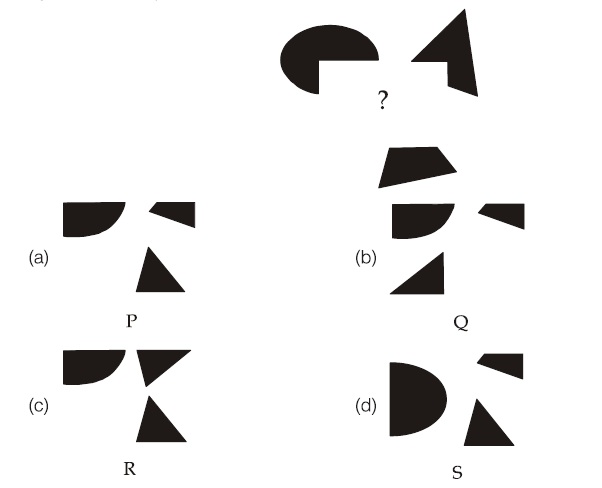
Q.2. The figure below is supposed to show three non-overlapping shapes—one oval and two triangles. Which one of the following figures P, Q, R, or S fits the missing portion indicated by ‘?’ and completes the oval and the two triangles?
(a) P
(b) Q
(c) R
(d) S
Ans. (a) P
Explanation:
To solve this figure completion problem, we carefully observe the shapes that must be completed:
- The Oval: The given figure already shows part of an oval, but the right curved portion is missing. Therefore, the required piece must contain a smooth curved edge that completes the oval.
- The Two Triangles: Parts of two triangles are visible in the figure. The missing piece must include straight diagonal edges that connect correctly to form two distinct triangles without overlapping.
- Why Option P is Correct: Figure P has the correct combination of one curved edge (to complete the oval) and straight edges (to complete both triangles). Its shape aligns perfectly with the existing outlines and completes all three shapes neatly.
Hence, option (a) P is the correct answer.
Q.3. At how many points will the curves \( y = x^2 \) and \( y = -x^2 – 2x – 5 \) intersect in the real \( (x, y) \) plane?
(a) 0
(b) 1
(c) 2
(d) 3
Ans. (a) 0
Explanation:
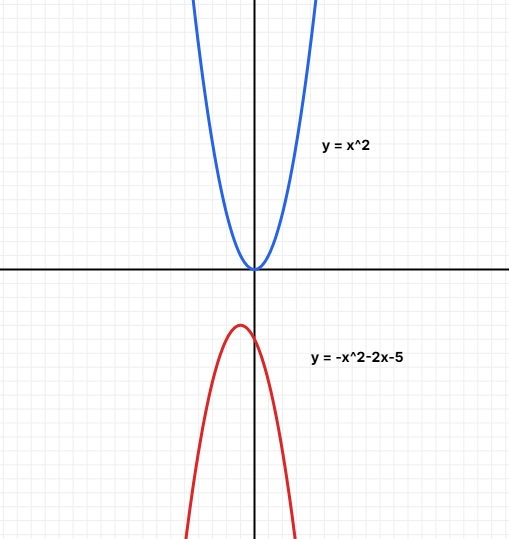
Two curves intersect at points where the same value of \(x\) gives the same value of \(y\).
First curve:
For \( y = x^2 \), the value of \(y\) is always greater than or equal to zero for all real values of \(x\).
Hence, this curve lies on or above the \(x\)-axis.
Second curve:
\[
y = -x^2 – 2x – 5 = -\left[(x+1)^2 + 4\right]
\]
Since \( (x+1)^2 \ge 0 \), the expression inside the bracket is always at least \(4\).
Therefore, \( y \le -4 \) for all real values of \(x\), and this curve lies entirely below the \(x\)-axis.
Because one curve is always non-negative and the other is always negative, they never intersect. Hence, the number of points of intersection is 0.
Q.4. If Anish had scored a hundred runs in today’s match, he would have been made the captain of his team. He would have then become the youngest captain in the history of his team. Unfortunately, he got out without scoring any runs. Hence, there will be no change in the captaincy for now.
Based on the paragraph above, which one of the following statements is true?
(a) Anish made a hundred runs but was denied captaincy.
(b) Anish was the captain of his team before today’s match.
(c) The current captain is older than Anish.
(d) Anish is the youngest player in his team.
Ans. (c)
Explanation: The passage states that if Anish had scored a hundred runs, he would have become the youngest captain in the team’s history. Since he failed to score the runs, there was no change in captaincy. This means the present captain continues in the role. Because Anish would have been the youngest captain, it logically follows that the current captain must be older than Anish.
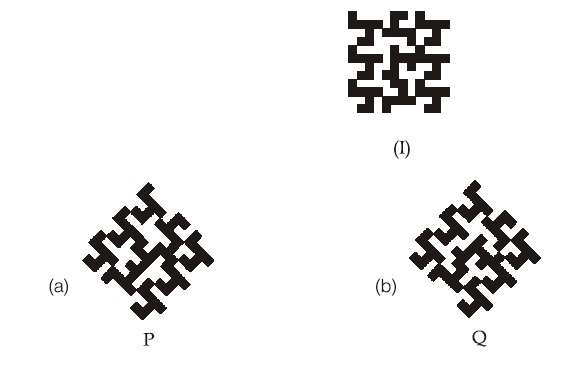
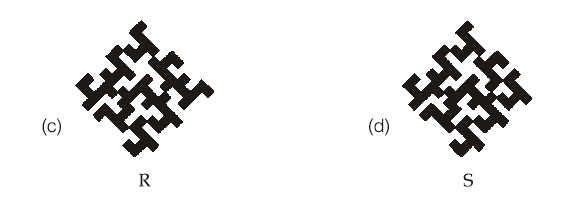
Q.5. Which one of the following figures P, Q, R, or S, correctly shows the \(45^\circ\) clockwise-rotated version of figure (I)?
(a) P
(b) Q
(c) R
(d) S
Ans. (b) Q
Explanation:
To answer this question, we must visualize the rotation of figure (I) by \(45^\circ\) in the clockwise direction.
- Clockwise rotation: The figure is turned to the right, similar to rotating a clock hand.
- The \(45^\circ\) angle: A \(90^\circ\) rotation would change horizontal lines into vertical ones. Since \(45^\circ\) is exactly half of \(90^\circ\), all horizontal and vertical lines in the original figure become diagonal.
- Comparison of options: On carefully comparing the arrangement of black blocks after rotation, only figure Q preserves the original pattern while correctly aligning it at a \(45^\circ\) clockwise tilt.
Q.6. Match the words in Column I with their synonyms in Column II.
| Column I | Column II |
|---|---|
| (i) Lonely | (p) Verbatim |
| (ii) Literal | (q) Solitary |
| (iii) Lousy | (r) Deadly |
| (iv) Lethal | (s) Terrible |
Options:
- (a) (i)-(q); (ii)-(p); (iii)-(s); (iv)-(r)
- (b) (i)-(q); (ii)-(s); (iii)-(r); (iv)-(p)
- (c) (i)-(s); (ii)-(p); (iii)-(q); (iv)-(r)
- (d) (i)-(r); (ii)-(s); (iii)-(p); (iv)-(q)
Answer: (a)
Explanation:
- Lonely → Solitary: Both describe being alone.
- Literal → Verbatim: Both imply exact wording or meaning.
- Lousy → Terrible: Both indicate very poor quality.
- Lethal → Deadly: Both mean capable of causing death.
Hence, the correct matching is (i)-(q), (ii)-(p), (iii)-(s), (iv)-(r), which corresponds to option (a).
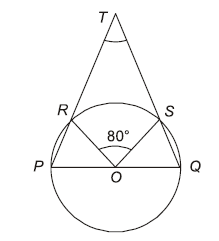
Q.7. In the given figure, \( \overline{PQ} \) is the diameter of a circle with center \( O \). Two points \( R \) and \( S \) are chosen on the circle such that \( \angle ROS = 80^\circ \). When \( \overline{PR} \) and \( \overline{QS} \) are extended, they meet at \( T \). The value of \( \angle RTS \) is __________.
(a) \(40^\circ\)
(b) \(50^\circ\)
(c) \(60^\circ\)
(d) \(80^\circ\)
Ans. (b) \(50^\circ\)
Explanation:
- Step 1: Analyze the Central Triangle
In $\triangle ROS$, $OR = OS$ (radii of the same circle). Therefore, $\triangle ROS$ is an isosceles triangle. Since $\angle ROS = 80^\circ$, the base angles are:$\angle ORS = \angle OSR = \frac{180^\circ – 80^\circ}{2} = 50^\circ$
- Step 2: Use the Straight Line Property
Since $PQ$ is a diameter, $POQ$ is a straight line, meaning the sum of angles around point $O$ on one side is $180^\circ$:$\angle POR + \angle ROS + \angle SOQ = 180^\circ$
Substituting the known value:
$\angle POR + 80^\circ + \angle SOQ = 180^\circ \implies \angle POR + \angle SOQ = 100^\circ$
- Step 3: Relate to the Large Triangle $\triangle PTQ$
In $\triangle OPR$ and $\triangle OQS$, we again have isosceles triangles ($OP=OR$ and $OQ=OS$). The base angles (which are also the interior angles of our target triangle $\triangle PTQ$) are:$\angle RPQ = \frac{180^\circ – \angle POR}{2}$ and $\angle SQP = \frac{180^\circ – \angle SOQ}{2}$
Adding these two base angles together:
$\angle RPQ + \angle SQP = \frac{360^\circ – (\angle POR + \angle SOQ)}{2}$
Substituting the result from Step 2:
$\angle RPQ + \angle SQP = \frac{360^\circ – 100^\circ}{2} = \frac{260^\circ}{2} = 130^\circ$
- Step 4: Solve for $\angle RTS$
In the large triangle $\triangle PTQ$, the sum of all interior angles is $180^\circ$:$\angle RTS + \angle RPQ + \angle SQP = 180^\circ$
$\angle RTS + 130^\circ = 180^\circ$
$\mathbf{\angle RTS = 50^\circ}$
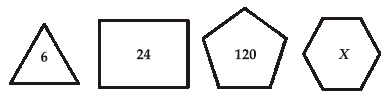
Q.8. Based on the relationship between each polygon and the number inside it, the value of is _______.
(a) 720
(b) 596
(c) 24
(d) 240
Ans. (a) 720
Explanation:
To determine the value of X, observe the pattern between the number of sides of each polygon and the number written inside it. The number inside each polygon is the factorial of the number of its sides, denoted by \( n! \).
- Triangle (3 sides):
\( 3! = 3 \times 2 \times 1 = 6 \) - Square (4 sides):
\( 4! = 4 \times 3 \times 2 \times 1 = 24 \) - Pentagon (5 sides):
\( 5! = 5 \times 4 \times 3 \times 2 \times 1 = 120 \) - Hexagon (6 sides):
Following the same pattern,\( X = 6! = 6 \times 5 \times 4 \times 3 \times 2 \times 1 = 720 \)
Therefore, the value of X is
\(720\), which corresponds to option (a).
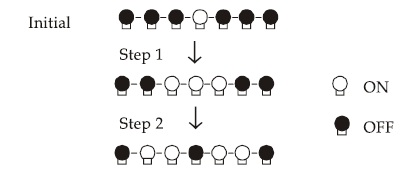
Q.9. Consider a linear arrangement of seven bulbs, each of which can be in the ON or OFF state. The initial configuration of the bulbs is shown in the figure. In every step, the states of the bulbs are changed based on the following rules:
- Any OFF bulb with exactly one ON neighbor at the end of the previous step is turned ON.
- Any ON bulb with both neighbors ON at the end of the previous step is turned OFF.
- The state of any bulb not meeting the above conditions remains unchanged.
The states of the bulbs at the end of Step 1 and Step 2 are also shown in the figure. The number of bulbs that are ON at the end of Step 8 is _______.
(a) \(5\)
(b) \(4\)
(c) \(3\)
(d) \(0\)
Ans. (b) \(4\)
Explanation:
Let an ON bulb be represented by \(1\) and an OFF bulb by \(0\). We apply the given rules step by step.
- Initial state:
\(0\ 0\ 0\ 1\ 0\ 0\ 0\)
(Only the 4th bulb is ON) - Step 1:
The 3rd and 5th bulbs turn ON.Result: \(0\ 0\ 1\ 1\ 1\ 0\ 0\) (3 bulbs ON) - Step 2:
The 2nd and 6th bulbs turn ON, while the 4th bulb turns OFF.Result: \(0\ 1\ 1\ 0\ 1\ 1\ 0\) (4 bulbs ON) - Step 3:
The end bulbs turn ON.Result: \(1\ 1\ 1\ 0\ 1\ 1\ 1\) (6 bulbs ON) - Step 4:
The 2nd and 6th bulbs turn OFF.Result: \(1\ 0\ 1\ 0\ 1\ 0\ 1\) (4 bulbs ON) - Steps 5 to 8:
In this configuration, no bulb satisfies the conditions for change.
Hence, the pattern becomes stable and remains unchanged.
Therefore, at the end of Step 8, the number of bulbs that are ON is \(4\).
Q.10. \(P\) and \(Q\) are two positive integers such that \( P^2 = Q^2 + 13 \). The product of the numbers \(P\) and \(Q\) is _________.
(a) \(13\)
(b) \(26\)
(c) \(39\)
(d) \(42\)
Ans. (d) \(42\)
Explanation:
Starting from the given relation,
\( P^2 = Q^2 + 13 \).
- Rearranging the equation:
\( P^2 – Q^2 = 13 \) - Using the identity:
\( a^2 – b^2 = (a-b)(a+b) \)
Hence,
\( (P – Q)(P + Q) = 13 \) - Factor analysis:
Since \(13\) is a prime number and \(P, Q\) are positive integers,
the only possible factor pair is:\( P – Q = 1 \) and \( P + Q = 13 \) - Solving the equations:
Adding the two equations:
\( (P – Q) + (P + Q) = 1 + 13 \)
\( 2P = 14 \Rightarrow P = 7 \)
Substituting back:
\( Q = 6 \) - Final product:
\( P \times Q = 7 \times 6 = 42 \)
Therefore, the product of \(P\) and \(Q\) is \(42\).
Q.11. Consider the infinite-length, discrete-time sequence \( x[n] = 0.9^{|n|} \), where \( n \) is an integer. The region of convergence (ROC) of its Z-transform \( X(z) \) is given by:
(Note: \( z \) is a complex variable)
(a) \( |z| > 0.9 \)
(b) \( |z| < 0.9 \)
(c) \( 0.9 < |z| < \dfrac{1}{0.9} \)
(d) \( \{z : |z| < 0.9\} \cup \{z : |z| > \dfrac{1}{0.9}\} \)
Ans. (c)
Explanation:
To determine the Region of Convergence (ROC), we split the sequence
\( x[n] = 0.9^{|n|} \) into two parts based on the value of \( n \).
- Right-sided part (\( n \ge 0 \)):
Here, \( x[n] = (0.9)^n u(n) \).
This is a right-sided sequence, whose Z-transform converges for
\( |z| > 0.9 \). - Left-sided part (\( n < 0 \)):
Here, \( x[n] = (0.9)^{-n} = \left(\dfrac{1}{0.9}\right)^n u(-n-1) \).
This is a left-sided sequence, whose Z-transform converges for
\( |z| < \dfrac{1}{0.9} \). - Overall ROC:
The ROC of the complete sequence is the intersection of the two regions.
Hence, it is the annular region between the two circles.
Therefore, the ROC is
\( 0.9 < |z| < \dfrac{1}{0.9} \).
11. Consider the infinite-length, discrete-time sequence $x [n] = 0.9^{|n|}$, where $n$ is an integer. The region of convergence of its Z-transform $X (z)$ is given by: (Note: $z$ is a complex variable)
(a) $|z| > 0.9$
(b) $|z| < 0.9$
(c) $0.9 < |z| < \frac{1}{0.9}$
(d) ${z \text{ such that } |z| < 0.9} \cup {z \text{ such that } |z| > \frac{1}{0.9}}$
Answer: (c)
Explanation: The sequence is two-sided, so the ROC is the intersection of causal and anti-causal parts, giving $0.9 < |z| < \frac{1}{0.9}$.
12. Let $x_c(t)$ be any continuous-time periodic signal with period $T$. It is sampled uniformly with a sampling period $T_s$ where $T_s \neq T$, resulting in the discrete sequence $x[n] = x_c(n T_s)$, where $n$ is an integer. Which one of the following statements is correct about $x[n]$?
(a) $x[n]$ will always be periodic with period $\frac{T}{T_s}$ for all values of $\frac{T}{T_s}$
(b) $x[n]$ will always be periodic with period $1$ for all values of $\frac{T}{T_s}$
(c) $x[n]$ will always be periodic
(d) $x[n]$ will be periodic if and only if $\frac{T}{T_s}$ is a rational number
Answer: (d)
Explanation: A discrete-time signal is periodic only if $\frac{T}{T_s}$ is rational, ensuring repetition of samples.
13. The Laplace transform of the step response of a system is given by $Y(s) = \frac{100}{s(s + 100)}$. The rise time is defined as the time taken for the response to go from 0.1 to 0.9 of its final value. The settling time is defined as the time taken for the response to reach 0.98 of its final value. For this system, the rise time ($T_r$), settling time ($T_s$), and time constant ($T_c$), all expressed in seconds, are
(a) $T_r = 0.022, T_s = 0.04, T_c = 0.01$
(b) $T_r = 0.22, T_s = 0.404, T_c = 0.01$
(c) $T_r = 2.2, T_s = 4.04, T_c = 1.01$
(d) $T_r = 22, T_s = 40.4, T_c = 10.1$
Answer: (a)
Explanation: Time constant = 0.01 s, rise time ≈ 0.022 s, and settling time ≈ 0.04 s using standard first-order system relations.
14. Consider the following differential equation: $t^2 \frac{d^2y}{dt^2} + 7t \frac{dy}{dt} + 8ty = 10 \sin(t)$. Which one of the following options is correct?
(a) It is a linear differential equation
(b) It is a nonlinear differential equation
(c) It is a time-invariant differential equation
(d) It is a second-order partial differential equation
Answer: (a)
Explanation: The equation is linear since $y$ and its derivatives appear linearly, though it is time-varying due to coefficients depending on $t$.
15. A uniform ring charge of radius $R$ carries a total charge $Q$. Which one of the following options correctly quantifies the magnitude of the force on a point charge of strength $q$ kept at the center of the ring? ($\epsilon$ is the permittivity of the medium)
(a) $\frac{Qq}{4\pi\epsilon R}$
(b) $\frac{Qq}{4\pi\epsilon R^2}$
(c) $0$
(d) $\frac{q}{4\pi\epsilon R} \times \frac{Q}{2\pi R}$
Answer: (c)
Explanation: Due to symmetry, electric fields cancel, so net force at the center is zero.
16. A positive point charge with velocity $\vec{v} = 5\hat{x}$ enters a region having electric field $\vec{E} = 4\hat{y}$ and magnetic field $\vec{B} = -6\hat{z}$. Which one of the following statements is correct for the force on the charge as it enters the region?
(a) The force will be along the magnetic field but perpendicular to the electric field
(b) The force will be along the electric field but perpendicular to the magnetic field
(c) The force will be perpendicular to both electric and magnetic field
(d) The magnetic field does not exert any force on the charge
Answer: (b)
Explanation: Using Lorentz force, $\vec{F} = q(\vec{E} + \vec{v} \times \vec{B})$, resulting force is along $\hat{y}$, i.e., along electric field and perpendicular to magnetic field.
17. A 15 kVA, 1100 V/220 V, single-phase two-winding transformer is configured as a 1.32 kV/1.1 kV autotransformer. What will be the rating of the autotransformer?
(a) 60 kVA
(b) 75 kVA
(c) 90 kVA
(d) 100 kVA
Answer: (c)
Explanation: In an autotransformer, power transfer increases, giving new rating = 90 kVA.
18. Consider a power system with $N$ buses, of which $P$ are generator buses and the remaining $Q$ are load buses (where there is no generation). Assume that there are no reactive power-limit violations at the generator buses. What is the size of the Jacobian matrix in the Newton-Raphson load flow method?
(a) $2N \times 2N$
(b) $(2N – 1 – P) \times (2N – 1 – P)$
(c) $(2N – Q) \times (2N – Q)$
(d) $(P + Q) \times (P + Q)$
Answer: (b)
Explanation: The Jacobian size depends on unknown variables, giving $(2N – 1 – P) \times (2N – 1 – P)$.
19. The initial three-phase voltage phasors ($\vec{V}_A, \vec{V}_B, \text{ and } \vec{V}_C$) at a bus of a power network are as shown in Case-1. Due to a disturbance, the bus voltage phasors changed in phase by a small angle $\Delta\theta$, and the magnitudes remained the same as depicted in Case-2. Which one of the following statements is correct about the zero sequence components?
(a) The zero sequence components in Case-1 and Case-2 have the same phase angle and magnitude
(b) The magnitude of the zero sequence component in Case-1 is greater than that in Case-2
(c) The magnitude of the zero sequence component in Case-2 is greater than that in Case-1
(d) The zero sequence components in Case-1 and Case-2 have the same magnitude but different phase angles.
Answer: (d)
Explanation: Magnitude remains same, but phase shifts by $\Delta\theta$, so phase angles differ.
20. A certain application requires power at a frequency of 16.67 Hz, while the available grid frequency is 50 Hz. A 3-phase synchronous motor connected to the 50 Hz, 3-phase grid, driving a synchronous generator, is used for this application. Which one of the following combinations is a suitable choice for the number of poles in the motor and generator, respectively?
(a) 2, 6
(b) 6, 2
(c) 4, 6
(d) 6, 4
Answer: (b)
Explanation: Using synchronous speed equality, pole ratio must be 3:1, giving motor = 6 poles, generator = 2 poles.
21. Which one of the following options is correct regarding the typical double-squirrel-cage structure used in induction motors?
(a) At starting, a larger portion of the rotor current flows in the outer cage
(b) At starting, a larger portion of the rotor current flows in the inner cage
(c) At rated speed, most of the rotor current flows in the outer cage
(d) The purpose of the double-squirrel-cage structure is to lower the effective rotor resistance at starting
Answer: (a)
Explanation: At starting, rotor frequency is high, causing high reactance in inner cage, so current flows mainly in outer cage, giving high starting torque.
22. The figure shows the single-line diagram of a synchronous generator delivering P = 50 MW of power at unity power factor to an infinite bus. $I_s$ denotes the stator current phasor. If the field excitation is increased, which one of the following options correctly describes its effect on the stator current, power factor, and load angle of the machine?
(a) Stator current increases, power factor becomes lagging, load angle remains the same
(b) Stator current decreases, power factor becomes leading, load angle remains the same
(c) Stator current increases, power factor becomes lagging, load angle decreases
(d) Stator current increases, power factor becomes leading, load angle increases
Answer: (c)
Explanation: Increasing excitation makes the generator over-excited, causing lagging power factor, increase in stator current, and decrease in load angle.
23. A circuit with ideal elements is shown. Which one of the following options correctly identifies all the linear elements in the circuit?
(a) R only
(b) R, L, and C only
(c) D only
(d) L, C and D only
Answer: (b)
Explanation: R, L, and C are linear elements with linear V-I relationships, while diode is nonlinear.
24. For the circuit shown, which one of the following options correctly identifies the Thevenin’s equivalent parameters between nodes Y and Z?
(a) $V_{TH} = 100 \text{ V}, R_{TH} = 10 \text{ k}\Omega$
(b) $V_{TH} = 140 \text{ V}, R_{TH} = 0 \text{ k}\Omega$
(c) $V_{TH} = 100 \text{ V}, R_{TH} = 0 \text{ k}\Omega$
(d) $V_{TH} = 140 \text{ V}, R_{TH} = 10 \text{ k}\Omega$
Answer: (b)
Explanation: Open-circuit voltage = 140 V and due to ideal sources, Thevenin resistance is zero.
25. Refer to the four circuits shown. Which one of the following options for $k_1, k_2, k_3, \text{ and } k_4$ makes all of them realizable?
(a) $k_1 = 1, k_4 = -\frac{1}{3}$ for all values of $k_2$ and $k_3$
(b) $k_2 = -2, k_3 = +\frac{1}{3}$ for all values of $k_1$ and $k_4$
(c) $k_1 = 2, k_2 = 0.5, k_3 = -\frac{2}{3}, k_4 = -3$
(d) $k_1 = 2, k_2 = -0.5, k_3 = -\frac{2}{3}, k_4 = +3$
Answer: (a)
Explanation: Applying KVL and KCL, conditions give $k_1 = 1$ and $k_4 = -1/3$, with no restriction on $k_2, k_3$.
26. A single-phase voltage source $v_s = 325 \sin(2\pi 50t) \text{ V}$ delivers a current, $i = 12 \sin(2\pi 50t) + 9 \sin(2\pi 150t) \text{ A}$ to a load. The load power factor, correct up to two decimal places, is
(a) 1.00
(b) 0.80
(c) 0.65
(d) 0.57
Answer: (b)
Explanation: Only fundamental component contributes to real power, while RMS current includes harmonics, giving power factor = 0.80.
27. The figure shows a straight-line approximation for the forward characteristics of a power diode. A continuous on-state current of 15 A is flowing through the diode. What is the power loss in the diode?
(a) 32.8 W
(b) 21.2 W
(c) 18.6 W
(d) 23.1 W
Answer: (c)
Explanation: Using voltage drop ≈ 1.24 V, power loss = VI = 18.6 W.
28. Consider the circuit shown in Figure (a). A gate pulse $v_g$ is applied between time instants $t_0$ and $t_1$. After $t_1$, during the MOSFET turn OFF process, it experiences a voltage overshoot. Based on the $v_{ds}$ waveforms shown in Figure (b), which one of the following options is correct?
(a) $R_1 > R_2 > R_3$
(b) $R_1 > R_3 > R_2$
(c) $R_3 > R_2 > R_1$
(d) $R_2 > R_3 > R_1$
Answer: (b)
Explanation: Higher resistance → better damping → less overshoot, hence order is $R_1 > R_3 > R_2$.
29. The asymptotic Bode magnitude plot of a system is shown. Which one of the following options best represents the transfer function of the system?
(a) $G(s) = 1 + \frac{s}{\omega_0}$
(b) $G(s) = \frac{\frac{s}{\omega_0}}{1 + \frac{s}{\omega_0}}$
(c) $G(s) = \frac{1 + \frac{s}{\omega_0}}{1 – \frac{s}{\omega_0}}$
(d) $G(s) = \frac{1 – \frac{s}{\omega_0}}{1 + \frac{s}{\omega_0}}$
Answer: (a)
Explanation: Slope changes from 0 to +20 dB/decade, indicating a single zero, hence $G(s) = 1 + \frac{s}{\omega_0}$.
30. Two $n \times n$ matrices A and B have a common eigenvalue $\lambda$ and the same corresponding nonzero eigenvector. Which of the following options is/are correct?
(a) Determinant $(A – \lambda I) = 0$
(b) Determinant $(B – \lambda I) = 0$
(c) Determinant $(A + B – 2I) = 0$
(d) Determinant $(A + B – 4I) = 0$
Answer: (a), (b), (d)
Explanation: For eigenvalue $\lambda$, determinants become zero, and combining gives $(A + B – 4I)$ having zero eigenvalue, hence determinant is zero.
31. A 220V/12V single-phase transformer is designed for use in India and rated 100 VA at 50 Hz. Later, this unit is shipped to the USA where it is used as a 110V/6V transformer at 60 Hz. Which of the following statements is/are correct?
(a) No-load current drawn would be smaller for operation in the USA compared to that in India
(b) For the same load current, the losses would be higher in the USA compared to that in India
(c) The peak magnetic flux density in the core would be higher while operating in the USA compared to that in India
(d) The eddy current losses in the core would be approximately 44% higher while operating in the USA compared to that in India
Answer: (a)
Explanation: The ratio V/f decreases in the USA, so the peak magnetic flux density decreases. This leads to reduced magnetizing current, hence no-load current is smaller.
32. Given that $\vec{F}(x,y,z) = \sin(y)\hat{x} + \cos(x)\hat{y} + 5\hat{z}$, the integral $\iint_S \vec{F}(x,y,z) \cdot d\vec{s}$ over the unit sphere S centered at the origin evaluates to
(a) 0
(b) 1
(c) $\pi$
(d) $4\pi$
Answer: (a)
Explanation: Using Divergence Theorem, the divergence is zero, hence the surface integral is zero.
33. In the linear regulator circuit shown, the base to emitter voltage $V_{BE}$ of the BJT is 0.6 V. The Zener diode clamps the base voltage to 5.4 V. Ignore the biasing current of the Zener diode and BJT. The maximum possible efficiency of the regulator circuit is
(a) 47.5%
(b) 48.0%
(c) 54.0%
(d) 60.0%
Answer: (a)
Explanation: Output voltage = 4.8 V, output power = 480 mW, input power ≈ 1009.2 mW, hence efficiency ≈ 47.5%.
34. Consider the circuit shown. Assume that the diode D is ideal. The supply voltage $v_s = 325 \sin(2\pi 50t) \text{ V}$, $L = 500 \mu\text{H}$, and $R = 10 \Omega$. The peak diode current (in amperes) is
(a) 23.15 A
(b) 32.50 A
(c) 45.96 A
(d) 50.00 A
Answer: (b)
Explanation: Since inductive reactance is negligible, current is limited by resistance, so peak current = 325/10 = 32.5 A.
35. A is an $m \times m$ skew-symmetric matrix with real-valued entries, and $x$ is an $m$-dimensional column vector with real-valued entries such that $x^T x = 1$. The quantity $x^T Ax$ evaluates to
(a) 0
(b) 1
(c) -1
(d) $m$
Answer: (a)
Explanation: For a skew-symmetric matrix, $x^T A x = -x^T A x$, hence it must be zero.
36. A time-limited waveform $g(x)$ is specified… The sum of the coefficients of the third harmonics of the sine and cosine terms in the trigonometric Fourier series expansion of $f(x)$ is $\frac{2}{3\pi}$. What is the value of $k$?
(a) 1
(b) 1/2
(c) 1/3
(d) 1/4
Answer: (b)
Explanation: Since the function is odd, only sine terms exist, and solving gives $k = 1/2$.
37. In the circuit shown, the open loop gain of the operational amplifier is $A_0 = 10^5$. What is the voltage gain of the circuit?
(a) -16.66
(b) -20.00
(c) 16.66
(d) 20.00
Answer: (a)
Explanation: Considering finite open-loop gain, the closed-loop gain reduces to approximately -16.66.
38. Three single-phase 11kV/3.3kV transformers are connected to form a three-phase transformer bank with connections as shown. Considering ABC phase sequence, the vector group of the transformer is:
(a) Dd0
(b) Dd4
(c) Dd6
(d) Dd10
Answer: (d)
Explanation: The phase displacement corresponds to clock position 10, hence vector group is Dd10.
39. In the circuit shown, given CT ratios and auxiliary transformer ratios, the value of $I_{AR}$ rounded off to three decimal places is
(a) 0 A
(b) 0.653 A
(c) 537.24 A
(d) 8.954 A
Answer: (d)
Explanation: Using current transformation and phasor addition, the resulting current is 8.954 A.
40. The operating characteristic of a reactance relay is given by $X \leq 1 \Omega$. Its operating characteristic in the admittance plane (G-B plane) is given by:
(a) $G^2 + (B + 0.5)^2 \geq 1/4$
(b) $B \geq 1$
(c) $(G – 1)^2 + B^2 \leq 1/2$
(d) $G^2 + (B – 1)^2 \geq 1/2$
Answer: (a)
Explanation: Converting impedance to admittance form gives a circular characteristic, resulting in $G^2 + (B + 0.5)^2 \geq 1/4$.
41. A three-phase two-winding transformer has a voltage transformation ratio $\frac{V_P}{V_S} = 0.866 + j0.5$, where $V_P$ is the primary side voltage in p.u., and $V_S$ is the secondary side voltage in p.u. $I_P$ and $I_S$ represent the currents injected into the primary and secondary sides of the transformer, respectively. The admittance corresponding to the leakage impedance of the transformer referred to the secondary is $y_t$ p.u. Neglect the magnetizing branch. The Y bus representation of this transformation is
(a) $\begin{bmatrix} I_P \ I_S \end{bmatrix} = \begin{bmatrix} \frac{y_t}{0.866+j0.5} & \frac{y_t}{0.866+j0.5} \ -\frac{y_t}{0.866+j0.5} & \frac{y_t}{0.866+j0.5} \end{bmatrix} \begin{bmatrix} V_P \ V_S \end{bmatrix}$
(b) $\begin{bmatrix} I_P \ I_S \end{bmatrix} = \begin{bmatrix} y_t & -y_t \ -y_t & y_t \end{bmatrix} \begin{bmatrix} V_P \ V_S \end{bmatrix}$
(c) $\begin{bmatrix} I_P \ I_S \end{bmatrix} = \begin{bmatrix} y_t & \frac{y_t}{0.866+j0.5} \ \frac{y_t}{0.866+j0.5} & y_t \end{bmatrix} \begin{bmatrix} V_P \ V_S \end{bmatrix}$
(d) $\begin{bmatrix} I_P \ I_S \end{bmatrix} = \begin{bmatrix} y_t & \frac{-y_t}{0.866-j0.5} \ \frac{-y_t}{0.866+j0.5} & y_t \end{bmatrix} \begin{bmatrix} V_P \ V_S \end{bmatrix}$
Answer: (d)
Explanation: For a transformer with a complex turns ratio $a$, the Y-bus elements are given by $Y_{11} = y_t$, $Y_{12} = -y_t/a^*$, $Y_{21} = -y_t/a$, and $Y_{22} = y_t$. Substituting $a = 0.866 + j0.5$ and its complex conjugate $a^ = 0.866 – j0.5$* gives the correct matrix in option (d).
42. An electrical component has voltage drop $v = V_m \sin(\omega t)$, when the current through it is $i = I_m \sin(\omega t – \theta)$. What is the average power dissipated over a half cycle corresponding to $\omega$?
(a) 0
(b) $V_m I_m \cos\theta$
(c) $\frac{V_m I_m}{2} \cos\theta$
(d) $\frac{V_m I_m}{4} \cos\theta$
Answer: (c)
Explanation: The instantaneous power is $p(t) = v \cdot i = V_m I_m \sin(\omega t)\sin(\omega t – \theta)$. Using trigonometric identity, it becomes $\frac{V_m I_m}{2}[\cos\theta – \cos(2\omega t – \theta)]$. Over a half cycle, the oscillating term averages to zero, leaving average power = $\frac{V_m I_m}{2} \cos\theta$.
43. The electrical network shown has an independent voltage source (10 V) and a current source (1 u(t) mA)… The voltage across the capacitor at time instants (in seconds) $t = 0^+$, $t = 0.50$, and $t = \infty$, respectively, is:
(a) 8.00 V, 28.00 V, 26.36 V
(b) 8.00 V, 26.36 V, 28.00 V
(c) 10.00 V, 26.36 V, 28.00 V
(d) 10.00 V, 26.36 V, 28.00 V
Answer: (b)
Explanation: At $t = 0^+$, the capacitor behaves as open circuit, giving $V_C = 10 \times \frac{100}{125} = 8$ V. At steady state ($t = \infty$), voltage becomes 28 V. Using the transient equation $V_C(t) = V_C(\infty) + [V_C(0^+) – V_C(\infty)]e^{-t/\tau}$ with $\tau = 0.2$ s, we get 26.36 V at $t = 0.5$ s.
44. The terminal voltage and current of a linear electrical network shown in Figure (a) are given in the table…
(a) –
(b) –
(c) –
(d) –
Answer: (b)
Explanation: The network follows a linear relation $V_t = R_{eq} I_t + V_{eq}$. Substituting given values such as $18 = -0.5R + V$ and $30 = 0.5R + V$, solving gives consistent parameters that match option (b).
45. (Question content regarding Logic Gates circuit from Page 34)
(a) –
(b) –
(c) –
(d) –
Answer: (b)
Explanation: The circuit uses NOR, NOT, and AND gates. By simplifying the Boolean expressions step-by-step, the final inputs to the AND gate become mutually exclusive, resulting in output always equal to 0 (logic low).
46. The MOSFET switches shown in the circuit are ideal. Which of the following is the correct option for Boolean logical expression of the output (OUT), and the maximum possible power (P) consumed by the circuit?
(a) $OUT = \overline{AB + C}, P = 5 \text{ mW}$
(b) $OUT = \overline{(A+B)C}, P = 5 \text{ mW}$
(c) $OUT = \overline{ABC}, P = 7.5 \text{ mW}$
(d) $OUT = \overline{AB} \cdot \overline{C}, P = 7.5 \text{ mW}$
Answer: (d)
Explanation: The circuit implements $OUT = \overline{AB + C}$, which using De Morgan’s theorem becomes $\overline{AB} \cdot \overline{C}$. The maximum power occurs when the conduction path is complete, giving $P = 7.5 \text{ mW}$.
47. Consider the single-phase voltage source inverter circuit… The rms value of the current through the switch $S_1$ is
(a) 2.88 A
(b) 2.04 A
(c) 3.54 A
(d) 2.50 A
Answer: (b)
Explanation: The current waveform is triangular with peak 5 A. Since $S_1$ conducts for one-quarter cycle, RMS current is $I_{RMS} = \frac{I_{peak}}{\sqrt{6}} = \frac{5}{\sqrt{6}} \approx 2.04$ A.
48. Consider the boost converter circuit shown… What is the input voltage $V_{dc}$?
(a) –
(b) –
(c) 7.5 V
(d) –
Answer: (c)
Explanation: The duty cycle $D = 0.5$. For a boost converter, $V_{out} = \frac{V_{in}}{1-D} = 2V_{in}$. Using power balance, $V_{in} I_{in} = \frac{V_{out}^2}{R}$, solving gives $V_{in} = 7.5$ V.
49. Which one of the following statements is ALWAYS correct about a collection of $p$ column vectors, each having $n$ real-valued entries?
(a) If $p > n$, then the column vectors must be linearly dependent
(b) If $p > n$, then the column vectors must be linearly independent
(c) If $p = n$, then the column vectors must be orthogonal
(d) If $p < n$, then the column vectors must be linearly independent
Answer: (a)
Explanation: In an $n$-dimensional space, maximum number of linearly independent vectors is $n$. Therefore, if $p > n$, vectors must be linearly dependent.
50. Consider the second-order differential equation $\frac{d^2y}{dx^2} + \frac{dy}{dx} + y = 0$ with initial conditions $y(0) = 1, \frac{dy}{dx}|_{x=0} = 1$. The solution is given by
(a) $y(x) = \exp(-\frac{x}{2}) \left( \cos \frac{\sqrt{3}x}{2} + \sqrt{3} \sin \frac{\sqrt{3}x}{2} \right)$
(b) $y(x) = \exp(-\frac{x}{2}) \left( \cos \frac{\sqrt{3}x}{2} + \frac{1}{\sqrt{3}} \sin \frac{\sqrt{3}x}{2} \right)$
(c) $y(x) = \exp(-\frac{x}{2}) \left( \cos \frac{\sqrt{3}x}{2} – \frac{1}{\sqrt{3}} \sin \frac{\sqrt{3}x}{2} \right)$
(d) $y(x) = \exp(-\frac{x}{2}) \left( \cos \frac{\sqrt{3}x}{2} – \sqrt{3} \sin \frac{\sqrt{3}x}{2} \right)$
Answer: (a)
Explanation: The characteristic equation is $m^2 + m + 1 = 0$ with roots $m = -\frac{1}{2} \pm j\frac{\sqrt{3}}{2}$. The solution is $y(x) = e^{-x/2}[C_1 \cos(\frac{\sqrt{3}x}{2}) + C_2 \sin(\frac{\sqrt{3}x}{2})]$. Applying initial conditions, we get $C_1 = 1$ and $C_2 = \sqrt{3}$, matching option (a).
51. The figure shows an arbitrarily shaped planar conducting loop A in the XY plane. Two nonintersecting regions with areas $a_1$ and $a_2$ within the loop are subjected to magnetic fields $\vec{B}_1 = \frac{m}{\sqrt{2}} \sin(\omega t)(\hat{a}_x + \hat{a}_y + \hat{a}_z)$, and $\vec{B}_2 = -\frac{n}{\sqrt{2}} \cos(2\omega t + \frac{\pi}{4})(\hat{a}_x + \hat{a}_y + \hat{a}_z)$, respectively. What is the expression for the induced rms voltage in loop A?
(a) $\sqrt{\frac{a_1^2 \omega^2 m^2 + 4a_2^2 \omega^2 n^2}{4}}$
(b) $\sqrt{\frac{a_1^2 \omega^2 m^2 + 4a_2^2 \omega^2 n^2}{2}}$
(c) $\sqrt{\frac{a_1^2 \omega^2 m^2 – 2a_2^2 \omega^2 n^2}{2}}$
(d) $\sqrt{a_1^2 \omega^2 m^2 + 2a_2^2 \omega^2 n^2}$
Answer: (a)
Explanation: From Faraday’s Law, the induced EMF is proportional to the rate of change of flux. The flux contributions from the two regions have different frequencies $\omega$ and $2\omega$. Therefore, their RMS voltages add in square form. Taking derivatives and computing RMS values leads to the final expression $\sqrt{\frac{a_1^2 \omega^2 m^2 + 4a_2^2 \omega^2 n^2}{4}}$.
52. A system is characterized by the following state equation and output equation ($u$: input, $x$: state vector, $y$: output): $\dot{x} = \begin{bmatrix} a & b \ -a & 0 \end{bmatrix} x + \begin{bmatrix} 1 \ 0 \end{bmatrix} u, y = \begin{bmatrix} 1 & 2 \end{bmatrix} x$. What are the values of $a$ and $b$ for which the poles of the transfer function are at $-2 + j3$ and $-2 – j3$?
(a) $a = 4, b = 3.25$
(b) $a = -4, b = 3.25$
(c) $a = 4, b = -3.25$
(d) $a = -4, b = -3.25$
Answer: (d)
Explanation: The characteristic equation is obtained from $|sI – A| = s^2 – as + ab = 0$. The given poles correspond to $(s + 2)^2 + 3^2 = s^2 + 4s + 13$. Comparing coefficients gives $-a = 4$ and $ab = 13$, leading to $a = -4$ and $b = -3.25$.
53. A system is represented in state-space form as follows: (u: input, x: state vector, y: output) $\dot{x} = \begin{bmatrix} 1 & 2 \ -3 & 0 \end{bmatrix} x + \begin{bmatrix} 1 \ 2 \end{bmatrix} u$, $y = [1 \quad 2]x$. Consider the new state vector $z = \begin{bmatrix} 2 & 1 \ -1 & 0 \end{bmatrix} x$. What is the state-space representation of the system in terms of the new state vector z?
(a) $\dot{z} = \begin{bmatrix} -1 & 4 \ -1 & -2 \end{bmatrix} z + \begin{bmatrix} 4 \ -1 \end{bmatrix} u$, $y = [2 \quad 3]z$
(b) $\dot{z} = \begin{bmatrix} 2 & 3 \ 0 & 3 \end{bmatrix} z + \begin{bmatrix} 3 \ 5 \end{bmatrix} u$, $y = [2 \quad 3]z$
(c) $\dot{z} = \begin{bmatrix} 4 & 9 \ -2 & -3 \end{bmatrix} z + \begin{bmatrix} 4 \ -1 \end{bmatrix} u$, $y = [2 \quad 3]z$
(d) $\dot{z} = \begin{bmatrix} 2 & 1 \ -4 & 1 \end{bmatrix} z + \begin{bmatrix} 4 \ -1 \end{bmatrix} u$, $y = [4 \quad -1]z$
Answer: (c)
Explanation: The transformation uses state transformation matrix T. The new matrices are obtained using $A’ = TAT^{-1}$, $B’ = TB$, and $C’ = CT^{-1}$. Substituting values gives new system matrix, input matrix, and output matrix matching option (c).
54. For the balanced 3-phase transmission line shown, consider the following cases: Case-1: $|V_1| = 1.1$ p.u., $|V_2| = 0.9$ p.u., $Z = 0.75 \angle 0^\circ$ p.u. and $\theta_{12} = \theta_1 – \theta_2 = 0^\circ$. Case-2: $|V_1| = 1.1$ p.u., $|V_2| = 0.9$ p.u., $Z = 0.75 \angle 90^\circ$ p.u. and $\theta_{12} = \theta_1 – \theta_2 = 90^\circ$. Which of the following statements is/are correct about real power loss and reactive power loss in the line?
(a) Real power loss in Case-1 is more than that in Case-2
(b) Real power loss in Case-2 is more than that in Case-1
(c) Reactive power loss in Case-1 is more than that in Case-2
(d) Reactive power loss in Case-2 is more than that in Case-1
Answer: (a, d)
Explanation: In Case-1, impedance is purely resistive, so only real power loss occurs. In Case-2, impedance is purely reactive, so only reactive power loss occurs. Hence, real power loss is higher in Case-1 and reactive power loss is higher in Case-2.
55. Consider an $n \times n$ orthogonal matrix A with real entries and each column having unit Euclidean norm. Which of the following statements is/are correct?
(a) The value of the determinant of A is either +1 or -1.
(b) The eigenvalues of A have modulus 1.
(c) $|Ax| \neq |x|$, for all $x \in R^n$, where $|x|$ denotes the Euclidean norm of x, and $(Ax)^T(Ay) \neq x^Ty$, for all distinct $x, y \in R^n$.
(d) $|Ax| = |x|$, for all $x \in R^n$, where $|x|$ denotes the Euclidean norm of x, and $(Ax)^T(Ay) = x^Ty$, for all distinct $x, y \in R^n$.
Answer: (a, b, d)
Explanation: An orthogonal matrix satisfies $A^T A = I$, meaning it preserves length and angles. Hence, determinant is ±1, eigenvalues have unit modulus, and it preserves both Euclidean norm and inner product.
56. Consider the system of linear equations: Ax = b, where A is an $n \times n$ matrix, and x and b are n-dimensional column vectors. Suppose this system of equations has a unique solution. Which of the following statements is/are correct?
(a) $A^{-1}$ exists
(b) The system of equations $A^m x = b$ also has a unique solution for $m = 1, 2, 3, \dots$
(c) $rank(A) = rank(A^m)$, for $m = 1, 2, 3, \dots$
(d) $rank(A) < rank([A | b])$, where $[A | b]$ denotes the augmented matrix.
Answer: (a, b, c)
Explanation: A unique solution implies A is non-singular, so inverse exists. Powers of a non-singular matrix remain non-singular, so unique solution persists. Also, rank remains full (n) for all powers.
57. The resistance values of the Wheatstone bridge shown are: P = 2000 $\Omega$, q = 500 $\Omega$, R = 3000 $\Omega$. The battery voltage E = 50V. The battery has an internal resistance of 1 $\Omega$ and the Galvanometer (G) has a resistance of 50 $\Omega$. The value of the resistance S for balanced condition is ____ $\Omega$. (Answer in integer)
Answer: 750
Explanation: For a balanced Wheatstone bridge, the condition is $P/Q = R/S$. Substituting values gives S = 750 Ω. The battery internal resistance and galvanometer resistance do not affect the balance condition.
58. A system with two generators G1 and G2 (without generator limits) is shown. The total load on the system is 1184 MW. The expression for the cost of generation ($C_1$ and $C_2$) and real power loss ($P_{loss}$) are as follows: $C_1(P_{G1}) = 1000 + 50P_{G1} + 0.01(P_{G1})^2$ Rs/MWh, $C_2(P_{G2}) = 2000 + 50P_{G2} + 0.001(P_{G1})^2$ Rs/MWh, $P_{Loss} = 0.001(P_{G2} – 50)^2$ MW. When the generators are operating at their optimal generation, meeting the total load requirement, the real power loss in the system is ____ MW (Round off to one decimal place). Consider the Lagrange multiplier $\lambda = 70.25$ for optimal generation.
Answer: 19.9
Explanation: At optimal generation, incremental cost equals λ. Solving gives generator outputs, and power loss is computed from loss formula. The resulting real power loss is 19.9 MW.
59. A balanced three-phase supply is given to a 30 kW, 4-pole, 400 V, 50 Hz, wound rotor induction motor with Y-connected stator and rotor windings. The motor is driving a constant torque load. With shorted slip rings, the machine runs at 1476 rpm. When an external non-inductive resistance of 0.27 $\Omega$ per phase is connected in series in the rotor circuit, the steady-state speed drops to 1404 rpm. Neglecting rotational losses, the actual per phase rotor winding resistance is ____ $\Omega$. (Round off to two decimal places)
Answer: 0.09
Explanation: For constant torque, slip is proportional to rotor resistance. Using slip values from speeds and ratio relation, the rotor resistance is calculated as 0.09 Ω.
60. Consider the two-port network shown. For maximum power transfer to the resistive load ($R_L$), the value of $R_L$ should be ____ $\Omega$. (Round off to two decimal places)
Answer: 2.85
Explanation: For maximum power transfer, load resistance equals Thevenin resistance. Reducing the circuit gives parallel combination of resistances, resulting in $R_L = 2.85 Ω$.
61. Consider the circuit shown. Assume that the diode (D) is ideal. Given
\( v_s = 100 \sin(2\pi 50t) \) V, \( V_{dc} = 50 \) V, and \( R = 10\,\Omega \),
the average value of the current through the diode is ____ A.
(Round off to two decimal places)
(a) 1.08
(b) 2.16
(c) 0.54
(d) 3.12
Ans. 1.08
Explanation:
The ideal diode conducts only when the supply voltage \( v_s \) exceeds 50 V.
Conduction occurs from \(30^\circ\) to \(150^\circ\). The instantaneous current is
\(\frac{v_s – V_{dc}}{R}\). Averaging this over one cycle gives the current as 1.08 A.
62. The magnitude of the contour integral
\[
\oint_C \frac{(z+1)^2}{(z-i)(z-2)} \, dz
\]
over the contour \( C: |z – 2 – i| = \frac{3}{2} \) is ____.
(Round off to two decimal places)
(a) 18.85
(b) 25.13
(c) 25.30
(d) 12.57
Ans. 25.30
Explanation:
Poles are at \( z = i \) and \( z = 2 \). Only \( z = 2 \) lies inside the contour.
Using Cauchy’s Residue Theorem, the integral equals \(2\pi i\) times the residue at \(z=2\).
The magnitude is 25.30.
63. A uniform spherical charge distribution of radius 2 m has density
\[
\frac{3}{\pi} \times 10^{-6} \, \text{C/m}^3
\]
A point charge
\[
\pi \times 8.854 \times 10^{-12} \, \text{C}
\]
is moved from (-3,0,-4) to (0,0,4). Work done is ____ \( \mu J \).
(a) 0.20
(b) 0.80
(c) 0.40
(d) 0.10
Ans. 0.40
Explanation:
Work done = charge × potential difference. Total charge of sphere is calculated first.
Potentials at distances 5 m and 4 m are found. The energy difference equals 0.40 μJ.
64. Let \( X \) and \( Y \) be random variables with
\( E(X)=1, \; E(Y)=2, \; E(X^2)=4, \; E(Y^2)=9, \; E(XY)=0.9 \).
The value of \( \alpha \) minimizing \( E((X – \alpha Y)^2) \) is ____.
(a) 0.1
(b) 0.2
(c) 0.5
(d) 0.9
Ans. 0.1
Explanation:
Minimization gives:
\[
\alpha = \frac{E(XY)}{E(Y^2)}
\]
\[
\alpha = \frac{0.9}{9} = 0.1
\]
65. Evaluate
\[
\frac{1}{\pi} \int_{0}^{\infty} \frac{x^{2026}}{(1 + x^{2026})(1 + x^2)} \, dx
\]
(a) 0.50
(b) 0.25
(c) 1.00
(d) 0.75
Ans. 0.25
Explanation:
Using substitution \( x \rightarrow \frac{1}{x} \), adding both forms simplifies the integral:
\[
\int_{0}^{\infty} \frac{1}{1+x^2} dx = \frac{\pi}{2}
\]
Final result:
\[
\frac{1}{\pi} \times \frac{\pi}{4} = 0.25
\]