The Normal Probability Curve (NPC), also known as the Gaussian distribution, is a fundamental concept in statistics and measurement theory. It is widely used to describe the distribution of random errors in measurements. In practical measurements, errors are unavoidable, and the normal probability curve helps in understanding how these errors are distributed.
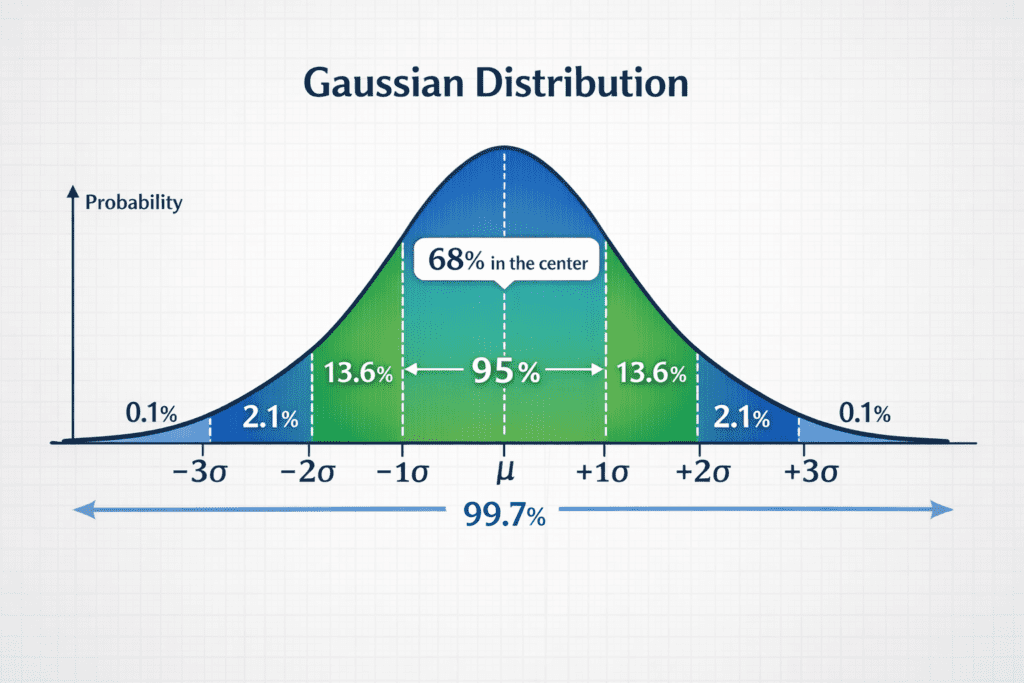
Table of Contents
Mathematical Expression
The probability density function (PDF) of the normal distribution is given by:
\[
f(x) = \frac{1}{\sigma \sqrt{2\pi}} \, e^{-\frac{(x – \mu)^2}{2\sigma^2}}
\]
where
- \(\mu\) = mean (average value)
- \(\sigma\) = standard deviation
- \(x\) = random variable
Key Characteristics
Symmetrical Shape
- The curve is symmetrical about the mean
- Left and right halves are identical
Mean, Median, Mode
\[
\text{Mean} = \text{Median} = \text{Mode}
\]
All three coincide at the center of the curve.
Bell-Shaped Curve
- Maximum value occurs at the mean
- Tapers off gradually on both sides
Asymptotic Nature
- The curve never touches the X-axis
- Extends infinitely in both directions
Standard Deviation and Spread
The spread of the curve is determined by standard deviation (\(\sigma\)):
- Small \(\sigma\) → narrow and tall curve
- Large \(\sigma\) → wide and flat curve
Empirical Rule (Important for GATE)
- 68.3% of values lie within \(\mu \pm \sigma\)
- 95.5% of values lie within \(\mu \pm 2\sigma\)
- 99.7% of values lie within \(\mu \pm 3\sigma\)
Importance in Measurement
- Represent random errors
- Estimate accuracy and precision
- Analyze measurement uncertainty
- Perform statistical quality control
Random Errors and NPC
- Random errors are unpredictable
- They follow a normal distribution
- Most errors are small, large errors are rare
Standard Normal Distribution
If mean is zero and standard deviation is one:
\[
Z = \frac{x – \mu}{\sigma}
\]
This is called the standard normal variable.
Applications
- Error analysis in measurements
- Quality control in industries
- Signal processing
- Probability and statistics problems