Exercise Questions
1. A man has to go 50m due north, 40m due east and 20m due south to reach a field.
(a)What distance he has to walk to reach the field?
(b)What is his displacement from his house to the field?
Solution:
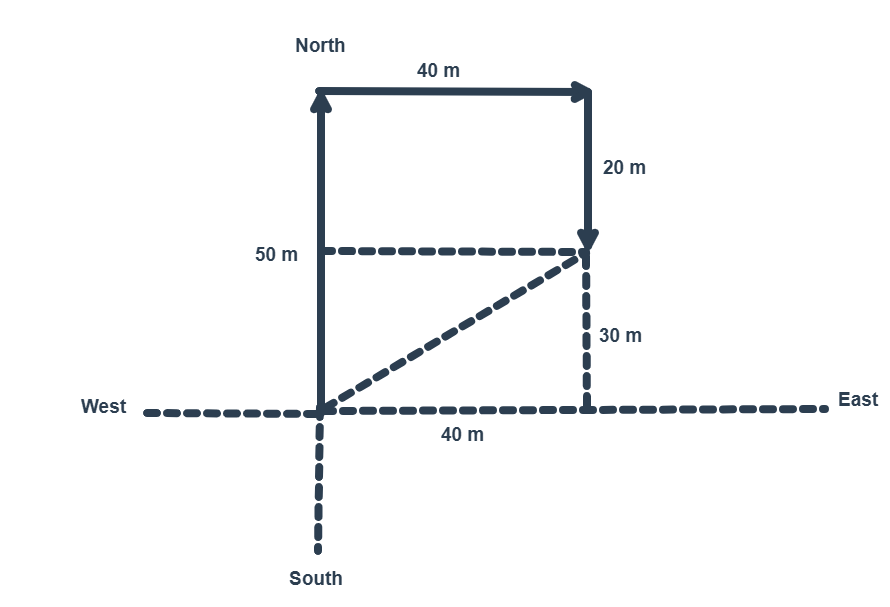
Step 1: Identify the Path Segments
The motion consists of three distinct parts. To analyze these, we treat the movements as individual segments of a total path.
- $d_1 = 50\text{ m}$ (North)
- $d_2 = 40\text{ m}$ (East)
- $d_3 = 20\text{ m}$ (South)
Step 2: Calculate Total Distance
The sources define distance as a scalar quantity representing the total area an object covers in motion. It is calculated by summing all segments using the formula $d=d_1+d_2+d_3$.
- $d = 50\text{ m} + 40\text{ m} + 20\text{ m}$
- Total Distance = $\mathbf{110\text{ m}}$
Step 3: Establish a Coordinate System for Displacement
Displacement is a vector quantity that indicates how far an object is from its destination. According to the sources, it is expressed as $x = x_f – x_i$, where $x_f$ is the final position and $x_i$ is the initial position. We set the starting point (house) as the origin $(0,0)$.
- After moving North: $(0, 50)$
- After moving East: $(40, 50)$
- After moving South: $(40, 50 – 20) = (40, 30)$
The final position $x_f$ is $(40, 30)$.
Step 4: Calculate the Magnitude of Displacement
Using the coordinates of the initial position $(0,0)$ and final position $(40,30)$, we find the magnitude (the straight-line distance):
- $|x| = \sqrt{(40 – 0)^2 + (30 – 0)^2}$
- $|x| = \sqrt{1600 + 900} = \sqrt{2500}$
- Magnitude = $\mathbf{50\text{ m}}$
Step 5: Determine the Direction
The sources emphasize that for displacement, it is mandatory to specify the direction of travel. We find the angle $\theta$ relative to the East axis:
- $\tan \theta = \frac{\text{Vertical Displacement}}{\text{Horizontal Displacement}} = \frac{30}{40} = 0.75$
- $\theta = \tan^{-1}(0.75) \approx \mathbf{37^\circ}$
- Final Displacement: $\mathbf{50\text{ m}}$ at $\mathbf{37^\circ \text{ North of East}}$.
2. A particle starts from the origin, goes along the X-axis to the point \( (20\,\text{m}, 0) \) and then returns along the same line to the point \( (-20\,\text{m}, 0) \). Find the distance and displacement of the particle during the trip.
Solution:
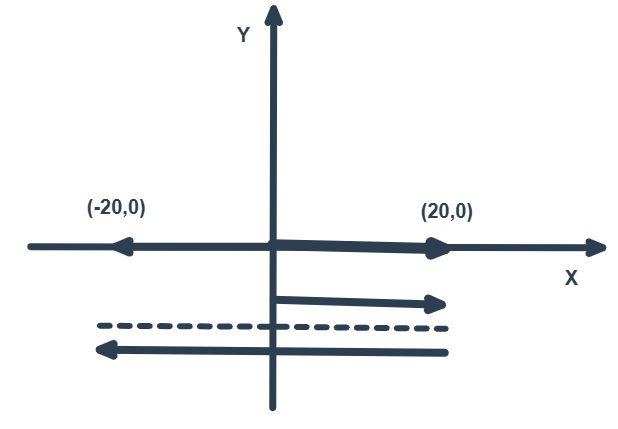
Step 1: Description of Motion
- Initial position: \( (0,0) \)
- Motion from origin to +20 m: \( 0 \rightarrow +20\,\text{m} \)
- Return motion from +20 m to −20 m: \( +20 \rightarrow -20\,\text{m} \)
(a) Distance Travelled
Distance is the total length of the actual path
travelled by the particle.
\[
\text{Distance} = 20 + 40 = \boxed{60\,\text{m}}
\]
(b) Displacement
Displacement is the change in position of the particle
from start to end.
\[
\text{Displacement} = x_f – x_i = (-20) – 0 = \boxed{-20\,\text{m}}
\]
The negative sign indicates that the displacement is along the
negative X-axis.
Distance by road = \(320 \, \text{km}\)
Time taken by aeroplane = \(30 \, \text{minutes} = 0.5 \, \text{hour}\)
Time taken by bus = \(8 \, \text{hours}\)
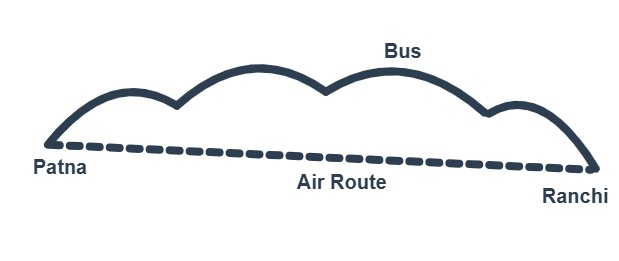
\[
\text{Average speed} = \frac{\text{Total distance}}{\text{Total time}}
\]
\[
= \frac{260}{0.5} = 520 \, \text{km/h}
\]
\text{Average speed} = \frac{320}{8} = 40 \, \text{km/h}
\]
\[
\text{Average velocity} = \frac{\text{Displacement}}{\text{Time}}
\]
\[
= \frac{260}{0.5} = 520 \, \text{km/h}
\]
Direction: from Patna to Ranchi
\[
\text{Average velocity} = \frac{260}{8} = 32.5 \, \text{km/h}
\]
Final meter reading = \(12416 \, \text{km}\)
Total time taken = \(2 \, \text{hours}\)
\text{Distance} = 12416 – 12352 = 64 \, \text{km}
\]
\[
\text{Average speed} = \frac{\text{Total distance}}{\text{Total time}}
\]
\[
= \frac{64}{2} = 32 \, \text{km/h}
\]
Therefore, displacement \(= 0\).
\[
\text{Average velocity} = \frac{\text{Displacement}}{\text{Time}} = \frac{0}{2} = 0 \, \text{km/h}
\]
\[
u = 0
\]
\[
v = 18 \times \frac{5}{18} = 5 \, \text{m/s}
\]
\[
t = 2 \, \text{s}
\]
\[
v = u + at
\]
5 = 0 + a(2)
\]
a = \frac{5}{2} = 2.5 \, \text{m/s}^2
\]
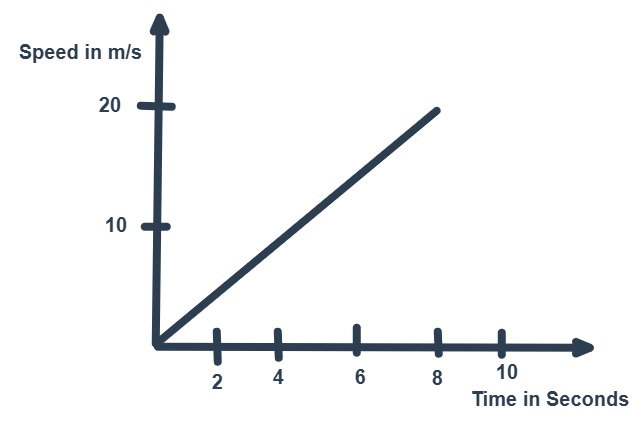
From the graph:
Initial speed, \(u = 0 \, \text{m/s}\)
Final speed, \(v = 20 \, \text{m/s}\)
Time taken, \(t = 8 \, \text{s}\)
Distance travelled is equal to the area under the speed–time graph.
The graph forms a triangle.
\text{Distance} = \frac{1}{2} \times \text{base} \times \text{height}
\]
\[
= \frac{1}{2} \times 8 \times 20 = 80 \, \text{m}
\]
\[
a = \frac{v – u}{t}
\]
\[
= \frac{20 – 0}{8} = 2.5 \, \text{m/s}^2
\]
Acceleration of the car = \(2.5 \, \text{m/s}^2\)
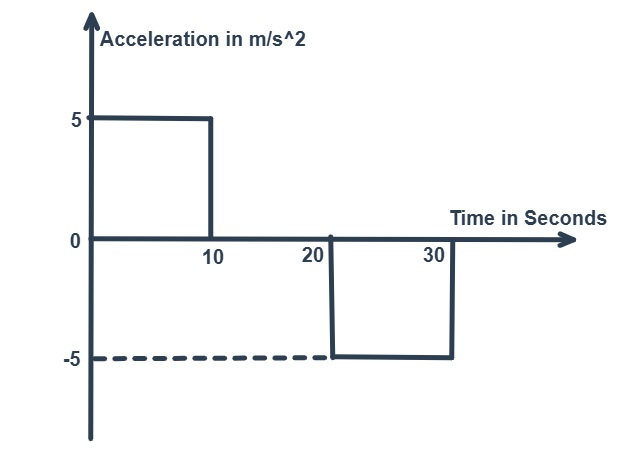
\[
u = 0
\]
\[
a = 5 \, \text{m/s}^2
\]
\[
v = u + at
\]
v = 0 + 5(10)
\]
v = 50 \, \text{m/s}
\]
a = 0 \Rightarrow v = 50 \, \text{m/s (constant)}
\]
a = -5 \, \text{m/s}^2
\]
v = 50 + (-5)(10)
\]
v = 0
\]
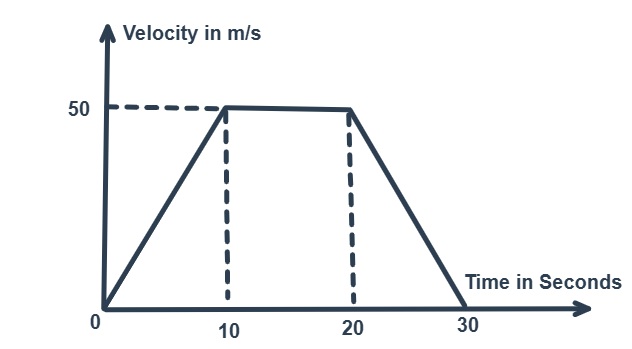
\text{Distance} = \frac{1}{2} \times (30 + 10) \times 50
\]
= \frac{1}{2} \times 40 \times 50
\]
= 1000 \, \text{m}
\]
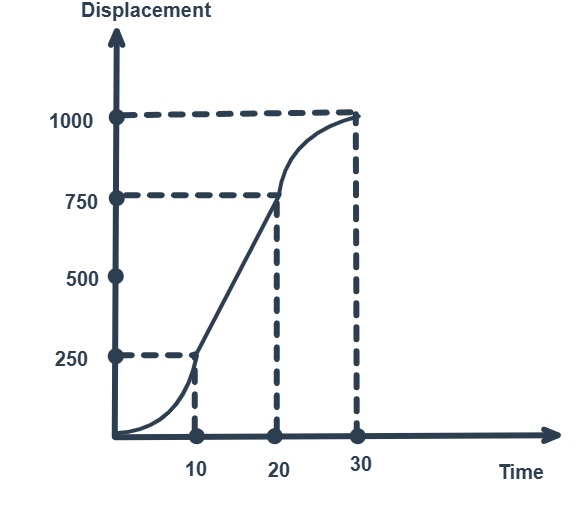
(a) The acceleration
(b) The distance travelled in 0 to 10 s
(c) The displacement in 0 to 10 s
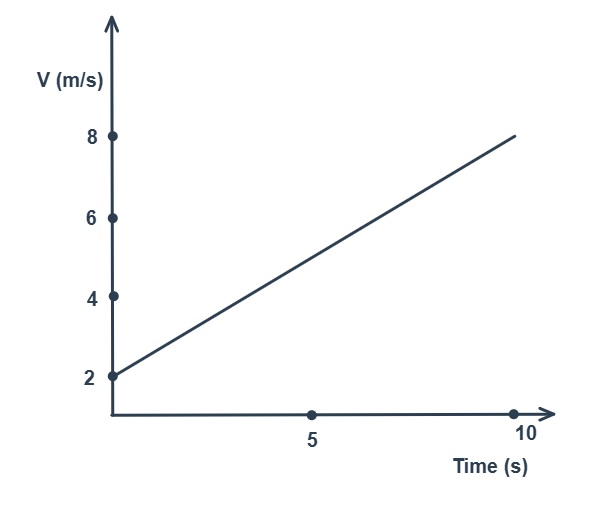
\[
a = \frac{v – u}{t}
\]
\[
= \frac{8 – 2}{10}
= 0.6 \, \text{m/s}^2
\]
\[
\text{Area} = \frac{1}{2} \times ( \text{sum of parallel sides} ) \times \text{height}
\]
\[
= \frac{1}{2} \times (2 + 8) \times 10
= 50 \, \text{m}
\]
displacement = area under the graph.
\[
\text{Displacement} = 50 \, \text{m}
\]
9. The given figure shows the graph of x-coordinate of a particle going along the X-axis as a function of time. Find:
(a) The average velocity during 0 to 10 s
(b) Instantaneous velocity at 2 s, 5 s, 8 s and 12 s.
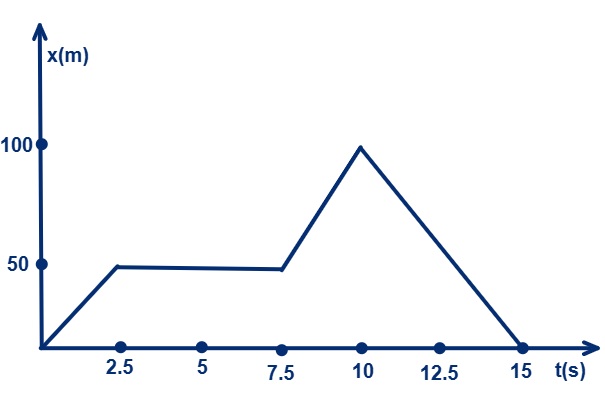
Displacement from 0 to 10 s:
Initial position at \(t = 0\), \(x = 0\)
Final position at \(t = 10\), \(x = 100 \, \text{m}\)
\text{Average velocity} = \frac{\text{Displacement}}{\text{Time}}
\]
\[
= \frac{100}{10} = 10 \, \text{m/s}
\]
\[
\text{Slope} = \frac{50 – 0}{2.5 – 0}
= \frac{50}{2.5}
= 20 \, \text{m/s}
\]
At \(t = 5 \, \text{s}\) (horizontal segment):
Slope \(= 0\)
\[
v = 0 \, \text{m/s}
\]
\[
\text{Slope} = \frac{100 – 50}{10 – 7.5}
= \frac{50}{2.5}
= 20 \, \text{m/s}
\]
\[
\text{Slope} = \frac{0 – 100}{15 – 10}
= \frac{-100}{5}
= -20 \, \text{m/s}
\]
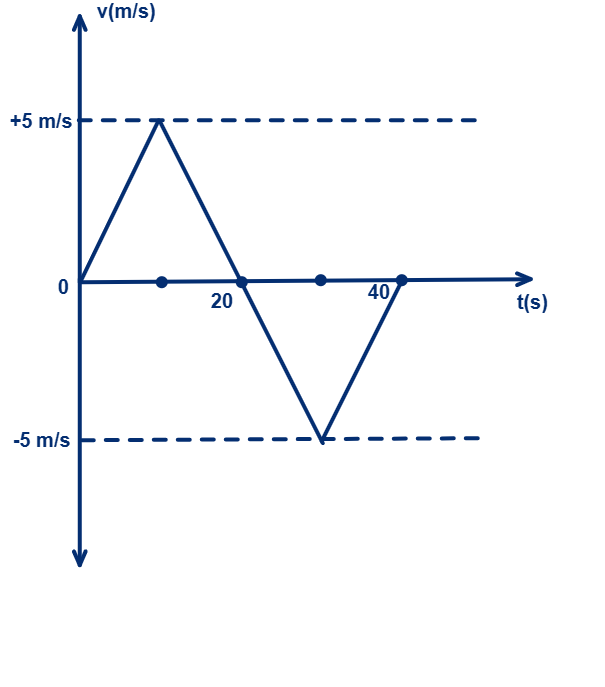
\text{Distance} =
\left( \frac{1}{2} \times 20 \times 5 \right)
+
\left( \frac{1}{2} \times 20 \times 5 \right)
\]
= 50 + 50 = 100 \, \text{m}
\]
\text{Displacement} =
\left( \frac{1}{2} \times 20 \times 5 \right)
+
\left( -\frac{1}{2} \times 20 \times 5 \right)
\]
= 50 – 50 = 0
\]
V_{\text{avg}} = \frac{\text{Displacement}}{\text{Time}}
\]
V_{\text{avg}} = \frac{0}{40} = 0 \, \text{m/s}
\]
11. The given figure shows x–t graph of a particle. Find the time \(t\) such that the average velocity of the particle during the period 0 to \(t\) is zero.
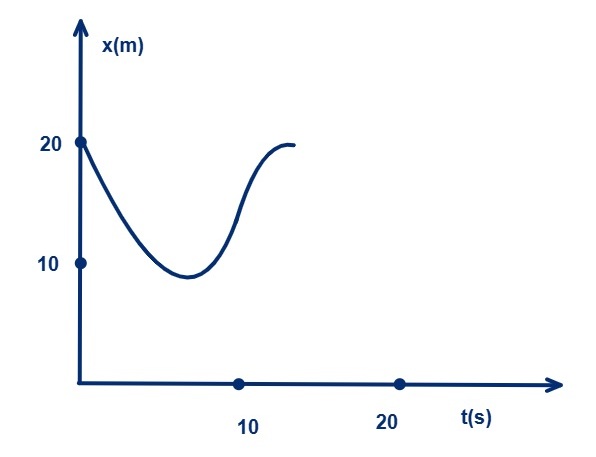
Solution:
Average velocity is given by:
\[
\text{Average velocity} = \frac{\text{Displacement}}{\text{Time}}
\]
For average velocity to be zero, displacement must be zero.
From the graph:
At \(t = 0\), \(x = 20\).
The particle again reaches \(x = 20\) at \(t = 12 \, \text{s}\).
Hence, displacement from 0 to 12 s is zero.
Required time, \(t = 12 \, \text{s}\).
12. A particle starts from a point A and travels along the solid curve shown in the given figure. Find approximately the position B of the particle such that the average velocity between the positions A and B has the same direction as the instantaneous velocity at B.
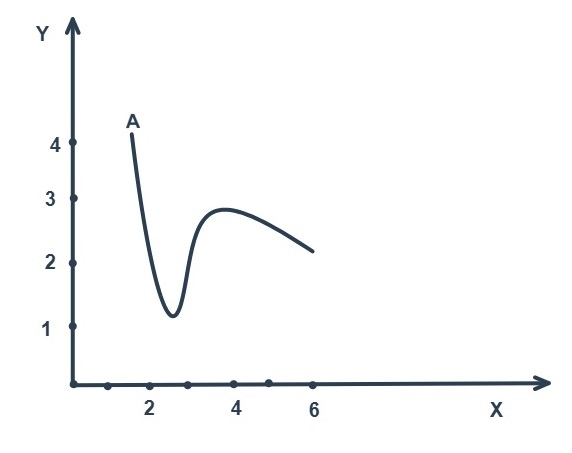
Solution: Average velocity between A and B is along the straight line joining A and B.
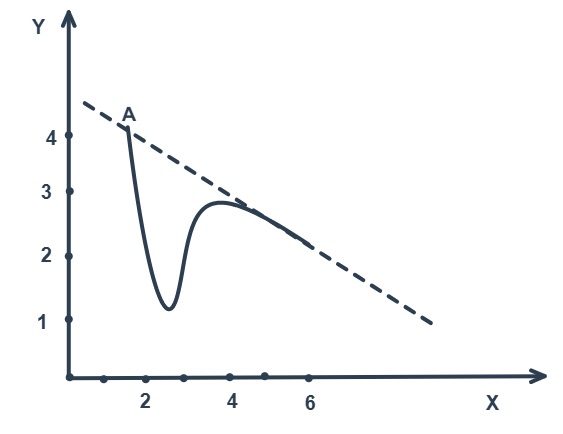
Instantaneous velocity at B is along the tangent to the curve at point B.
For both velocities to have the same direction, the straight line AB must be parallel to the tangent at B.
Hence, point B is approximately point (5,3) on the curve where the tangent drawn at B is parallel to the line joining A and B.
13. An object having a velocity 4.0 m/s is accelerated at the rate of 1.2 m/s² for 5.0 s. Find the distance travelled during the period of acceleration.
Solution:
Given:
\[
u = 4 \, \text{m/s}, \quad a = 1.2 \, \text{m/s}^2, \quad t = 5 \, \text{s}
\]
Distance travelled is given by:
\[
s = ut + \frac{1}{2}at^2
\]
\[
s = (4)(5) + \frac{1}{2}(1.2)(5)^2
\]
\[
s = 20 + \frac{1}{2}(1.2)(25)
\]
\[
s = 20 + 15 = 35 \, \text{m}
\]
Distance travelled = \(35 \, \text{m}\).
14. A person travelling at 43.2 km/h applies the brake giving a deceleration of 6.0 m/s² to his scooter. How far will it travel before stopping?
Solution:
Convert speed into m/s:
\[
u = 43.2 \times \frac{5}{18} = 12 \, \text{m/s}
\]
Final velocity,
\[
v = 0
\]
Acceleration (retardation),
\[
a = -6 \, \text{m/s}^2
\]
Using the equation:
\[
v^2 = u^2 + 2as
\]
\[
0^2 = (12)^2 + 2(-6)s
\]
\[
0 = 144 – 12s
\]
\[
12s = 144
\]
\[
s = 12 \, \text{m}
\]
Distance travelled before stopping = \(12 \, \text{m}\).
15. A train starts from rest and moved with a constant acceleration of 2.0 m/s² for half a minute. The brakes are then applied and the train comes to rest in one minute.
(a) Find the total distance moved by the train
(b) The maximum speed attained by the train
(c) The position(s) of the train at half the maximum speed.
Solution:
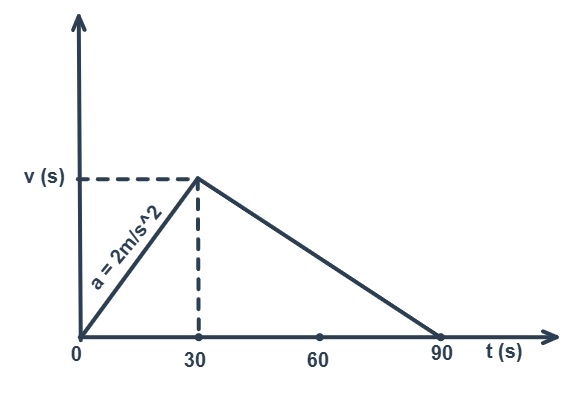
(a) Total Distance Moved
The motion is divided into two parts: acceleration and deceleration.
Part 1: Acceleration (\(S_1\))
- Initial velocity (\(u\)) = \(0\)
- Acceleration (\(a\)) = \(2 \text{ m/s}^2\)
- Time (\(t\)) = \(30 \text{ sec}\)
- \(S_1 = ut + \frac{1}{2}at^2 = 0 + \frac{1}{2}(2)(30)^2 = 900 \text{ m}\)
Part 2: Deceleration (\(S_2\))
- First, find the maximum velocity:
\(v = u + at = 0 + (2)(30) = 60 \text{ m/s}\) - For braking phase:
\(u’ = 60 \text{ m/s}, \quad v’ = 0, \quad t’ = 60 \text{ sec}\) - Deceleration:
\(a’ = \frac{v’ – u’}{t’} = \frac{0 – 60}{60} = -1 \text{ m/s}^2\) - \(S_2 = \frac{v’^2 – u’^2}{2a’} = \frac{0 – 60^2}{2(-1)} = 1800 \text{ m}\)
Total Distance:
\(S = S_1 + S_2 = 900 + 1800 = 2700 \text{ m} = 2.7 \text{ km}\)
(b) Maximum Speed Attained
The maximum speed is reached just before braking:
\(v_{\text{max}} = 60 \text{ m/s}\)
(c) Positions at Half the Maximum Speed
Half of the maximum speed = \(30 \text{ m/s}\). This occurs twice:
- During Acceleration:
\(v^2 – u^2 = 2aS\)
\(30^2 = 2(2)S \Rightarrow 900 = 4S \Rightarrow S = 225 \text{ m}\) - During Deceleration:
\(S = \frac{v^2 – u^2}{2a} = \frac{30^2 – 60^2}{2(-1)} = 1350 \text{ m}\)
Total position from start:
\(900 + 1350 = 2250 \text{ m} = 2.25 \text{ km}\)
16. A bullet travelling with a velocity of 16 m/s penetrates a tree trunk and comes to rest in 0.4 m. Find the time taken during the retardation.
Solution:
Given:
\[
u = 16 \, \text{m/s}, \quad v = 0, \quad s = 0.4 \, \text{m}
\]
Using the equation of motion:
\[
v^2 = u^2 + 2as
\]
\[
0^2 = (16)^2 + 2(a)(0.4)
\]
\[
0 = 256 + 0.8a
\]
\[
a = -320 \, \text{m/s}^2
\]
Using:
\[
v = u + at
\]
\[
0 = 16 + (-320)t
\]
\[
t = \frac{16}{320} = 0.05 \, \text{s}
\]
Time taken during retardation = \(0.05 \, \text{s}\).
17. A bullet going with speed 350 m/s enters a concrete wall and penetrates a distance 5.0 cm before coming to rest. Find the deceleration.
Solution:
Given:
\[
u = 350 \, \text{m/s}, \quad v = 0, \quad s = 5 \times 10^{-2} \, \text{m}
\]
Using the equation of motion:
\[
v^2 = u^2 + 2as
\]
\[
0^2 = (350)^2 + 2(a)(0.05)
\]
\[
0 = 122500 + 0.1a
\]
\[
a = -1.225 \times 10^6 \, \text{m/s}^2
\]
Deceleration of the bullet = \(1.225 \times 10^6 \, \text{m/s}^2\).
18. A particle starting from rest moves with constant acceleration. If it takes 5.0 s to reach the speed 18.0 km/h. Find
(a) The average velocity during this period
(b) The distance travelled by the particle during this period.
Solution:
Given:
\[
u = 0, \quad t = 5 \, \text{s}
\]
Final velocity:
\[
v = 18 \times \frac{5}{18} = 5 \, \text{m/s}
\]
Using:
\[
v = u + at
\]
\[
5 = 0 + a(5)
\]
\[
a = 1 \, \text{m/s}^2
\]
(b) Distance travelled
\[
s = ut + \frac{1}{2}at^2
\]
\[
s = 0 + \frac{1}{2}(1)(5)^2
\]
\[
s = 12.5 \, \text{m}
\]
(a) Average velocity
\[
V_{\text{avg}} = \frac{\text{Distance}}{\text{Time}}
\]
\[
V_{\text{avg}} = \frac{12.5}{5} = 2.5 \, \text{m/s}
\]
Average velocity = \(2.5 \, \text{m/s}\),
Distance travelled = \(12.5 \, \text{m}\).
19. A driver takes 0.20 s to apply the brakes after he sees a need for it. This is called the reaction time of the driver. If he is driving a car at a speed of 54 km/h and the brakes cause a deceleration of 6.0 m/s², find the distance travelled by the car after he sees the need to put the brakes on.
Solution:
Speed of the car:
\[
v = 54 \times \frac{5}{18} = 15 \, \text{m/s}
\]
Distance travelled during reaction time:
\[
s_1 = vt = 15 \times 0.2 = 3 \, \text{m}
\]
When brakes are applied:
\[
u = 15 \, \text{m/s}, \quad v = 0, \quad a = -6 \, \text{m/s}^2
\]
Using the equation:
\[
v^2 = u^2 + 2as
\]
\[
0^2 = (15)^2 + 2(-6)s_2
\]
\[
0 = 225 – 12s_2
\]
\[
s_2 = 18.75 \, \text{m}
\]
Total distance travelled:
\[
s = s_1 + s_2 = 3 + 18.75 = 21.75 \, \text{m}
\]
\[
\approx 22 \, \text{m}
\]
Total distance travelled after seeing the need to brake = \(22 \, \text{m}\).
20. Complete the following table:
| Car Model | Driver X | Driver Y |
|---|---|---|
| A Deceleration on hard braking = 6.0 m/s² |
Speed = 54 km/h Braking distance a = ……………………. Total stopping distance b = …………………….. |
Speed = 54 km/h Braking distance a = ……………………. Total stopping distance b = …………………….. |
| Speed = 72 km/h Braking distance c = ……………………. Total stopping distance d = …………………….. |
Speed = 72 km/h Braking distance c = ……………………. Total stopping distance d = …………………….. |
|
| B Deceleration on hard braking = 7.5 m/s² |
Speed = 54 km/h Braking distance e = ……………………. Total stopping distance f = …………………….. |
Speed = 54 km/h Braking distance e = ……………………. Total stopping distance f = …………………….. |
| Speed = 72 km/h Braking distance g = ……………………. Total stopping distance h = …………………….. |
Speed = 72 km/h Braking distance g = ……………………. Total stopping distance h = …………………….. |
| Car Model | Driver X (Reaction time = 0.20 s) | Driver Y (Reaction time = 0.30 s) |
|---|---|---|
| A Deceleration on hard braking = 6.0 m/s² |
Speed = 54 km/h Braking distance a = 18.75 m Total stopping distance b = 21.75 m |
Speed = 54 km/h Braking distance a = 18.75 m Total stopping distance b = 23.25 m |
| Speed = 72 km/h Braking distance c = 33.33 m Total stopping distance d = 37.33 m |
Speed = 72 km/h Braking distance c = 33.33 m Total stopping distance d = 39.33 m |
|
| B Deceleration on hard braking = 7.5 m/s² |
Speed = 54 km/h Braking distance e = 15.0 m Total stopping distance f = 18.0 m |
Speed = 54 km/h Braking distance e = 15.0 m Total stopping distance f = 19.5 m |
| Speed = 72 km/h Braking distance g = 26.67 m Total stopping distance h = 30.67 m |
Speed = 72 km/h Braking distance g = 26.67 m Total stopping distance h = 32.67 m |
Explanation:
To complete the table, we calculate three quantities:
1. Speed in m/s
2. Braking distance
3. Reaction distance and total stopping distance
Step 1: Convert speed from km/h to m/s
\[
u = \text{Speed in km/h} \times \frac{5}{18}
\]
For 54 km/h:
\[
u = 54 \times \frac{5}{18} = 15 \, \text{m/s}
\]
For 72 km/h:
\[
u = 72 \times \frac{5}{18} = 20 \, \text{m/s}
\]
Step 2: Formula for braking distance
Braking distance is given by:
\[
s_b = \frac{u^2}{2a}
\]
where
\(u\) = initial speed,
\(a\) = deceleration on hard braking.
Car Model A (deceleration = 6.0 m/s²)
For speed 54 km/h (\(u = 15 \, \text{m/s}\)):
\[
s_b = \frac{15^2}{2 \times 6}
= \frac{225}{12}
= 18.75 \, \text{m}
\]
For speed 72 km/h (\(u = 20 \, \text{m/s}\)):
\[
s_b = \frac{20^2}{2 \times 6}
= \frac{400}{12}
= 33.33 \, \text{m}
\]
Car Model B (deceleration = 7.5 m/s²)
For speed 54 km/h (\(u = 15 \, \text{m/s}\)):
\[
s_b = \frac{15^2}{2 \times 7.5}
= \frac{225}{15}
= 15.0 \, \text{m}
\]
For speed 72 km/h (\(u = 20 \, \text{m/s}\)):
\[
s_b = \frac{20^2}{2 \times 7.5}
= \frac{400}{15}
= 26.67 \, \text{m}
\]
Step 3: Reaction distance
Reaction distance is given by:
\[
s_r = u \times t_r
\]
where \(t_r\) is reaction time.
Driver X (reaction time = 0.20 s)
For 54 km/h:
\[
s_r = 15 \times 0.20 = 3.0 \, \text{m}
\]
For 72 km/h:
\[
s_r = 20 \times 0.20 = 4.0 \, \text{m}
\]
Driver Y (reaction time = 0.30 s)
For 54 km/h:
\[
s_r = 15 \times 0.30 = 4.5 \, \text{m}
\]
For 72 km/h:
\[
s_r = 20 \times 0.30 = 6.0 \, \text{m}
\]
Step 4: Total stopping distance
\[
\text{Total stopping distance} = s_b + s_r
\]
Examples:
Car A, Driver X, 54 km/h:
\[
= 18.75 + 3.0 = 21.75 \, \text{m}
\]
Car A, Driver Y, 72 km/h:
\[
= 33.33 + 6.0 = 39.33 \, \text{m}
\]
Car B, Driver X, 72 km/h:
\[
= 26.67 + 4.0 = 30.67 \, \text{m}
\]
Car B, Driver Y, 54 km/h:
\[
= 15.0 + 4.5 = 19.5 \, \text{m}
\]
Conclusion:
Higher speed and longer reaction time increase the stopping distance,
while higher deceleration (better braking system) reduces the stopping distance.
21. A police jeep is chasing a culprit going on a motorbike. The motorbike crosses a turning at a speed of 72 km/h. The jeep follows it at a speed of 90 km/h, crossing the turning ten seconds later than the bike. Assuming that they travel at constant speeds, how far from the turning will the jeep catch up with the bike?
Solution:
Speed of the motorbike:
\[
V_{\text{bike}} = 72 \times \frac{5}{18} = 20 \,\text{m/s}
\]
Speed of the police jeep:
\[
V_{\text{jeep}} = 90 \times \frac{5}{18} = 25 \,\text{m/s}
\]
Distance travelled by the motorbike in 10 seconds:
\[
\text{Distance} = \text{Speed} \times \text{Time} = 20 \times 10 = 200 \,\text{m}
\]
Relative speed of the jeep with respect to the bike:
\[
V_{\text{relative}} = 25 – 20 = 5 \,\text{m/s}
\]
Time taken by the jeep to catch the bike:
\[
t = \frac{\text{Relative distance}}{\text{Relative speed}} = \frac{200}{5} = 40 \,\text{s}
\]
Distance travelled by the jeep in this time:
\[
\text{Distance} = 25 \times 40 = 1000 \,\text{m} = 1 \,\text{km}
\]
Answer: The police jeep will catch the motorbike at a distance of 1 km from the turning.
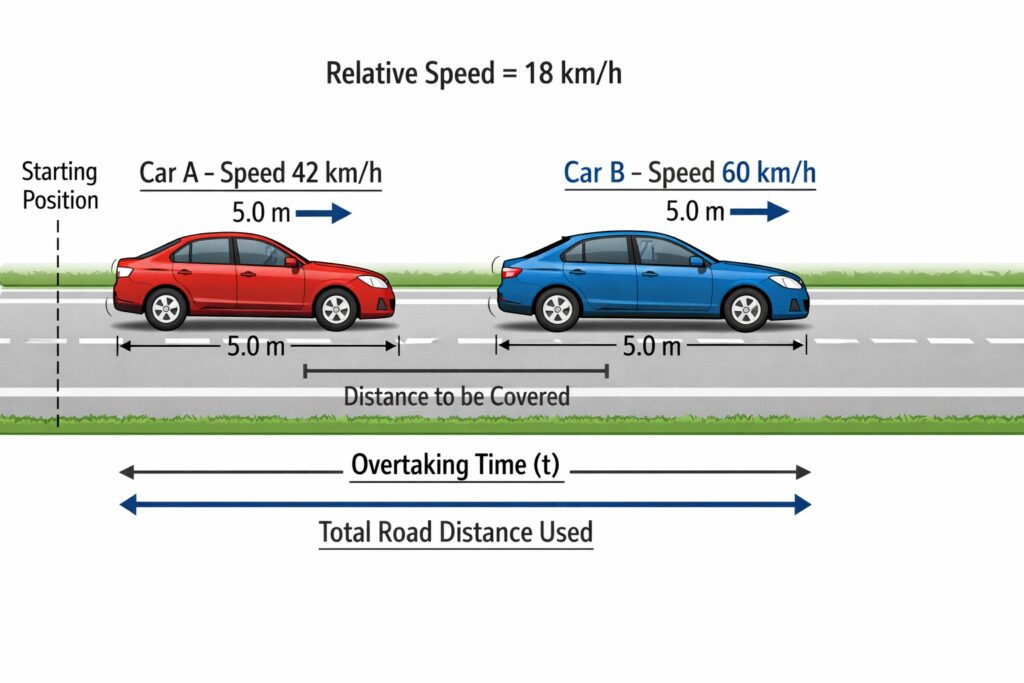
\[
V_1 = 60 \times \frac{5}{18} = 16.6 \text{ m/s}
\]
\[
V_2 = 42 \times \frac{5}{18} = 11.6 \text{ m/s}
\]
\[
V_{\text{rel}} = 16.6 – 11.6 = 5 \text{ m/s}
\]
\[
d_{\text{rel}} = 5 + 5 = 10 \text{ m}
\]
\[
t = \frac{d_{\text{rel}}}{V_{\text{rel}}} = \frac{10}{5} = 2 \text{ s}
\]
\[
d = 16.6 \times 2 = 33.2 \text{ m}
\]
\[
= 33.2 + 5 = 38.2 \text{ m} \approx 38 \text{ m}
\]
23. A ball is projected vertically upward with a speed of \(50 \text{ m/s}\). Find:
(a) the maximum height reached,
(b) the time taken to reach the maximum height, and
(c) the speed at half the maximum height.
(Take \(g = 10 \text{ m/s}^2\))
Solution
Given:
- Initial velocity (\(u\)) = \(50 \text{ m/s}\)
- Acceleration due to gravity (\(g\)) = \(-10 \text{ m/s}^2\)
- Final velocity at highest point (\(v\)) = \(0\)
(a) Maximum Height Reached (\(H\))
Using the third equation of motion:
\(v^2 – u^2 = 2aH\)
\(0 – (50)^2 = 2(-10)H\)
\(-2500 = -20H\)
\(H = \frac{2500}{20} = 125 \text{ m}\)
(b) Time taken to reach maximum height (\(t\))
Using the first equation of motion:
\(v = u + at\)
\(0 = 50 + (-10)t\)
\(10t = 50\)
\(t = 5 \text{ sec}\)
(c) Speed at half the maximum height
Half of the maximum height:
\(s’ = \frac{125}{2} = 62.5 \text{ m}\)
Using the third equation of motion:
\(v’^2 – u^2 = 2as’\)
\(v’^2 – (50)^2 = 2(-10)(62.5)\)
\(v’^2 – 2500 = -1250\)
\(v’^2 = 1250\)
\(v’ = \sqrt{1250} = 35.35 \text{ m/s} \approx 35 \text{ m/s}\)
24. A ball is dropped from a balloon going up at a speed of \(7 \text{ m/s}\). If the balloon was at a height of \(60 \text{ m}\) at the time of dropping the ball, how long will the ball take to reach the ground?
(Take \(g = 10 \text{ m/s}^2\))
Solution:
Important Concept: When the ball is dropped, it inherits the velocity of the balloon. Since the balloon is moving upward, the initial velocity of the ball is also upward.
Given:
- Initial velocity (\(u\)) = \(-7 \text{ m/s}\) (upward negative, downward positive)
- Displacement (\(s\)) = \(60 \text{ m}\) (downward)
- Acceleration (\(a\)) = \(10 \text{ m/s}^2\)
Equation of Motion:
\(s = ut + \frac{1}{2}at^2\)
\(60 = -7t + \frac{1}{2}(10)t^2\)
\(60 = -7t + 5t^2\)
Rearranging into quadratic form:
\(5t^2 – 7t – 60 = 0\)
Using quadratic formula:
\(t = \frac{-b \pm \sqrt{b^2 – 4ac}}{2a}\)
\(t = \frac{-(-7) \pm \sqrt{(-7)^2 – 4(5)(-60)}}{2(5)}\)
\(t = \frac{7 \pm \sqrt{49 + 1200}}{10}\)
\(t = \frac{7 \pm \sqrt{1249}}{10}\)
\(t \approx \frac{7 \pm 35.34}{10}\)
Final Result:
- Taking positive root:
\(t = \frac{7 + 35.34}{10} = 4.2 \text{ sec}\)
The ball takes approximately \(4.2 \text{ seconds}\) to reach the ground.
25. A ball is thrown vertically upward with a speed of \(28 \text{ m/s}\).
(a) Find the maximum height reached by the ball.
(b) Find its velocity one second before it reaches the maximum height.
(c) Does the answer to part (b) change if the initial speed is more than \(28 \text{ m/s}\) (e.g., \(40 \text{ m/s}\) or \(80 \text{ m/s}\))?
Solution
Given:
- Initial velocity (\(u\)) = \(28 \text{ m/s}\)
- Final velocity at maximum height (\(v\)) = \(0\)
- Acceleration due to gravity (\(g\)) = \(-9.8 \text{ m/s}^2\)
(a) Maximum Height Reached (\(S\))
Using the equation:
\(v^2 – u^2 = 2aS\)
\(0 – (28)^2 = 2(-9.8)S\)
\(-784 = -19.6S\)
\(S = \frac{784}{19.6} = 40 \text{ m}\)
(b) Velocity one second before reaching maximum height
First, find the time to reach maximum height:
\(v = u + at\)
\(0 = 28 – 9.8t\)
\(t = \frac{28}{9.8} \approx 2.85 \text{ sec}\)
Time one second before highest point:
\(t’ = t – 1 = 1.85 \text{ sec}\)
Velocity at this time:
\(v’ = u + at’\)
\(v’ = 28 – (9.8)(1.85)\)
\(v’ = 28 – 18.13 = 9.87 \text{ m/s}\)
(c) Does the answer change for higher initial speed?
No.
The velocity one second before reaching the maximum height will always be \(9.8 \text{ m/s}\), regardless of the initial speed.
This is because during the last one second of upward motion, the velocity decreases uniformly under gravity:
\(v = v’ + at \Rightarrow 0 = v’ – (9.8)(1)\)
\(v’ = 9.8 \text{ m/s}\)
26. A person sitting on the top of a tall building is dropping balls at regular intervals of one second. Find the positions of the 3rd, 4th, and 5th balls when the 6th ball is being dropped.
(Take \(g = 9.8 \text{ m/s}^2\))
Solution
Key Concept: When the 6th ball is being dropped (\(t = 0\)), the earlier balls have already been falling for different times:
- 5th ball: falling for \(1 \text{ s}\)
- 4th ball: falling for \(2 \text{ s}\)
- 3rd ball: falling for \(3 \text{ s}\)
Given:
- Initial velocity (\(u\)) = \(0\)
- Acceleration (\(a\)) = \(9.8 \text{ m/s}^2\)
- Distance formula: \(S = \frac{1}{2}gt^2\)
1. Position of the 3rd Ball (\(t = 3 \text{ s}\))
\(S_3 = \frac{1}{2}(9.8)(3)^2 = \frac{1}{2}(9.8)(9) = 44.1 \text{ m}\)
The 3rd ball is \(44.1 \text{ m}\) below the top.
2. Position of the 4th Ball (\(t = 2 \text{ s}\))
\(S_4 = \frac{1}{2}(9.8)(2)^2 = \frac{1}{2}(9.8)(4) = 19.6 \text{ m}\)
The 4th ball is \(19.6 \text{ m}\) below the top.
3. Position of the 5th Ball (\(t = 1 \text{ s}\))
\(S_5 = \frac{1}{2}(9.8)(1)^2 = 4.9 \text{ m}\)
The 5th ball is \(4.9 \text{ m}\) below the top.
Final Answer:
- 3rd Ball: \(44.1 \text{ m}\) below top
- 4th Ball: \(19.6 \text{ m}\) below top
- 5th Ball: \(4.9 \text{ m}\) below top
27. A healthy young man standing at a distance of \(7 \text{ m}\) from an \(11.8 \text{ m}\) high building sees a kid slipping from the top floor. With what speed (assumed uniform) should he run to catch the kid at the arms height \(1.8 \text{ m}\)?
Solution
The man must reach the building in the same time it takes the kid to fall to the arms height.
1. Time taken by the kid to fall
- Initial velocity (\(u\)) = \(0 \text{ m/s}\)
- Initial height = \(11.8 \text{ m}\)
- Final height = \(1.8 \text{ m}\)
Displacement:
\(s = 11.8 – 1.8 = 10 \text{ m}\)
- Acceleration (\(g\)) = \(9.8 \text{ m/s}^2\)
Using equation of motion:
\(s = ut + \frac{1}{2}gt^2\)
\(10 = 0 + \frac{1}{2}(9.8)t^2\)
\(10 = 4.9t^2\)
\(t^2 = \frac{10}{4.9} \approx 2.04\)
\(t \approx 1.43 \text{ s}\)
2. Speed of the man
- Distance = \(7 \text{ m}\)
- Time = \(1.43 \text{ s}\)
Using:
\(v = \frac{\text{Distance}}{\text{Time}}\)
\(v = \frac{7}{1.43} \approx 4.9 \text{ m/s}\)
Final Answer: The man should run with a uniform speed of \(4.9 \text{ m/s}\).
28. An NCC cadet is marching at a speed of \(6 \text{ km/h}\) under a grove of mango trees. A mango falls from a tree from a height of \(19.6 \text{ m}\). At what distance from the tree should the cadet be at the time the mango falls to catch it?
(Take \(g = 9.8 \text{ m/s}^2\))
Solution
To catch the mango, the cadet must reach the point directly below the tree at the same time the mango reaches the ground.
1. Time taken by the mango to fall
- Initial velocity (\(u\)) = \(0\)
- Height (\(s\)) = \(19.6 \text{ m}\)
- Acceleration (\(g\)) = \(9.8 \text{ m/s}^2\)
Using:
\(s = ut + \frac{1}{2}gt^2\)
\(19.6 = 0 + \frac{1}{2}(9.8)t^2\)
\(19.6 = 4.9t^2\)
\(t^2 = 4 \Rightarrow t = 2 \text{ s}\)
2. Distance covered by the cadet
- Speed = \(6 \text{ km/h} = \frac{5}{3} \text{ m/s}\)
- Time = \(2 \text{ s}\)
Using:
\(d = vt\)
\(d = \frac{5}{3} \times 2 = \frac{10}{3} \approx 3.33 \text{ m}\)
Final Answer: The cadet should be at a distance of \(3.33 \text{ m}\) from the tree.
29. A ball is dropped from a height. If it takes \(0.2 \text{ s}\) to cross the last \(6 \text{ m}\) before hitting the ground, find the total height from which it was dropped.
(Take \(g = 9.8 \text{ m/s}^2\))
Solution:
1. Analysis of the last 6 m
- Distance (\(S\)) = \(6 \text{ m}\)
- Time (\(t\)) = \(0.2 \text{ s}\)
- Acceleration (\(a\)) = \(9.8 \text{ m/s}^2\)
- Initial velocity (\(u\)) = ?
Using:
\(S = ut + \frac{1}{2}at^2\)
\(6 = u(0.2) + \frac{1}{2}(9.8)(0.2)^2\)
\(6 = 0.2u + 4.9(0.04)\)
\(6 = 0.2u + 0.196\)
\(u = \frac{6 – 0.196}{0.2} = \frac{5.804}{0.2} = 29 \text{ m/s}\)
2. Motion before the last 6 m
- Initial velocity = \(0 \text{ m/s}\)
- Final velocity = \(29 \text{ m/s}\)
- Acceleration = \(9.8 \text{ m/s}^2\)
Using:
\(v^2 – u^2 = 2aS\)
\(29^2 = 2(9.8)x\)
\(841 = 19.6x\)
\(x = \frac{841}{19.6} \approx 42.05 \text{ m}\)
3. Total Height
\(\text{Total Height} = x + 6 = 42.05 + 6 = 48.05 \text{ m}\)
Final Answer: The total height is approximately \(48 \text{ m}\).
30. A ball is dropped from a height of \(5 \text{ m}\) onto a sandy floor and penetrates the sand up to \(10 \text{ cm}\) before coming to rest. Find the retardation of the ball in the sand.
(Take \(g = 9.8 \text{ m/s}^2\))
Solution
The motion is divided into two parts: free fall in air and motion in sand.
1. Motion in Air (Free Fall)
- Initial velocity (\(u\)) = \(0\)
- Distance (\(s\)) = \(5 \text{ m}\)
- Acceleration (\(a\)) = \(9.8 \text{ m/s}^2\)
Using:
\(v^2 = u^2 + 2as\)
\(v^2 = 0 + 2(9.8)(5) = 98\)
\(v = \sqrt{98} \approx 9.89 \text{ m/s}\)
Velocity just before entering sand = \(9.89 \text{ m/s}\)
2. Motion in Sand (Retardation)
- Initial velocity (\(u_1\)) = \(9.89 \text{ m/s}\)
- Final velocity (\(v_1\)) = \(0\)
- Distance (\(s\)) = \(0.1 \text{ m}\)
Using:
\(v_1^2 – u_1^2 = 2as\)
\(0 – (9.89)^2 = 2(a)(0.1)\)
\(-98 = 0.2a\)
\(a = -490 \text{ m/s}^2\)
Final Answer: The retardation of the ball in sand is \(490 \text{ m/s}^2\).
31. An elevator is descending with a constant acceleration. A coin is dropped from a height of \(6 \text{ ft} \, (1.8 \text{ m})\) above the elevator floor and takes \(1 \text{ s}\) to hit it. Find the acceleration of the elevator.
(Take \(g = 9.8 \text{ m/s}^2\))
Solution
1. Motion of the coin
- Initial velocity (\(u\)) = \(0\)
- Time (\(t\)) = \(1 \text{ s}\)
- Acceleration = \(9.8 \text{ m/s}^2\)
Using:
\(S_c = ut + \frac{1}{2}gt^2\)
\(S_c = 0 + \frac{1}{2}(9.8)(1)^2 = 4.9 \text{ m}\)
2. Motion of the elevator floor
- Initial velocity (\(u\)) = \(0\)
- Time (\(t\)) = \(1 \text{ s}\)
- Acceleration = \(a\)
Using:
\(S_e = ut + \frac{1}{2}at^2\)
\(S_e = \frac{1}{2}a(1)^2 = \frac{a}{2}\)
3. Condition for collision
The coin meets the floor when:
\(S_c = 1.8 + S_e\)
\(4.9 = 1.8 + \frac{a}{2}\)
4. Solving for \(a\)
\(4.9 – 1.8 = \frac{a}{2}\)
\(3.1 = \frac{a}{2}\)
\(a = 6.2 \text{ m/s}^2\)
Conversion to ft/s\(^2\):
\(a = 6.2 \times 3.28 \approx 20.34 \text{ ft/s}^2\)
Final Answer: The acceleration of the elevator is \(6.2 \text{ m/s}^2\) (approximately \(20.34 \text{ ft/s}^2\)).
32. A ball is thrown horizontally from a height of \(100 \text{ m}\) with an initial velocity of \(20 \text{ m/s}\).
- Find the time taken to reach the ground.
- Find the horizontal range.
- Find the velocity (magnitude and direction) with which it strikes the ground.
(Take \(g = 9.8 \text{ m/s}^2\))
Solution:
1. Time taken to reach the ground
For horizontal projection, time depends only on height:
\(t = \sqrt{\frac{2h}{g}} = \sqrt{\frac{2 \times 100}{9.8}} = 4.51 \text{ s}\)
2. Horizontal range
Horizontal velocity remains constant:
\(x = ut = 20 \times 4.51 \approx 90 \text{ m}\)
3. Velocity at impact
- Horizontal component (\(V_x\)) = \(20 \text{ m/s}\)
- Vertical component (\(V_y\)):
\(V_y = gt = 9.8 \times 4.51 = 44.1 \text{ m/s}\)
Resultant velocity:
\(V = \sqrt{V_x^2 + V_y^2} = \sqrt{20^2 + (44.1)^2} \approx 48.42 \text{ m/s}\)
Direction:
\(\tan \beta = \frac{V_y}{V_x} = \frac{44.1}{20} = 2.205\)
\(\beta = \tan^{-1}(2.205) \approx 66^\circ\)
Final Answer: The ball strikes the ground with a velocity of \(48.42 \text{ m/s}\) at an angle of \(66^\circ\) to the horizontal.
33. A ball is projected with a velocity of \(40 \text{ m/s}\) at an angle of \(60^\circ\) with the horizontal.
- Find the maximum height reached by the ball.
- Find the horizontal range.
(Take \(g = 10 \text{ m/s}^2\))
Solution:
Given:
- Initial velocity (\(u\)) = \(40 \text{ m/s}\)
- Angle of projection (\(\theta\)) = \(60^\circ\)
- Acceleration due to gravity (\(g\)) = \(10 \text{ m/s}^2\)
1. Maximum Height
Using:
\(h = \frac{u^2 \sin^2 \theta}{2g}\)
\(h = \frac{40^2 \times (\sin 60^\circ)^2}{2 \times 10}\)
\(h = \frac{1600 \times \frac{3}{4}}{20} = 60 \text{ m}\)
2. Horizontal Range
Using:
\(X = \frac{u^2 \sin 2\theta}{g}\)
\(X = \frac{40^2 \sin(120^\circ)}{10}\)
\(X = \frac{1600 \times \frac{\sqrt{3}}{2}}{10} = 80\sqrt{3} \text{ m}\)
Final Answer: Maximum height = \(60 \text{ m}\), Range = \(80\sqrt{3} \text{ m}\).
34. A football is kicked with a velocity of \(64 \text{ ft/s}\) at an angle of \(45^\circ\). A goal post is located \(40 \text{ yards}\) away. Will the ball reach the goal post if the height of the post is \(10 \text{ ft}\)?
(Take \(g = 32.2 \text{ ft/s}^2\))
Solution
1. Given Values
- Horizontal distance (\(x\)) = \(40 \text{ yd} = 120 \text{ ft}\)
- Initial velocity (\(u\)) = \(64 \text{ ft/s}\)
- Angle (\(\theta\)) = \(45^\circ\)
- Acceleration (\(g\)) = \(32.2 \text{ ft/s}^2\)
2. Time to reach the goal post
Using:
\(x = u \cos\theta \cdot t\)
\(t = \frac{120}{64 \cos 45^\circ} \approx 2.65 \text{ s}\)
3. Height of the ball at this time
Using:
\(y = u \sin\theta \cdot t – \frac{1}{2}gt^2\)
\(y = 64 \sin 45^\circ (2.65) – \frac{1}{2}(32.2)(2.65)^2\)
\(y \approx 7.08 \text{ ft}\)
4. Conclusion
Since the height of the ball \(7.08 \text{ ft}\) is less than the goal post height \(10 \text{ ft}\), the ball will pass below the top bar and enter the goal.
Final Answer: Yes, the ball will reach the goal post.
35. A marble (goli) is projected horizontally from a height of \(0.196 \text{ m}\). If it hits the ground at a horizontal distance of \(2 \text{ m}\), find the initial velocity with which it was projected.
(Take \(g = 9.8 \text{ m/s}^2\))
Solution:
1. Time to reach the ground
For horizontal projection, time depends only on height:
\(t = \sqrt{\frac{2h}{g}}\)
\(t = \sqrt{\frac{2 \times 0.196}{9.8}} = \sqrt{0.04} = 0.2 \text{ s}\)
2. Horizontal velocity
Using:
\(x = ut\)
\(2 = u \times 0.2\)
\(u = \frac{2}{0.2} = 10 \text{ m/s}\)
Final Answer: The initial horizontal velocity is \(10 \text{ m/s}\).
36. A motor-cyclist is trying to jump across a ditch. The road is horizontal on one side of the ditch and is at a height of \(4.9 \text{ m}\) above the other side. The width of the ditch is \(6.5 \text{ m}\). Find the minimum speed the motor-cyclist must have to clear the ditch.
(Take \(g = 9.8 \text{ m/s}^2\))
Solution:
The motorcycle leaves the road horizontally, so this is a horizontal projectile motion problem.
To clear the ditch, the motor-cyclist must travel \(6.5 \text{ m}\) horizontally in the time it takes to fall \(4.9 \text{ m}\).
1. Time of fall
Using:
\(h = \frac{1}{2}gt^2\)
\(4.9 = \frac{1}{2}(9.8)t^2\)
\(4.9 = 4.9t^2\)
\(t^2 = 1 \Rightarrow t = 1 \text{ s}\)
2. Minimum horizontal speed
Using:
\(x = ut\)
\(6.5 = u \times 1\)
\(u = 6.5 \text{ m/s}\)
Final Answer: The minimum speed required is \(6.5 \text{ m/s}\).
37. A particle is projected from the ground at an angle of \(45^\circ\) with an initial velocity of \(20\sqrt{2} \text{ m/s}\). Find:
- The change in velocity in the time interval from \(t = 0\) to \(t = 3 \text{ s}\).
- The magnitude of the average velocity in the same time interval.
(Take \(g = 10 \text{ m/s}^2\))
Solution:
1. Change in Velocity
In projectile motion, the horizontal component remains constant, so change occurs only in the vertical direction.
- Initial vertical velocity:
\(u_y = u \sin\theta = 20\sqrt{2} \times \frac{1}{\sqrt{2}} = 20 \text{ m/s}\) - Vertical velocity at \(t = 3 \text{ s}\):
\(v_y = u_y – gt = 20 – (10 \times 3) = -10 \text{ m/s}\)
Change in velocity:
\(\Delta \vec{v} = v_y – u_y = -10 – 20 = -30 \text{ m/s}\)
Magnitude: \(30 \text{ m/s}\) (downward)
2. Average Velocity
Horizontal displacement:
\(x = (u \cos\theta)t = (20\sqrt{2} \times \frac{1}{\sqrt{2}}) \times 3 = 20 \times 3 = 60 \text{ m}\)
Vertical displacement:
\(y = u_y t – \frac{1}{2}gt^2 = (20 \times 3) – \frac{1}{2}(10)(3)^2 = 60 – 45 = 15 \text{ m}\)
Resultant displacement:
\(S = \sqrt{x^2 + y^2} = \sqrt{60^2 + 15^2} = \sqrt{3825} \approx 61.85 \text{ m}\)
Average velocity magnitude:
\(V_{\text{avg}} = \frac{S}{t} = \frac{61.85}{3} \approx 20.62 \text{ m/s}\)
Final Answer: Change in velocity = \(30 \text{ m/s}\) (downward), Average velocity = \(20.62 \text{ m/s}\).
38. A ball is projected from a point on the ground with a speed of \(15 \text{ m/s}\) at an angle of \(60^\circ\) with the horizontal. Check if the ball will hit a wall at a distance of:
- \(5 \text{ m}\) from the point of projection.
- \(22 \text{ m}\) from the point of projection.
Solution
Given:
- Initial velocity (\(u\)) = \(15 \text{ m/s}\)
- Angle of projection (\(\theta\)) = \(60^\circ\)
- Acceleration due to gravity (\(g\)) = \(9.8 \text{ m/s}^2\)
Horizontal Range
Using:
\(X = \frac{u^2 \sin 2\theta}{g}\)
\(X = \frac{(15)^2 \sin(120^\circ)}{9.8}\)
\(X = \frac{225 \times \frac{\sqrt{3}}{2}}{9.8} \approx 19.88 \text{ m}\)
Conclusion
- Case 1: \(5 \text{ m} < 19.88 \text{ m}\) → The ball will hit the wall.
- Case 2: \(22 \text{ m} > 19.88 \text{ m}\) → The ball will not hit the wall.
39: A projectile is fired at an angle \(\theta\) with the horizontal with an initial velocity \(u\). Find the average velocity of the projectile between the instant it is fired and the instant it reaches its maximum height.
Solution:
Total time to reach maximum height:
\(t = \frac{u \sin \theta}{g}\)
Displacement during this time:
Horizontal displacement:
\(x = (u \cos \theta)\, t = (u \cos \theta)\left(\frac{u \sin \theta}{g}\right) = \frac{u^2 \sin \theta \cos \theta}{g}\)
Vertical displacement (maximum height):
\(y = \frac{u^2 \sin^2 \theta}{2g}\)
Resultant displacement:
\(\vec{S} = x\,\hat{i} + y\,\hat{j}\)
Average velocity:
\(\vec{V}_{avg} = \frac{\vec{S}}{t}\)
\(\vec{V}_{avg} = \frac{1}{\frac{u \sin \theta}{g}} \left( \frac{u^2 \sin \theta \cos \theta}{g}\,\hat{i} + \frac{u^2 \sin^2 \theta}{2g}\,\hat{j} \right)\)
\(\vec{V}_{avg} = u \cos \theta\,\hat{i} + \frac{u \sin \theta}{2}\,\hat{j}\)
Final Answer:
Average velocity \(= u \cos \theta\,\hat{i} + \frac{u \sin \theta}{2}\,\hat{j}\)
40. A bomb is dropped from an aeroplane moving horizontally at a constant speed. Where will the bomb explode with respect to the aeroplane? Does the answer change if the aeroplane is flying at an angle with the horizontal?
Solution:
Case 1: Aeroplane moving horizontally
- When the bomb is released, it retains the horizontal velocity of the aeroplane due to inertia.
- There is no horizontal acceleration (neglecting air resistance), so this velocity remains constant.
- Both the aeroplane and the bomb travel the same horizontal distance \(= ut\) in the same time \(t\).
Result: The bomb always remains vertically below the aeroplane and explodes directly beneath it.
Case 2: Aeroplane moving at an angle
- If the aeroplane moves at an angle \(\theta\), its horizontal component of velocity is \(u \cos \theta\).
- At the moment of release, the bomb also has the same horizontal component \(u \cos \theta\).
- Thus, both travel the same horizontal distance \((u \cos \theta)t\) in time \(t\).
Result: Even in this case, the bomb remains vertically below the aeroplane.
Final Conclusion: In both situations, the bomb explodes directly below the aeroplane because their horizontal velocities are identical throughout the motion.
41. A person standing on a truck moving with a constant acceleration of \(1 \text{ m/s}^2\) throws a ball vertically upwards with a speed of \(9.8 \text{ m/s}\) relative to the truck. How far behind the person will the ball land?
Solution:
Given:
- Horizontal acceleration of truck (\(a\)) = \(1 \text{ m/s}^2\)
- Initial vertical velocity (\(u_y\)) = \(9.8 \text{ m/s}\)
- Acceleration due to gravity (\(g\)) = \(9.8 \text{ m/s}^2\)
1. Time of flight
Since the ball is thrown vertically:
\(t = \frac{2u_y}{g} = \frac{2 \times 9.8}{9.8} = 2 \text{ s}\)
2. Horizontal motion
- Ball: retains initial horizontal velocity of the truck →
\(S_b = ut\) - Truck: continues to accelerate →
\(S_c = ut + \frac{1}{2}at^2\)
3. Separation distance
\(\Delta S = S_c – S_b = \frac{1}{2}at^2\)
\(\Delta S = \frac{1}{2} \times 1 \times (2)^2 = 2 \text{ m}\)
Final Answer: The ball lands \(2 \text{ m}\) behind the person.
42. A ball is projected horizontally from the top of a staircase. Each step is \(20 \text{ cm}\) wide and \(20 \text{ cm}\) high. If the ball is projected from the origin (point \(A\)), find the minimum horizontal velocity required for the ball to just touch the edge of the second step (point \(E\)) and reach the ground.
Solution:
1. Coordinates of point \(E\)
- Horizontal distance: \(x = 20 + 20 = 40 \text{ cm}\)
- Vertical distance: \(y = -20 \text{ cm}\)
2. Given
- Angle of projection (\(\theta\)) = \(0^\circ\)
- Acceleration due to gravity (\(g\)) = \(1000 \text{ cm/s}^2\)
3. Trajectory equation
\(y = x \tan \theta – \frac{g x^2 \sec^2 \theta}{2u^2}\)
For \(\theta = 0^\circ\):
\(y = -\frac{g x^2}{2u^2}\)
4. Substitution
\(-20 = -\frac{1000 \times (40)^2}{2u^2}\)
\(20 = \frac{1000 \times 1600}{2u^2}\)
\(40u^2 = 1{,}600{,}000\)
\(u^2 = 40{,}000\)
\(u = 200 \text{ cm/s} = 2 \text{ m/s}\)
Final Answer: The minimum horizontal velocity is \(2 \text{ m/s}\).
43. A ball is thrown from a truck which is moving at a constant speed of \(14.7 \text{ m/s}\) on a horizontal road.
- From the truck: The ball is thrown in such a way that it returns to the truck after the truck has moved \(58.8 \text{ m}\). Find the vertical velocity of the ball.
- From the road: Find the speed and angle of projection of the ball as seen by an observer on the road.
Solution
(a) As seen from the truck
From the truck frame, the ball moves vertically up and down.
1. Time of flight
\(t = \frac{58.8}{14.7} = 4 \text{ s}\)
2. Vertical initial velocity
Time to reach maximum height = \(\frac{t}{2} = 2 \text{ s}\)
Using:
\(v = u + at\)
\(0 = u_y – (9.8 \times 2)\)
\(u_y = 19.6 \text{ m/s}\)
(b) As seen from the road
The ball has both horizontal and vertical components:
- Horizontal velocity: \(u_x = 14.7 \text{ m/s}\)
- Vertical velocity: \(u_y = 19.6 \text{ m/s}\)
1. Resultant velocity
\(u = \sqrt{u_x^2 + u_y^2} = \sqrt{14.7^2 + 19.6^2} \approx 24.5 \text{ m/s}\)
2. Angle of projection
\(\tan \theta = \frac{u_y}{u_x} = \frac{19.6}{14.7} = 1.333\)
\(\theta = \tan^{-1}(1.333) \approx 53^\circ\)
Final Answer: Vertical velocity = \(19.6 \text{ m/s}\); Speed from road = \(24.5 \text{ m/s}\) at \(53^\circ\).
44. A ball is projected from a point \(1 \text{ m}\) above the ground with an initial velocity of \(35 \text{ m/s}\) at an angle of \(53^\circ\) with the horizontal. In front of the point of projection, there are benches, each \(1 \text{ m}\) wide and \(1 \text{ m}\) high. The first bench is \(110 \text{ m}\) away from the projection point. On which bench will the ball land?
Solution:
Given:
- Initial height = \(1 \text{ m}\)
- Initial velocity (\(u\)) = \(35 \text{ m/s}\)
- Angle (\(\theta\)) = \(53^\circ\), with
\(\tan 53^\circ = \frac{4}{3}, \quad \sec^2 53^\circ = \frac{25}{9}\) - Bench width = \(1 \text{ m}\), height = \(1 \text{ m}\)
- Distance to first bench = \(110 \text{ m}\)
1. Coordinates of landing point
If the ball lands on the \(n\)-th bench:
- Vertical position: \(y = n – 1\)
- Horizontal position: \(x = 110 + (n – 1) = 110 + y\)
2. Trajectory equation
\(y = x \tan \theta – \frac{g x^2 \sec^2 \theta}{2u^2}\)
Substituting values:
\(y = (110 + y)\left(\frac{4}{3}\right) – \frac{10(110 + y)^2 \left(\frac{25}{9}\right)}{2(35)^2}\)
3. Solving
On simplification:
\(y = 5\)
Since \(y = n – 1\):
\(5 = n – 1 \Rightarrow n = 6\)
Final Answer: The ball lands on the 6th bench.
45. An apple is thrown from the edge of a cliff with an initial velocity of \(10 \text{ m/s}\). Below the cliff, a boat is moving. The apple will land inside the boat if its horizontal range lies between \(5 \text{ m}\) and \(6 \text{ m}\).
Solution:
Given:
- Initial velocity (\(u\)) = \(10 \text{ m/s}\)
- Acceleration due to gravity (\(g\)) = \(10 \text{ m/s}^2\)
Range formula:
\(x = \frac{u^2 \sin 2\theta}{g}\)
1. Condition for near end (\(x = 5 \text{ m}\))
\(5 = \frac{10^2 \sin 2\theta}{10}\)
\(5 = 10 \sin 2\theta \Rightarrow \sin 2\theta = \frac{1}{2}\)
\(2\theta = 30^\circ \text{ or } 150^\circ\)
\(\theta = 15^\circ \text{ or } 75^\circ\)
2. Condition for far end (\(x = 6 \text{ m}\))
\(6 = \frac{10^2 \sin 2\theta}{10}\)
\(6 = 10 \sin 2\theta \Rightarrow \sin 2\theta = 0.6\)
\(2\theta = \sin^{-1}(0.6) \approx 37^\circ \text{ or } 143^\circ\)
\(\theta \approx 18.5^\circ \text{ or } 71.5^\circ\)
Final Answer:
- \(15^\circ \le \theta \le 18.5^\circ\) (lower trajectory)
- \(71.5^\circ \le \theta \le 75^\circ\) (higher trajectory)
46. A boat moves relative to water with a velocity of \(10 \text{ m/s}\) and the river is flowing at \(2 \text{ m/s}\). The width of the river is \(400 \text{ m}\).
- Find the time taken by the boat to cross the river.
- Find the drift (downstream distance).
Solution
(a) Time to cross the river
The boat is directed perpendicular to the flow, so only the vertical component determines crossing time.
\(\text{Time} = \frac{\text{Width}}{\text{Velocity}} = \frac{400}{10} = 40 \text{ s}\)
(b) Drift (downstream distance)
During this time, the river current carries the boat downstream.
\(\text{Drift} = (\text{river velocity}) \times (\text{time})\)
\(\text{Drift} = 2 \times 40 = 80 \text{ m}\)
Final Answer: Time = \(40 \text{ s}\), Drift = \(80 \text{ m}\).
47. A man can swim in still water at a speed of \(3 \text{ km/h}\). He wants to cross a river that is \(500 \text{ m}\) wide and flows at \(5 \text{ km/h}\).
- Case A: He swims at an angle \(\theta\) with the river flow to minimize drift. Find the time taken.
- Case B: Find the time taken if he crosses in the shortest possible time.
Solution
(a) Crossing at an angle \(\theta\)
The effective velocity across the river is the perpendicular component:
\(v_{\perp} = 3 \sin \theta \text{ km/h}\)
Width of river = \(0.5 \text{ km}\)
\(\text{Time} = \frac{0.5}{3 \sin \theta} \text{ hr}\)
\(\text{Time} = \frac{10}{\sin \theta} \text{ minutes}\)
(b) Crossing in minimum time
To minimize time, he swims perpendicular to the flow, using full speed across the river.
\(\text{Time} = \frac{0.5}{3} \text{ hr} \approx 0.167 \text{ hr}\)
\(\text{Time} \approx 10 \text{ minutes}\)
Final Answer: Minimum time = \(10 \text{ minutes}\).
48. A man can swim in still water at a speed of \(3 \text{ km/h}\) and wants to cross a river of width \(500 \text{ m}\) flowing at \(5 \text{ km/h}\). Find the minimum drift he can achieve and the direction he should swim.
Solution:
Given:
- Speed of swimmer (\(V_m\)) = \(3 \text{ km/h}\)
- Speed of river (\(V_r\)) = \(5 \text{ km/h}\)
- Width of river = \(0.5 \text{ km}\)
1. Velocity components
Let the swimmer move at an angle \(\theta\) with the river flow:
- Horizontal component: \(R_x = 5 + 3\cos\theta\)
- Vertical component: \(R_y = 3\sin\theta\)
Time to cross:
\(t = \frac{0.5}{3\sin\theta}\)
2. Drift
\(H = R_x \cdot t\)
\(H = (5 + 3\cos\theta)\left(\frac{0.5}{3\sin\theta}\right)\)
\(H = \frac{5 + 3\cos\theta}{6\sin\theta}\)
3. Condition for minimum drift
On minimizing:
\(\cos\theta = -\frac{3}{5}\)
\(\sin\theta = \frac{4}{5}\)
4. Minimum drift
\(H = \frac{5 + 3(-3/5)}{6(4/5)} = \frac{3.2}{4.8} = \frac{2}{3} \text{ km}\)
Final Answer: Minimum drift = \(\frac{2}{3} \text{ km} \approx 667 \text{ m}\), direction given by \(\cos\theta = -\frac{3}{5}\) (i.e., \(\theta \approx 127^\circ\) with river flow).
49. An aeroplane has a speed of \(150 \text{ m/s}\) in still air. It needs to travel between two points \(A\) and \(B\), where \(B\) is located \(500 \text{ km}\) away in a direction \(30^\circ\) east of north. A wind is blowing from north to south at a speed of \(20 \text{ m/s}\).
Solution:
Given:
- Aeroplane speed: \(V_a = 150 \text{ m/s}\)
- Wind speed: \(V_w = 20 \text{ m/s}\) (north to south)
- Distance: \(500 \text{ km} = 500{,}000 \text{ m}\)
- Required direction: \(30^\circ\) east of north
(a) Direction of flight
Let the aeroplane be steered at an angle \(A\) such that the resultant velocity aligns along \(AB\).
\(\frac{20}{\sin A} = \frac{150}{\sin 30^\circ}\)
\(\sin A = \frac{20 \times \sin 30^\circ}{150} = \frac{20 \times 1/2}{150} = \frac{1}{15}\)
\(A = \sin^{-1}\left(\frac{1}{15}\right) \approx 3.8^\circ\)
Final Direction: The aeroplane should fly at an angle of \(\sin^{-1}(1/15)\) east of the line \(AB\).
(b) Time taken
Resultant speed (from vector combination):
\(R \approx 167 \text{ m/s}\)
Time taken:
\(t = \frac{500{,}000}{167}\)
\(t \approx 2994 \text{ s} \approx 50 \text{ minutes}\)
Final Answer: Time taken is approximately 50 minutes.
50. The distance between points \(A\) and \(B\) is \(x\). Let \(v\) be the velocity of sound in still air and \(u\) be the velocity of air (wind).
- In the first case, sound takes time \(t_1\) to travel from \(A\) to \(B\).
- In the second case, sound takes time \(t_2\) to travel from \(B\) to \(A\).
Find the velocity of air (\(u\)) and the velocity of sound (\(v\)).
Solution:
1. Case 1: Sound moving with the wind (A → B)
\(v + u = \frac{x}{t_1}\) …(1)
2. Case 2: Sound moving against the wind (B → A)
\(v – u = \frac{x}{t_2}\) …(2)
3. Solving for \(v\) and \(u\)
Adding (1) and (2):
\(2v = \frac{x}{t_1} + \frac{x}{t_2} = x\left(\frac{1}{t_1} + \frac{1}{t_2}\right)\)
\(v = \frac{x}{2}\left(\frac{1}{t_1} + \frac{1}{t_2}\right)\)
Subtracting (2) from (1):
\(2u = \frac{x}{t_1} – \frac{x}{t_2} = x\left(\frac{1}{t_1} – \frac{1}{t_2}\right)\)
\(u = \frac{x}{2}\left(\frac{1}{t_1} – \frac{1}{t_2}\right)\)
Final Answer:
Velocity of sound: \(v = \frac{x}{2}\left(\frac{1}{t_1} + \frac{1}{t_2}\right)
Velocity of air: \(u = \frac{x}{2}\left(\frac{1}{t_1} – \frac{1}{t_2}\right)
51. Using the results from Question 50, find the time taken for sound to travel between two points \(A\) and \(B\) if the wind is blowing at an angle. Specifically, calculate the time lag \(t\) in terms of \(t_1\) and \(t_2\) (the times taken for sound to travel with and against the wind).
Solution:
1. Setup
- Let \(v\) be the velocity of sound and \(u\) be the velocity of air.
- The resultant speed of sound along \(AB\) in presence of wind is:
\(V_{res} = \sqrt{v^2 – u^2}\)
2. Time taken
\(t = \frac{x}{\sqrt{v^2 – u^2}}\)
3. Using results from Question 50
\(v + u = \frac{x}{t_1}\)
\(v – u = \frac{x}{t_2}\)
Now:
\(\sqrt{v^2 – u^2} = \sqrt{(v+u)(v-u)}\)
\(\sqrt{v^2 – u^2} = \sqrt{\left(\frac{x}{t_1}\right)\left(\frac{x}{t_2}\right)} = \frac{x}{\sqrt{t_1 t_2}}\)
4. Final result
\(t = \frac{x}{\frac{x}{\sqrt{t_1 t_2}}} = \sqrt{t_1 t_2}\)
Final Answer:
The time taken is \(t = \sqrt{t_1 t_2}\), i.e., the geometric mean of \(t_1\) and \(t_2\).
52. Three particles \(A\), \(B\), and \(C\) are situated at the vertices of an equilateral triangle of side \(L\). At \(t = 0\), each particle starts moving with a constant speed \(v\). \(A\) always moves towards \(B\), \(B\) towards \(C\), and \(C\) towards \(A\). At what time will the particles meet each other?
Solution:
This is a symmetric pursuit problem. Due to symmetry, all three particles meet at the centroid of the equilateral triangle.
1. Relative velocity approach
Consider particles \(A\) and \(B\):
- Speed of \(A\) towards \(B\): \(v\)
- Speed of \(B\) towards \(C\): \(v\)
- Angle between \(BA\) and \(BC\): \(60^\circ\)
Component of \(B\)’s velocity along \(BA\):
\(v \cos 60^\circ\)
So, the closing (approach) speed is:
\(V_{app} = v + v\cos 60^\circ\)
\(V_{app} = v + \frac{v}{2} = \frac{3v}{2}\)
2. Time of meeting
Initial separation between any two particles is \(L\).
\(t = \frac{\text{distance}}{\text{speed}} = \frac{L}{\frac{3v}{2}}\)
\(t = \frac{2L}{3v}\)
Final Answer:
The particles meet at the centroid at time \(t = \frac{2L}{3v}\).