- Download Question Paper
- Download Answer Key
1 A 50 MHz uniform plane wave is propagating in a material with relative permeability and relative permittivity as 2.25 and 1 respectively. The material is assumed to be loss less. Find the phase constant of the wave propagation.
(a) π rad/m
(b) π/4 rad/m
(c) π/2 rad/m
(d) 2π rad/m
Answer: (c) π/2 rad/m
Explanation:
1. Identify Given Parameters
- Frequency: \( f = 50 \text{ MHz} = 50 \times 10^6 \text{ Hz} \)
- Relative permeability: \( \mu_r = 2.25 \)
- Relative permittivity: \( \epsilon_r = 1 \)
- Speed of light: \( c = 3 \times 10^8 \text{ m/s} \)
2. Calculate Phase Velocity
For a lossless medium:
\[
v_p = \frac{c}{\sqrt{\mu_r \epsilon_r}}
\]
\[
v_p = \frac{3 \times 10^8}{\sqrt{2.25 \times 1}} = \frac{3 \times 10^8}{1.5} = 2 \times 10^8 \text{ m/s}
\]
3. Determine Angular Frequency
\[
\omega = 2\pi f
\]
\[
\omega = 2\pi \times (50 \times 10^6) = 100\pi \times 10^6 \text{ rad/s}
\]
4. Calculate Phase Constant
\[
\beta = \frac{\omega}{v_p}
\]
\[
\beta = \frac{100\pi \times 10^6}{2 \times 10^8} = \frac{100\pi}{200} = \frac{\pi}{2} \text{ rad/m}
\]
\[
\beta = \frac{\pi}{2} \text{ rad/m} \approx 1.57 \text{ rad/m}
\]
2. A non-magnetic lossy dielectric material with relative permittivity \( \varepsilon_r = 2.25 \) and conductivity \( \sigma = 10^{-4} \, \text{mho/m} \) is applied with an electromagnetic wave of frequency \( 2.5 \, \text{MHz} \). What is the loss tangent?
(a) 0.32
(b) 3.13
(c) 11.11
(d) None of the above
Answer: (a) 0.32
Explanation:
To determine the loss tangent of a lossy dielectric material, we use the ratio of conduction current density to displacement current density.
1. Identify Given Parameters
- Conductivity: \( \sigma = 10^{-4} \text{ S/m} \)
- Relative permittivity: \( \epsilon_r = 2.25 \)
- Frequency: \( f = 2.5 \text{ MHz} = 2.5 \times 10^6 \text{ Hz} \)
- Permittivity of free space: \( \epsilon_0 = 8.854 \times 10^{-12} \text{ F/m} \)
2. Calculate Angular Frequency
\[
\omega = 2\pi f
\]
\[
\omega = 2\pi \times (2.5 \times 10^6) = 5\pi \times 10^6 \text{ rad/s}
\]
3. Calculate Absolute Permittivity
\[
\epsilon = \epsilon_r \epsilon_0
\]
\[
\epsilon = 2.25 \times 8.854 \times 10^{-12} \approx 1.992 \times 10^{-11} \text{ F/m}
\]
4. Calculate Loss Tangent
\[
\tan \delta = \frac{\sigma}{\omega \epsilon}
\]
\[
\tan \delta = \frac{10^{-4}}{(5\pi \times 10^6)(1.992 \times 10^{-11})}
\]
\[
\tan \delta = \frac{10^{-4}}{0.0003129} \approx 0.3195
\]
\[
\tan \delta \approx 0.32
\]
3. A solid conductor with relative permeability \( \mu_r = 200 \), conductivity \( \sigma = 5 \times 10^{6} \, \text{mho/m} \), having outer diameter \( 8 \, \text{mm} \) and length \( 2 \, \text{mm} \). If the total current carried by the conductor is \( i(t) = 2 \cos(\pi \times 10^{4} t) \, \text{A} \), find the skin depth.
(a) 2.25 mm
(b) 0.225 mm
(c) 0.16 mm
(d) 1.60 mm
Answer: (b) 0.225 mm
Explanation:
1. Identify Given Parameters
- Relative Permeability ($\mu_r$): $200$
- Conductivity ($\sigma$): $5 \times 10^6 \text{ S/m}$ (or mho/m)
- Angular Frequency ($\omega$): From $i(t) = 2 \cos(\pi \times 10^4 t)$, we get $\omega = \pi \times 10^4 \text{ rad/s}$
- Permeability of Free Space ($\mu_0$): $4\pi \times 10^{-7} \text{ H/m}$
2. Calculate Absolute Permeability ($\mu$)
$$\mu = \mu_r \mu_0$$ $$\mu = 200 \times (4\pi \times 10^{-7}) = 8\pi \times 10^{-5} \text{ H/m}$$
3. Calculate Linear Frequency ($f$)
$$2\pi f = \pi \times 10^4$$ $$f = \frac{10^4}{2} = 5,000 \text{ Hz (or 5 kHz)}$$
4. Calculate Skin Depth ($\delta$)
$$\delta = \sqrt{\frac{2}{\omega \mu \sigma}} \quad \text{or} \quad \delta = \frac{1}{\sqrt{\pi f \mu \sigma}}$$
$$\delta = \sqrt{\frac{2}{(\pi \times 10^4) \times (8\pi \times 10^{-5}) \times (5 \times 10^6)}}$$ $$\delta = \sqrt{\frac{2}{\pi^2 \times 10^4 \times 8 \times 10^{-5} \times 5 \times 10^6}}$$ $$\delta = \sqrt{\frac{2}{40\pi^2 \times 10^5}}$$ $$\delta = \sqrt{\frac{2}{4\pi^2 \times 10^6}} = \frac{\sqrt{2}}{2\pi \times 10^3}$$ $$\delta \approx \frac{1.414}{6283.18} \approx 0.000225 \text{ m}$$
The skin depth is 0.225 mm, indicating depth of current penetration.
4. A uniform plane wave at the boundary of an overhead transmission line and underground cable has reflection coefficient \( \gamma \). The standing wave ratio (SWR) is:
(a) \(\dfrac{1-\gamma}{1+\gamma}\)
(b) \(\dfrac{1-|\gamma|}{1+|\gamma|}\)
(c) \(\dfrac{1+|\gamma|}{1-|\gamma|}\)
(d) \(\dfrac{1+\gamma^2}{1-\gamma}\)
Answer: (c) \(\dfrac{1+|\gamma|}{1-|\gamma|}\)
Explanation
The standing wave ratio is defined as:
\[
\text{SWR} = \frac{V_\text{max}}{V_\text{min}} = \frac{1+|\gamma|}{1-|\gamma|}
\]
It represents the degree of impedance mismatch between the transmission line and load. The SWR depends only on the magnitude of the reflection coefficient and indicates how efficiently power is transferred along the line.
5 Working principle of thermo-couple is
(a) Seeback effect
(b) Hall effect
(c) Faraday’s law
(d) None of the above
Answer: (a) Seeback effect
Explanation: A thermocouple works on the Seebeck effect, where a temperature difference between two dissimilar metals produces an emf, which is used for temperature measurement.
6 Which of the following represents a stable system?
(a) Impulse response of the system increases exponentially.
(b) Area within the impulse response is infinite.
(c) Roots of the characteristic equation of the system are real and negative.
(d) None of the above
Answer: (c) Roots of the characteristic equation of the system are real and negative.
Explanation: A system is stable if its impulse response is bounded. In the s-domain, this corresponds to poles lying in the left half plane, meaning real parts are negative, ensuring decaying response.
7. Of following transfer function of second order linear time-invariant systems, the under damped system is represented by?
(a) $H(s) = \frac{1}{s^2 + 4s + 4}$
(b) $H(s) = \frac{1}{s^2 + 5s + 4}$
(c) $H(s) = \frac{1}{s^2 + 4.5s + 4}$
(d) $H(s) = \frac{1}{s^2 + 3s + 4}$
Answer: (d) $H(s) = \frac{1}{s^2 + 3s + 4}$
Explanation: A second order system is classified using the discriminant $b^2 – 4ac$ of the characteristic equation $as^2 + bs + c = 0$. For an underdamped system, the discriminant must be less than zero, resulting in complex conjugate poles. For option (d), the value is $3^2 – 4(1)(4) = 9 – 16 = -7$, which is negative, hence the system is underdamped. Option (a) gives $D = 0$, so it is critically damped, while options (b) and (c) give $D > 0$, so they are overdamped systems.
8. Which of the following measures cannot be effective in reducing the noise?
(a) Reduction in signalling rate
(b) Increase in transmitted power
(c) Increase in channel bandwidth
(d) None of the above
Answer: (c) Increase in channel bandwidth
Explanation: Noise power is proportional to bandwidth, so increasing bandwidth increases thermal noise. Hence, it is not effective in noise reduction.
9. Assuming leakage flux to be negligible, when HV side of a single-phase 100 V/50 V, 50 Hz transformer is connected to 50 V, 25 Hz AC source, the core flux of the transformer is
(a) same as that of rated flux
(b) half that of the rated flux
(c) twice that of the rated flux
(d) four times that of the rated flux
Answer: (a) same as that of rated flux
Explanation: The core flux depends on the ratio V/f. Since V/f remains constant in both cases, the flux remains unchanged, equal to the rated flux.
10. The Schmitt trigger circuit shown in the figure below uses Zener diode with Vd = 0.7 V. If the threshold voltage V1 is zero and hysteresis voltage VH = 0.2 V, then what is R1/R2 and VR?
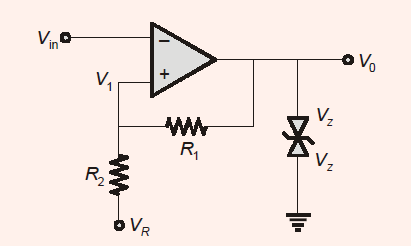
(a) R1/R2 = 67 and VR = 0.15 V
(b) R1/R2 = 67 and VR = -0.15 V
(c) R1/R2 = 66 and VR = -0.10 V
(d) R1/R2 = 66 and VR = -0.15 V
Answer: (c) R1/R2 = 66 and VR = -0.10 V
Explanation: Using hysteresis relation and trigger conditions, the ratio R1/R2 is obtained from VH expression. Substituting given values gives ratio as 66, and applying threshold condition results in reference voltage VR = -0.10 V.
11. For a given relation $\sqrt{1 – x^2} + \sqrt{1 – y^2} = P(x – y)$, where $P$ is a constant, the value of $\frac{dy}{dx}$ at point $(0, 0)$ is
(a) –1
(b) 0
(c) 1
(d) –2
Answer: (c)
Explanation: Differentiating the given relation implicitly with respect to $x$, we obtain
$\frac{-x}{\sqrt{1 – x^2}} + \frac{-y’}{\sqrt{1 – y^2}} = P(1 – y’)$.
Evaluating at the point $(0, 0)$, the terms simplify since $x = 0$ and $y = 0$, giving
$0 – y’ = P(1 – y’)$.
Rearranging, we get $-y’ = P – Py’$ which leads to $y'(P – 1) = P$.
Thus, $\frac{dy}{dx} = \frac{P}{P} = 1$, hence the slope is unity.
12. The integral $\int_{0}^{1} \int_{0}^{x^2} (x^2 + y^2), dy, dx$ equals to
(a) $\frac{26}{105}$
(b) $\frac{4}{105}$
(c) $\frac{12}{105}$
(d) $\frac{16}{105}$
Answer: (a)
Explanation: First integrate with respect to $y$, giving
$\int (x^2 + y^2), dy = x^2 y + \frac{y^3}{3}$.
Substituting limits from $0$ to $x^2$, we get
$x^2(x^2) + \frac{(x^2)^3}{3} = x^4 + \frac{x^6}{3}$.
Now integrating with respect to $x$ from $0$ to $1$,
$\int_{0}^{1} \left(x^4 + \frac{x^6}{3}\right) dx = \frac{1}{5} + \frac{1}{21} = \frac{26}{105}$.
13. An open-loop system represented by the transfer function, $G(s) = \frac{s – 1}{(s + 2)(s + 3)}$ is
(a) stable and of the minimum phase type
(b) stable and of the non-minimum phase type
(c) unstable and of the minimum phase type
(d) unstable and of the non-minimum phase type
Answer: (b)
Explanation: The stability of a system depends on the location of poles. Here, the poles are at $s = -2$ and $s = -3$, which lie in the left half plane, hence the system is stable. However, the zero at $s = +1$ lies in the right half plane, which makes the system a non minimum phase system.
14. A load center of 120 MW derives power from two power stations connected by 220 kV transmission lines of 25 km and 75 km as shown in figure below. The three generators $G_1$, $G_2$ and $G_3$ are of 100 MW capacity each and have identical fuel cost characteristics. The minimum loss generation schedule for supplying the 120 MW load is
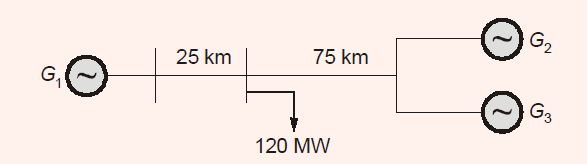
(a) $P_1 = 90$ MW, $P_2 = 15$ MW, $P_3 = 15$ MW
(b) $P_1 = 80$ MW, $P_2 = 20$ MW, $P_3 = 20$ MW
(c) $P_1 = 60$ MW, $P_2 = 30$ MW, $P_3 = 30$ MW
(d) $P_1 = 40$ MW, $P_2 = 40$ MW, $P_3 = 40$ MW
Answer: (a)
Explanation: To achieve minimum transmission losses, more power should be generated closer to the load center because line losses increase with distance and current. Since $G_1$ is located at 25 km, it is closest, so it supplies maximum power. Generators $G_2$ and $G_3$, being farther at 75 km, supply less power, resulting in overall reduced transmission losses.
15 A capacitor is made with a polymeric dielectric having a relative permittivity $\epsilon_r$ of 2.26 and a dielectric breakdown strength of 50 kV per cm. The permittivity of free space is 8.85 pF per m. If the rectangular plates of the capacitor have a width of 20 cm and a length of 40 cm, then the maximum electric charge in the capacitor is
(a) 2 $\mu$C
(b) 4 $\mu$C
(c) 8 $\mu$C
(d) 10 $\mu$C
Answer: (c)
Explanation: The maximum charge is given by $Q = \epsilon E A$, where $\epsilon = \epsilon_0 \epsilon_r$. The area of plates is $0.2 \times 0.4 = 0.08 , m^2$, and the breakdown electric field is $50 \times 10^5 , V/m$. Substituting values, $Q = (8.85 \times 10^{-12} \times 2.26) \times (5 \times 10^6) \times 0.08$, which gives approximately $8 \mu C$.
16 For a circuit shown below calculate the value of $i_1$?
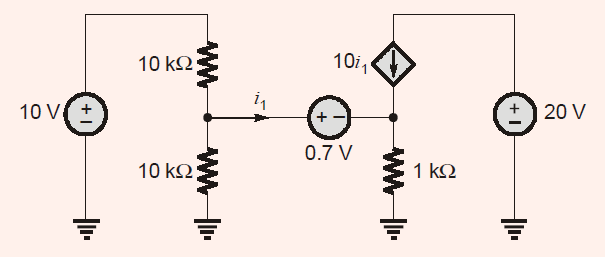
(a) $43/160$ mA
(b) $117/32$ mA
(c) $117/22$ mA
(d) $117/11$ mA
Answer: (a)
Explanation: The value of current $i_1$ is obtained by applying $\mathbf{Kirchhoff’s\ Voltage\ Law\ (KVL)}$ to the circuit loops, which forms a set of $\mathbf{simultaneous\ linear\ equations}$. Solving these equations gives the branch current as $\mathbf{i_1 = \frac{43}{160}\ mA}$.
17. Calculate v₁ for the circuit given below?
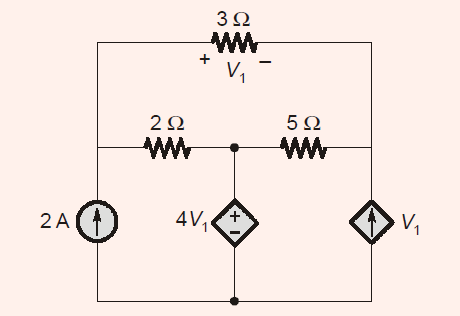
(a) 28/5 V
(b) 48/25 V
(c) 128/25 V
(d) 12/25 V
Answer: (d)
Explanation: Using KVL and circuit simplification, the node voltages are determined. Solving gives v₁ = 12/25 V.
18 What is Laplace transform of function $e^{-5t} \cos 4t$?
(a) $\dfrac{s+4}{(s+4)^2 + 25}$
(b) $\dfrac{5}{(s+4)^2 + 25}$
(c) $\dfrac{4}{(s+5)^2 + 16}$
(d) $\dfrac{s+5}{(s+5)^2 + 16}$
Answer: (d)
Explanation: The $\mathbf{Laplace\ transform}$ of $\cos 4t$ is $\dfrac{s}{s^2 + 16}$. Using the $\mathbf{frequency\ shifting\ property}$ for $e^{-5t}$, we replace $\mathbf{s}$ by $\mathbf{(s+5)}$. Thus, the transformed function becomes $\mathbf{\dfrac{s+5}{(s+5)^2 + 16}}$.
18. What is Laplace transform of function e⁻⁵ᵗ cos 4t?
(a) (s+4) / ((s+4)² + 25)
(b) 5 / ((s+4)² + 25)
(c) 4 / ((s+5)² + 16)
(d) (s+5) / ((s+5)² + 16)
Answer: (d)
Explanation: Using Laplace transform of cos(4t) and applying frequency shifting property, replace s by (s+5) to get (s+5)/((s+5)² + 16).
19 Given digits 2, 2, 3, 3, 3, 4, 4, 4, 4. How many distinct 4 digit numbers greater than 3000 can be formed using these digits?
(a) 50
(b) 51
(c) 52
(d) 54
Answer: (b)
Explanation: Numbers greater than 3000 must start with 3 or 4. Counting valid permutations without repetition limits, we get 25 cases starting with 3 and 26 cases starting with 4, totaling 51.
20 The characteristic equation of a 3 × 3 matrix P is defined as : |λI – P| = λ³ + λ² + 2λ + 1 = 0. “I” denotes identity matrix, then inverse of matrix P will be :
(a) P² + P + 2I
(b) P² + P + I
(c) -(P² + P + I)
(d) -(P² + P + 2I)
Answer: (d)
Explanation: By Cayley-Hamilton theorem, matrix satisfies its own equation: P³ + P² + 2P + I = 0. Multiplying by P⁻¹ and rearranging gives P⁻¹ = -(P² + P + 2I).
21 A function y(t) satisfies the following differential equation: dy(t)/dt + y(t) = δ(t) Where δ(t) is unit impulse function and u(t) is unit step function. Assuming zero initial conditions, what is y(t)?
(a) eᵗ
(b) e⁻ᵗ
(c) eᵗ u(t)
(d) e⁻ᵗ u(t)
Answer: (d)
Explanation: Applying the Laplace Transform gives sY(s) + Y(s) = 1, leading to Y(s) = 1/(s+1). Taking the inverse Laplace transform results in e⁻ᵗ u(t), which represents a causal response.
22 A solid non-magnetic conductor of circular cross section has its axis on z-axis and carries a uniformly distributed total current of 60 A in the a_z direction. If the radius of the conductor is 4 mm, find the magnetic flux density at ρ = 5 mm.
(a) 3.1 mT
(b) 2.1 mT
(c) 2.4 mT
(d) 4.0 mT
Answer: (c)
Explanation: Using Ampere’s Law, for points outside the conductor H = I/(2πρ). Substituting values and multiplying by μ₀, we get B = μ₀H, resulting in 2.4 mT.
23 The magnetic flux density in a magnetic material with susceptibility χm = 6 in a given region as B = 0.005y² a_x T. Find the magnitude of current density J at y = 0.4 m.
(a) 10⁴ / 7π A/m²
(b) 10⁴ / 5π A/m²
(c) 10² / π A/m²
(d) None of the above
Answer: (a)
Explanation: First compute relative permeability μr = 1 + χm = 7. Using J = curl(H) = curl(B/μ₀μr) and evaluating at y = 0.4 m, the magnitude becomes 10⁴ / 7π A/m².
24 The internal inductance of a straight wire of circular cross-section with radius r, length l and permeability μ is
(a) (μ/2π) ln(r/l) H/m
(b) μ / 4π H/m
(c) μ / 8π H/m
(d) None of the above
Answer: (c)
Explanation: For a conductor with uniform current distribution, the internal inductance per unit length is constant and equals μ / 8π H/m, independent of radius.
25 Determine the energy density in free space created by a magnetic field with intensity H = 10³ A/m.
(a) 314 mJ/m³
(b) 314 μJ/m³
(c) 628 mJ/m³
(d) 628 μJ/m³
Answer: (c)
Explanation: Energy density is given by (1/2) μ₀ H². Substituting values gives 2π × 10⁻¹ J/m³, which is approximately 628 mJ/m³.
26 A triangle defined by A(2, –5, 1), B(0, 2, 4) and C(0, 3, 1). What is area of the triangle?
(a) 10.11
(b) 12.41
(c) 16.12
(d) 8.41
Answer: (b)
Explanation: Area is half the magnitude of cross product of vectors AB and AC. Computing |AB × AC|/2 gives 12.41.
27 A 2 mC positive charge is located in vacuum at point P₁(3, –2, –4) and 5 μC negative charge is located at P₂(1, –4, 2). What is the magnitude of force on the charge at P₁?
(a) 2.04 N
(b) 1.96 N
(c) 2.91 N
(d) 3.10 N
Answer: (a)
Explanation: Using Coulomb’s Law, F = k|Q₁Q₂|/R². Distance between points is √44, leading to a force of 2.04 N.
28 Four infinite uniform sheets of charges with following uniform charge density are placed at different points in space as following : Sheet-1 : 20 pC/m² at y = 7, Sheet-2 : –8 pC/m² at y = 3, Sheet-3 : 6 pC/m² at y = –1, Sheet-4 : –18 pC/m² at y = –4. Find the magnitude of Electric field E at point P(2, 6, –4). Consider relative permittivity of the medium as 1.
(a) 40/18π V/m
(b) 40π V/m
(c) 18/25 V/m
(d) 18π V/m
Answer: (c)
Explanation: Electric field due to each sheet is σ/2ε₀. Considering direction and superposition, summing contributions gives 18/25 V/m.
29 A 25 μC point charge is located at origin. Calculate electric flux passing through the portion of sphere defined by r = 20 cm, bounded by θ = 0 and π rad, φ = 0 and π/2 rad.
(a) 5 μC
(b) 25 μC
(c) 6.25 μC
(d) 12.5 μC
Answer: (c)
Explanation: Total flux is Q, and portion depends on solid angle fraction. Given region covers 1/4 of sphere, so flux is 25/4 = 6.25 μC.
30 A dielectric material is placed in vacuum in a uniform electric field of E = 4 V/m. What is the electric field inside the material if the relative permittivity of dielectric material is 2?
(a) Zero
(b) 4 V/m
(c) 2 V/m
(d) 8 V/m
Answer: (c)
Explanation: Using boundary condition D₁ = D₂, we get ε₀E₁ = ε₀εrE₂. Thus E₂ = E₁/εr = 4/2 = 2 V/m.
31 Find the relative permittivity of dielectric material used in a parallel plate capacitor if electric flux density D = 15 μC per m square and energy density is 20 J per m cube.
(a) 0.6
(b) 0.8
(c) 0.9
(d) 1.1
Answer: (a)
Explanation: Energy density in a dielectric is given by w = 1 by 2 multiplied by D square divided by epsilon naught epsilon r. Substituting given values of flux density and energy density, we solve for relative permittivity and obtain approximately 0.635, hence closest value is 0.6.
32 For a homogeneous medium with volume charge density rho v, permittivity epsilon and voltage V. What is the Laplacian of V?
(a) minus rho v epsilon
(b) rho v divided by epsilon
(c) rho v epsilon
(d) minus rho v divided by epsilon
Answer: (d)
Explanation: According to Poisson equation, Laplacian of potential is equal to negative charge density divided by permittivity. Hence, del square V = minus rho v by epsilon.
33 Which among the following equation is true for a steady magnetic field? Where B is magnetic flux density, J is current density and H is magnetic field intensity.
(a) divergence of B equals J
(b) curl of H equals zero
(c) curl of H equals J
(d) None of the above
Answer: (c)
Explanation: For steady magnetic field, Ampere circuital law in differential form gives curl of H equals current density J.
34 An electron beam carries a total current of minus 500 micro ampere in the az direction and has a current density Jz in the region 0 less than or equal to r less than or equal to 10 power minus 4 m and zero in the region r greater than 10 power minus 4 m. Electron beam velocity is given by Vz equals 8 multiplied by 10 power 7 z m per second. Calculate the volume charge density at z equals 2 cm.
(a) 200 m C per m cube
(b) 10 m C per m cube
(c) minus 10 m C per m cube
(d) minus 200 m C per m cube
Answer: (c)
Explanation: Using relation current density equals charge density multiplied by velocity, we calculate charge density. Substituting current density and velocity at given position, the result is negative value indicating electron flow, hence minus 10 m C per m cube.
35 Find the magnitude of the electric field intensity in a sample of silver having conductivity sigma equals 6.17 multiplied by 10 power 7 mho per meter, mobility equals 0.006 m square per volt second and drift velocity 1 mm per second.
(a) 1 by 10 V per meter
(b) 1 by 3 V per meter
(c) 1 by 2 V per meter
(d) 1 by 6 V per meter
Answer: (d)
Explanation: Using relation drift velocity equals mobility multiplied by electric field, we get electric field equals drift velocity divided by mobility. Substituting values gives 1 by 6 volt per meter.
36 Which among the following statement is correct regarding an ideal conductor in a static electric field?
(a) Static electric field intensity inside conductor is non zero
(b) Static field intensity outside conductor is zero
(c) Static field intensity at the surface of conductor is directly normal to the surface
(d) Static field intensity at the surface of the conductor is directly parallel to the surface
Answer: (c)
Explanation: In electrostatic condition, electric field inside conductor is zero and field at surface is always perpendicular. Hence field is normal to surface.
37 Consider electron and hole mobilities of germanium at 300 K is 0.36 m square per volt second and 0.17 m square per volt second respectively and hole and electron concentration of 2.7 multiplied by 10 power 19 per m cube. Find the conductivity of germanium at 300 K.
(a) 1.4 mho per meter
(b) 2.3 mho per meter
(c) 1.3 mho per meter
(d) 2.0 mho per meter
Answer: (b)
Explanation: Conductivity is given by sigma equals n multiplied by charge multiplied by sum of mobilities. Substituting carrier concentration and mobilities, we get 2.3 mho per meter.
38 The technology CMOS used for fabricating integrated circuit refers to
(a) Compound Metal Oxide Semiconductor
(b) Complementary Metal Oxide Semiconductor
(c) Conditional Metal Oxide Semiconductor
(d) Compound Metal Oxide Superconductor
Answer: (b)
Explanation: CMOS stands for Complementary Metal Oxide Semiconductor, which uses both p type and n type devices for efficient circuit design.
39 A 3 phase, 50 Hz synchronous generator is connected to an infinite bus. The maximum power that can be transferred to infinite bus is 1 per unit. The mechanical input to the generator is root 3 by 2 per unit. Inertia constant of the generator is 5 second. Find the natural frequency of oscillation of the system?
(a) root 10 pi rad per second
(b) root 20 pi rad per second
(c) root 15 pi rad per second
(d) root 5 pi rad per second
Answer: (d)
Explanation: Using swing equation, natural frequency depends on synchronizing power coefficient and inertia constant. Substituting values gives root 5 pi rad per second.
40 A 3 phase, 50 Hz synchronous generator is connected to an infinite bus through a transformer and two parallel transmission lines. The input mechanical power to synchronous generator is 0.8 per unit. Grid is consuming a power of 0.8 plus j 0.4 per unit, generator impedance is 0.25 per unit, transformer impedance is 0.5 per unit and each transmission line impedance is 0.5 per unit. If the infinite bus voltage is 1 angle 0 per unit then, what is the generator voltage load angle?
(a) 26.56 degree
(b) 31.30 degree
(c) 30 degree
(d) 60 degree
Answer: (a)
Explanation: Using power angle equation and calculating equivalent reactance, we find relation tan delta equals reactive power divided by real power, giving delta equals 26.56 degree.
41 Which is the power semiconductor device having highest switching speed?
(a) SCR
(b) IGBT
(c) MOSFET
(d) GTO
Answer: (c)
Explanation: Power MOSFET is a majority carrier device and does not involve minority carrier storage, which eliminates storage delay and results in very high switching speed compared to other devices.
42 For a PN junction diode, width of space charge region increases as?
(a) Forward bias voltage increases
(b) Reverse bias voltage increases
(c) Forward bias voltage reduces
(d) Reverse bias voltage reduces
Answer: (b)
Explanation: In reverse bias condition, majority carriers move away from junction, increasing immobile ion region, thus depletion width increases.
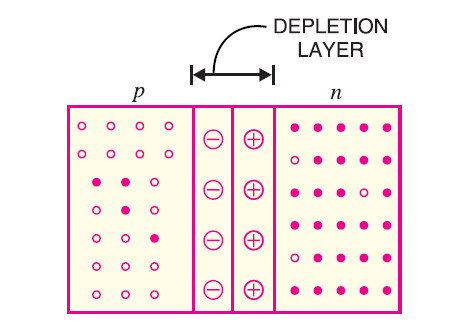
43 If unit step response of a network is (1 minus e power minus alpha t) then its unit impulse response will be
(a) alpha e power minus alpha t
(b) alpha e power 1 by alpha t
(c) 1 by alpha e power minus alpha t
(d) (1 minus alpha) e power minus alpha t
Answer: (a)
Explanation: Impulse response is the derivative of step response. Differentiating 1 minus e power minus alpha t gives alpha e power minus alpha t.
44 What is the Laplace transform of function delta of t minus 2?
(a) 2
(b) 0
(c) e power minus 2s
(d) 2s
Answer: (c)
Explanation: Using time shifting property, Laplace transform of delta t minus a is e power minus a s, hence result is e power minus 2s.
45 What is the range of K for which the unity feedback closed loop system with open loop gain G of s equals K divided by s square multiplied by s plus a will be unstable?
(a) minus a less than K less than a
(b) K greater than 0
(c) K equals 0
(d) minus infinity less than K less than infinity
Answer: (d)
Explanation: The characteristic equation becomes s cube plus a s square plus K equals zero. Since s term is missing, Routh stability condition fails, making system unstable for all values of K.
46 A power supply having output resistance 1.5 ohm supplies a full load current of 500 mA to a 50 ohm load. Determine the percentage voltage regulation of supply?
(a) 2 percent
(b) 3 percent
(c) 4 percent
(d) 5 percent
Answer: (b)
Explanation: Voltage regulation equals internal resistance divided by load resistance multiplied by 100. Thus 1.5 divided by 50 multiplied by 100 equals 3 percent.
47 Find the voltage V N for the circuit shown below?
(a) 6 V
(b) 4 V
(c) 5 V
(d) 3 V
Answer: (d)
Explanation: Using virtual short concept in operational amplifier, we apply nodal analysis and solve equation 3 V N equals 6 plus V N, giving V N equals 3 V.
48 The integral 1 by 2 pi integral from 0 to 2 pi sin t minus tau cos tau d tau equals to
(a) sin t cos t
(b) 0
(c) one by two cos t
(d) one by two sin t
Answer: (d)
Explanation: Using trigonometric identities and integrating over complete period, terms cancel except sin t term, giving one by two sin t.
49 If u t, r t denote unit step and unit ramp function respectively and u t convolution r t their convolution, then function u t plus 1 convolution r t minus 2 is
(a) one by two t minus 1 multiplied by t minus 2
(b) one by two t minus 1 square multiplied by t minus 2
(c) one by two t minus 1 square u t minus 1
(d) None of the above
Answer: (c)
Explanation: Convolution of step and ramp gives t square by 2 multiplied by u t. Applying time shifting property, result becomes one by two t minus 1 square multiplied by u t minus 1.
50 Consider function f of x equals x square minus 4 whole square, where x is a real number. The function f of x has
(a) Only one minimum
(b) Only two minima
(c) Only three maxima
(d) None of the above
Answer: (b)
Explanation: Differentiating gives critical points at x equals 0 and plus minus 2. Using second derivative test, x equals plus minus 2 are minima and x equals 0 is maximum, hence two minima exist.
51 A is an m cross n matrix with m greater than n and I is identity matrix. Let A one equals A transpose A inverse multiplied by A transpose, then which of the following statement is false?
(a) A A one A equals A
(b) A A one whole square equals A A one
(c) A A one equals I
(d) A A one A equals A one
Answer: (d)
Explanation: Using pseudo inverse property, we get A one A equals identity matrix. Hence A A one A equals A, so option (a) is correct. Also A A one is idempotent, so square equals itself. But A A one A is not equal to A one, hence statement (d) is false.
52 For the circuit diagram shown below, calculate the voltage across capacitor V t at t equals 160 micro second?
(a) 16.5 V
(b) 18.4 V
(c) 20.2 V
(d) None of the above
Answer: (b)
Explanation: The capacitor follows discharging equation V t equals V initial e power minus t by tau. With time constant tau equals R C equals 160 micro second, at t equals tau, voltage becomes 50 e power minus 1, giving 18.4 V.
53 Consider a parallel R L C circuit having inductance of 10 milli henry, capacitance of 100 micro farad. Determine the value of resistance that would lead to a critically damped response?
(a) 5 ohm
(b) 10 ohm
(c) 20 ohm
(d) 15 ohm
Answer: (a)
Explanation: For critical damping, damping ratio equals 1. Using relation 1 equals 1 by 2 R multiplied by root of L by C, solving gives R equals 5 ohm.
54 A power B J T has collector current I C equals 20 A at I B equals 2.5 A and reverse saturation current equals 15 milli ampere. Find out current gain beta?
(a) 8
(b) 7.95
(c) 7
(d) 8.95
Answer: (b)
Explanation: Using relation I C equals beta I B plus 1 plus beta multiplied by I C O, rearranging gives beta equals I C minus I C O divided by I B plus I C O, resulting in 7.95.
55 One cycle of square wave signal observed on an oscilloscope is found to occupy 6 cm at a scale setting of 30 micro second per cm. What is the signal frequency?
(a) 1.8 kHz
(b) 5.55 kHz
(c) 18 kHz
(d) 55.5 kHz
Answer: (b)
Explanation: Time period equals length multiplied by time scale, so T equals 6 multiplied by 30 micro second equals 180 micro second. Frequency equals 1 by T, giving 5.55 kHz.
56 Two equal voltages of same frequency applied to X and Y plates of C R O produce a circle on the screen. The phase difference between the two voltages will be?
(a) 30 degree
(b) 60 degree
(c) 90 degree
(d) 150 degree
Answer: (c)
Explanation: For Lissajous pattern, a circle is formed when two signals have equal amplitude and phase difference of 90 degree.
57 The magnetic field intensity of uniform plane wave in air is 20 A per meter in the direction a y. The wave is propagating in the a z direction at a frequency of 2 multiplied by 10 power 9 rad per second. What is the wavelength of the plane wave?
(a) 3 by 20 m
(b) 3 by 10 m
(c) 3 pi by 20 m
(d) 3 pi by 10 m
Answer: (d)
Explanation: Wavelength equals 2 pi multiplied by velocity divided by angular frequency. Substituting velocity of light and given omega, we get 3 pi by 10 meter.
58 A loss less transmission line segment has characteristic impedance Z naught equals 100 ohm electromagnetic wave propagation velocity in the transmission line equals 0.8 times velocity of light in vacuum. The frequency of the electromagnetic wave transmitted is 100 MHz. The phase constant is beta and beta l equals pi rad, then what is the length of the transmission line segment l?
(a) 24 m
(b) 12 pi by 10 m
(c) 10 pi by 12 m
(d) 1.2 m
Answer: (d)
Explanation: Using relation beta equals omega by velocity, and given beta l equals pi, we get l equals pi multiplied by velocity divided by omega, resulting in 1.2 meter.
59 A 100 pF capacitor has a maximum charging current of 150 micro ampere. What is the slew rate of capacitor?
(a) 1.50 V per second
(b) 0.67 V per micro second
(c) 0.67 V per second
(d) 1.50 V per micro second
Answer: (d)
Explanation: Slew rate equals current divided by capacitance. Substituting values gives 1.5 multiplied by 10 power 6 V per second, which is 1.50 V per micro second.
60 An operational amplifier has a time rate of change of voltage of 2 V per micro second. If the peak output voltage is 12 V, what is the bandwidth of the amplifier?
(a) 1 by 12 pi MHz
(b) 1 by 24 pi kHz
(c) 1 by 24 pi MHz
(d) None of the above
Answer: (a)
Explanation: Maximum frequency without distortion is given by f equals slew rate divided by 2 pi multiplied by peak voltage. Substituting values gives 1 by 12 pi MHz.
Q.61 A 10 kVA, 200 V/2000 V transformer is feeding a load resistance of 2.5 p.u. based on ratings of HV side. The actual value of load resistance referred to LV side?
(a) 10 ohm
(b) 100 ohm
(c) 1000 ohm
(d) 10000 ohm
Answer: (a)
Explanation: The base impedance on HV side is calculated as V square divided by S, giving 2000 square divided by 10000 equals 400 ohm. The actual load resistance on HV side becomes 2.5 times 400 equals 1000 ohm. Referring to LV side using turns ratio square, where ratio is 0.1, we get 1000 multiplied by 0.01 equals 10 ohm.
Q.62 While performing short circuit test on a single-phase 110/220 V, 50 Hz transformer with LV side shorted, wattmeter reading is found to be 20 W. If the same test is performed on the transformer with HV side shorted, the wattmeter reading will be?
(a) 5 W
(b) 10 W
(c) 20 W
(d) 40 W
Answer: (c)
Explanation: The wattmeter in short circuit test measures the copper loss at rated current, which is a constant property of the transformer. Hence, the reading remains same irrespective of which side is shorted.
Q.63 For a 3-phase slip-ring induction motor, the electrical rotor losses are proportional to
(a) Synchronous speed
(b) Air gap power
(c) Slip
(d) None of the above
Answer: (c)
Explanation: The rotor copper loss is given by product of slip and air gap power, hence it is directly proportional to slip.
Q.64 The blocked-rotor test of squirrel-cage induction motor determines?
(a) Its equivalent series resistance and reactance as seen from the stator
(b) Its equivalent shunt resistance and reactance as seen from the stator
(c) Its equivalent series resistance and reactance as seen from the rotor
(d) Its equivalent shunt resistance and reactance as seen from the rotor
Answer: (a)
Explanation: The blocked rotor test is similar to short circuit test, and it determines the equivalent series parameters, namely resistance and leakage reactance referred to stator.
Q.65 Which among the following statement is true for a power system with lagging power factor?
(a) Active power will flow from lagging voltage bus to leading voltage bus
(b) Active power will flow from leading voltage bus to lagging voltage bus
(c) Reactive power will flow from lagging voltage bus to leading voltage bus
(d) Reactive power will flow from leading voltage bus to lagging voltage bus
Answer: (b)
Explanation: The active power flow depends on phase angle difference, and it always flows from leading voltage angle bus to lagging voltage angle bus.
66. What is the volume charge density at point \(P(1, 2, 1)\) associated with electric flux field \(\mathbf{D} = xy^2 \hat{a}_x + yx^2 \hat{a}_y + z \hat{a}_z \, \text{C/m}^2\)?
(a) 6 C/m3
(b) 4 C/m3
(c) 1 C/m3
(d) 10 C/m3
Answer: (a)
Detailed Explanation:
The volume charge density \(\rho_v\) is related to the electric flux density
\(\mathbf{D}\) through Gauss’s law in differential form:
\(\rho_v = \nabla \cdot \mathbf{D}\)
So, we need to calculate the divergence of the given vector field:
\(\mathbf{D} = xy^2 \hat{a}_x + yx^2 \hat{a}_y + z \hat{a}_z\)
The divergence in Cartesian coordinates is:
\(\nabla \cdot \mathbf{D} = \frac{\partial D_x}{\partial x} + \frac{\partial D_y}{\partial y} + \frac{\partial D_z}{\partial z}\)
Now compute each term step by step:
- \(\frac{\partial}{\partial x}(xy^2) = y^2\)
(since \(y^2\) is constant with respect to \(x\)) - \(\frac{\partial}{\partial y}(yx^2) = x^2\)
(since \(x^2\) is constant with respect to \(y\)) - \(\frac{\partial}{\partial z}(z) = 1\)
Adding all the components:
\(\rho_v = y^2 + x^2 + 1\)
Substitute the coordinates of point \(P(1,2,1)\):
\(\rho_v = (2)^2 + (1)^2 + 1\)
\(\rho_v = 4 + 1 + 1 = 6 \, \text{C/m}^3\)
Q.67 An electric field is given by \(\mathbf{E} = z y^2 \hat{a}_x + 2xyz \hat{a}_y + xy^2 \hat{a}_z \, \text{V/m}\). An incremental path is represented by \(\Delta \mathbf{L} = (-3 \hat{a}_x + 5 \hat{a}_y – 2 \hat{a}_z)\) micrometer. Find the work done in moving \(4 \, \mu C\) charge along the incremental path at point \(P(1,1,1)\).
(a) 20 pJ
(b) 40 pJ
(c) −40 pJ
(d) −20 pJ
Answer: (d)
Explanation: The work done is given by:
\(W = -Q \, (\mathbf{E} \cdot \Delta \mathbf{L})\).
At point \(P(1,1,1)\):
\(\mathbf{E} = (1 \cdot 1^2)\hat{a}_x + (2 \cdot 1 \cdot 1 \cdot 1)\hat{a}_y + (1 \cdot 1^2)\hat{a}_z\)
\(\mathbf{E} = \hat{a}_x + 2\hat{a}_y + \hat{a}_z\)
Now compute the dot product:
\(\mathbf{E} \cdot \Delta \mathbf{L} = (1)(-3) + (2)(5) + (1)(-2)\)
\(= -3 + 10 – 2 = 5\)
Convert path to meters:
\(5 \, \mu m = 5 \times 10^{-6} \, \text{m}\)
Thus,
\(W = – (4 \times 10^{-6}) \times (5 \times 10^{-6})\)
\(W = -20 \times 10^{-12} \, \text{J} = -20 \, \text{pJ}\)
Q.67 An electric Field is given by E = zy square ax + 2xyz ay + xy square az V per m, an incremental path is represented by delta L = minus 3 ax plus 5 ay minus 2 az micrometer. Find the work done in moving 4 micro C charge along the incremental path if the location of the path is at point P(1, 1, 1).
(a) 20 pJ
(b) 40 pJ
(c) minus 40 pJ
(d) minus 20 pJ
Answer: (d)
Explanation: The work done is given by minus Q into dot product of electric field and path vector. At the point, E becomes ax plus 2 ay plus az, and dot product gives 5. Multiplying with charge and path scaling factor results in minus 20 pico joule.
Q.68 Assuming zero voltage at infinity, find the potential at \(P(0, 0, 10)\) caused by a charge distribution of \(10 \, \text{nC/m}\) along the line \(x = 0, y = 0, -1 < z < 1\) in free space.
(a) 18 V
(b) 8 V
(c) 5 V
(d) 20 V
Answer: (a)
Explanation:
Using the symmetry of the setup and assuming that the total charge is concentrated at the origin (as a point charge), the calculation becomes significantly simpler.
1. Total Charge (\(Q\))
Since the charge density \(\rho_L\) is constant \((10 \, \text{nC/m})\) over the length from \(z = -1\) to \(z = 1\):
- Length: \(L = 1 – (-1) = 2 \, \text{m}\)
- Total Charge: \(Q = \rho_L \times L = 10 \, \text{nC/m} \times 2 \, \text{m} = \mathbf{20 \, \text{nC}}\)
2. Point Charge Approximation
By concentrating the charge at the origin \((0,0,0)\), the distance to point \(P(0,0,10)\) becomes \(R = 10 \, \text{m}\). The potential due to a point charge is given by:
\[
V = \frac{Q}{4 \pi \epsilon_0 R}
\]
3. Calculation
Using the approximation \(\frac{1}{4 \pi \epsilon_0} \approx 9 \times 10^9 \, \text{V·m/C}\):
- \(Q = 20 \times 10^{-9} \, \text{C}\)
- \(R = 10 \, \text{m}\)
\[
V \approx \frac{9 \times 10^9 \times 20 \times 10^{-9}}{10}
\]
\[
V \approx \frac{180}{10} = \mathbf{18 \, \text{V}}
\]
Q.69 A point charge of \(+3 \, \mu C\) and \(-3 \, \mu C\) are located at \((0, 0, 1)\) and \((0, 0, -1)\) respectively, in free space. Find the magnitude of dipole moment. Consider distances in meters.
(a) 12 \(\mu C \cdot m\)
(b) 6 \(\mu C \cdot m\)
(c) 18 \(\mu C \cdot m\)
(d) 3 \(\mu C \cdot m\)
Answer: (b)
Explanation: The electric dipole moment is given by:
\(p = q \times d\),
where \(q\) is the magnitude of charge and \(d\) is the separation distance between the charges.
Here, the charges are located at \(z = +1\) and \(z = -1\), so the separation distance is:
\(d = 1 – (-1) = 2 \, \text{m}\).
Thus,
\(p = 3 \, \mu C \times 2 = 6 \, \mu C \cdot m\).
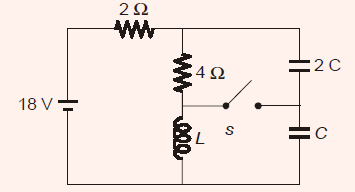
Q.70 In the circuit shown below, steady state was reached when the switch s was open. The switch was closed at t = 0. The initial value of the current through the capacitor 2 C is
 (a) 0 A
(b) 1 A
(c) 2 A
(d) 3 A
Answer: (c)
Explanation: Before switching, the capacitors store charge according to steady state voltages. At instant of switching, applying Kirchhoff voltage law and capacitor voltage continuity, the resulting equations give the initial current through capacitor as 2 A.
Q.71 The Laplace transform of \((t^2 – 2t)u(t – 1)\) is?
(a) \(\frac{2}{s^3} e^{-s} – \frac{2}{s^2} e^{-s}\)
(b) \(\frac{2}{s^3} e^{-s} + \frac{2}{s^2} e^{-s}\)
(c) \(\frac{2}{s^3} e^{-2s} – \frac{2}{s^2} e^{-s}\)
(d) None of the above
Answer: (d)
Explanation: First rewrite the given function:
\(t^2 – 2t = (t – 1)^2 – 1\)
So,
\((t^2 – 2t)u(t – 1) = \big[(t – 1)^2 – 1\big] u(t – 1)\).
Using the time-shifting property of Laplace transform:
\(\mathcal{L}\{f(t-a)u(t-a)\} = e^{-as}F(s)\)
Let \(f(t) = t^2 – 1\), then:
\(\mathcal{L}\{t^2\} = \frac{2}{s^3}\),
\(\mathcal{L}\{1\} = \frac{1}{s}\)
Thus,
\(F(s) = \frac{2}{s^3} – \frac{1}{s}\)
Applying time shift \(a = 1\):
\(\mathcal{L}\{(t^2 – 2t)u(t – 1)\} = e^{-s}\left(\frac{2}{s^3} – \frac{1}{s}\right)\)
This result does not match any of the given options.
Q.72 A source \(V_s = 200 \cos \omega t\) delivers power to a load at power factor \(0.8\) lag. The reactive power is \(300 \, \text{VAR}\). The Active Power is given by?
(a) 200 Watts
(b) 225 Watts
(c) 400 Watts
(d) 300 Watts
Answer: (c)
Explanation: The relation between active power \(P\) and reactive power \(Q\) is given by:
\(P = \frac{Q}{\tan \phi}\).
Given power factor \(\cos \phi = 0.8\), therefore:
\(\sin \phi = \sqrt{1 – (0.8)^2} = 0.6\).
Thus,
\(\tan \phi = \frac{\sin \phi}{\cos \phi} = \frac{0.6}{0.8} = 0.75\).
Now,
\(P = \frac{300}{0.75} = 400 \, \text{W}\).
Q.73 An ideal constant current source is connected in series with an ideal constant voltage source. Considering both together the combination will be a?
(a) Constant voltage source
(b) Constant current source
(c) Constant power source
(d) None of the above
Answer: (b)
Explanation: In series connection, the current remains fixed by current source, hence the combination behaves as a constant current source.
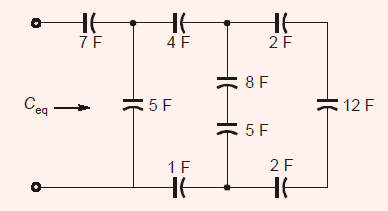
74 Calculate $C_{eq}$ of the circuit given below?
(a) $\dfrac{17}{3}$ F
(b) $\dfrac{119}{38}$ F
(c) $5$ F
(d) $4$ F
Answer: (b)
Explanation: The equivalent capacitance is obtained by applying $\mathbf{series\ and\ parallel\ combination\ rules}$. First, capacitors $\mathbf{8\ F}$ and $\mathbf{5\ F}$ are in $\mathbf{parallel}$ giving $\mathbf{13\ F}$. This is then combined with other capacitors in $\mathbf{series}$ and $\mathbf{parallel}$ step-by-step. Using standard relations $\mathbf{C_{series} = \frac{C_1 C_2}{C_1 + C_2}}$ and $\mathbf{C_{parallel} = C_1 + C_2}$, the final equivalent capacitance is $\mathbf{\dfrac{119}{38}\ F}$.
75 The voltage across 2H inductor is $6 \cos (5t)$ V. Determine the resulting inductor current at $t = \pi$, if the inductor current at $t = -\pi/2$ is 1 A?
(a) $1.6$ A
(b) $+1$ A
(c) $-1.6$ A
(d) Zero
Answer: (a)
Explanation: For an inductor, $\mathbf{v_L = L \frac{di}{dt}}$, so current is obtained by $\mathbf{integration}$. Thus, $\mathbf{i(t) = \frac{1}{L} \int v(t),dt} = \frac{1}{2} \int 6\cos(5t),dt = 0.6\sin(5t) + C$. Using the $\mathbf{initial\ condition}$ at $t = -\pi/2$, we get $\mathbf{C = 1.6}$. Hence, at $t = \pi$, $\mathbf{i(\pi) = 1.6 + 0.6\sin(5\pi) = 1.6\ A}$.
76. Given the points $A(x = 2, y = 3, z = -1)$ and $B(r = 4, \theta = 30^\circ, \phi = 120^\circ)$. Find distance between $A$ and $B$.
(a) $7.26$
(b) $4.10$
(c) $6.12$
(d) $5.53$
Answer: (d)
Explanation: Convert point $B$ from $\mathbf{spherical\ coordinates}$ to $\mathbf{Cartesian\ coordinates}$ using $\mathbf{x = r \cos\phi \sin\theta}$, $\mathbf{y = r \sin\phi \sin\theta}$, $\mathbf{z = r \cos\theta}$. This gives $B(-1, \sqrt{3}, 2\sqrt{3})$. Using the $\mathbf{distance\ formula}$ $\mathbf{\sqrt{(x_2-x_1)^2 + (y_2-y_1)^2 + (z_2-z_1)^2}}$, the result is approximately $\mathbf{5.53}$.
77. A synchronous motor is operating at constant load, while its excitation is adjusted to get unity power factor. If the excitation is now increased, the power factor will be?
(a) Leading
(b) Remains at unity
(c) Lagging
(d) Becomes zero
Answer: (a)
Explanation: In a $\mathbf{synchronous\ motor}$, increasing excitation beyond normal causes $\mathbf{over-excitation}$, which makes the motor draw $\mathbf{leading\ current}$. Hence, the $\mathbf{power\ factor\ becomes\ leading}$.
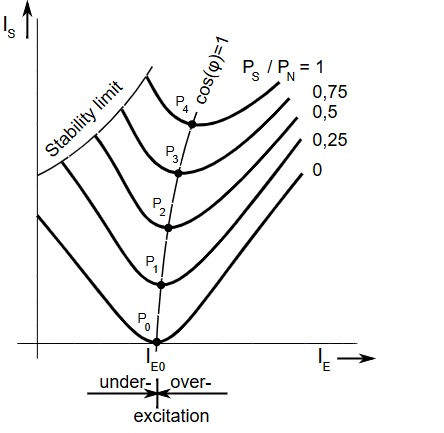
If the excitation of a synchronous motor is increased beyond the level corresponding to unity power factor, the motor operates at a leading power factor. This behavior is explained using the V-curve characteristic, which represents the relationship between armature current \(I_a\) and field current \(I_f\). When the motor is under-excited, it behaves like an inductor, draws reactive power from the supply, and operates at a lagging power factor. At normal excitation, the armature current becomes minimum and the motor operates at unity power factor. However, when the excitation is increased further (over-excitation), the motor behaves like a capacitor and begins to supply reactive power to the system, resulting in a leading power factor.
During over-excitation, the internal back EMF \(E_b\) increases and becomes greater than the applied terminal voltage \(V\). As a result, the motor supplies reactive power \(Q\) to the source, and the armature current \(I_a\) leads the terminal voltage \(V\). This leading current is responsible for the leading power factor condition. Due to this property, over-excited synchronous motors are commonly used as synchronous condensers in power systems. In such applications, the motor operates without mechanical load to provide leading reactive power, thereby improving the overall power factor of the system.
78. If the positive, negative and zero-sequence reactances of an element of a power system are 0.3, 0.3 and 0.8 p.u. respectively, then the element would be a?
(a) Synchronous generator
(b) Synchronous motor
(c) Static load
(d) Transmission line
Answer: (d)
Explanation: For a $\mathbf{transmission\ line}$, $\mathbf{positive}$ and $\mathbf{negative\ sequence\ reactances}$ are equal ($\mathbf{X_1 = X_2}$), while $\mathbf{zero\ sequence\ reactance}$ is higher. The given values $\mathbf{0.3,\ 0.3,\ 0.8}$ match this $\mathbf{characteristic\ pattern}$.
79. A 100 MW power station delivers 100 MW for 2 hours, 50 MW for 6 hours in a day and is shut down for maintenance for 45 days each year. Calculate its annual load factor?
(a) $20%$
(b) $21%$
(c) $22.5%$
(d) $18.3%$
Answer: (d)
Explanation:
The power station operates on a specific schedule during its operational days. We calculate the energy produced in a single day by multiplying the power output (MW) by the duration (hours) for each segment.
- Segment 1: \(100 \text{ MW} \times 2 \text{ hours} = 200 \text{ MWh}\)
- Segment 2: \(50 \text{ MW} \times 6 \text{ hours} = 300 \text{ MWh}\)
- Total daily energy: \(200 + 300 = 500 \text{ MWh}\)
The station is shut down for 45 days a year for maintenance, meaning it only generates power for the remaining days.
- Operational days per year: \(365 – 45 = 320 \text{ days}\)
- Total annual energy: \(500 \text{ MWh/day} \times 320 \text{ days} = 160{,}000 \text{ MWh}\)
The load factor is the ratio of actual energy generated to the maximum energy the station could have generated if it ran at full capacity (100 MW) for every hour of the entire year.
- Total hours in a year: \(365 \text{ days} \times 24 \text{ hours} = 8{,}760 \text{ hours}\)
- Maximum annual energy: \(100 \text{ MW} \times 8{,}760 \text{ hours} = 876{,}000 \text{ MWh}\)
Load factor formula:
\[
\text{Annual Load Factor} =
\frac{\text{Total Actual Annual Energy}}{\text{Maximum Possible Annual Energy}} \times 100
\]
\[
\text{Annual Load Factor} =
\frac{160{,}000}{876{,}000} \times 100 \approx 18.3\%
\]
Note: The average Plant Load Factor (PLF) for thermal power plants in India generally lies in the range of 50% to 60%.
80. Determine the inductor voltage $V$ in the circuit shown below for $t > 0$?
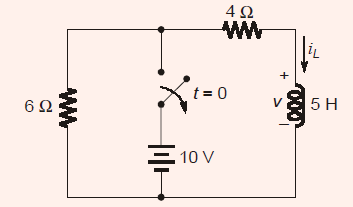
(a) $25e^{-2t}$
(b) $2.5e^{-0.5t}$
(c) $-2.5e^{-0.5t}$
(d) $-25e^{-2t}$
Answer: (d)
Explanation: After switching, the circuit becomes a $\mathbf{source\text{-}free\ RL\ circuit}$. The $\mathbf{time\ constant}$ is $\mathbf{\tau = \frac{L}{R} = \frac{5}{10} = 0.5\ s}$. Current is $\mathbf{i(t) = 2.5e^{-t/0.5} = 2.5e^{-2t}}$. The inductor voltage is $\mathbf{V_L = L \frac{di}{dt}}$, giving $\mathbf{V = -25e^{-2t}\ V}$.