1. The storage battery of a car has an emf of 12 V. If the internal resistance of the battery is 0.4Ω, what is the maximum current that can be drawn from the battery?
(A) 30 A
(B) 40 A
(C) 20 A
(D) 50 A
Answer: (A) 30 A
Explanation:
The maximum current is drawn when the external resistance is zero.
According to Ohm’s Law, current \( I = \frac{E}{r} \).
Substituting values, \( I = \frac{12}{0.4} = 30 \, A \).
Hence, the maximum current is 30 A.
2. A battery of emf 10 V and internal resistance 3 Ω is connected to a resistor. If the current in the circuit is 0.5 A, what is the resistance of the resistor? What is the terminal voltage of the battery when the circuit is closed?
(A) 17 Ω and 8.5 V
(B) 20 Ω and 10 V
(C) 15 Ω and 7.5 V
(D) 23 Ω and 9.5 V
Answer: (A) 17 Ω and 8.5 V
Explanation:
Using Ohm’s Law for the complete circuit, \( I = \frac{E}{R + r} \).
Substituting the given values, \( 0.5 = \frac{10}{R + 3} \), which gives \( R + 3 = 20 \). Hence, \( R = 17 \, \Omega \).
The terminal voltage is given by \( V = E – Ir \).
Substituting values, \( V = 10 – (0.5 \times 3) = 10 – 1.5 = 8.5 \, V \).
Thus, the resistance is 17 Ω and terminal voltage is 8.5 V.
3. At room temperature (27.0 °C) the resistance of a heating element is 100 Ω. What is the temperature of the element if the resistance is found to be 117 Ω, given that the temperature coefficient of the material of the resistor is 1.70 × 10⁻⁴ °C⁻¹.
(A) 1027 °C
(B) 1127 °C
(C) 927 °C
(D) 1000 °C
Answer: (A) 1027 °C
Explanation:
The resistance-temperature relation is given by \( R = R_0 [1 + \alpha (T – T_0)] \).
Substituting the given values, \( 117 = 100 [1 + 1.70 \times 10^{-4} (T – 27)] \).
Simplifying, \( \frac{117}{100} = 1 + 1.70 \times 10^{-4} (T – 27) \), so \( 0.17 = 1.70 \times 10^{-4} (T – 27) \).
Thus, \( T – 27 = \frac{0.17}{1.70 \times 10^{-4}} = 1000 \).
Hence, \( T = 1000 + 27 = 1027 \, ^\circ C \).
Therefore, the temperature of the element is 1027 °C.
4. A negligibly small current is passed through a wire of length 15 m and uniform cross-section 6.0 × 10⁻⁷ m², and its resistance is measured to be 5.0 Ω. What is the resistivity of the material at the temperature of the experiment?
(A) 1.5 × 10⁻⁷ Ω m
(B) 2.0 × 10⁻⁷ Ω m
(C) 1.0 × 10⁻⁷ Ω m
(D) 2.5 × 10⁻⁷ Ω m
Answer: (B) 2.0 × 10⁻⁷ Ω m
Explanation:
Resistivity is given by \( \rho = \frac{RA}{l} \).
Substituting the given values, \( \rho = \frac{5.0 \times 6.0 \times 10^{-7}}{15} \).
This simplifies to \( \frac{30.0 \times 10^{-7}}{15} = 2.0 \times 10^{-7} \, \Omega m \).
Thus, the resistivity is 2.0 × 10⁻⁷ Ω m.
5. A silver wire has a resistance of 2.1 Ω at 27.5 °C, and a resistance of 2.7 Ω at 100 °C. Determine the temperature coefficient of resistivity of silver.
(A) 0.0039 °C⁻¹
(B) 0.0041 °C⁻¹
(C) 0.0033 °C⁻¹
(D) 0.0045 °C⁻¹
Answer: (A) 0.0039 °C⁻¹
Explanation:
Temperature coefficient is given by \( \alpha = \frac{R_2 – R_1}{R_1 (T_2 – T_1)} \).
Substituting values, \( \alpha = \frac{2.7 – 2.1}{2.1 \times (100 – 27.5)} \).
This gives \( \alpha = \frac{0.6}{2.1 \times 72.5} \approx 0.0039 \, ^\circ C^{-1} \).
Thus, the temperature coefficient is 0.0039 °C⁻¹.
6. A heating element using nichrome connected to a 230 V supply draws an initial current of 3.2 A which settles after a few seconds to a steady value of 2.8 A. What is the steady temperature of the heating element if the room temperature is 27.0 °C? Temperature coefficient of resistance of nichrome averaged over the temperature range involved is 1.70 × 10⁻⁴ °C⁻¹.
(A) 840 °C
(B) 867 °C
(C) 800 °C
(D) 827 °C
Answer: (B) 867 °C
Explanation:
Using Ohm’s Law, initial resistance \( R_1 = \frac{230}{3.2} = 71.875 \, \Omega \) and final resistance \( R_2 = \frac{230}{2.8} = 82.14 \, \Omega \).
Using the relation \( R_2 = R_1 [1 + \alpha (T_2 – T_1)] \), we get
\( T_2 – T_1 = \frac{R_2 – R_1}{R_1 \alpha} \).
Substituting values, \( \frac{82.14 – 71.875}{71.875 \times 1.70 \times 10^{-4}} \approx 840 \, ^\circ C \).
Adding room temperature, \( T_2 = 840 + 27 = 867 \, ^\circ C \).
Thus, the steady temperature is 867 °C.
7. Determine the current in each branch of the network shown in Fig. 3.20:
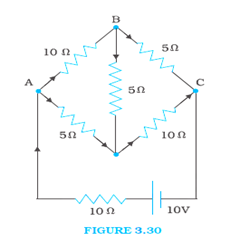
(A) AB=4/17 A, BC=6/17 A, AD=6/17 A, DC=4/17 A, BD=-2/17 A
(B) AB=1/2 A, BC=1/4 A, AD=1/4 A, DC=1/2 A, BD=0 A
(C) AB=2/15 A, BC=4/15 A, AD=4/15 A, DC=2/15 A, BD=1/15 A
(D) AB=3/10 A, BC=3/10 A, AD=2/10 A, DC=2/10 A, BD=1/10 A
Answer: (A) AB=4/17 A, BC=6/17 A, AD=6/17 A, DC=4/17 A, BD=-2/17 A
Explanation:
Kirchhoff’s Rules are applied to the junctions and closed loops of the circuit to form simultaneous equations.Due to the symmetry of the network and the given voltage source, solving these equations gives the current in each branch.
The negative sign in branch BD indicates that the actual direction of current is opposite to the assumed direction.
8. A storage battery of emf 8.0 V and internal resistance 0.5 Ω is being charged by a 120 V dc supply using a series resistor of 15.5 Ω. What is the terminal voltage of the battery during charging? What is the purpose of having a series resistor in the charging circuit?
(A) 11.5 V; To increase charging speed
(B) 10.0 V; To act as a voltage regulator
(C) 11.5 V; To limit the current drawn from the supply
(D) 12.0 V; To protect the DC supply
Answer: (C) 11.5 V; To limit the current drawn from the supply
Explanation:
During charging, the effective EMF is the difference between supply and battery, \( 120 – 8 = 112 \, V \).
The total resistance is \( 15.5 + 0.5 = 16 \, \Omega \). Hence, current \( I = \frac{112}{16} = 7 \, A \).
The terminal voltage is \( V = E + Ir = 8.0 + (7 \times 0.5) = 11.5 \, V \).
The series resistor is used to limit the current to a safe value and prevent damage.
9. The number density of free electrons in a copper conductor estimated in Example 3.1 is 8.5 × 10²⁸ m⁻³. How long does an electron take to drift from one end of a wire 3.0 m long to its other end? The area of cross-section of the wire is 2.0 × 10⁻⁶ m² and it is carrying a current of 3.0 A.
(A) 2.5 × 10⁴ s
(B) 2.7 × 10⁴ s
(C) 3.1 × 10⁴ s
(D) 3.5 × 10⁴ s
Answer: (B) 2.7 × 10⁴ s
Explanation:
The drift velocity is given by \( v = \frac{I}{neA} \).
The time taken is \( t = \frac{l}{v} = \frac{neAl}{I} \).
Substituting values \( n = 8.5 \times 10^{28} \), \( e = 1.6 \times 10^{-19} \), \( A = 2.0 \times 10^{-6} \), \( l = 3.0 \), \( I = 3.0 \), we get approximately \( 2.7 \times 10^4 \, s \).
Thus, the time taken is 2.7 × 10⁴ s.