The Open Circuit Characteristic (OCC) of a synchronous machine (alternator) represents the relationship between the generated electromotive force (EMF) and the field current when the machine is running at rated speed with no load connected. It is also commonly known as the Magnetization Curve or No-Load Saturation Curve.
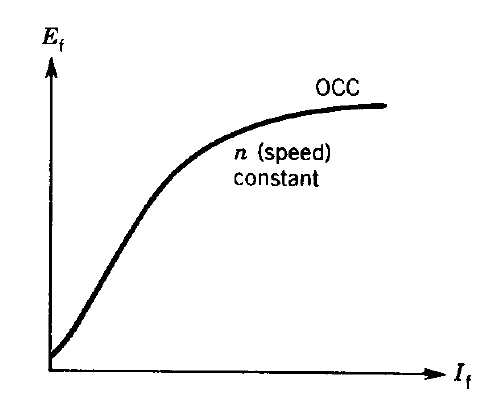
Table of Contents
Equipment Required for Plotting Open Circuit Characteristics of a Synchronous Machine
- Synchronous generator
- Prime mover (to drive the generator at rated speed)
- DC supply for field excitation
- Voltmeter (to measure terminal voltage)
- Ammeter (to measure field current)
Procedure
- Run the alternator at rated speed using a prime mover.
- Keep the armature terminals open (no load connected).
- Start with zero field current.
- Gradually increase the field current ( I_f ).
- Record the corresponding terminal voltage (which equals generated EMF ( E_0 )).
- Plot the curve between ( E_0 ) and ( I_f ).
Nature of the OCC Curve
The OCC curve is non-linear and has three distinct regions:
(a) Residual Magnetism Region
- At ( I_f = 0 ), a small voltage exists due to residual magnetism in the poles.
(b) Linear Region (Unsaturated Region)
- Initially, the curve is almost straight.
- Magnetic circuit is not saturated.
- EMF increases proportionally with field current.
(c) Saturation Region
- At higher field currents, the curve flattens.
- Magnetic core becomes saturated.
- Increase in EMF is slower despite increase in ( I_f ).
Note: The saturation magnetic flux density for Cold-Rolled Non-Grain-Oriented (CRNGO) silicon steel typically lies in the range of 1.6 to 1.8 Tesla.
Graphical Representation
The OCC resembles a magnetization curve of magnetic materials:
- Starts from a small residual voltage
- Rises linearly
- Then bends due to saturation