Licchavi Lyceum

ll

Licchavi Lyceum

Relay Working Principle

A relay is an electrically operated switching device used in power systems to detect abnormal conditions such as faults and automatically isolate the faulty section to protect equipment and maintain system stability. In power system protection, relays continuously monitor electrical quantities like current, voltage, frequency, or impedance through instrument transformers. When these parameters exceed preset limits, the relay sends a trip signal to the circuit breaker, which then disconnects the affected part of the system. Relays can be electromagnetic, static, or numerical, and they play a critical role in ensuring safety, reliability, and continuity of supply in high-voltage networks ranging from generation to distribution systems.
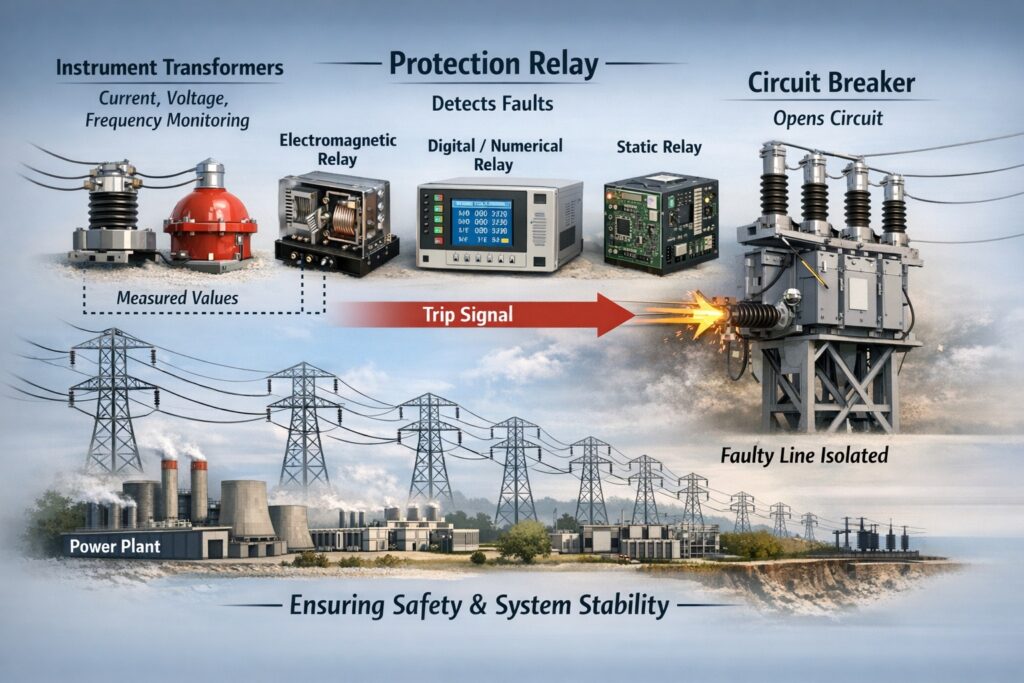
Protection Relay

What is a Relay?

A relay is an automatic protective device that senses abnormal electrical conditions such as overcurrent, overvoltage, underfrequency, or faults, and sends a tripping signal to the circuit breaker to isolate the faulty section of the system.

In simple words:

  • The relay acts as the brain of the protection system.
  • The circuit breaker acts as the muscle that disconnects the faulty section.

Without a relay, the circuit breaker would not know when to open.


Why Do We Need Relays in Power Systems?

Power systems operate at high voltage levels ranging from 11 kV to 765 kV and carry very large currents. During faults such as short circuits, the fault current may become 5 to 20 times the normal current.

If the fault is not cleared quickly:

  • Generators may get damaged
  • Transformers may burn
  • Transmission lines may collapse
  • Large areas may experience blackouts

Relays ensure:

  1. Fast fault detection
  2. Selective isolation of only the faulty part
  3. Protection of expensive equipment
  4. Safety of personnel
  5. Stability of the power system

Basic Working Principle of a Relay

The operation of a relay involves three main steps:

1. Sensing

The relay continuously monitors system quantities like current and voltage through:

  • Current Transformer (CT)
  • Potential Transformer (PT)

These instruments step down high system values to safe measurable levels.

2. Decision Making

The relay compares the measured value with a preset setting.

For example:

  • If current exceeds the set value, the relay detects an overcurrent condition.
  • If voltage drops below the set limit, it detects undervoltage.

3. Tripping

If the condition satisfies the relay logic:

  • The relay energizes the trip coil of the circuit breaker.
  • The circuit breaker opens.
  • The faulty section gets isolated.

This entire process happens within milliseconds.


Main Types of Relays Used in Power System Protection

1. Overcurrent Relay

Operates when current exceeds a preset value.
Used in feeders and distribution systems.

2. Earth Fault Relay

Detects ground faults caused by insulation failure.

3. Differential Relay

Compares currents entering and leaving a protected zone.
Commonly used for:

  • Transformers
  • Generators
  • Busbars

4. Distance Relay

Measures impedance between relay location and fault point.
Used mainly in transmission line protection.

5. Underfrequency and Overfrequency Relay

Used for system stability and load shedding schemes.


Classification of Relays

Relays can be classified based on technology:

Electromechanical Relays

  • Operate using magnetic attraction
  • Older technology
  • Slower and bulkier

Static Relays

  • Use electronic components
  • Faster than electromechanical

Numerical Relays

  • Microprocessor-based
  • Highly accurate
  • Multi-function capability
  • Widely used in modern substations

Today, most substations use numerical relays because of their flexibility, event recording capability, and communication features.


Important Characteristics of a Good Relay

A relay must possess the following qualities:

  1. Reliability – Must operate correctly when required
  2. Selectivity – Should isolate only the faulty section
  3. Sensitivity – Should detect even small faults
  4. Speed – Must operate quickly
  5. Stability – Should not operate for external faults

Relay Coordination

Relay coordination ensures that:

  • The nearest relay to the fault operates first.
  • Backup protection operates only if primary protection fails.

For example:

  • A feeder relay should trip before the upstream transformer relay.
  • Time grading and current grading are used for coordination.

Relay and Circuit Breaker Coordination

Remember:

Relay detects the fault.
Circuit breaker clears the fault.

A relay alone cannot interrupt fault current. It must work together with a properly rated circuit breaker to ensure safe interruption.


Applications of Relays in Power Systems

Relays are used in:

  • Power generation plants
  • Transmission substations
  • Distribution substations
  • Industrial electrical systems
  • Large motors and generators

Every critical electrical equipment is protected by one or more relays.


Conclusion

A relay is one of the most important components in power system protection. It acts as an intelligent sensing and decision-making device that ensures quick isolation of faults, preventing damage to equipment and maintaining system stability.

In high-voltage systems where fault currents can reach thousands of amperes, proper relay protection is not just a design requirement — it is a necessity.