Sag is the vertical distance between the lowest point of a conductor and the straight line joining the supports.
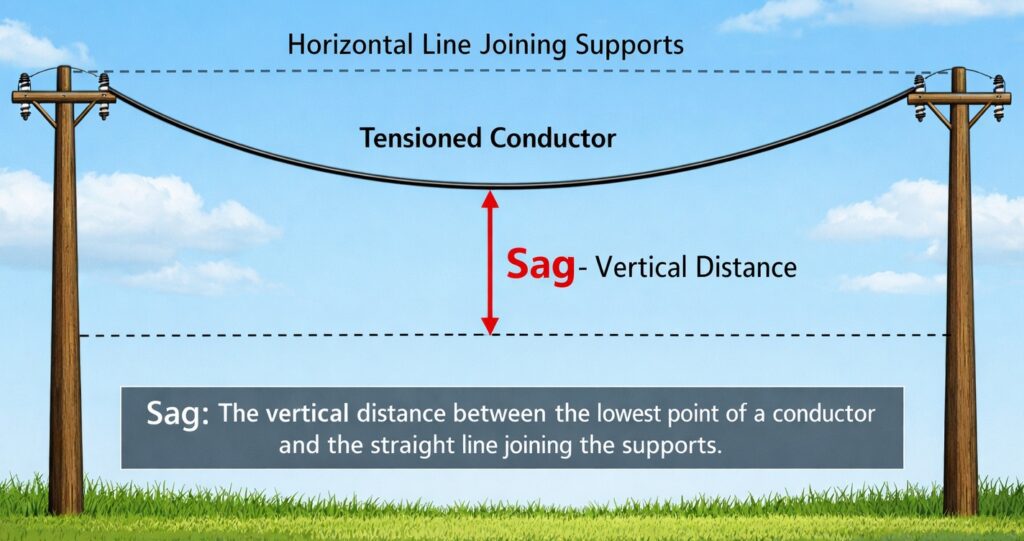
Table of Contents
Shape of Conductor
- Actual shape: Catenary
- Approximation: Parabola
Sag Equation
\[
S = \frac{wL^2}{8T}
\]
- \(S\): Sag
- \(w\): Weight per unit length
- \(L\): Span length
- \(T\): Tension
Unequal Supports
- Sag becomes unequal
- Lowest point shifts toward lower support
Factors Affecting Sag
- Higher weight increases sag
- Sag ∝ \(L^2\)
- Higher tension reduces sag
- Higher temperature increases sag
- Increase effective weight
Importance
- Maintains ground clearance
- Ensures mechanical safety
- Prevents accidents
Sag vs Tension
- Low sag → high tension
- High sag → low tension
Span Types
- Level span: symmetrical sag
- Unequal span: asymmetrical sag
Important Points
\[
S = \frac{wL^2}{8T}
\]
- Sag increases with weight, span, temperature
- Sag decreases with tension
- Curve: catenary (actual), parabola (approx.)
Conclusion
Sag is essential for safe and efficient transmission line design, balancing ground clearance and mechanical stress.