The slope detector is one of the simplest methods used for FM demodulation. It converts the frequency variations of an FM signal into amplitude variations, which are then detected using an envelope detector. Although simple in design, the slope detector is not widely used in practical communication systems due to its poor performance and sensitivity to noise.
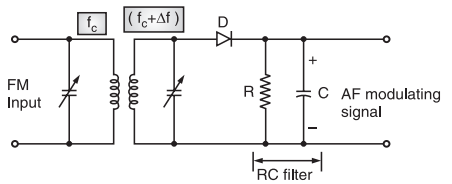
Table of Contents
Basic Principle
In frequency modulation, the instantaneous frequency of the carrier varies according to the modulating signal, while the amplitude remains constant.
The slope detector works on the principle that if an FM signal is applied to a tuned circuit that is slightly detuned from the carrier frequency, the amplitude of the output voltage varies with frequency.
Thus,
Frequency variations → Amplitude variations → Envelope detection → Original signal
Circuit of Slope Detector
The basic slope detector consists of:
• A tuned LC circuit
• A diode detector
• An RC filter
Circuit Operation
1. The FM signal is applied to a tuned circuit whose resonant frequency is slightly different from the carrier frequency.
2. Because the circuit is operating on the slope of the resonance curve, small frequency changes produce changes in output amplitude.
3. These amplitude variations are then applied to a diode envelope detector.
4. The diode rectifies the signal and the RC filter removes the carrier component.
5. The output across the load resistor becomes the recovered modulating signal.
Frequency Response of Slope Detector
The tuned circuit has a resonance curve where output voltage varies with frequency.
• If the carrier frequency lies on the slope of the curve, frequency deviations produce proportional amplitude changes.
• When the frequency increases, the output voltage increases or decreases depending on the slope.
• This variation in amplitude is then detected by the envelope detector.
Operation Explanation
Let
\(f_c\) = carrier frequency
\(f_m\) = modulating frequency
During modulation, the instantaneous frequency varies between
\[
f_c + \Delta f
\]
and
\[
f_c – \Delta f
\]
Because the tuned circuit operates on the slope of the resonance curve, these frequency variations produce corresponding amplitude variations at the output.
The envelope detector then recovers the original message signal.
Advantages of Slope Detector
• Very simple circuit
• Requires few components
• Easy to implement
Disadvantages
• Poor linearity
• Sensitive to amplitude noise
• Requires careful tuning
• Distortion occurs for large frequency deviations
Because of these drawbacks, the slope detector is generally replaced by improved FM demodulators such as:
• Foster-Seeley discriminator
• Ratio detector
• Phase-Locked Loop (PLL) detector
Applications
Although rarely used in modern receivers, slope detectors are useful for:
• Basic FM demodulation experiments
• Educational demonstrations
• Simple communication circuits
Conclusion
The slope detector is the simplest method of FM demodulation. It works by converting frequency variations of the FM signal into amplitude variations using a detuned resonant circuit, followed by envelope detection. While its simplicity makes it suitable for basic applications and educational purposes, its poor linearity and susceptibility to noise limit its use in practical communication systems.