A DC Motor is widely used in electric drives because its speed can be controlled easily over a wide range. Speed control is essential in applications such as electric traction, cranes, rolling mills, elevators, and machine tools where different operating speeds are required.
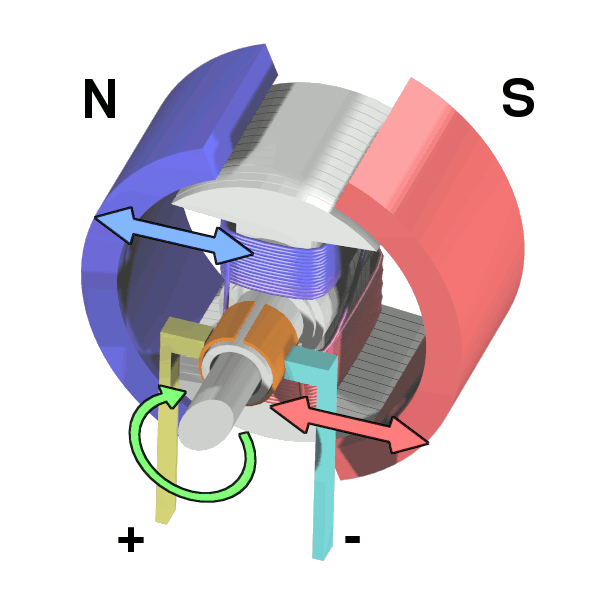
The speed of a DC motor depends on the applied voltage, field flux, and armature resistance. The fundamental speed equation of a DC motor is given by:
\[
N = \frac{V – I_a R_a}{k\phi}
\]
Where:
- \(N\) = speed of the motor
- \(V\) = applied armature voltage
- \(I_a\) = armature current
- \(R_a\) = armature resistance
- \(\phi\) = flux per pole
- \(k\) = machine constant
From this equation, the speed can be controlled by changing three main parameters.
Table of Contents
Armature Voltage Control Method
In this method, the voltage applied to the armature is varied while keeping the field flux constant.
- If the armature voltage increases, the motor speed increases.
- If the armature voltage decreases, the motor speed decreases.
This method provides smooth and efficient speed control below the rated speed. It is commonly used in modern drives using controlled rectifiers or DC converters.
Advantages
- High efficiency
- Good speed regulation
- Smooth speed control
Applications
- Electric traction
- Elevators
- Industrial variable-speed drives
Field Flux Control Method (Field Control)
In this method, the field current is varied to change the magnetic flux.
From the speed equation:
- Speed is inversely proportional to flux.
- If flux decreases, speed increases.
Thus, by inserting a variable resistor in the field circuit, the field current is reduced and the motor runs at a higher speed than rated speed.
Characteristics
- Used for speed above the base speed
- Power output remains nearly constant
Advantages
- Simple method
- Requires small power because field current is small
Disadvantages
- Excessive field weakening may cause instability
- Limited speed range
Armature Resistance Control Method
In this method, a variable resistor is connected in series with the armature circuit.
This increases the effective armature resistance, which reduces the voltage across the armature and therefore reduces the speed.
Characteristics
- Used for speeds below rated speed
- Simple and inexpensive
Disadvantages
- Large power loss in the resistor
- Low efficiency
- Poor speed regulation
Because of these disadvantages, this method is used only for short-time or low-power applications.
Summary of Speed Control Methods
| Method | Parameter Controlled | Speed Range | Efficiency |
|---|---|---|---|
| Armature Voltage Control | Armature voltage | Below rated speed | High |
| Field Control | Field flux | Above rated speed | High |
| Armature Resistance Control | Armature circuit resistance | Below rated speed | Low |
Conclusion
The speed control of a DC motor is relatively simple compared to many other motors because speed depends directly on
voltage and flux. By controlling the armature voltage, field flux, or armature resistance, a wide range of speeds can be achieved. Among these methods, armature voltage control and field control are the most efficient and widely used in practical DC drive systems.